
Before September: English Schools Must Audit the Curriculum, Not Merely Rewrite the Policy
Revised statutory guidance on Relationships, Sex and Health Education and a new safeguarding framework take effect in England on 1 September 2026. Schools must now examine the actual lessons, scripts, films, books and external resources placed before children—not merely change the date on an existing policy.

September 2026 presents schools in England with a deadline that cannot responsibly be met by administrative housekeeping. Revised statutory guidance governing Relationships Education, Relationships and Sex Education and Health Education takes effect on 1 September. The new edition of Keeping Children Safe in Education becomes operative on the same day; until 31 August, schools must continue to follow the 2025 safeguarding guidance.¹
This transition requires more than the substitution of one statutory reference for another. A policy may quote the latest legislation, carry the approval of the governing body and reproduce all the expected language about equality, inclusion and safeguarding while bearing only a remote relationship to what children encounter in the classroom.
The decisive question is what lies beneath the policy: lesson plans, teacher scripts, slides, worksheets, diagrams, films, books, websites, visiting speakers and recommended external organisations. Unless those materials are examined, a school cannot know whether inherited content remains compatible with the new guidance, whether parents have been told what will actually be taught, or whether supposedly statutory lessons contain additional sex education from which primary-school parents possess a right of withdrawal.
Nor is the need for an audit hypothetical. Documentary evidence examined for this editorial includes a Year 6 scheme written by PSHE lead teachers on behalf of an English city council to support its primary curriculum. The pack directed schools to accompanying presentations and resources hosted on the authority’s educational platform and explained that its lessons were informed by local RSE guidance issued in 2015, together with material from national PSHE and sex-education organisations.²
These were not anonymous worksheets downloaded from an obscure campaigning website. They were professionally presented local-authority materials, offered to schools with the presumption of competence and authority that official provenance naturally carries.
The scheme said that inclusive RSE could be reinforced by “teaching about gender identity”. Its proposed core messages included the statement that “some people don’t feel like a boy or a girl”. Teachers were advised to use “all genders” rather than boys and girls and not to assume that children would grow up to be “cisgender”. The pack also adopted the proposition that gender identity might not correspond with biological sex.³
This was not merely a lesson against restrictive stereotypes. It inserted a particular theory of internal identity into the vocabulary through which primary pupils were expected to understand their bodies, puberty and personal development. The theory was not identified as a disputed belief held by some people, distinct from biological fact and open to reasoned disagreement. It appeared as ordinary curriculum knowledge.
That distinction now matters decisively. The revised statutory guidance requires pupils to be taught the facts and law concerning biological sex and gender reassignment, including the legal protection from discrimination owed to those with the protected characteristic. It then warns schools that beyond those facts and the law there is significant debate. Schools should not teach as fact that “all people have a gender identity”, nor use resources that “encourage pupils to question their gender”.⁴
There is no conflict between this requirement and freeing children from stereotypes. A girl does not cease to be a girl because she prefers engineering to ballet. A boy does not become less male because he prefers drama to rugby. Clothes, hobbies, temperament and professional ambition do not determine sex.
Indeed, the local-authority materials sometimes expressed that sound principle by saying that there were many ways to be a boy or girl. Taken by itself, that formulation may be entirely proper. The problem arises when the same programme moves from rejecting stereotypes to suggesting that a child’s feelings, interests or discomfort with puberty may indicate that he is not a boy or she is not a girl. The first message liberates children from stereotypes; the second risks turning those stereotypes into evidence of another identity.
The gender language is not the only reason inherited schemes require scrutiny. The same Year 6 pack included considerably more sexual material than many parents would infer from headings such as “puberty”, “online safety” or “growing and changing”.
Teachers were instructed to explain masturbation to pupils, describe it as normal and pleasurable, and advise that a child choosing to do it should be alone in a private place such as a bedroom or bathroom. This material appeared in the teaching about both female and male puberty.⁵
A later lesson introduced pornography to the whole Year 6 class. It explained that some adults choose to view images of people engaged in sexual activities. The scheme also warned that pornography is unsafe for children, distorted, stereotypical and unlike a healthy relationship. Those warnings are important, but they do not remove the need for schools to decide whether a planned universal lesson introducing the subject in this manner is necessary and developmentally appropriate for every ten- and eleven-year-old.⁶
The lesson on reproduction went further. It said that adults in loving relationships might have sex “for fun and pleasure”. Marriage before sexual relations was described merely as something considered important in some communities. Teachers were warned that the recommended films contained cartoons of naked bodies, sexual intercourse and birth. The lesson introduced contraception, instructed staff to use “LGBT inclusive language” when explaining how babies begin, referred them to material produced by a campaigning organisation and recommended an expressly LGBTQ+-inclusive children’s book about sex, gender, bodies and families.⁷
Not every reference to pornography, contraception, same-sex parents or family diversity is necessarily improper. Schools have a legitimate responsibility to protect children from harm, answer necessary questions, explain relevant law and ensure that pupils from every family background are treated with dignity.
The issue is whether each piece of content is necessary, appropriate to the age and maturity of the pupils, transparently disclosed to parents and accurately classified. A safeguarding rationale cannot become a universal solvent capable of making any sexual subject suitable for primary children. Nor can detailed sexual content be converted into statutory relationships education merely by placing it inside a lesson called online safety or puberty.
The revised guidance expressly requires school policies to differentiate relationships education from sex education. It states that relationships education does not involve explaining the detail of different forms of sexual activity. It also says primary pupils should receive protective teaching in a manner that does not cause unreasonable alarm or appear to normalise risky behaviour. Sensitive safeguarding topics can be addressed without describing the underlying sexual activity in detail.⁸
This makes lesson-by-lesson classification indispensable. Schools should identify what belongs to national-curriculum science, what is statutory relationships education, what is health education and what constitutes additional primary sex education. Administrative headings cannot settle the question. The substance of what is said, shown and discussed must do so.
The urgency of this work is reinforced by a local-authority primary curriculum map prepared for 2026. It arranges parts of the programme around equality-calendar events, including LGBT History Month, begins gender-equality education in Reception and tells Year 1 pupils that there are many ways to be a boy or girl. Similar language continues in Year 3, while Year 5 contains a named gender-equality unit intended to consolidate the same proposition and teach pupils to challenge perceived gender prejudice.⁹
None of those headings necessarily proves objectionable teaching. A lesson challenging stereotypes may be entirely sound. A unit on family diversity may simply ensure that no child is treated badly because of his home circumstances. The same curriculum map also contains clear references to male and female bodies and to the changes experienced by boys and girls.
A map, however, cannot disclose the decisive details. It cannot show whether teachers are instructed to speak of “all genders”, whether sex is described as assigned rather than observed, whether pupils are invited to interpret themselves through an identity spectrum, or whether lawful disagreement is characterised as prejudice. It cannot reveal what films depict, what recommended websites now contain or how a teacher is instructed to answer a difficult question.
That is why schools must audit resources rather than approve headings.
The evidential distinction between an older detailed pack and a present curriculum map must be maintained. The legacy Year 6 scheme has not been confirmed as the programme that any particular school will use in September 2026. It may have been replaced, substantially revised or only partly retained.
Its significance is that it proves that contested identity language and detailed sexual material entered professionally produced, local-authority educational provision. Such content may survive in inherited lesson folders, copied presentations, archived links, teachers’ scripts or schemes that have been updated only selectively.
A school cannot therefore presume compliance because a resource originated with a local education authority, appeared on an official portal, was described as widely used or claimed alignment with a recognised professional organisation. Provenance is not current approval. Institutional branding is not legal authority. Widespread adoption is not evidence that a resource remains suitable.
The same warning applies to policy templates. A recent draft primary-school policy examined for this review said that a parental request for withdrawal would be respected “unless exceptional circumstances apply” and that the school would agree to “most withdrawals”. It identified only one lesson concerning conception and birth as withdrawable.¹⁰
That wording is incompatible with the September 2026 guidance. Where a primary school provides sex education outside the science curriculum, the headteacher “must automatically grant” a request for withdrawal. The discretion to refuse in exceptional circumstances belongs to the secondary-school process, not to primary education.¹¹
This is not a pedantic correction. If a policy understates a parent’s right, a parent may be discouraged from exercising it. If detailed sexual teaching has been distributed across lessons described as health, puberty or online safety, the school may also have failed to identify the true extent of its additional sex education.
A school cannot explain sexual practices, classify the lesson as relationships education and thereby extinguish the parental right. Substance must prevail over nomenclature.
Transparency with parents is therefore central to the new framework. Schools should engage parents proactively, show them a “representative sample” of the resources they intend to use and permit them to view “all curriculum materials” used for RSHE on request. Contracts purporting to prevent parental access are described as void and unenforceable. Copyright may govern how materials are shared, but it should never be used as a reason to refuse access altogether.¹²
Access can be managed responsibly through a parent portal, supervised inspection, presentations, screen-sharing or read-only documents. No reasonable parent needs an unrestricted right to republish a commercial lesson pack. Parents do, however, need to know what their children are being taught, particularly where the subject matter is intimate, morally disputed or potentially distressing.
A consultation consisting only of reassuring headings is insufficient. “Healthy relationships”, “identity”, “body confidence”, “family diversity” and “online safety” may describe sound and necessary teaching. They may also contain propositions and activities that parents would reasonably understand as sex education or ideological formation. Parents cannot offer an informed response to terminology that conceals more than it reveals.
Schools must also be precise when invoking professional endorsement. A provider may say that its programme follows or aligns with the PSHE Association Programme of Study, but that does not establish that the Association created, examined or endorsed the particular resources. The Association has clarified that only resources currently listed on its own website are endorsed and that it does not quality-assure complete PSHE or RSHE programmes.¹³
References to accreditation or quality marks should therefore begin scrutiny rather than end it. Which particular lesson was assessed? Which version? Did the assessment include the slides, diagrams, films and teachers’ scripts? Were linked external websites examined? Does the endorsement remain current under the September 2026 framework?
The Department for Education places ultimate responsibility on the school. External organisations may contribute expertise, but schools remain responsible for both content and delivery. They should check that resources are accurate, unbiased and suitable for pupils’ age and stage, exercise caution where an organisation has a strong partisan position on a contested matter, inspect lesson plans in advance and seek the views of parents.¹⁴
Responsibility likewise rests with governing bodies. The new guidance says governors and academy trustees should ensure that curriculum content and teaching materials align with the statutory guidance, that teaching is accessible to pupils with special educational needs and disabilities, and that parents receive clear information about content, resources, external providers and withdrawal rights. Foundation governors have an additional responsibility for maintaining and developing the religious ethos of faith schools.¹⁵
Governors cannot fulfil that responsibility by approving a polished policy while being denied sight of what lies underneath it. Copyright may justify controlled access. It cannot justify asking governors to assure compliance with a curriculum they have not examined.
The curriculum audit must also be joined to the safeguarding review. Keeping Children Safe in Education 2026 says schools “should not initiate any action regarding social transition”. When a child questioning gender asks a school for support, parents or carers should be engaged “as a matter of priority”, the decision-making process should be documented, and the welfare of the individual child must be considered alongside the effect of any proposed action upon other children.¹⁶
The guidance also requires schools to preserve sex-based safeguarding arrangements. Children must not be admitted to toilets designated for the opposite biological sex. Separate toilets must remain available for boys and girls aged eight and above, except where a facility is a secure room intended for one pupil at a time. Relevant staff must know a child’s biological sex, and schools are legally required to record it accurately wherever it is recorded. Children must not share overnight accommodation with pupils of the opposite biological sex, although sensitive alternative arrangements may be provided where necessary.¹⁷
A school cannot sensibly retain classroom material that encourages children to interpret themselves through an expansive identity framework while adopting a safeguarding policy that is required to be cautious, parent-inclusive and grounded in biological sex. Curriculum, safeguarding, behaviour, equality, record-keeping, premises, sport and residential-visit policies must operate coherently.
None of these requirements excuses bullying or unkindness. KCSIE is equally clear that schools should take a firm stand against bullying and intervene before it escalates. Protecting sex-based privacy and maintaining accurate records do not require the humiliation of a distressed child. Compassion and safeguarding are not rivals; compassion must be governed by reality if it is to protect rather than mislead.
Faith schools face a further test of integrity. The revised statutory guidance requires sensitivity to pupils’ religious backgrounds and expressly permits schools with a religious character to teach their distinctive faith perspective on relationships, while allowing balanced debate about contentious matters.¹⁸
A Christian school cannot discharge that responsibility by placing a biblical quotation or a reference to Christian values on the first page of an otherwise secular policy. Its understanding of the human person, marriage, fidelity, family and sexual morality must inform the substance of what is taught.
Diocesan guidance examined for this review says that RSE in a church school should be “rooted in the teachings of the church” and should allow pupils to reflect upon the Christian understanding of marriage as the context for sexual relationships. It also tells governors to ensure that RSE is delivered in a way that develops and maintains the school’s religious ethos.¹⁹
That is compatible with protecting every child from stigma. A child living with a single parent, grandparents, foster carers, adoptive parents or parents in a same-sex relationship is entitled to dignity, security and freedom from bullying. Respecting that child does not oblige a religious school to teach that every family structure and every sexual ethic is morally or doctrinally interchangeable.
Before September, every school should therefore know precisely which materials it intends to use, when they were written, what has been revised, who produced them and which external links they contain. It should know which elements are statutory and which are additional; what parents will be shown; how withdrawal requests will be handled; and how sensitive questions, anonymous submissions and safeguarding disclosures will be managed.
The headteacher, PSHE lead, designated safeguarding lead, SENCO and governing body should examine the programme together. In a faith school, foundation governors and the relevant religious authority should be involved not merely in approving the policy’s vocabulary but in examining whether the actual teaching expresses the school’s religious character.
No school should be embarrassed to discover that an inherited resource needs amendment or removal. The statutory framework has changed, and propositions once treated by sections of the educational establishment as uncontroversial can no longer simply be carried forward.
The failure would lie not in finding outdated material, but in refusing to look for it.
September 2026 must bring an end to governing by curriculum headings. Schools must open the files, read the scripts, watch the films, follow the links and inspect the books. They must distinguish biological fact from contested belief, statutory teaching from additional sex education, professional advice from legal authority and genuine parental consultation from managed consent.
The examples are real. They entered schools through official educational structures. Some may already have been replaced; others may remain embedded in present programmes. That uncertainty is not a reason to dismiss the concern. It is the reason an audit is necessary.
The responsibility cannot be outsourced. The guidance has changed. The materials must now be examined.
¹ Department for Education, Relationships Education, Relationships and Sex Education and Health Education: Statutory Guidance for Introduction on 1 September 2026; Department for Education, Keeping Children Safe in Education 2026. KCSIE 2025 remains operative until 31 August 2026.
² Local-authority Year 6 RSE lesson pack, revised autumn 2020, pp. 1–2. The document states that the lessons were written by PSHE lead teachers on behalf of the council and that accompanying presentations and resources were available through its education platform.
³ Ibid., pp. 1–2, including its references to teaching about gender identity, pupils who do not feel like boys or girls, “all genders” and “cisgender”.
⁴ Department for Education, revised RSHE guidance, paras 69–72.
⁵ Local-authority Year 6 RSE lesson pack, puberty lessons and teachers’ explanatory material concerning masturbation.
⁶ Ibid., Year 6 online-safety lesson concerning pornography and sexual imagery.
⁷ Ibid., reproduction lesson, pp. 34–36, including sexual pleasure, cartoon depictions of intercourse and birth, contraception, LGBT-inclusive language and recommended external resources.
⁸ Department for Education, revised RSHE guidance, paras 14, 23 and 29.
⁹ Local-authority PSHE, including RSHE Curriculum Map for Primary Schools 2026, pp. 1–7.
¹⁰ Anonymised draft primary-school RSE policy, pp. 5–9, including its reliance upon lessons created by the local authority and its withdrawal provisions.
¹¹ Department for Education, revised RSHE guidance, para. 18.
¹² Ibid., paras 55–60.
¹³ PSHE Association, “Clarity on What Resources We Endorse”, 3 September 2025, and “PSHE Association Quality Mark”.
¹⁴ Department for Education, revised RSHE guidance, paras 49–54.
¹⁵ Ibid., para. 61.
¹⁶ Department for Education, Keeping Children Safe in Education 2026, paras 258–266.
¹⁷ Ibid., paras 106–113, 197–201 and 280–281; School Premises (England) Regulations 2012, reg. 4.
¹⁸ Department for Education, revised RSHE guidance, paras 73–74.
¹⁹ Diocesan RSE guidance for church schools, September 2020, pp. 6, 29–31. The document itself predates the September 2026 statutory framework and should therefore be relied upon for its treatment of Christian ethos rather than as a current statement of every legal requirement.
RELATED ARTiCLES


LATEST ARTICLES
- Today’s Mass: September 05 Saint Lawrence JustinianSaint Lawrence Justinian, the first Patriarch of Venice, dedicated his life to the poor and the establishment of monasteries, rejecting noble marriage. Renowned for his humility and pastoral dedication, he emphasised the spiritual integrity of Venice’s safety. He was a precursor to the reforms of the Council of Trent, dying on 8 January 1455.
- 06.09.26 Nuntiatoria CXXII: NOMEN MANET, RES DEESTThis edition of Nuntiatoria explores the disconnect between the names of Catholic institutions and the realities they signify. Despite retaining their titles, many aspects of Catholicism—such as episcopal authority in China and religious practice in Poland—exhibit deteriorating substance. The piece cautions against superficial continuity, stressing the importance of genuine faith and practice over mere nomenclature.
- ORDO w/c 06.09.26The document outlines the liturgical schedule for the week of 6 to 13 September 2026, highlighting significant religious observances such as the Fifteenth Sunday after Pentecost and the Nativity of the Blessed Virgin Mary. It reflects on themes of compassion, holiness, fidelity, and humility, underscoring their importance in Christian life.
- The Fifteenth Sunday after Pentecost: When the Procession of Death Meets the Lord of LifeThe Fifteenth Sunday after Pentecost focuses on the transformative power of Christ, emphasising the supernatural life granted through grace. The liturgy highlights the Church’s role as a nurturing mother, mourning the spiritually dead while seeking their restoration. Christ’s compassion leads to resurrection, demonstrating that true life is found in dependence on Him.
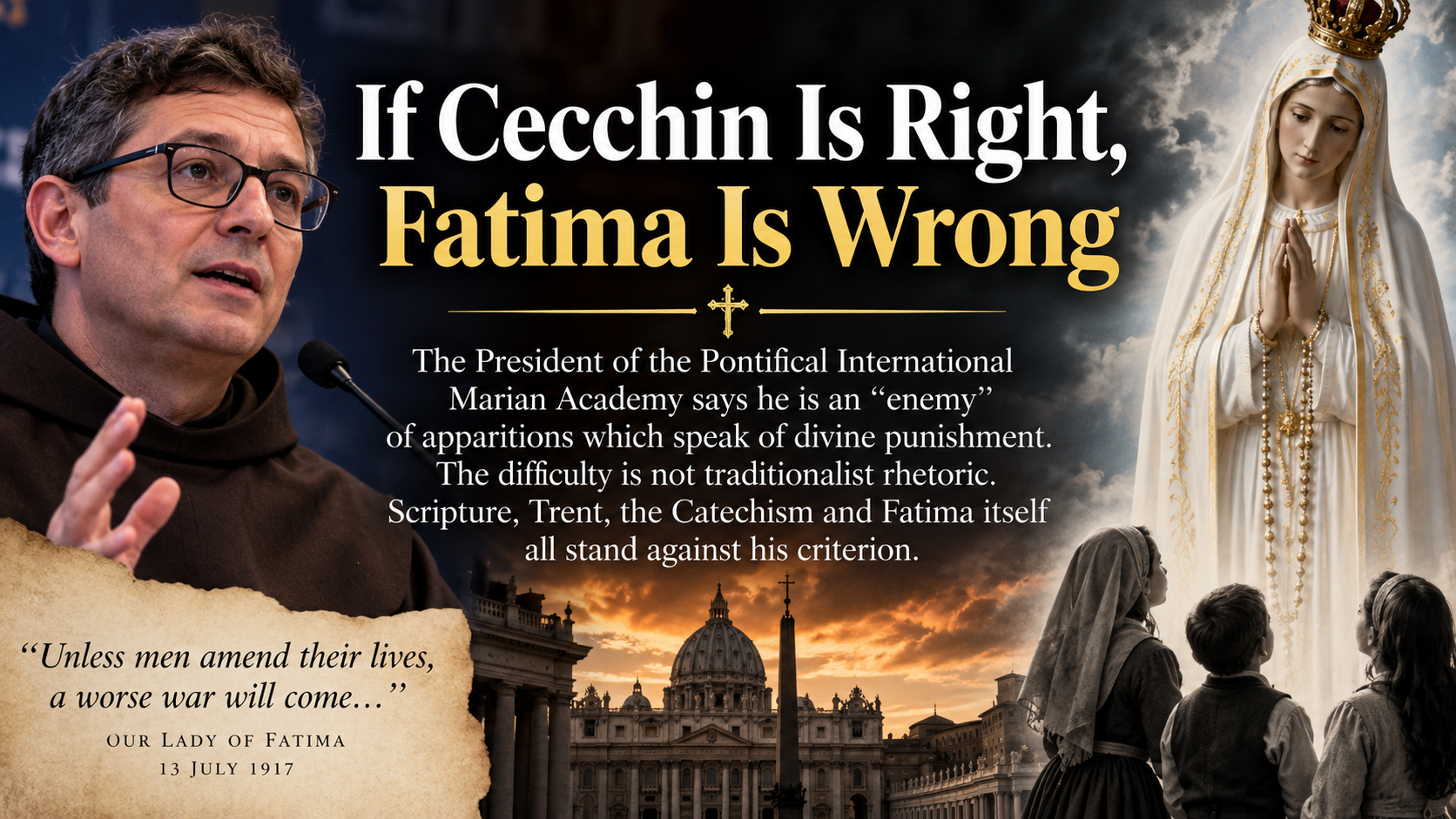
- If Cecchin Is Right, Fatima Is WrongFr Stefano Cecchin, President of the Pontifical International Marian Academy, has declared opposition to apparitions that speak of divine punishment, suggesting they are false. This stance contradicts fundamental Catholic doctrine, including teachings from Scripture, the Catechism, and specifically the Message of Fatima, which warns of divine consequences for sin.
CURRENT EDITION


Today’s Mass Propers
- Today’s Mass: September 05 Saint Lawrence Justinian
 Saint Lawrence Justinian, the first Patriarch of Venice, dedicated his life to the poor and the establishment of monasteries, rejecting noble marriage. Renowned for his humility and pastoral dedication, he emphasised the spiritual integrity of Venice’s safety. He was a precursor to the reforms of the Council of Trent, dying on 8 January 1455.



Leave a Reply