
St. Mary Magdalen
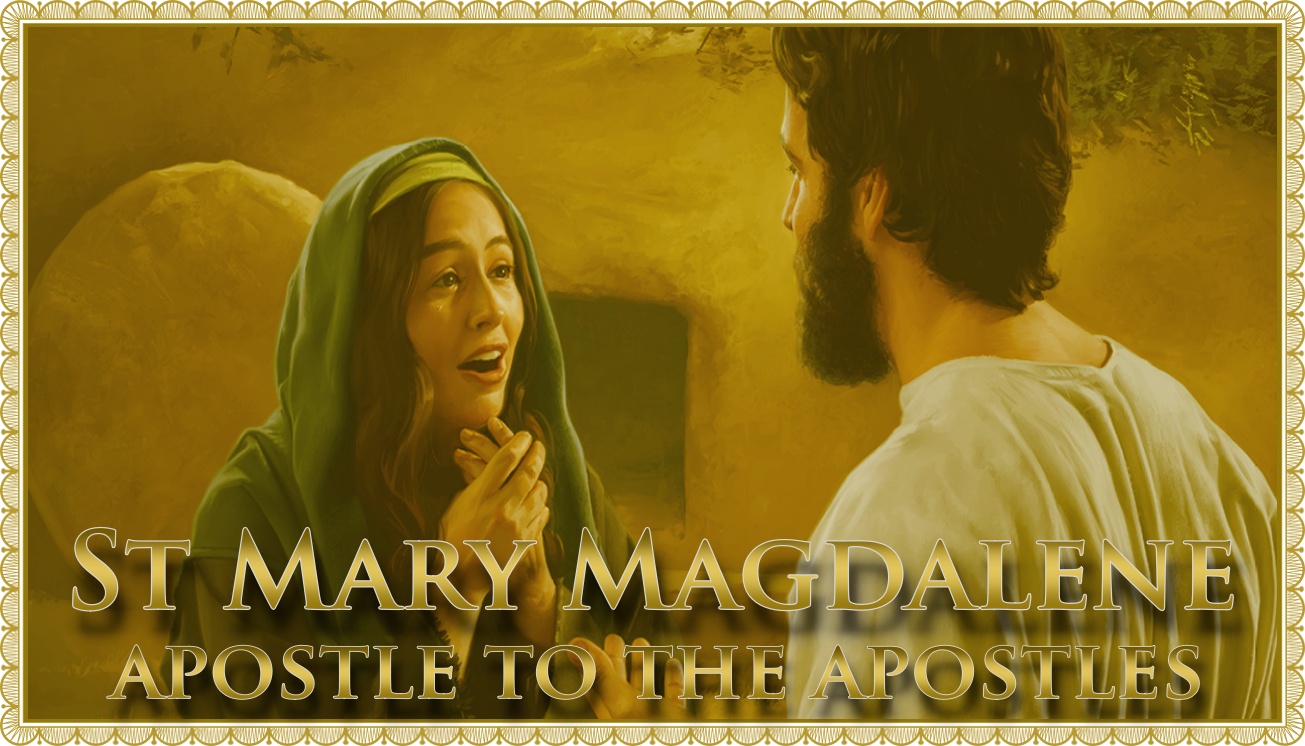
Today we celebrate the feast of St. Mary Magdalen. She was one of the most prominent of the female disciples of Jesus. St. Luke records that Jesus had driven from her seven devils. Although Jesus included only men among the Twelve, he also had many female followers. When the time came when he no longer taught, but acted and suffered, many of them remained with him to the end, among whom was Mary Magdalen. She saw that the tomb was empty on the first Easter morning and went and told St. Peter and St. John, the beloved disciple. It was to her that Jesus made his first resurrection appearance. Since the time of St. Gregory the Great the Western tradition has identified her with the sinful woman who had anointed Jesus’ feet, which is reason for this account being today’s Gospel. The Eastern tradition did not make the identification and maintained that the sinful woman was distinct from Mary Magdalen.
Today’s Gospel from St. Luke records an occasion when one of the Pharisees invited Jesus to eat with him. “And behold, a woman that was in the city, a sinner, when she knew he sat at meat in the Pharisee’s house, brought an alabaster box of ointment: and standing behind at his feet, she began to wash his feet with tears, and wiped them with the hairs of her head, and kissed his feet and anointed them with ointment.” The Pharisee said to himself that if Jesus were truly a prophet he would know that the woman was a sinner. Jesus responded with a parable about a creditor who had two debtors, one who owed five hundred pence and the other fifty. Since neither had the means to pay he forgave them both. He then asked the Pharisee which of the two would love him most. He replied the one to whom he forgave the most. Jesus then said to him: “Dost thou see this woman? I entered into thy house, thou gavest me no water for my feet: but she with tears has washed my feet, and with her hairs wiped them. Thou gavest me no kiss: but she, since she came in, hath not ceased to kiss my feet. My head with oil thou didst not anoint: but she with ointment hath anointed my feet. Wherefore, I say to thee: Many sins are forgiven her, for she hath loved much. But to whom less is forgiven, he loveth less.” He then told the woman that her sins were forgive. Those present were astonished at his claim to forgive sins. “And he said to the woman: Thy faith hath made thee safe: go in peace.”
Jesus proclaimed that the Kingdom of God, when his will would finally be done on earth as it is in heaven, was now breaking into history in his person and ministry. He appealed to all Israel, but he focused especially on the lost sheep of the nation, those whom the pious and respectable looked down upon as the “lesser breeds without the law”. This scandalised Jesus’ contemporaries and led many to believe that his behaviour discredited his claims.
But who were the Pharisees and why did they object so strongly to Jesus’ association with social outcasts? The Pharisees were the self appointed guardians of the ancestral traditions. The name is thought to be mean separated ones and it is usually supposed that they emerged at the time of the Maccabean revolt against the attempt by the Seleucid ruler Antiochus Epiphanes to suppress Judaism. But whereas the Hasmonean rulers during the century long period of national independence proved as worldly and compromised as those whom they replaced, the Pharisees were a genuinely religious movement. They included men of high moral and intellectual quality. They were respected and influential and formed fellowships for their mutual edification, but they fell into the trap of so many religious movements who saw themselves as the pillars of light and law. This was that they became self righteous and inward looking because they believed themselves (not without some validity) to be better than their neighbours. They came, like the Pharisee in the parable of the Pharisee and the Tax Collector, to trust in themselves that they were righteous and despise others. They knew that the Lord loveth the righteous and his ear is open to their prayer, and that he rewarded virtue and punished vice. Hence, Jesus’ association with social outcasts (such as the woman in today’s Gospel) seemed like a dissolution of all ethics.
Jesus replied that his critics had fundamentally misunderstood the nature of God. In the parable he told the Pharisee about the creditor with two debtors both of whom were unable to pay and who were both forgiven, the one who loved the most was the one who had the most debt. The Pharisee questioned whether Jesus could be a prophet because he had allowed a woman who was a notorious sinner to anoint him. But she had shown more gratitude to Jesus than the Pharisee had done himself. Her many sins were forgiven because she loved much.
The prophet Jeremiah had looked forward to a coming age when there would be a new covenant, in which sins would finally be forgiven and the law no longer be written on tablets of stone but in the hearts of men. Jesus claimed that this age was dawning in his own person and ministry. Hence, his claim to forgive sins. The time of preparation was now over, for they were already living in the days of fulfilment.
It is Jesus’ claim to offer sinners forgiveness that marks Christianity out from all other religions and philosophies. Confucius and the Buddha offered good advice about how to live. Mohammed claimed the status of a prophet, but not one who was able to forgive sins. The teachings of the Jewish sages included many wise moral precepts, as did those of the Greek philosophers. By contrast, Christianity offers not simply good advice, but good news, the good news of salvation through the life, death and resurrection of Jesus Christ.
All of us have sinned and fallen short of the glory of God and are justified freely by his grace. God was in Christ reconciling the world to himself and not counting our sins against us. This does not mean the indiscriminate endorsement of any kind of lifestyle. The Pharisees were right to encourage people to avoid falling into sinful patterns of behaviour. But they fell into the greatest sin of all, that of pride, of trusting in themselves and their own righteousness, rather than in the God who created them and redeemed them in person of Jesus Christ. By contrast, the Gospel knows no other basis for religious actions than that of gratitude for forgiveness experienced. It is only as we ourselves have been forgiven that we are also enabled to forgive.
The danger of religious people falling into the trap of thinking of their faith as an exam which we have to pass to merit salvation is just as present today as it was then. If we think of our religion as an exam it is one in which all have failed. But the good news of the Gospel is that this is not the end of the story, for God came to us in Christ to bring us that forgiveness which we could not achieve for ourselves. It is only when we abandon our pride in ourselves (not least the much vaunted cult of self esteem which contemporary culture exhorts us to cultivate at every possible opportunity) and recognise that we can never in this life get beyond being saved sinners that we can truly begin, by the grace of God, to do all such good works as he has prepared for us to walk in.
by the Revd Dr Robert Wilson PhD (Cantab), Old Roman Apostolate UK




Leave a Reply