
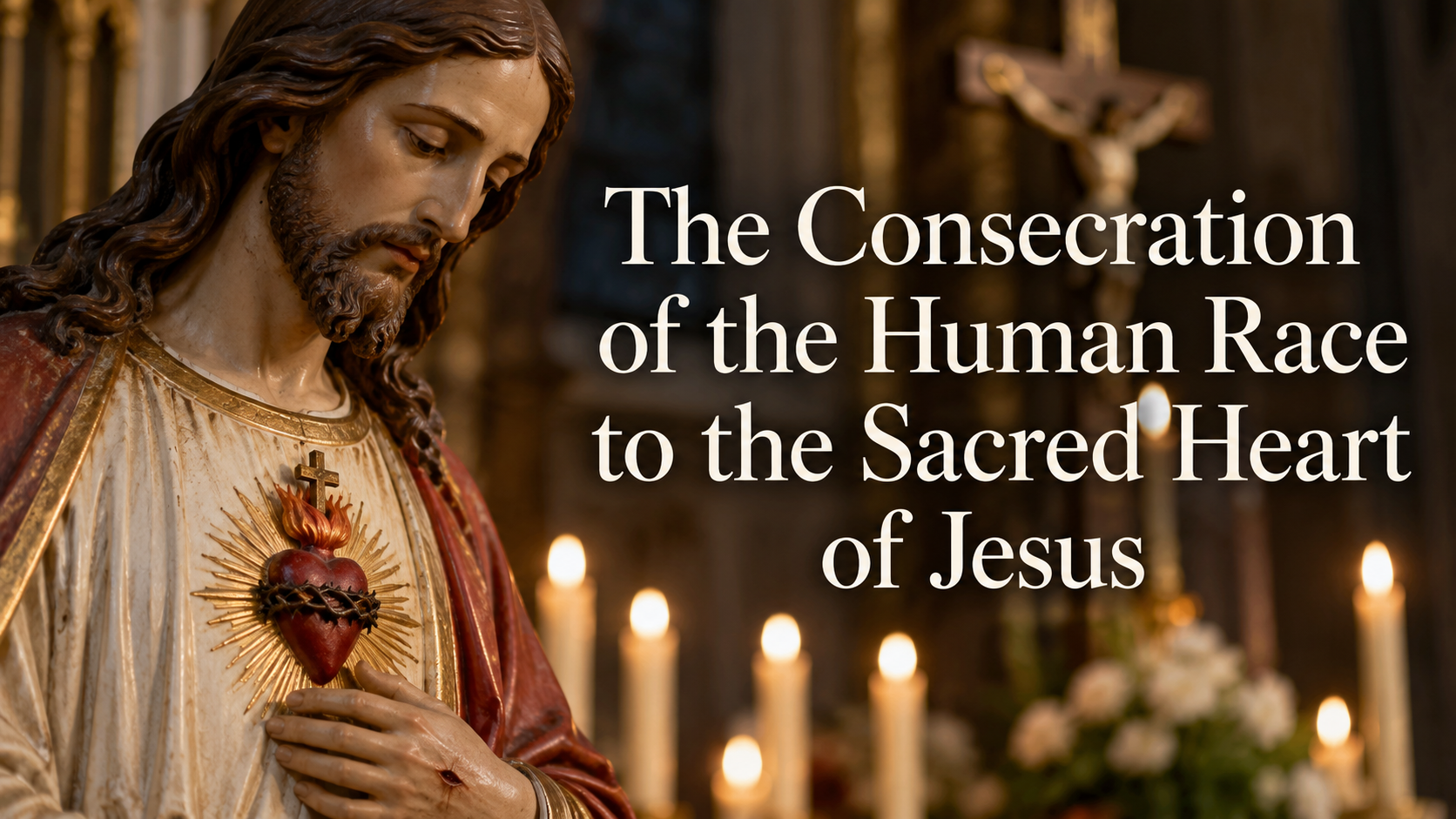
The solemn profession of Christ’s universal sovereignty, preserved in traditional Catholic chapels, and the theological, social and anthropological inheritance increasingly forgotten elsewhere in the Church
On Sunday, 25 October, Catholics attending traditional chapels for the Feast of Christ the King will renew the Consecration of the Human Race to the Sacred Heart of Jesus. They will acknowledge the sovereignty of Christ over all mankind, profess their willing submission to His authority, pray for the conversion of those who do not know Him, and implore the restoration of His reign over individuals and nations. Elsewhere, many Catholics will celebrate Christ the King in November without encountering this once-prominent devotion or knowing that it remains officially approved and indulgenced by the Holy See. The contrast is more significant than a difference in liturgical custom. The consecration expresses a coherent understanding of divine authority, human nature, freedom, religious truth and social responsibility whose transmission has been gravely weakened. Its preservation matters because it continues to teach what generations of Catholics are increasingly unlikely to hear explained.
When Catholics kneel before the Blessed Sacrament on the traditional Feast of Christ the King this Sunday and recite the Consecration of the Human Race to the Sacred Heart of Jesus, they will make a profession whose implications extend far beyond their individual spiritual lives. They will acknowledge that Jesus Christ possesses sovereign authority over every human being, whether baptised or unbaptised, believing or unbelieving, and that His reign must be recognised not only in the conscience but throughout human society. They will offer their own allegiance, pray for those who have abandoned His commandments, and implore the conversion of those who do not yet know Him. This is no incidental devotional exercise. In its successive petitions, the consecration expresses the Catholic understanding of creation, redemption, human liberty, the purpose of society and the supernatural destiny of mankind.
Pope Leo XIII prescribed the consecration in Annum Sacrum of 25 May 1899, directing that it be undertaken throughout the universal Church in June of that year. Pope St Pius X subsequently ordered its annual renewal, and Pius XI expressly associated it with the Feast of Christ the King through Quas Primas in 1925.¹ The relationship was deliberate. Devotion to the Sacred Heart reveals the charity by which mankind was redeemed; the feast proclaims the sovereignty belonging to Christ as God and Redeemer. Together they establish that His love cannot be separated from His authority, nor His mercy from the truth and justice by which He governs. The pierced Heart of the Redeemer is the Heart of the King, and the salvation accomplished through His sacrifice is inseparable from the obligation to acknowledge His divine law.
The consecration begins, Iesu dulcissime, Redemptor humani generis — Most sweet Jesus, Redeemer of the human race. Its opening words immediately establish the universality of Christ’s redemptive mission. He is not invoked simply as the founder of Christianity or the spiritual consolation of those who profess His name, but as the Saviour of mankind. His sacrifice possesses universal sufficiency because the Divine Person who offered it is the Redeemer of the world. Yet the universal scope of redemption does not mean that every individual has consequently received salvation irrespective of faith, repentance or grace. The prayer acknowledges what Christ has accomplished and petitions that its saving fruits may be received by those for whom He died. Its missionary intention follows necessarily from its opening profession.
The words which follow contain the essential distinction upon which the act depends: “We are Thine, and Thine we wish to be.” The first declaration recognises an objective relationship established by God; the second expresses the willing submission of the human person. Leo XIII explained that Christ possesses sovereignty by natural right as the Incarnate Son of God, to whom all creation belongs, and by acquired right as Redeemer, who purchased mankind through His Precious Blood.² Neither popular consent, political recognition nor religious profession establishes that sovereignty. Consecration therefore does not confer upon Christ an authority which He previously lacked. It brings the human will into conformity with an authority which already exists. Man belongs to Christ by creation and redemption; he is called to acknowledge that belonging freely through faith, love and obedience.
Here the consecration offers an understanding of human nature radically different from the assumptions which increasingly govern contemporary society. The human person is not an autonomous being who constructs his ultimate purpose through the exercise of personal preference. He is a creature whose existence, nature and final end are received from God. His dignity is intrinsic because he is made in the divine image, not because he possesses unlimited powers of self-definition. Nor is freedom perfected through emancipation from every obligation which has not been personally chosen. Its proper exercise consists in recognising and pursuing the good for which man was created. Obedience to Christ is therefore not the diminution of human freedom but its fulfilment. The consecration’s opening profession rejects the premise that personal autonomy is the supreme measure of human dignity, insisting instead that dignity and liberty become fully intelligible only in relation to man’s Creator.
The Sacred Heart reveals why such obedience is not servitude in the degrading human sense. The Heart wounded by the lance and encircled with thorns represents the charity which accepted the sacrifice of Calvary for mankind’s redemption. The Cross demonstrates simultaneously the gravity of sin and the immensity of divine mercy. Christ does not love humanity by declaring its moral choices inconsequential, but by offering the grace through which sinners may be reconciled to God. His commandments are not arbitrary restrictions upon happiness; they express the moral order proper to creatures called to eternal communion with Him. Love seeks the genuine good of the beloved, and man’s supreme good is God Himself. The sovereignty of the Sacred Heart is consequently neither coercive domination nor sentimental benevolence, but the rightful authority of divine charity directing mankind towards salvation.
The consecration then extends its petitions beyond those already professing the faith. It asks Christ to reign over those who have never known Him, to recall those who have rejected His commandments, and to restore those separated from the unity of His Church. These requests presuppose that divine revelation possesses objective truth, that contradictory religious beliefs cannot all be equally true, and that communion with Christ is a good which the Church must desire for every human being. Respect for persons of other religions, including their dignity and freedom of conscience, does not require indifference towards religious error. Nor does the existence of sincerity or goodness outside the visible boundaries of the Church render evangelisation unnecessary. Whatever salvation is granted comes through Christ, and the Church’s commission remains to make Him known to all nations.
The historical form of the consecration included petitions naming particular religious communities. In 1959, during the pontificate of John XXIII, specific references to Muslims, adherents of other non-Christian religions and the Jewish people were removed. Nevertheless, the text retained in the modern Enchiridion Indulgentiarum continues to pray for those who have never known Christ and those separated through error or discord, asking that they be brought into the unity of faith so that there may be one flock and one Shepherd.³ Its language has undergone alteration, but its fundamental missionary purpose remains. The Church continues officially to commend a prayer which desires the conversion of mankind, not merely the peaceful coexistence of religious convictions.
This provides an illuminating contrast with the questions raised in recent Nuntiatoria commentary on interreligious dialogue. The interpretation of the Assisi gatherings, the promotion of Buddhism within preparations for World Youth Day, and the tendency to present religious encounter as a sufficient pastoral achievement all require examination according to the same principle: dialogue cannot replace evangelisation. Mutual understanding, peaceful relations and cooperation in works of justice are legitimate goods, but they are not the supreme good which Christian charity seeks for another person. The Church was not commissioned merely to facilitate coexistence between religious traditions. She was commanded to teach all nations and communicate the means of salvation entrusted to her by Christ. The consecration preserves that distinction with unmistakable clarity, insisting that charity towards those outside the faith must include the desire that they should come to know their Redeemer.
The same understanding necessarily governs the Church’s internal life. Consultation, dialogue and the participation of the faithful may assist ecclesiastical authority in determining how best to fulfil its mission, but they cannot determine the content of divine revelation. The truths professed in the consecration are received, not constructed through deliberation. Christ’s sovereignty, the necessity of redemption, the objective character of moral truth and the supernatural destiny of mankind do not depend upon the preferences of consultative assemblies. Recent Nuntiatoria examinations of synodality have repeatedly addressed the danger of allowing ecclesiastical processes to become substitutes for doctrinal clarity. The consecration recalls the prior principle: the Church belongs to Christ and is subject to His revelation. Her responsibility is to preserve, explain and transmit what she has received, not to negotiate its substance according to changing cultural expectations.
The petition that Christ’s reign be acknowledged throughout the world also carries profound social implications. Human society is not morally self-sufficient, nor does political authority possess the power to determine what is intrinsically good or evil. Governments exercise legitimate competence within their proper sphere, but remain accountable to the natural and divine law. A legislature may permit conduct contrary to the moral order; its permission does not make that conduct morally good. Similarly, a democratic majority cannot transform injustice into justice merely through agreement. Christ’s sovereignty over nations does not require the Church to administer every department of government, nor does it identify His Kingdom with a particular constitution. It establishes that civil society, like individual conscience, is answerable to a standard which mankind did not create.
Pius XI instituted Christ the King precisely to confront the exclusion of Christ and His law from public affairs. In Quas Primas, he identified that exclusion as a fundamental source of disorder and insisted that peace could not be secured through the repudiation of divine authority.⁴ Yet the social Kingship of Christ must not be confused with ethnic nationalism, political resentment or the appropriation of Christianity as the possession of a particular people. The recent Nuntiatoria examination of the relationship between Christianity and Britishness raised this distinction. Cultural attachment to Christian heritage is not equivalent to supernatural faith, while rejection of religious nationalism does not oblige Christians to accept the moral independence of the State from God. No nation possesses an exclusive claim upon Christ; every nation remains subject to His authority. His Kingship is universal precisely because He is the Creator and Redeemer of mankind.
The consequences of this doctrine reach into the ordering of ordinary social life. The family is not simply an arrangement whose meaning derives from legislative recognition; human dignity is not established by usefulness or social approval; and the protection of innocent life cannot be made dependent upon changing political preferences. Catholic moral teaching rests upon an understanding of human nature as objective and intelligible, with rights and responsibilities arising from creation rather than from the permission of the State. The consecration expresses the theological foundation of that understanding. Once the relationship between Creator and creature is obscured, individual moral doctrines may appear as disconnected prohibitions rather than the consequences of a coherent account of man’s nature and destiny. The difficulty many Catholics experience in explaining the Church’s teachings is therefore inseparable from the weakening of the theological formation which once made those teachings intelligible.
Equally important is the distinction between the temporal common good and man’s supreme good. Political society rightly seeks justice, peace, prosperity, security and the conditions necessary for human flourishing. These are genuine goods, and Christians possess serious obligations concerning them. But man’s final end is eternal communion with God, which no material prosperity can supply. Recent Nuntiatoria commentary on the relationship between moral responsibility, justice and the purpose of Christian charity has stressed the danger of treating temporal welfare as though it exhausted the Church’s mission. The consecration restores the proper hierarchy. The commandment to love one’s neighbour includes the corporal works of mercy and concern for social justice, but it cannot be fulfilled while remaining indifferent to his eternal salvation. Charity seeks the whole good of the person, and the supernatural good is supreme.
This also explains the relationship between consecration and reparation. In Miserentissimus Redemptor of 1928, Pius XI distinguished the offering of the human will to Christ from the satisfaction offered for offences against His love.⁵ Consecration expresses allegiance; reparation acknowledges the sins by which that allegiance has been violated. Both derive their supernatural value from the sacrifice of Calvary. The proper fulfilment of devotion to the Sacred Heart therefore belongs to sacramental life, repentance, penance, worthy Holy Communion and participation in the Holy Sacrifice of the Mass. Those who profess Christ’s sovereignty are obliged to make their personal conduct conform to His commandments. The Christian who condemns the moral disorders of society while tolerating habitual injustice, dishonesty or uncharitableness in his own life has failed to understand the act he pronounces.
Its formative significance explains why Pius XI associated the consecration with the Feast of Christ the King. He expressly directed that the meaning and importance of the feast should be explained to the faithful so that its annual observance might influence their lives. The intention was not simply to add another ceremony to the liturgical calendar. It was to make the doctrine of Christ’s Kingship comprehensible, public and personally demanding. The Mass proclaimed His sovereignty through its sacred texts and sacrifice; the consecration invited the faithful to acknowledge that sovereignty in their own conduct and pray for its recognition throughout the world. The connection between worship, doctrine and moral responsibility was essential to the purpose of the observance.
It is this connection which traditional Catholic chapels continue to preserve when the consecration is solemnly renewed on the last Sunday of October. The faithful do not merely hear Christ described as King; they acknowledge themselves as His subjects and pray that all mankind may come to recognise His reign. The prayer therefore performs a catechetical function as well as a devotional one. Its words place the obligations of faith before the congregation in language which is memorable, comprehensive and directed towards action. The practice cannot guarantee that every participant understands or fulfils those obligations, but it provides an annual opportunity for the Church’s teaching to enter the imagination and conscience of the faithful.
The contrast with much ordinary Catholic experience is particularly striking because the consecration has never ceased to enjoy official recognition. The fourth edition of the Enchiridion Indulgentiarum, issued by the Apostolic Penitentiary in 1999, retains the Actus dedicationis humani generis Iesu Christo Regi and grants a plenary indulgence, subject to the usual conditions, for its public recitation on the Solemnity of Christ the King.⁶ The Holy See therefore continues explicitly to encourage a profession whose theological significance may remain entirely unknown to many Catholics attending Mass upon that feast. This is not a question of restoring something the Church has formally rejected. It concerns the neglect of a devotion which remains part of her officially approved spiritual inheritance.
The omission is visible even in the Vatican’s published papal celebrations. The official order of service for Pope Benedict XVI’s Mass on Christ the King in St Peter’s Basilica on 21 November 2010 contains no consecration. Neither do the booklets for Pope Francis’s celebration on 24 November 2024 or Pope Leo XIV’s Mass in St Peter’s Square on 23 November 2025.⁷ These documents do not establish that the prayer was absent from every Vatican celebration or that it was not recited separately. They do demonstrate its omission from the published orders of three principal papal Masses spanning fifteen years and three pontificates. The significance is not that those liturgies failed to proclaim the sovereignty of Christ, which their prayers and readings certainly did, but that the particular act deliberately associated with His Kingship by Pius XI was not presented as part of those celebrations. Its diminished public prominence is therefore a development extending well beyond the preferences of any one pontiff.
Nor can this be explained by suggesting that the consecration’s theology was subsequently repudiated. Pope John Paul II expressly recalled its continuing importance in his centenary letter of 11 June 1999, commending its annual renewal on the Feast of the Sacred Heart and reaffirming its relationship to the Church’s missionary vocation.⁸ The modern Enchiridion separately continues to attach the plenary indulgence to public recitation on Christ the King. The devotion remains officially recognised; what has weakened is the transmission of its meaning. Many Catholics may consequently attend the feast without knowing that the Church still encourages them to make a solemn profession of precisely the doctrines which the celebration was instituted to communicate.
This illustrates a wider crisis repeatedly examined in recent Nuntiatoria commentary. The decline of Christian practice in Britain, the contraction of diocesan structures, and the increasingly managerial responses to diminishing participation all raise a question more fundamental than institutional survival: what understanding of the faith is actually being transmitted? Churches may remain open, diocesan departments may continue to operate, pastoral programmes may multiply and sacramental preparation may be administered, while the supernatural foundations of Catholic life become less familiar to successive generations. The disappearance of the consecration from ordinary experience is a particularly revealing example. A prayer may remain formally approved while the doctrine it was intended to communicate gradually disappears from the habitual consciousness of the faithful.
There is no reason to suppose that restoring the words alone would remedy such an impoverishment. A devotional formula recited without understanding can become as empty as any other neglected expression of faith. Its recovery must therefore include serious preaching and catechesis concerning the Incarnation, redemption, grace, natural law, the nature of the Church and man’s eternal destiny. Catholics must understand why Christ’s sovereignty extends beyond private belief, why human freedom is ordered towards truth, why civil authority remains accountable to God, and why evangelisation cannot be reduced to dialogue or social cooperation. These are not unrelated doctrines conveniently assembled within an old prayer. They are consequences of the single truth that Jesus Christ is the Redeemer and rightful King of mankind.
Traditional Catholics, meanwhile, should recognise that preserving the consecration carries responsibilities as well as privileges. The act must never become merely a badge of liturgical identity or a means of asserting superiority over Catholics who worship elsewhere. Its first demand is humility and conversion from those who pronounce it. Its universal petitions require genuine charity towards those outside the faith, and its profession of Christ’s sovereignty demands obedience in private conduct no less than in public controversy. The value of preserving the tradition lies not in possessing something others have lost, but in continuing to make available a means by which the Church’s doctrine can be understood, professed and lived.
The Consecration of the Human Race to the Sacred Heart of Jesus therefore offers a profound corrective to the fragmentation of contemporary Catholic understanding. Its theology begins with the sovereignty of the Incarnate Word; its anthropology recognises man as a creature endowed with freedom and ordered towards God; its social teaching acknowledges the subordination of human authority to divine justice; and its missionary purpose seeks the salvation of every soul. The prayer makes visible the relationship between the doctrines Catholics profess and the obligations arising from them. Without that relationship, religious language may survive while its implications for human existence are progressively obscured.
On Sunday, as the consecration is renewed in traditional Catholic chapels, the faithful will publicly profess an understanding of Christ, mankind and society which remains as necessary today as when Leo XIII prescribed it. The Sacred Heart is the Heart of the King, and the King who reigns from the Cross seeks not merely admiration but the willing allegiance of those whom He has redeemed. His sovereignty is not established by human recognition, nor diminished by human forgetfulness. The Church’s responsibility is to proclaim it, explain its consequences and lead souls towards the salvation for which Christ shed His Blood.
The words with which the consecration begins remain its most eloquent summary: “We are Thine, and Thine we wish to be.” They acknowledge both the truth of man’s dependence upon God and his vocation to embrace that dependence freely through love. In traditional chapels this weekend, those words will once again be publicly proclaimed. The tragedy is not that the Church has ceased to approve them. It is that so many Catholics may no longer know why they matter.
Actus Consecrationis Humani Generis
Sacratissimo Cordi Iesu
To be recited kneeling before the Blessed Sacrament
ACT OF CONSECRATION OF THE HUMAN RACE
TO THE SACRED HEART OF JESUS
Jesu Dulcissime, Redemptor humani generis, respice nos ad altare tuum humillime provolutos. Tui sumus, tui esse volumus; quo autem tibi conjuncti firmius esse possimus, en hodie sacratissimo Cordi tuo se quisque nostrum sponte dedicat. Te quidem multi novere numquam; te, spretis mandatis tuis, multi repudiarunt. Miserere utrorumque, benignissime Jesu, atque ad sanctum Cor tuum rape universos.
Rex esto, Domine, nec fidelium tantum qui nullo tempore discessere a te, sed etiam prodigorum filiorum qui te reliquerunt: fac hos, ut domum paternam cito repetant, ne miseria et fame pereant. Rex esto eorum, quos aut opinionum error deceptos habet, aut discordia separatos, eosque ad portum veritatis atque ad unitatem fidei revoca, ut brevi fiat unum ovile et unus pastor.
Rex esto eorum omnium, qui in tenebris idololatriae aut islamismi adhuc versantur, eosque in lumen regnumque tuum vindicare ne renuas. Respice denique misericordiae oculis illius gentis filios, quae tamdiu populus electus fuit: et Sanguis, qui olim super eos invocatus est, nunc in illos quoque redemptionis vitaeque lavacrum descendat.
Largire, Domine, Ecclesiae tuae securam cum incolumitate libertatem; largire cunctis gentibus tranquillitatem ordinis; perfice, ut ab utroque terrae vertice una resonet vox: Sit laus divino Cordi, per quod nobis parta salus: ipsi gloria et honor in saecula. Amen.
Most sweet Jesus, Redeemer of the human race, look down upon us humbly prostrate before Thine Altar. We are Thine, and Thine we wish to be; but to be more surely united to Thee, behold, each one of us this day freely dedicates himself to Thy Most Sacred Heart. Many, indeed, have never known Thee; many, too, despising Thy precepts have rejected Thee. Have mercy on them all, most merciful Jesus, and draw them to Thy Sacred Heart.
Be Thou King, O Lord not only of the faithful who have never forsaken Thee, but also of the prodigal sons who have abandoned Thee; grant that they may quickly return to their Father’s house, lest they perish of wretchedness and hunger. Be Thou King of those whom heresy holds in error or discord keeps aloof; call them back to the harbour of truth and the unity of faith, so that soon there may be but one fold and one Shepherd.
Be Thou King of all those who even now sit in the shadow of idolatry or Islam, and refuse not Thou to bring them into the light of Thy kingdom. Look, finally, with eyes of pity upon the children of that race, which was for so long a time Thy chosen people; and let Thy Blood, which was once invoked upon them in vengeance, now descend upon them also in a cleansing flood of redemption and eternal life.
Grant, O Lord, to Thy Church assurance of freedom and immunity from harm; unto all nations give an ordered tranquillity; bring it to pass that from pole to pole the earth may resound with one cry: Praise to the divine Heart that wrought our salvation; to It be honour and glory for ever and ever. Amen.
Litaniæ de Sacratissimo Corde Iesu
Litany of the Most Sacred Heart of Jesus
Opening invocations
| Latin | English |
|---|---|
| V. Kyrie, eleison. | V. Lord, have mercy. |
| R. Kyrie, eleison. | R. Lord, have mercy. |
| V. Christe, eleison. | V. Christ, have mercy. |
| R. Christe, eleison. | R. Christ, have mercy. |
| V. Kyrie, eleison. | V. Lord, have mercy. |
| R. Kyrie, eleison. | R. Lord, have mercy. |
| V. Christe, audi nos. | V. Christ, hear us. |
| R. Christe, exaudi nos. | R. Christ, graciously hear us. |
| Pater de cælis, Deus, | God the Father of Heaven, |
| Fili, Redemptor mundi, Deus, | God the Son, Redeemer of the world, |
| Spiritus Sancte, Deus, | God the Holy Ghost, |
| Sancta Trinitas, unus Deus, | Holy Trinity, one God, |
Response to each invocation of the Blessed Trinity: R. Miserere nobis. — R. Have mercy on us.
The thirty-three invocations
| Latin | English |
|---|---|
| 1. Cor Iesu, Filii Patris æterni, | Heart of Jesus, Son of the Eternal Father, |
| 2. Cor Iesu, in sinu Virginis Matris a Spiritu Sancto formatum, | Heart of Jesus, formed by the Holy Ghost in the womb of the Virgin Mother, |
| 3. Cor Iesu, Verbo Dei substantialiter unitum, | Heart of Jesus, substantially united to the Word of God, |
| 4. Cor Iesu, maiestatis infinitæ, | Heart of Jesus, of infinite majesty, |
| 5. Cor Iesu, templum Dei sanctum, | Heart of Jesus, holy temple of God, |
| 6. Cor Iesu, tabernaculum Altissimi, | Heart of Jesus, tabernacle of the Most High, |
| 7. Cor Iesu, domus Dei et porta cæli, | Heart of Jesus, house of God and gate of Heaven, |
| 8. Cor Iesu, fornax ardens caritatis, | Heart of Jesus, burning furnace of charity, |
| 9. Cor Iesu, iustitiæ et amoris receptaculum, | Heart of Jesus, abode of justice and love, |
| 10. Cor Iesu, bonitate et amore plenum, | Heart of Jesus, full of goodness and love, |
| 11. Cor Iesu, virtutum omnium abyssus, | Heart of Jesus, abyss of all virtues, |
| 12. Cor Iesu, omni laude dignissimum, | Heart of Jesus, most worthy of all praise, |
| 13. Cor Iesu, rex et centrum omnium cordium, | Heart of Jesus, King and centre of all hearts, |
| 14. Cor Iesu, in quo sunt omnes thesauri sapientiæ et scientiæ, | Heart of Jesus, in whom are all the treasures of wisdom and knowledge, |
| 15. Cor Iesu, in quo habitat omnis plenitudo divinitatis, | Heart of Jesus, in whom dwelleth all the fulness of the Godhead, |
| 16. Cor Iesu, in quo Pater sibi bene complacuit, | Heart of Jesus, in whom the Father was well pleased, |
| 17. Cor Iesu, de cuius plenitudine omnes nos accepimus, | Heart of Jesus, of whose fulness we have all received, |
| 18. Cor Iesu, desiderium collium æternorum, | Heart of Jesus, desire of the everlasting hills, |
| 19. Cor Iesu, patiens et multæ misericordiæ, | Heart of Jesus, patient and most merciful, |
| 20. Cor Iesu, dives in omnes qui invocant te, | Heart of Jesus, enriching all who invoke Thee, |
| 21. Cor Iesu, fons vitæ et sanctitatis, | Heart of Jesus, fountain of life and holiness, |
| 22. Cor Iesu, propitiatio pro peccatis nostris, | Heart of Jesus, propitiation for our sins, |
| 23. Cor Iesu, saturatum opprobriis, | Heart of Jesus, loaded with reproaches, |
| 24. Cor Iesu, attritum propter scelera nostra, | Heart of Jesus, bruised for our iniquities, |
| 25. Cor Iesu, usque ad mortem obœdiens factum, | Heart of Jesus, obedient unto death, |
| 26. Cor Iesu, lancea perforatum, | Heart of Jesus, pierced with a lance, |
| 27. Cor Iesu, fons totius consolationis, | Heart of Jesus, source of all consolation, |
| 28. Cor Iesu, vita et resurrectio nostra, | Heart of Jesus, our life and resurrection, |
| 29. Cor Iesu, pax et reconciliatio nostra, | Heart of Jesus, our peace and reconciliation, |
| 30. Cor Iesu, victima peccatorum, | Heart of Jesus, victim for our sins, |
| 31. Cor Iesu, salus in te sperantium, | Heart of Jesus, salvation of those who hope in Thee, |
| 32. Cor Iesu, spes in te morientium, | Heart of Jesus, hope of those who die in Thee, |
| 33. Cor Iesu, deliciæ Sanctorum omnium, | Heart of Jesus, delight of all the Saints, |
R. Miserere nobis. — R. Have mercy on us.
This response is repeated by the congregation after each of the thirty-three invocations.
Concluding petitions
| Latin | English |
|---|---|
| V. Agnus Dei, qui tollis peccata mundi, | V. Lamb of God, who takest away the sins of the world, |
| R. Parce nobis, Domine. | R. Spare us, O Lord. |
| V. Agnus Dei, qui tollis peccata mundi, | V. Lamb of God, who takest away the sins of the world, |
| R. Exaudi nos, Domine. | R. Graciously hear us, O Lord. |
| V. Agnus Dei, qui tollis peccata mundi, | V. Lamb of God, who takest away the sins of the world, |
| R. Miserere nobis. | R. Have mercy on us. |
| V. Iesu, mitis et humilis Corde. | V. Jesus, meek and humble of Heart. |
| R. Fac cor nostrum secundum Cor tuum. | R. Make our hearts like unto Thine. |
Oratio — Collect
| Latin | English |
|---|---|
| Oremus. | Let us pray. |
| Omnipotens sempiterne Deus, respice in Cor dilectissimi Filii tui, et in laudes et satisfactiones, quas in nomine peccatorum tibi persolvit; iisque misericordiam tuam petentibus, tu veniam concede placatus, in nomine eiusdem Filii tui Iesu Christi: Qui tecum vivit et regnat in sæcula sæculorum. | Almighty and eternal God, look upon the Heart of Thy most beloved Son, and upon the praises and satisfaction which He offereth Thee in the name of sinners; and to those who implore Thy mercy, in Thy great goodness grant forgiveness in the name of the same Jesus Christ, Thy Son, who liveth and reigneth with Thee for ever and ever. |
| R. Amen. | R. Amen. |
- Leo XIII, Annum Sacrum, 25 May 1899; Pius XI, Quas Primas, 11 December 1925, §28; John Paul II, Letter on the Centenary of the Consecration, 11 June 1999.
- Leo XIII, Annum Sacrum, on Christ’s natural and acquired right of sovereignty; Pius XI, Quas Primas, §§7–13.
- Apostolic Penitentiary, Enchiridion Indulgentiarum, fourth edition, 1999, concession 2; Jewish Telegraphic Agency, Pope Orders Passages Offensive to Jews, Moslems Omitted from Prayer, 28 September 1959.
- Pius XI, Quas Primas, §§18–20, 28–33.
- Pius XI, Miserentissimus Redemptor, 8 May 1928.
- Apostolic Penitentiary, Enchiridion Indulgentiarum, fourth edition, concession 2, Actus dedicationis humani generis Iesu Christo Regi.
- Office for the Liturgical Celebrations of the Supreme Pontiff, Christ the King: Benedict XVI, 21 November 2010; Christ the King: Francis, 24 November 2024; Christ the King: Leo XIV, 23 November 2025.
- John Paul II, Letter on the Centenary of the Consecration of the Human Race to the Divine Heart of Jesus, 11 June 1999.



Leave a Reply