
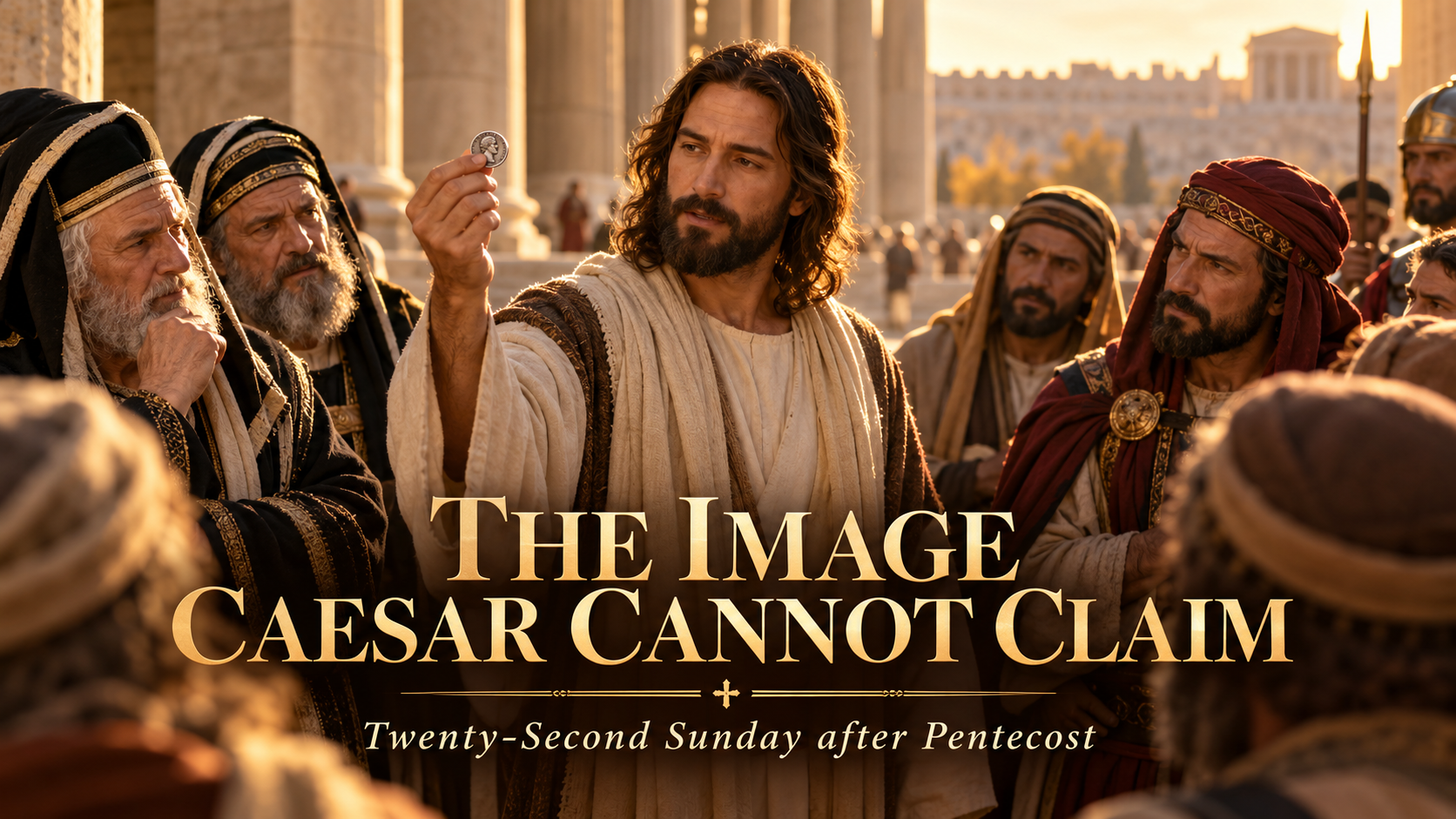
The Pharisees send their disciples to ask Our Lord whether tribute should be paid to Caesar, hoping to entrap Him in a dispute about earthly authority. His answer exposes their hypocrisy and directs attention towards a far greater obligation: the duty of man to render himself to God. The traditional Roman Mass develops this teaching through penitence, charity, fidelity and the sacramental grace by which the Christian soul is restored and sanctified.
The Pharisees have devised a question calculated to place Our Lord in an impossible position. Is it lawful to pay tribute to Caesar? Having considered the possible answers, they arrange their accusation accordingly. If Christ condemns the tribute, He may be denounced to the Roman authorities as a disturber of public order. If He approves it, they hope to discredit Him among those who resent foreign domination. Rather than approach Him themselves, they send their disciples accompanied by the Herodians, whose political sympathies make them useful accomplices. Men ordinarily divided by their interests have found sufficient common purpose in their hostility towards Jesus Christ. Their concern is not the lawfulness of taxation, but the destruction of the Teacher whose authority they refuse to acknowledge.¹
The opening compliments of these emissaries betray the contradiction at the heart of their purpose. They acknowledge Christ as a truthful teacher, one who faithfully expounds the way of God and does not alter His judgement to obtain the favour of men. Everything they say about His character is true; everything about their intention is false. They recognise the qualities which distinguish Him from other teachers, only to employ that recognition in an attempt to destroy Him. Our Lord exposes their malice, asks to see the money of the tribute, and is shown a denarius. Whose image and inscription does it bear? Caesar’s, they reply. Christ then pronounces the words which have become fundamental to Christian teaching on the relationship between temporal and divine authority: Reddite ergo, quae sunt Caesaris, Caesari; et, quae sunt Dei, Deo. — “Render therefore to Caesar the things that are Caesar’s; and to God, the things that are God’s.”¹
The immediate meaning is clear. Our Lord recognises that legitimate temporal obligations do not disappear because the civil ruler is a pagan or because his government is politically unwelcome. Those who participate in the ordinary arrangements of civil society may be required to fulfil the lawful responsibilities arising from them. But Christ’s answer cannot be understood merely as a convenient resolution of a dispute over taxation. Having identified what belongs to Caesar, He immediately declares the superior obligation to render what belongs to God. The question which His opponents have constructed around earthly authority is thus transformed into a demand concerning divine authority. They came seeking a judgement about tribute; they receive a reminder of the claims of their Creator.
St Hilary of Poitiers identifies a deeper spiritual significance in the coin which Our Lord employs. The denarius bears the image of Caesar, but man bears the image of God. The likeness of an emperor is impressed upon a piece of metal; the divine image belongs to the rational nature of the human person. St Hilary consequently teaches that what must be rendered to God includes man’s body, soul and will. The comparison does not abolish the immediate instruction concerning lawful tribute. Rather, it draws out the greater obligation implied by the contrast. Caesar may possess a limited claim upon the coin bearing his likeness, but the human person belongs by creation to God.²
This patristic interpretation places the Gospel within the fundamental doctrine of man’s creation. In Genesis, God declares His purpose to make man to His image and likeness: Faciamus hominem ad imaginem et similitudinem nostram. Human dignity therefore does not originate in citizenship, social position, political recognition or the possession of material goods. It arises from the creative act of God. Man possesses an immortal soul endowed with intellect and will, capable of knowing and loving his Creator. These gifts confer a dignity which earthly authority must respect, but they also establish obligations which the creature cannot legitimately disregard. The divine image is not a declaration of human independence from God. It signifies the very relationship which makes man’s highest fulfilment possible.³
The obligation expressed in the Gospel is consequently one of religion in its fullest meaning. God is owed adoration because He is God; thanksgiving because every good ultimately proceeds from Him; repentance because man has sinned against Him; and obedience because His will is the supreme rule of human conduct. St Jerome, commenting upon Christ’s answer, includes the tithes, first-fruits and offerings due to God, thereby identifying the concrete religious obligations which the Pharisees’ question threatens to obscure. The first duty of the creature is not simply to live respectably among other creatures, but to acknowledge and worship the Creator.²
Here lies the principal theological distinction which the Gospel establishes. Temporal authority has genuine rights, but it cannot determine the ultimate purpose of human existence. The State is concerned with the temporal common good; the human person is destined for the supernatural possession of God. These ends need not conflict, for a rightly ordered society assists rather than obstructs the fulfilment of legitimate human duties. Nevertheless, when an earthly demand contradicts the divine law, the Christian cannot treat the command of a ruler as superior to the command of God. St John Chrysostom explicitly limits the rendering of Caesar’s due to those things which do not oppose religion. The Christian’s obligation to obey legitimate authority is therefore real, but never absolute.²
Pope Leo XIII developed this doctrine in Immortale Dei, explaining that civil authority derives its ultimate legitimacy from God and exists for the common good. Political society itself possesses duties towards the divine and natural law; it is not an autonomous moral order in which government may define good and evil according to its own preferences. St Thomas Aquinas similarly teaches that just human laws bind in conscience, while unjust commands require moral discrimination, and those contrary to the divine law must not be obeyed. These principles protect the rightful place of civil authority without confusing it with the sovereignty of God. They also prevent conscience from becoming an excuse for arbitrary disobedience, since conscience itself must be instructed and governed by truth.⁴ ⁵
Yet the Gospel would be seriously diminished if its teaching were confined to the rights and limitations of government. The Pharisees’ hypocrisy concerns the religious condition of the soul, not merely its political opinions. They speak of the way of God while refusing to follow it. They profess reverence for truth while deliberately seeking to entrap Truth Himself. Their conduct reveals the possibility of possessing considerable religious knowledge without allowing that knowledge to govern one’s intentions. The man who can identify every obligation in theory may still fail to fulfil the most elementary obligation of sincerity before God.
The contrast is uncomfortable because it concerns a temptation from which religious people are not exempt. It is possible to defend sound doctrine while cultivating pride, to insist upon the commandments while excusing one’s own disobedience, or to speak of divine authority while seeking chiefly the triumph of one’s own opinions. Orthodoxy is indispensable, but the profession of orthodox belief does not dispense with the obligation to live according to it. Christ condemns the Pharisees not because they are concerned with religious law, but because they have permitted their outward religious observance to become detached from the truth and justice which that law exists to uphold.
The Church’s choice of Introit for this Sunday brings the faithful immediately before the judgement of God. Si iniquitates observaveris, Domine: Domine, quis sustinebit? quia apud te propitiatio est, Deus Israel. — If Thou, O Lord, shalt mark iniquities, Lord, who shall endure it? For with Thee there is merciful forgiveness, O God of Israel. The accompanying verse, De profundis clamavi ad te, Domine, raises the prayer of the sinner from the depths of his misery. The question is no longer what Caesar may demand, or what obligations other people have neglected, but whether the worshipper himself has rendered to God what is His due.⁶
The answer must begin with repentance. Sin represents a refusal, whether deliberate or arising from culpable weakness, to order one’s life according to the will of God. The gifts of creation have been employed against the purpose of the Creator. The intellect has consented to falsehood, the will has preferred lesser goods to the supreme good, and the affections have become attached to what cannot satisfy them. Were divine justice to exact an immediate and complete account of every such offence, no sinner could endure it. Yet the Psalmist does not end in despair. With God there is forgiveness, and the Christian approaches the altar because the redemption accomplished by Jesus Christ has opened the way of reconciliation.
The Collect continues this appeal to divine mercy: Deus, refugium nostrum et virtus — O God, our refuge and our strength. The Church asks the Author of devotion to hear her prayers and grant that what is faithfully requested may be effectually obtained. The prayer recognises that the soul’s restoration cannot be achieved through unaided human resolution. Grace is necessary not only for the forgiveness of sin, but for the supernatural life which must follow reconciliation. The Christian does not render himself to God through an isolated act of determination. He responds to the divine initiative which calls him, strengthens him and enables him to persevere.⁶
St Paul’s Epistle to the Philippians develops this dependence upon grace with particular tenderness. The Apostle expresses confidence that God, who has begun a good work in the faithful, will bring it to completion until the day of Jesus Christ. He writes as one personally concerned for the spiritual welfare of those he addresses, remembering their fellowship with him in the defence and confirmation of the Gospel. Even his imprisonment has not diminished his solicitude for their holiness. His confidence rests upon the faithfulness of God, but it is accompanied by a prayer for their continued growth in virtue. The supernatural life begun in the soul must be brought to maturity.⁷
The Apostle asks that their charity may abound increasingly in knowledge and understanding, enabling them to approve the better things and remain sincere and without offence until Christ comes. This petition provides a direct answer to the spiritual disorder exposed in the Gospel. The Pharisees possess knowledge without charity and employ their understanding in the service of malice. St Paul desires a charity perfected by knowledge, in which the recognition of truth directs the exercise of love. Christian charity cannot consist in approving whatever another person happens to desire, nor can fidelity to truth justify deliberate cruelty. The good of the neighbour is ultimately his eternal salvation, and every genuinely Christian exercise of charity must remain ordered towards that end.
The Gradual, drawn from Psalm 132, praises the beauty of brethren dwelling together in unity: Ecce quam bonum et quam jucundum, habitare fratres in unum. Such unity is the fruit of charity informed by truth, rather than the product of indifference towards doctrine or mere agreement in worldly interests. The Alleluia then gives this supernatural unity its proper foundation: Qui timent Dominum sperent in eo: adjutor et protector eorum est. — They that fear the Lord, let them hope in Him; He is their helper and protector. Holy fear does not contradict confidence in God’s goodness. It preserves the soul from treating the approval or displeasure of men as the ultimate measure of its conduct.⁶
The Offertory introduces the prayer of Queen Esther, whose circumstances provide a striking counterpart to the Gospel. She must approach an earthly ruler whose decision carries grave consequences for her people, and she invokes the assistance of the God who rules over every human power: Recordare mei, Domine, omni potentatui dominans: et da sermonem rectum in os meum, ut placeant verba mea in conspectu principis. — Remember me, O Lord, Thou who rulest over all power, and put right speech into my mouth, that my words may find favour in the presence of the prince.⁶
The contrast between Esther and the Pharisees deserves particular attention. Both approach an encounter in which speech will have serious consequences. The Pharisees conceal their malice beneath carefully chosen compliments; Esther asks God to direct her words towards a just purpose. She acknowledges the earthly ruler’s position without forgetting the sovereignty of God, and she seeks the prudence necessary to fulfil her duty faithfully. The righteousness of her cause does not excuse manipulation or carelessness. She desires that her words themselves should be rightly ordered, recognising that truth must be served truthfully.
Here the liturgy offers a practical lesson for every Christian called to bear witness in difficult circumstances. Courage is not measured by the intensity of one’s language, nor is prudence equivalent to cowardice. It is possible to defend a just cause badly, to damage the truth through exaggeration, or to compromise a necessary witness through fear of opposition. Esther’s prayer directs the faithful towards the union of courage, humility and integrity. It is not enough to desire a favourable result. The means employed must also be consistent with the law of God.
The Mass now directs these moral and spiritual obligations towards their fulfilment in the sacrifice of Christ. The Secret asks that the saving oblation may continually free the faithful from the guilt of their offences and defend them against adversity. The Communion antiphon, drawn from Psalm 16, expresses confidence in the God who hears the prayer of His servant: Ego clamavi, quoniam exaudisti me, Deus: inclina aurem tuam, et exaudi verba mea. The Postcommunion then asks that the sacred mystery received may assist human weakness. The sequence completes the movement begun in the penitential Introit: the sinner recognises his failure, seeks divine mercy and receives through the sacramental life of the Church the assistance necessary for his sanctification.⁶
The Eucharistic culmination also reveals why the Gospel must never be reduced to a moral instruction detached from the mystery of Christ. The One who answers the Pharisees is not simply an exceptionally wise teacher resolving a difficult political controversy. He is the incarnate Son of God, through whom all things were made and by whom fallen humanity is redeemed. St Paul calls Him the image of the invisible God and teaches that the faithful are called to be made conformable to the image of the Son. The divine image impressed upon man at creation thus finds its supernatural perfection in union with Jesus Christ. What sin has disfigured, grace restores; what human weakness cannot accomplish alone, the merits of the Redeemer make possible.⁸ ⁹
The duty of rendering to God what belongs to Him is consequently fulfilled not through external conformity alone, but through a life transformed by grace. The Christian must offer his intellect in the assent of faith, his will in obedience, his heart in charity and his body in the service of righteousness. He must worship God according to the true religion, receive the sacraments with proper dispositions, fulfil the obligations of his state of life and persevere in repentance whenever he falls. The distinction between religious observance and ordinary conduct cannot become a separation between two unrelated lives. What is professed before the altar must govern what is chosen beyond it.
This fidelity is ordinarily tested in circumstances far less dramatic than an encounter with political authority. The Christian who neglects prayer because other interests continually appear more urgent has failed to give God His due. So has the man who excuses dishonesty because it secures an advantage, refuses forgiveness because resentment has become habitual, or conceals his faith because he values human approval more highly than obedience to Christ. Such failures may appear insignificant beside the controversies of Church and State, but they concern the same fundamental question of allegiance. The true disposition of the soul is disclosed in the decisions through which it reveals what it loves most.
As the ecclesiastical year approaches its conclusion, St Paul’s reference to the day of Jesus Christ gives these considerations their final perspective. Every earthly authority is temporary, every worldly possession perishable, and every human reputation subject to the judgement of history. The soul, however, must answer to God. Its destiny cannot be secured by wealth, influence, political success or the approval of others. It depends upon dying in the grace and friendship of Jesus Christ, having persevered in the supernatural life which God Himself has bestowed.
The Pharisees sent their disciples seeking a judgement about the ownership of a coin. Christ’s answer revealed the far greater question of what man owes to his Creator. The denarius bore the likeness of an emperor whose power would pass away; the human soul bears the image of the eternal God, for whose knowledge and love it was made. The Christian must fulfil his legitimate earthly obligations, but they cannot determine the ultimate purpose of his existence. He has been created for God, redeemed by Jesus Christ and called through grace to eternal communion with Him. To render himself to God is not to surrender something alien to his nature, but to accomplish the purpose for which he received existence.
Caesar may receive what bears his image. God must receive the love, worship and obedience of the soul which bears His.
- Douay-Rheims Bible, St Matthew 22:15–21.
- St Thomas Aquinas, Catena Aurea, St Matthew 22:15–22: Commentaries of St Hilary, St John Chrysostom and St Jerome.
- Douay-Rheims Bible, Genesis 1:26–27.
- Pope Leo XIII, Immortale Dei, 1 November 1885.
- St Thomas Aquinas, Summa Theologiae, I–II, Question 96, Article 4: Whether Human Law Binds a Man in Conscience.
- Missale Romanum, Dominica XXII post Pentecosten: Proper Prayers and Antiphons.
- Douay-Rheims Bible, Philippians 1:6–11.
- Douay-Rheims Bible, Colossians 1:15–20.
- Douay-Rheims Bible, Romans 8:29.



Leave a Reply