
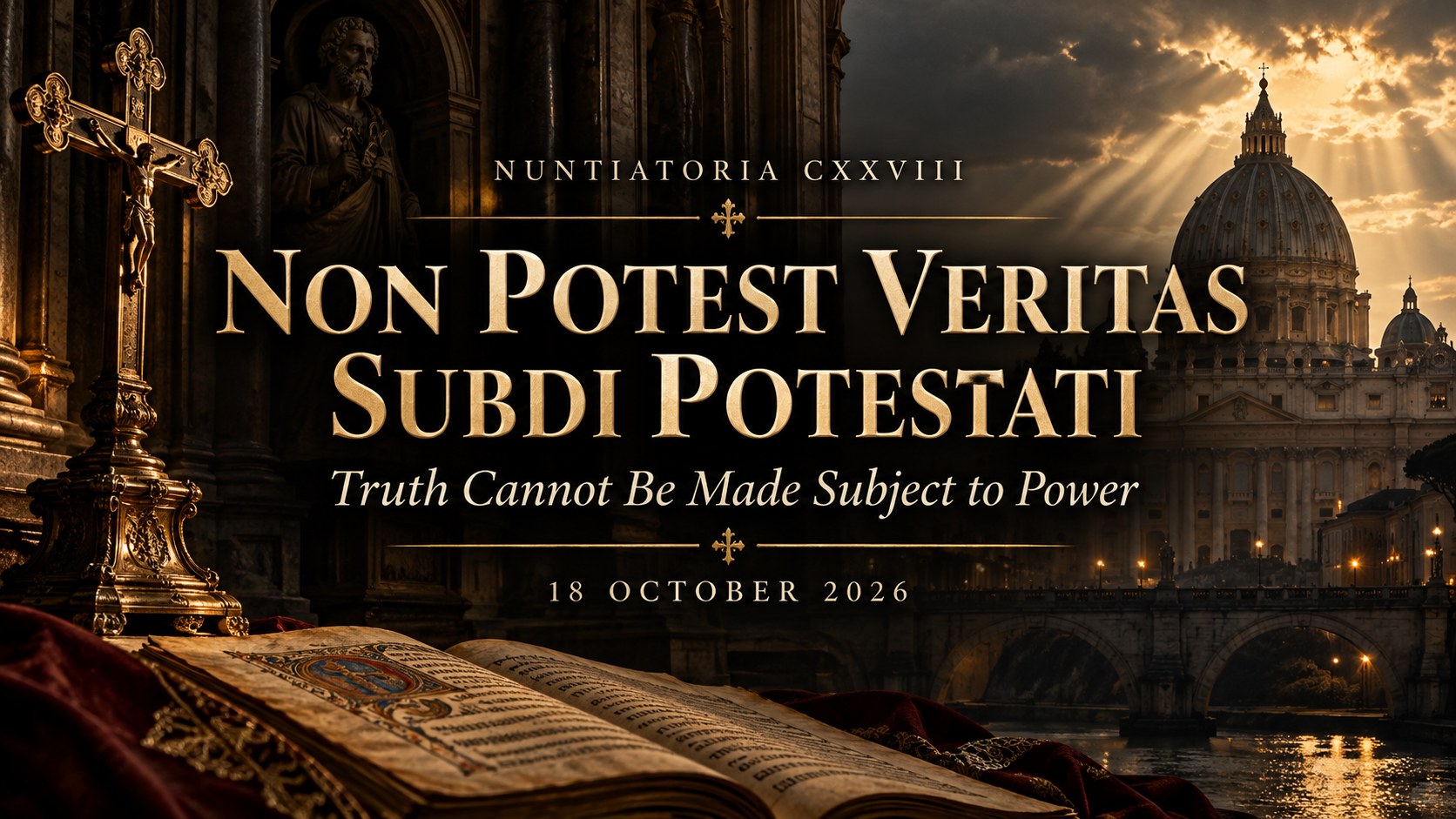
Editorial: Truth Cannot Be Made Subject to Power
Authority does not determine what is true. It receives obligations from the truth, and its legitimacy depends upon fulfilling them. From the exercise of papal and episcopal authority to the conduct of governments, public institutions and those entrusted with the protection of the vulnerable, this edition examines the consequences of forgetting that distinction. Against the growing temptation to make truth subordinate to institutional power stands an enduring Catholic principle: authority exists to serve what is right, not to manufacture it.
EDITORIAL
Power possesses an extraordinary capacity to persuade itself that whatever it can enforce must consequently be right. The temptation is neither new nor confined to tyrannies. It flourishes wherever an office becomes more important than its purpose, where the preservation of institutional credibility displaces accountability, and where obedience is demanded without sufficient regard for the justice of what is commanded. It is especially dangerous when those exercising authority convince themselves that questioning their decisions necessarily constitutes an assault upon the institutions they represent.
Non potest veritas subdi potestati. Truth cannot be made subject to power.
This is the governing proposition of Nuntiatoria CXXVIII. It is not an argument against authority, still less an invitation to anarchic individualism. Catholic theology has always recognised authority as necessary to human society and to the visible constitution of the Church. But authority is neither self-originating nor morally self-sufficient. Its possession does not confer infallibility upon every judgment, sanctity upon every policy, or justice upon every exercise of jurisdiction. There are things that no office can make true, no majority can make good, and no administrative decree can make morally obligatory merely by commanding them.
The distinction is particularly urgent within the Church, where supernatural authority, precisely because of its sacred character, can be misunderstood as admitting no meaningful limits. Yet the Catholic understanding of ecclesiastical office is the opposite of arbitrary personal sovereignty. The Pope is the supreme earthly guardian of a deposit of faith that he did not invent. The bishops are successors of the Apostles, not founders of a new religion. Their authority is real, divinely instituted and deserving of reverence; but its dignity arises from the sacred trust entrusted to them, not from any supposed power to reconstruct that trust according to contemporary ecclesiastical preferences.
Several articles in this edition expose the growing tension between that understanding and the exercise of ecclesiastical authority in the present crisis. Cardinal Arthur Roche’s suggestion that traditional Catholics are moving away from the centre of Catholicism invites a question more fundamental than the merits of any particular liturgical restriction. By what criterion is that centre to be identified? If the Church’s inherited Roman liturgy, sanctified by centuries of uninterrupted use and formative in the lives of innumerable saints, can now be treated as an impediment to ecclesial unity, something has plainly gone wrong with the argument. The problem is not the existence of legitimate disciplinary authority. It is the attempt to make contemporary disciplinary preferences the measure of Catholic fidelity.
The treatment of Archbishop Salvatore Cordileone, the theological assumptions advanced by Professor Jacob Phillips, and the broader controversies concerning the reception of the Second Vatican Council all return to this central problem. Development cannot be established simply by invoking the authority of those who announce it. Continuity must be demonstrated, not presumed. The Church’s living Magisterium possesses the authority to teach and to clarify; it does not possess the authority to transform contradiction into continuity by institutional declaration. What was received as sacred cannot become intrinsically suspect merely because subsequent administrators prefer a different expression of ecclesiastical life.
The continuing dispute surrounding the Society of Saint Pius X brings these questions into particularly sharp relief. Episcopal consecrations without pontifical mandate constitute a grave canonical matter; the Society’s invocation of necessity does not automatically settle the case in its favour. But neither does the mere announcement of penalties remove the obligation to examine their legal and moral foundations. The nature of the act, the relevant canonical provisions, the circumstances alleged in justification, the distinction between episcopal orders and jurisdiction, and the requirements of due process must all be considered. Justice does not become unnecessary because ecclesiastical authority is involved. Indeed, the sacred character of that authority makes the obligation to administer justice more exacting.
It would be a profound mistake to conclude that criticism of an ecclesiastical decision necessarily entails rejection of the Church’s constitution. Catholics can recognise the Roman Pontiff, profess the dogmas concerning his primacy and infallibility, and acknowledge the obligation of legitimate obedience without believing that every exercise of papal or curial power must consequently be prudent, just or beyond criticism. The alternative is not Catholic orthodoxy but a species of ecclesiastical positivism in which legality, truth and righteousness are treated as interchangeable whenever a sufficiently elevated authority speaks.
The same confusion appears, in a different form, in contemporary controversies over Holy Communion. The dispute generated by Fr James Martin’s remarks and the continuing interpretation of Amoris Laetitia illustrate the consequences of allowing pastoral sentiment to displace theological distinctions. Mercy cannot alter the objective meaning of marriage, nor can a desire to avoid personal offence abolish the Church’s responsibility to safeguard the Blessed Sacrament. Yet the converse is equally important: ecclesiastical discipline cannot legitimately proceed by assuming knowledge of another person’s private culpability. The distinction between an individual’s interior state and the public significance of an objectively irregular situation is indispensable.
This is not a contest between kindness and severity. It concerns the relationship between truth, charity and sacramental order. A priest does not serve a penitent by declaring sin harmless; neither does he serve justice by making accusations unsupported by the facts. Public scandal, personal responsibility, repentance and admission to Holy Communion involve related but distinct questions. When those distinctions are discarded, pastoral practice becomes either arbitrary indulgence or arbitrary exclusion. Neither serves souls. Neither honours the authority entrusted to the Church.
Even the apparently modest question of ecclesiastical titles belongs within this examination. The historical character of the title Monsignor, its relationship to the Papal Household, and its distinction from other legitimate ecclesiastical honours remind us that dignity and jurisdiction are not interchangeable. An ecclesiastical style acquires meaning from its proper historical and institutional context. It cannot simply be appropriated because someone possesses the ceremonial means or personal preference to employ it. The point may seem minor beside controversies over doctrine and the sacraments, but institutional integrity often depends upon maintaining precisely those distinctions that vanity finds inconvenient.
Beyond the Church, the same principle confronts the modern administrative state. The NHS’s revision of policies governing single-sex accommodation, in consequence of judicial clarification, raises questions that cannot be answered merely by announcing that the relevant guidance has changed. How did public institutions come to adopt interpretations that exposed the dignity, privacy and legitimate expectations of women to such uncertainty? Why was the recognition of biological sex treated in some quarters as though it were an expression of ideological hostility rather than an ordinary material reality? And what assurance exists that administrative cultures resistant to the implications of the law will actually implement its requirements?
The importance of the issue extends far beyond hospital accommodation. A public authority may establish procedures, adopt terminology and enforce compliance, but it cannot confer reality upon a proposition by making that proposition administratively compulsory. Where ideology enters institutional governance, ordinary persons are too often required to accommodate official abstractions at the expense of their own experience, rights and legitimate concerns. The remedy must involve more than revised documentation. It requires the restoration of the principle that institutions are answerable to facts, law and the people they exist to serve.
Questions surrounding the handling of information about puberty blockers expose an even more troubling possibility: that evidence itself may become vulnerable to institutional convenience. When the welfare of children is at stake, the obligation to disclose material information, acknowledge uncertainty and subject professional decisions to independent scrutiny is paramount. Claims concerning suppressed or mishandled information must, of course, be established by evidence rather than indignation. But the public is entitled to know whether relevant findings were communicated accurately, whether dissenting professional judgments received proper consideration, and whether institutional reputations influenced decisions that should have been governed solely by safeguarding and clinical responsibility.
Related safeguarding controversies reveal how easily the language of protection can become a substitute for protection itself. Institutions become adept at describing procedures, announcing reviews and reassuring the public that appropriate arrangements exist. None of these activities necessarily establishes that vulnerable people were protected. The decisive questions remain stubbornly practical: what was known, when was it known, who possessed responsibility, what action followed, and what consequences ensued when that responsibility was neglected? Accountability begins where institutional self-description ends.
International affairs supply further examples of the same disorder. The question of Palestinian democracy cannot be resolved by the rhetoric of recognition alone. The legitimate aspirations and rights of a people do not eliminate the necessity of accountable political authority. Indeed, those aspirations are diminished when political leadership becomes effectively insulated from popular judgment. External diplomatic recognition may confer international standing; it cannot manufacture democratic consent where the institutions necessary to express that consent have failed or been suspended. To insist upon democratic accountability is not to deny Palestinian rights but to refuse the assumption that rulers may indefinitely claim to embody a people without periodically submitting themselves to that people’s judgment.
In Armenia, the confrontation between political power and the ancient Apostolic Church raises a different but related concern. Religious institutions are not exempt from the law, and ecclesiastical office does not establish immunity from legitimate investigation. Nevertheless, political leaders must not be permitted to convert state power into an instrument for subduing religious opposition. Allegations require evidence, prosecutions require lawful foundations, and the independence of religious institutions cannot be made conditional upon their willingness to endorse the government’s programme. Where these safeguards fail, legal process risks becoming indistinguishable from political coercion.
The debate concerning Islamist organisations and public definitions of hostility towards Muslims similarly demands resistance to convenient simplification. Genuine hatred, discrimination and intimidation directed against Muslims must be condemned. But the prohibition of hatred cannot be expanded into a prohibition of theological disagreement, historical examination or criticism of religious doctrines and political movements. There is a fundamental difference between attacking persons because of their religion and challenging the truth claims of that religion. A state that fails to maintain the distinction threatens the very religious liberty it claims to defend.
For Christians, this is not merely an abstract dispute about freedom of expression. The Church is commanded to proclaim the Gospel to all nations. That commission necessarily includes the assertion that Jesus Christ is Lord, that His revelation is true, and that all mankind is called to conversion. Such claims cannot be made subject to the approval of political authorities or interreligious sensitivities without falsifying the missionary mandate itself. Charity governs how the Christian speaks; it does not require him to surrender what he is commanded to proclaim.
It is therefore particularly fitting that this edition appears on the feast of St Luke the Evangelist. Luke’s vocation unites careful attention to reality with the proclamation of supernatural truth. His Gospel begins by expressing concern for an orderly account of the things accomplished and handed down. He does not present Christian faith as an emotional construction detached from history. His concern for testimony and certainty reflects a conviction indispensable to Catholic civilisation: truth is to be received, investigated, witnessed and proclaimed, not manufactured according to the requirements of those who wield influence.
The physician and the evangelist belong together. The physician who conceals a diagnosis to preserve his reputation betrays his patient. The evangelist who obscures the demands of the Gospel to preserve institutional popularity betrays his commission. Neither truth without charity nor charity without truth fulfils the Christian vocation. The first may become an instrument of cruelty; the second dissolves into sentimentality. St Luke teaches something altogether more demanding: mercy grounded in reality, conversion offered as grace, and salvation proclaimed as the work of the living God rather than the achievement of human policy.
The missionary obligation of the Church consequently supplies the proper conclusion to the controversies examined in these pages. Christianity cannot survive as the religious department of contemporary consensus. Its credibility does not depend upon its capacity to harmonise every inherited doctrine with the changing moral assumptions of public institutions. Nor does genuine ecclesial unity consist in suppressing legitimate questions until no dissent remains audible. Unity is grounded in a common profession of the truth; where that foundation is neglected, administrative uniformity provides only its imitation.
There is, of course, a corresponding obligation upon those who challenge authority. Truth is not the exclusive possession of critics. Opposition can become habitual, self-righteous and every bit as careless with evidence as the institutions it condemns. The duty to resist error never releases anyone from the obligation to distinguish fact from allegation, doctrine from opinion, prudential judgment from immutable principle, or legitimate criticism from unjust personal attack. Fidelity demands intellectual discipline precisely because the cause is too serious to be discredited by exaggeration.
This edition does not propose that authority should be weakened. It proposes that authority should be worthy of its name. The strongest authority is not that which silences every objection, but that which can give an honest account of its decisions. The strongest ecclesiastical government is not that which secures the widest possible compliance with current policy, but that which most faithfully guards the deposit entrusted to it. The strongest civil institutions are not those most adept at protecting their reputations, but those most willing to correct themselves when confronted by reality.
Power will always be tempted to make itself the measure of truth. The Christian answer is to remind power that it, too, stands beneath judgment. The Pope, the bishop, the priest, the magistrate, the minister and the administrator possess different offices and different responsibilities, but none possesses the authority to overturn what is true merely because acknowledging it has become inconvenient.
There is no contradiction between reverence for legitimate authority and the duty to hold it accountable. Indeed, the one requires the other. Offices are honoured not by excusing every failure of their occupants, but by insisting that those entrusted with them remain faithful to their proper ends.
That conviction gives Nuntiatoria CXXVIII its unity. Behind the controversies over liturgy, doctrine, government, safeguarding, religious liberty and political legitimacy lies the same enduring question: will those entrusted with authority submit their actions to the truth, or expect the truth to submit to them?
The answer cannot be postponed indefinitely. For wherever truth is made subordinate to power, justice becomes conditional, charity becomes sentimental, and authority itself begins to lose the moral foundation upon which its legitimacy depends.
NON POTEST VERITAS SUBDI POTESTATI.
Truth cannot be made subject to power.
IN THIS EDITION
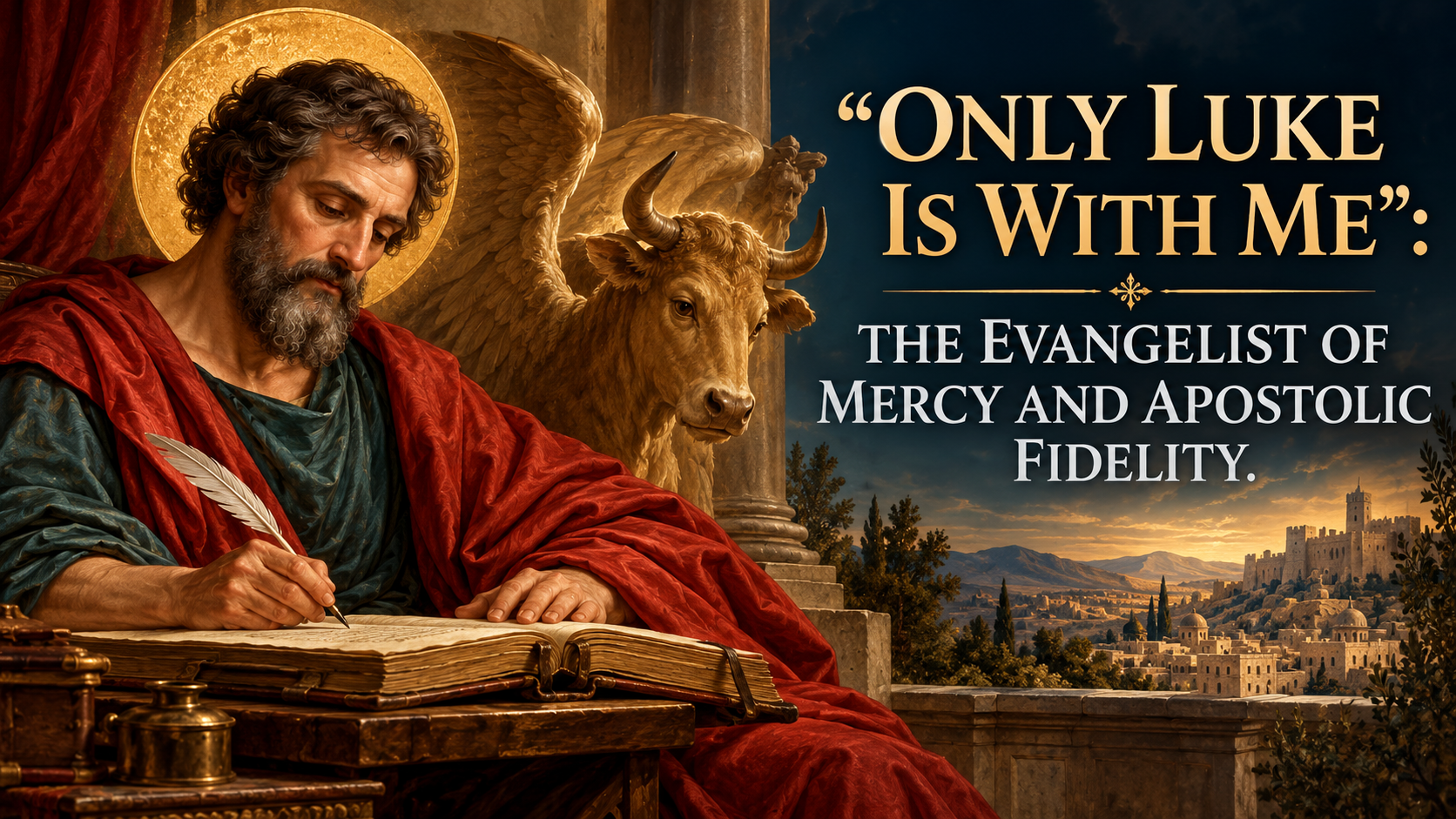
- “ONLY LUKE IS WITH ME”: THE EVANGELIST OF MERCY AND APOSTOLIC FIDELITY
 The feast of St Luke, celebrated on 18 October, honours the beloved physician and Evangelist whose writings convey crucial Christian truths. He emphasises the vital link between divine mercy, repentance, and sacrifice. As St Paul’s companion, Luke’s narrative preserves the essence of the Gospel, reminding the Church to uphold and transmit revelation faithfully.
 - ORDO w/c 18.10.26
 The liturgical calendar from 18 to 25 October 2026 includes the feast of St Luke the Evangelist, commemorating essential themes of forgiveness and evangelisation. Subsequent days honour St Peter of Alcantara, St John Cantius, St Ursula and St Raphael, culminating in the celebration of Christ the King, affirming His universal sovereignty over all creation.
 - THE DEBTOR AT HIS BROTHER’S THROAT: The Twenty-First Sunday after Pentecost
 The Twenty-First Sunday after Pentecost highlights the danger of receiving divine mercy and failing to extend the same to others, exemplified by the parable of the unforgiving servant. The Church emphasises the need for genuine charity, justice without vengeance, and the importance of faith in guiding interpersonal conduct amidst spiritual struggle.
 - THE MARRIAGE REGISTER IS PUBLIC; THE CONSCIENCE IS NOT
 Fr James Martin highlights the mistreatment of homosexual Catholics in receiving Holy Communion but overlooks key distinctions in Church doctrine. While homosexual inclination isn’t sinful, publicly recognising a same-sex marriage can lead to scandal. The Church must balance compassion with doctrinal integrity without compromising the truth of sacramental discipline.
 - SINGLE-SEX IN NAME ONLY: The NHS and Its Eighteen-Month Reckoning
 The NHS has revised its guidance on single-sex hospital accommodation, aligning it with the Supreme Court’s 2025 ruling that biological sex determines patient admission. This change aims to safeguard women’s rights but raises questions about patient safety and institutional accountability. It highlights the need for precise legal clarity in healthcare policies.
 - THE BISHOPS WHO DEFIED ROME — and Still Appeal to It
 The Society of Saint Pius X (SSPX) continues its challenge against a Roman decree of excommunication following recent episcopal consecrations. This ongoing situation highlights a complex ecclesiological paradox where the Society professes loyalty to papal authority while resisting it. Resolution of this crisis, rooted in significant doctrinal disputes, must ultimately come from Rome.
 - HELP FR PAOLO BRING HIS FATHER HOME
 Fr Paolo Miguel Cobangbang announced that his father, Nathaniel, has recovered enough to leave hospital, but faces a daunting bill of ₱1,550,306.01. Asking for help, Fr Paolo, who lives a life of service, has turned to the community for donations to cover the hospital expenses and shared his faith in divine providence.
 - The Roman Provenance of Monsignor
 The title “Monsignor” is often misunderstood as an ecclesiastical rank or honour, whereas it is merely a style of address linked to specific ecclesiastical offices. The distinction between substantive dignity and its verbal expression is crucial. Various regulations historically defined these roles, ensuring accurate representation of ecclesiastical authority and honour.
 - THE FAITHFUL WHO DO NOT RECEIVE
 Bishop Erik Varden and Archbishop Jerome Lloyd address the crisis of Eucharistic reverence, urging Catholics to view Holy Communion as a divine gift rather than a right. Their reflections highlight the need for proper preparation and spiritual disposition for receiving the Eucharist, emphasising worship over mere participation. This understanding safeguards the sacrament’s sanctity.
 - THE CHASUBLE RETURNED. THE ARTICLES DID NOT CHANGE.
 The English Reformation significantly reformed ecclesiastical practices, notably replacing the Eucharistic celebration with Morning Prayer as a primary Sunday service. In 1964, the Church of England reintroduced traditional vestments without altering Reformation doctrine. John Henry Newman’s later recognition that Article XXXI denounced Catholic Mass highlights the enduring theological divide. Restoration alone doesn’t re-establish sacramental continuity.
 - THE GOSPEL IS NOT HOSTILITY
 The European Parliament voted to scrutinise Muslim Brotherhood networks, highlighting concerns about their influence on public institutions. The situation raises significant issues for Catholics regarding the freedom to proclaim Christian doctrine without compromise. Protecting Muslims from hatred should not shield Islam from criticism, nor restrict legitimate religious expression.
 - The SNP’s Cancelled Debate: Women, Coercion and the Politics of Abortion
 A United Nations expert advocates for the criminalisation of coerced abortion, highlighting gaps in Scotland’s laws. However, the SNP has cancelled a related conference discussion due to pro-life objections, raising concerns about freedom of expression and political intolerance. This controversy underscores the need for rigorous debate on reproductive coercion and women’s protections.
 - LEO XIV’s RECOVERY and the True Measure of Papal Strength
 Pope Leo XIV is recovering from lung cancer surgery and has resumed limited duties. However, questions about his long-term prognosis persist. The analysis highlights the danger of equating papal effectiveness with public visibility, emphasising the office’s role in preserving the Faith rather than demonstrating personal capabilities. Continued prayer and understanding of ecclesiastical authority are essential.
 - TWENTY YOUNG PATIENTS, ONE RESTRICTED AUDIT — AND FIVE YEARS OF UNANSWERED QUESTIONS
 The Redvers tribunal revealed serious safeguarding failures at WellBN, linked to a 2021 NHS audit on puberty-blocker prescriptions for children. Despite concerns raised by Dr Sarah Redvers and others, NHS Sussex’s response raises questions about the accountability and safeguarding practices within the healthcare system, highlighting possible delays and a lack of action on credible warnings.



Leave a Reply