
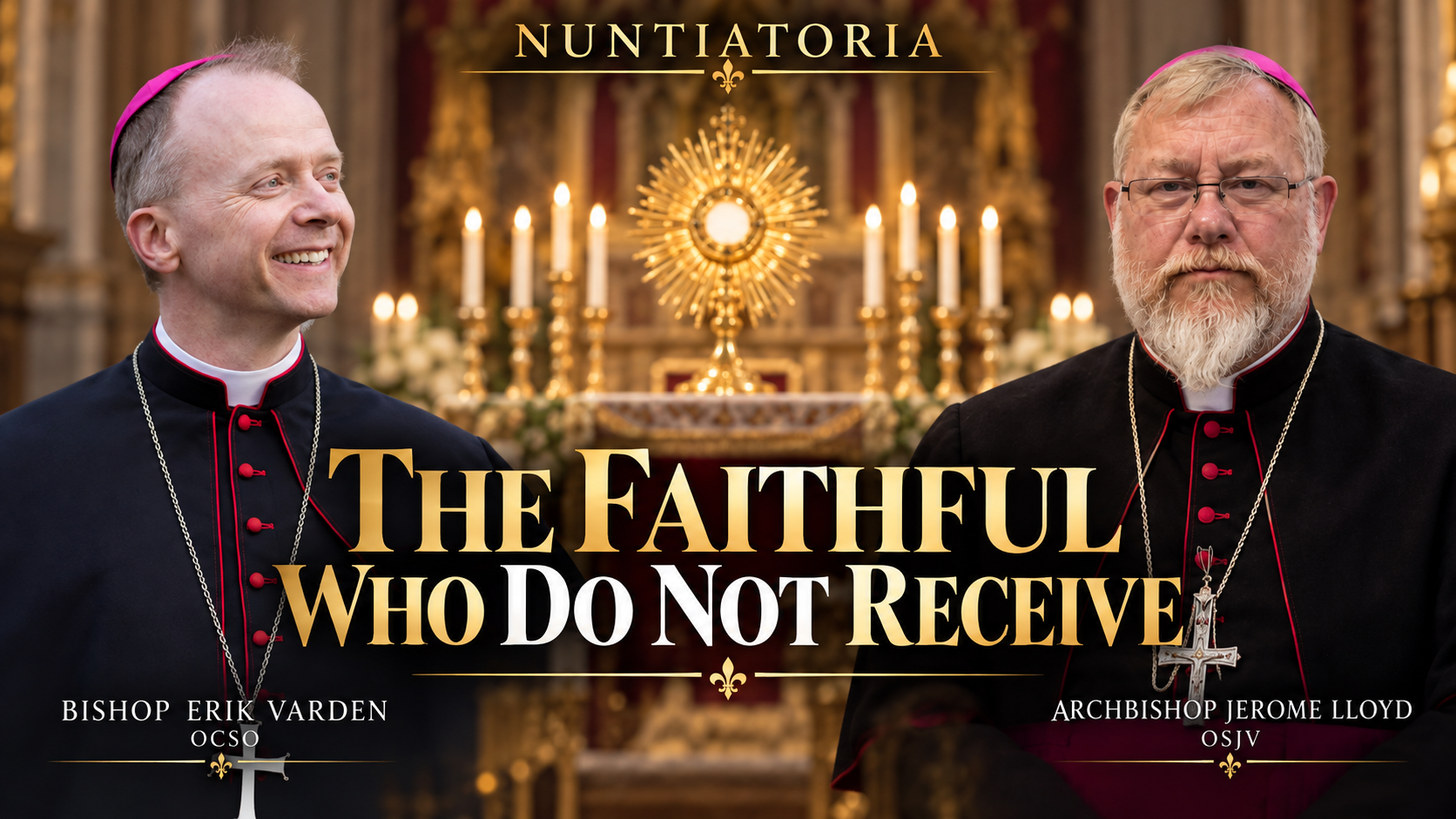
Bishop Erik Varden, Archbishop Jerome Lloyd, the crisis of Eucharistic reverence, and the forgotten purpose of attending Holy Mass
The controversy surrounding Amoris Laetitia exposes a crisis deeper than disputed sacramental discipline. Bishop Erik Varden’s reflections on Catholics who faithfully refrain from Holy Communion, together with Archbishop Jerome Lloyd’s critique of sacramental entitlement and habitual reception without examination of conscience, challenge a culture which increasingly mistakes Communion for an expression of social inclusion. Both interventions call for renewed Eucharistic reverence, while Archbishop Lloyd makes the wider case for recovering the Holy Mass principally as the sacrifice offered in worship and adoration of Almighty God, and the sacraments as undeserved gifts of divine mercy rather than personal achievements or entitlements.
The most serious consequence of the controversy surrounding Amoris Laetitia may not be the uncertainty it has introduced into sacramental discipline, but what that uncertainty reveals about the contemporary Catholic understanding of the Eucharist. Holy Communion has increasingly come to be treated as an expected feature of attendance at Mass, a sign of acceptance by the assembled community, and something from which no one should feel excluded. The question of whether a person is properly disposed to receive is too readily displaced by the assumption that reception itself constitutes an essential expression of belonging. Sacramental restraint consequently appears punitive, examination of conscience becomes an optional preliminary, and pastoral mercy is measured by the willingness to permit admission. Yet the Eucharist is not an ecclesiastical entitlement, a reward for religious participation or a ceremonial acknowledgement of personal dignity. It is the true Body and Blood of Jesus Christ, received as an extraordinary and undeserved gift of divine mercy. If that elementary truth is no longer understood, the Church faces a problem considerably more serious than disagreement about the application of particular canonical provisions. She faces the progressive loss of the theological understanding which makes Eucharistic discipline intelligible in the first place.
It is precisely this deeper difficulty which gives particular significance to the reflections published by Bishop Erik Varden of Trondheim following the Vatican gathering marking the tenth anniversary of Amoris Laetitia. Writing on 15 October, Varden described faithful Catholics who continue to attend Mass, participate in the Church’s life and refrain from Holy Communion because they recognise the demands of the sacrament. They are not ecclesiastical outcasts, nor do they regard their continued participation as meaningless because sacramental reception is presently impeded. They remain members of the Christian community, sustained by prayer, friendship and hope. Varden describes their example as a witness to the reality of the Eucharist and to the possibility that patient fidelity may eventually lead to sacramental reconciliation. His intervention is important because it challenges the assumption that authentic pastoral accompaniment must necessarily culminate in permission to receive. Sometimes the willingness to refrain reveals a more profound reverence for the sacrament than an unquestioning expectation of admission.¹
The immediate context is revealing. Monsignor Philippe Bordeyne, a member of the committee preparing the Vatican gathering’s final synthesis, confirmed to AdVaticanum on 15 October that the document will address Eucharistic Communion for divorced and civilly remarried Catholics, while insisting that the matter was “not the centre” of the discussions. Cardinal Gérald Cyprien Lacroix had similarly complained that debate surrounding Chapter Eight had overshadowed the wider concerns of Amoris Laetitia for a decade.² ³ Their point deserves acknowledgement. The Church’s responsibilities towards marriage and family life encompass far more than the sacramental circumstances of divorced and remarried Catholics. Yet a question does not become less important because it occupies fewer paragraphs in a Vatican report. The relationship between matrimonial indissolubility, personal culpability and Eucharistic communion concerns the coherence of Catholic sacramental theology itself. It cannot be relegated to the margins merely because other pastoral difficulties also deserve attention.
Varden’s contribution is especially valuable because he approaches these matters from the perspective of the Christian vocation rather than from the disputed limits of ecclesiastical permission. His essay, Laetitiae Amor, offers his personal reflections, not the conclusions of the Roman assembly, and should not be mistaken for a formal rejection of the interpretation authorised under Pope Francis. Its governing concern is the recovery of a Christian understanding of human nature, permanent commitment and conversion. Varden describes contemporary society as suffering a profound loss of confidence in the existence of an intelligible human nature and a transcendent purpose for human life. Relationships are increasingly treated as arrangements sustained by mutual satisfaction, while permanent obligations appear unreasonable because freedom is understood principally as the preservation of personal choice. Against this impoverished understanding, he presents marriage and monastic profession as distinct but related vocations in which fidelity, sacrifice and self-denial become instruments of spiritual growth. The permanence of Christian marriage is not an arbitrary restriction imposed upon human affection, but a participation in the irrevocable love of Christ for His Church.
This understanding is particularly important when marriages encounter serious difficulties. The Church must never minimise abandonment, cruelty, violence or the genuine suffering of those whose matrimonial lives have broken down. Legitimate separation may be necessary even where the matrimonial bond remains. Neither may she reduce every difficulty to an alleged lack of personal perseverance. Nevertheless, Christian marriage cannot be explained adequately without reference to the Cross. Its obligations are not conditional upon the uninterrupted experience of happiness, and its fidelity is sustained by grace rather than human determination alone. Varden’s monastic experience brings this truth into focus: the demands of a lifelong vocation may become occasions for conversion precisely because they require the surrender of self-will. The Church’s pastoral task is to help people understand and live those demands, not simply to devise accommodations whenever they become difficult.
Within that framework, Varden’s observations concerning Catholics in irregular matrimonial circumstances acquire their particular force. Such persons, he argues, should be received with genuine Christian friendship, enabled to contribute to their communities and supported in their spiritual lives, without pretending that their circumstances are doctrinally regular. Their situation is neither the totality of their identity nor something the Church must conceal in order to demonstrate compassion. Varden recalls Catholics who approach for a blessing rather than receive Holy Communion, while continuing to entrust themselves to the mercy of God. Their perseverance challenges the widespread assumption that sacramental abstention necessarily signifies exclusion from ecclesial life. It also reminds the wider congregation that the Eucharist possesses an objective holiness which cannot be reduced to an individual’s desire to receive. Such fidelity is not evidence of failed accompaniment; it may itself be one of accompaniment’s most spiritually fruitful expressions.
Archbishop Jerome Lloyd, Titular Archbishop of Selsey, identifies a wider pastoral failure underlying this contemporary misunderstanding: the gradual transformation of the sacraments, in popular Catholic consciousness, from undeserved gifts of divine grace into perceived personal accomplishments or entitlements.⁴ The celebrations surrounding First Holy Communion, Confirmation and even Sacred Ordination can reinforce this confusion. The emphasis too often falls upon what the individual has supposedly achieved: the child who has completed preparation, the young person who has reached another religious milestone, or the ordinand whose years of formation culminate in an impressive public ceremony. Families naturally rejoice on these occasions, and rightly so. Nevertheless, the sacrament is not the reward for successful preparation. It is a supernatural gift bestowed through the generosity of God, a grace which nobody could earn through personal achievement. Even the newly ordained priest has not received an ecclesiastical promotion which his accomplishments have made him intrinsically deserving of. He has been entrusted with a sacred office and responsibilities whose gravity should inspire humility rather than self-congratulation.
This distinction is not an objection to joyful celebration. It is an objection to allowing the celebration to obscure the supernatural event being celebrated. First Holy Communion can become a religious coming-of-age ceremony, Confirmation a graduation from catechetical instruction, and Ordination the culmination of an ecclesiastical career. The external festivities may be elaborate while the essential significance of the sacrament remains inadequately understood. Such misconceptions reverse the relationship between grace and human effort. Preparation and perseverance are necessary, but they do not purchase the gifts of God. The sacraments are instituted by Christ for the sanctification of His people; their proper reception imposes obligations upon the recipient rather than establishing a claim to personal recognition. The first response to sacramental grace should therefore be gratitude, humility and a renewed determination to live according to the gift received.
Nowhere has this confusion become more consequential than in the ordinary reception of Holy Communion. As Archbishop Lloyd observes, the Eucharist is increasingly perceived primarily as a sign of fellowship with the gathered congregation rather than as the reception of Christ Himself and the sacramental expression of communion with Him in the faith of His Church. Certainly, Holy Communion deepens ecclesial unity; that is intrinsic to its nature. But the communion of the faithful derives its supernatural significance from communion with Christ, not the reverse. Once that order is obscured, sacramental reception becomes a gesture of social inclusion. People may then assume that everyone present should receive, regardless of spiritual disposition, Catholic faith or the conditions established by the Church. The limited canonical provisions concerning sacramental sharing with other baptised Christians do not establish an unrestricted principle of admission.⁵ Ecclesial hospitality cannot confer a right to receive the Eucharist independently of what the sacrament signifies.
Archbishop Lloyd goes further in his pastoral judgement. He considers that far too many Catholics receive Holy Communion habitually when a serious examination of conscience ought to lead them to refrain. This is not a claim to know the interior condition of individual communicants, which remains known to God, nor an objection to frequent Communion by those properly disposed. It is a criticism of a culture in which reception has become so automatic that abstention appears extraordinary. In some congregations, the expectation of joining the Communion procession can seem stronger than the obligation to consider whether one is spiritually prepared. The visible number of communicants is no reliable measure of a parish’s holiness. A congregation in which virtually everyone receives may be a community of admirable Eucharistic devotion; equally, it may be one in which the necessity of preparation, repentance and confession has become insufficiently understood. The outward appearance alone cannot establish which is true. That uncertainty is precisely why serious catechesis and the formation of conscience are indispensable.
St Paul’s warning to the Corinthians leaves no doubt about the gravity of the matter. The Apostle commands the faithful to examine themselves before receiving and warns against approaching the Eucharist without discerning the Lord’s Body. In the Douay-Rheims translation, his admonition is unmistakable: “For he that eateth and drinketh unworthily, eateth and drinketh judgment to himself” (1 Corinthians 11:29).⁶ The text does not teach that every instance of unworthy reception automatically results in final damnation. Indeed, the Apostle subsequently distinguishes divine chastisement from condemnation with the world. Nevertheless, his warning cannot be reduced to a harmless figure of speech. Sacrilegious Communion is a grave spiritual matter, and the deliberate reception of the Blessed Sacrament while knowingly persisting in mortal sin endangers the soul. A Church which ceases to teach that truth in order to spare embarrassment is not exercising mercy. She is withholding knowledge which the faithful require for their salvation.
The remedy is the recovery of conscientious preparation, not the cultivation of anxiety for its own sake. Catholics should be encouraged to examine their lives honestly in the light of the commandments, to recognise grave sin where it exists, and to seek sacramental confession before receiving when conscious of mortal sin, according to the Church’s discipline. Where a genuine and well-founded doubt exists concerning one’s state of grace, prudent spiritual counsel and, where appropriate, abstention pending confession are preferable to reception undertaken merely for the sake of appearances. This must not become an encouragement to scrupulosity. Passing anxiety is not proof of mortal sin, and those troubled by persistent religious scruples should follow sound spiritual direction rather than repeatedly question settled judgements. The objective is a properly formed conscience, not an excessively fearful one. But the willingness to refrain when conscience genuinely requires it should be recognised as an honourable expression of reverence, not an embarrassment to be concealed.
The words Domine, non sum dignus — “Lord, I am not worthy” — should recover their practical meaning. They do not imply that the faithful must attain personal perfection before receiving Holy Communion, but that nobody possesses an inherent claim upon the Body and Blood of the Redeemer. The distinction between worthiness as personal merit and worthy reception through proper disposition is essential. Christ gives Himself precisely because mankind needs His grace; yet that generosity does not abolish the responsibility to approach Him according to His commandments. The purpose of confession is not to reward the morally successful, but to reconcile sinners with God. The purpose of Eucharistic discipline is not to identify the spiritually superior, but to safeguard the holiness of the sacrament and protect souls from receiving it sacrilegiously. The Church’s obligation to encourage frequent Communion must always be exercised within that understanding.
Here an important historical clarification is necessary. St Pius X strongly encouraged frequent and even daily Communion. His decree Sacra Tridentina Synodus of 1905 rejected the excessive rigorism which restricted sacramental reception to those thought to have attained exceptional holiness. It taught that Catholics in the state of grace who approached with a right and devout intention should not be prevented from receiving frequently. Yet the same decree warned against receiving from habit, vainglory or human respect, and insisted upon appropriate preparation and thanksgiving.⁷ The distinction is decisive. The problem is not frequent Communion, but unreflective Communion. Nor is infrequent reception necessarily evidence of greater sanctity. Worthy reception is to be encouraged; sacrilegious reception is to be avoided; conscientious abstention is to be respected. The Church’s pastoral responsibility is to teach the faithful the difference.
This raises a further question whose importance extends well beyond the immediate controversy surrounding Amoris Laetitia: what do Catholics understand themselves to be doing when they attend Holy Mass? The answer is increasingly framed in terms of their own participation, their reception of Communion and their experience of belonging to the congregation. Yet the Mass is first and foremost the Holy Sacrifice of Christ, the sacramental making-present of His one offering upon Calvary, accomplished in an unbloody manner and offered to the Eternal Father. Its essential orientation is towards Almighty God, to whom the Church renders adoration, thanksgiving, propitiation and supplication through the sacrifice of His Son. The faithful participate by uniting their prayers, intentions and lives with that offering. Holy Communion is an incomparable participation in the fruits of the sacrifice, but reception by every person present does not constitute the Mass as an act of divine worship.
Pope Pius XII addressed precisely this distinction in Mediator Dei. He affirmed that the integrity of the Eucharistic Sacrifice requires the sacramental Communion of the celebrating priest, but not that of every member of the congregation. He explicitly rejected the argument that universal Communion should be regarded as the culminating point of the entire celebration on the grounds that the Mass is essentially a fraternal meal. At the same time, he strongly encouraged the faithful to receive frequently and fervently, recognising the abundant spiritual fruits of worthy sacramental reception.⁸ The distinction is therefore neither an argument against frequent Communion nor a preference for passive attendance at Mass. It is a defence of the objective sacrificial nature of the liturgy. The Mass remains the Church’s supreme act of worship whether many, few or none of the congregation receive Holy Communion. Its worth derives from Christ, the principal Priest and Victim, not from the number of communicants.
The Council of Trent had already taught this with equal clarity. It encouraged the faithful to communicate not merely spiritually but sacramentally, so that they might receive more abundant fruit from the sacrifice. Nevertheless, it defended the legitimacy of Masses at which the priest alone communicates sacramentally, rejecting the suggestion that such celebrations were incomplete or contrary to the nature of the Eucharistic Sacrifice.⁹ That teaching deserves renewed attention because it directly challenges the assumption that attendance at Mass is spiritually unsuccessful unless it culminates in personal Communion. The Catholic who is unable to receive has nevertheless been present at the unbloody representation of Calvary. That person may unite himself to the sacrifice through adoration, contrition, thanksgiving and prayer, and may seek spiritual communion with Christ in a manner appropriate to his disposition. The absence of sacramental reception does not render the act of worship meaningless.
Archbishop Lloyd therefore argues that Catholic pastoral practice urgently needs to recover a culture in which worship and adoration of Almighty God are understood as the fundamental purpose of attending Mass. The question should not first be how many people received Communion, but whether the faithful understood the sacrifice being offered, united themselves reverently to it, and approached the altar with the dispositions required by so great a mystery. This calls for more than an occasional sermon on Eucharistic reverence. It requires sustained catechesis on the Real Presence, the sacrificial nature of the Mass, mortal sin, confession and the purpose of sacramental grace. The Sacrament of Penance must be readily available and its necessity properly explained. Eucharistic adoration, thanksgiving after Mass and the practice of examination of conscience should again become familiar features of Catholic life. Such renewal would not diminish Holy Communion, but restore the spiritual context within which its reception becomes properly intelligible.
The teaching of St John Paul II provides an important foundation for this recovery. In Ecclesia de Eucharistia, he insisted that sacramental Communion presupposes communion in the life of grace as well as the visible bonds of ecclesial unity. He reaffirmed the necessity of sacramental confession when conscious of mortal sin and distinguished the responsibility of the communicant before God from the Church’s obligation to safeguard public sacramental order.¹⁰ The Eucharist both signifies and deepens ecclesial communion, but it cannot be reduced to the expression of a fellowship already presumed to exist independently of Catholic faith and discipline. Reception must correspond to the mystery received.
This distinction also illuminates the unresolved theological questions raised by Amoris Laetitia. Catholic moral theology has always recognised that subjective culpability may be diminished by ignorance, fear, habit or circumstances affecting knowledge and freedom. A person may be living in objectively irregular circumstances without bearing the same degree of personal guilt as another in outwardly similar circumstances. Nevertheless, subjective culpability and public sacramental discipline are related but distinct questions. The Congregation for the Doctrine of the Faith’s 1994 letter concerning divorced and remarried Catholics maintained that ecclesial discipline could not be reduced to an individual’s private judgement concerning matrimonial status. The Pontifical Council for Legislative Texts subsequently clarified in 2000 that canon 915, concerning the minister’s responsibility regarding admission to Holy Communion, operates according to externally ascertainable circumstances and does not require knowledge of the communicant’s subjective mortal guilt. Canon 916, by contrast, concerns the communicant’s personal responsibility before God.¹¹
St John Paul II applied that distinction in Familiaris Consortio §84. He instructed pastors to support divorced and civilly remarried Catholics in the life of the Church, encouraging their participation in prayer, charity, penance and the education of their children. At the same time, he reaffirmed the discipline concerning Eucharistic admission where a subsequent conjugal union contradicted a continuing valid matrimonial bond. His justification was explicitly theological: the objective contradiction between that union and the indissoluble relationship of Christ with His Church, which the Eucharist signifies, and the danger of misleading the faithful concerning marriage. Benedict XVI reaffirmed the same understanding in Sacramentum Caritatis §29.¹² This discipline did not imply that every divorced Catholic was barred from Communion, nor that every person in an irregular situation was equally culpable. It recognised legitimate distinctions concerning matrimonial nullity, continence, responsibility towards children and the avoidance of scandal. Pastoral discernment was therefore not invented in 2016; it already belonged to the careful application of Catholic doctrine.
The interpretation of Amoris Laetitia authorised under Pope Francis brought the relationship between these principles into dispute. Chapter Eight recognised diminished subjective responsibility in certain objectively irregular circumstances, while footnote 351 envisaged sacramental assistance in particular cases. The Buenos Aires bishops subsequently issued guidelines contemplating access to Reconciliation and the Eucharist following pastoral discernment even where continence had not been maintained. Pope Francis expressly endorsed their interpretation, and the documents were published in the Acta Apostolicae Sedis as authentic magisterium. The Dicastery for the Doctrine of the Faith confirmed that interpretation in September 2023, while maintaining the proposal of continence and insisting that sacramental admission was neither automatic nor an unrestricted entitlement.¹³
These qualifications must be acknowledged. The authorised interpretation does not simply abolish sacramental discipline, nor does it permit every divorced and civilly remarried Catholic to receive Holy Communion without discernment. Nevertheless, the difficulty remains: how can a practice permitting admission in certain circumstances be reconciled with an earlier discipline whose stated justification included considerations independent of subjective culpability? If a valid matrimonial bond remains indissoluble, if a subsequent conjugal relationship objectively contradicts its exclusivity, and if the Eucharist publicly signifies Christ’s irrevocable union with His Church, how is the sacramental sign preserved without ambiguity? The question is not whether ecclesiastical authority has authorised an interpretation, but whether its doctrinal continuity has been adequately demonstrated. Authority establishes who may authorise a practice; it does not remove the responsibility to explain how that practice coheres with the theological principles previously invoked.
Bishop Varden does not purport to settle these disputed questions. His contribution is to challenge the assumption that their pastoral resolution must necessarily be measured by the extension of sacramental admission. He describes people who remain active within the Church while accepting a discipline which prevents them from receiving. Their fidelity does not erase the difficulties of their circumstances, nor should their suffering be idealised. They require genuine friendship, pastoral guidance, competent canonical assistance where appropriate, and practical support, particularly where children, abandonment or abuse are involved. Yet they also demonstrate that Christian belonging is not exhausted by sacramental reception. Their perseverance can be an act of faith in the very mystery they cannot presently receive, while their continued participation in the Holy Sacrifice sustains a real relationship with the worshipping Church.
Varden’s wider reflections make this especially significant. He observes that people can become weary of pastoral language centred upon listening, accompaniment and the idea of an indefinite journey when such expressions are not joined to a clear understanding of the destination. Christian accompaniment must lead somewhere. The Church is called to help people recognise the truth of their lives, understand the commandments of Christ and discover that His grace makes conversion possible. The encounter between Our Lord and the Samaritan woman illustrates this union of truth and mercy. Christ neither humiliates her nor pretends that her circumstances require no change. He reveals the truth of her life while offering the living water which alone can satisfy the human soul. Mercy becomes transformative because it is ordered towards salvation rather than mere reassurance.
There is a pertinent connection with Pope Leo XIV’s own contribution to the anniversary gathering. In his homily prepared for the concluding Mass on 14 October, and delivered by Cardinal Luis Antonio Tagle, the Pope emphasised the stable and sacrificial character of Christian marriage, the importance of chastity and the formation of young people for lifelong commitment. He also recognised the quiet fidelity of families whose sacrifices frequently remain unnoticed.¹⁴ These observations do not settle the doctrinal controversy surrounding Chapter Eight, nor should they be treated as evidence of a particular forthcoming decision. Nevertheless, they place the discussion within a necessary supernatural perspective. Christian marriage cannot be understood merely through the difficulties encountered when it fails, any more than the Eucharist can be understood merely through disputes concerning admission. Both must first be understood through the divine realities they signify.
Pope Leo XIV has undertaken to examine the fruits of the gathering and offer his reflections in due course.¹⁵ The unpublished synthesis cannot responsibly be prejudged. Yet a meaningful assessment of the previous decade must confront the theological uncertainty which persists. The Church’s pastoral responsibility towards families is undoubtedly wider than the controversy surrounding Eucharistic discipline, but that breadth of responsibility does not make doctrinal coherence dispensable. The faithful deserve an explanation of how the authorised application of Amoris Laetitia relates to the principles previously articulated in Familiaris Consortio, Sacramentum Caritatis and the Church’s canonical tradition. They also deserve a renewed understanding of the Eucharist which makes clear why any question of admission matters in the first place.
The issue is not whether the Church should be compassionate towards wounded souls. She must be. Nor is it whether she should encourage frequent Holy Communion. She should, whenever the faithful are properly disposed. The issue is whether compassion has become confused with permission, reception with entitlement, and participation in the Mass with the expectation of joining the Communion procession. Such confusions do not serve the faithful. They obscure the demands of conversion, weaken the practice of confession and risk reducing the Holy Sacrifice to an occasion for communal affirmation.
The recovery of Eucharistic reverence therefore requires a change in pastoral emphasis. Catholics should be taught that attending Mass is first an act of worship offered to Almighty God; that Holy Communion is an immense privilege rather than a personal accomplishment; that examining one’s conscience is an indispensable responsibility; and that refraining when conscience genuinely requires it may be an act of greater reverence than receiving through habit or social expectation. The Church must provide the instruction, confession and spiritual direction necessary to make these principles practicable. She must also ensure that those who cannot receive are neither humiliated nor abandoned, but supported in their continuing journey towards holiness and sacramental reconciliation.
Ultimately, the crisis revealed by Amoris Laetitia will not be resolved by multiplying pastoral exceptions while leaving the underlying sacramental misunderstanding intact. Nor will it be resolved by simply restating prohibitions without explaining their theological purpose. What is required is the restoration of a Catholic understanding of grace, worship and conversion in which the faithful know why they attend Mass, what is offered upon the altar, and what it means to receive the Body and Blood of Christ. The Eucharist is not the congregation’s celebration of itself. It is the sacrifice of the Redeemer, offered to the Eternal Father, and the most sublime gift entrusted to His Church.
Bishop Varden has recalled the quiet fidelity of those who cannot presently receive. Archbishop Lloyd’s wider argument identifies the lesson their witness offers to every Catholic. The sacraments are gifts, not achievements. Holy Communion is not an entitlement conferred by attendance. The Mass is not rendered spiritually fruitless because an individual refrains from receiving. The faithful come first to worship Almighty God through the Holy Sacrifice of Christ, from which flow the graces by which their lives may be sanctified.
The Church must teach her people not merely to receive Holy Communion frequently, but to receive worthily; not merely to participate in Mass, but to adore and worship; and not merely to seek the consolation of the sacraments, but to recognise the undeserved mercy by which they are given. Sometimes the most eloquent witness to the Blessed Sacrament is offered by those who, precisely because they believe what the Church teaches, have the courage to refrain.
- Erik Varden, “Laetitiae Amor”, Coram Fratribus, 15 October 2026.
- Niwa Limbu, “EXCLUSIVE: Amoris laetitia synthesis report to address Communion for divorced Catholics, but issue ‘not the centre’”, AdVaticanum, 15 October 2026.
- Niwa Limbu, “Cardinal Lacroix says Chapter 8 debate has ‘hijacked’ Amoris Laetitia for a decade”, AdVaticanum, 12 October 2026.
- Jerome Lloyd, “The Sacraments Are Gifts, Not Achievements”, Selsey.org, 16 October 2026.
- Code of Canon Law, “Book IV: The Sanctifying Function of the Church”, canons 843–844.
- The Holy Bible, Douay-Rheims, “First Epistle to the Corinthians, Chapter 11”, verses 27–32.
- Sacred Congregation of the Council, “Sacra Tridentina Synodus: Decree on Frequent and Daily Reception of Holy Communion”, approved by Pius X, 20 December 1905.
- Pius XII, “Mediator Dei”, Encyclical, §§112–119, 20 November 1947.
- Council of Trent, “Session XXII: Doctrine on the Most Holy Sacrifice of the Mass”, Chapter VI and Canon VIII, 17 September 1562.
- John Paul II, “Ecclesia de Eucharistia”, Encyclical, §§35–37, 17 April 2003.
- Congregation for the Doctrine of the Faith, “Letter Concerning the Reception of Holy Communion by the Divorced and Remarried Members of the Faithful”, 14 September 1994; Pontifical Council for Legislative Texts, “Declaration Concerning the Admission to Holy Communion of Faithful Who Are Divorced and Remarried”, 24 June 2000.
- John Paul II, “Familiaris Consortio”, Apostolic Exhortation, §84, 22 November 1981; Benedict XVI, “Sacramentum Caritatis”, Post-Synodal Apostolic Exhortation, §29, 22 February 2007.
- Francis, “Amoris Laetitia”, Apostolic Exhortation, §§300–305 and footnote 351, 19 March 2016; “Letter to the Bishops of the Buenos Aires Pastoral Region”, 5 September 2016; Dicastery for the Doctrine of the Faith, “Response to Cardinal Dominik Duka”, 25 September 2023.
- Leo XIV, “Holy Mass at the Conclusion of the Meeting Marking the Tenth Anniversary of Amoris Laetitia”, Homily, 14 October 2026.
- Leo XIV, “Message at the Conclusion of the Meeting on the Occasion of the Tenth Anniversary of Amoris Laetitia”, 13 October 2026.




Leave a Reply