
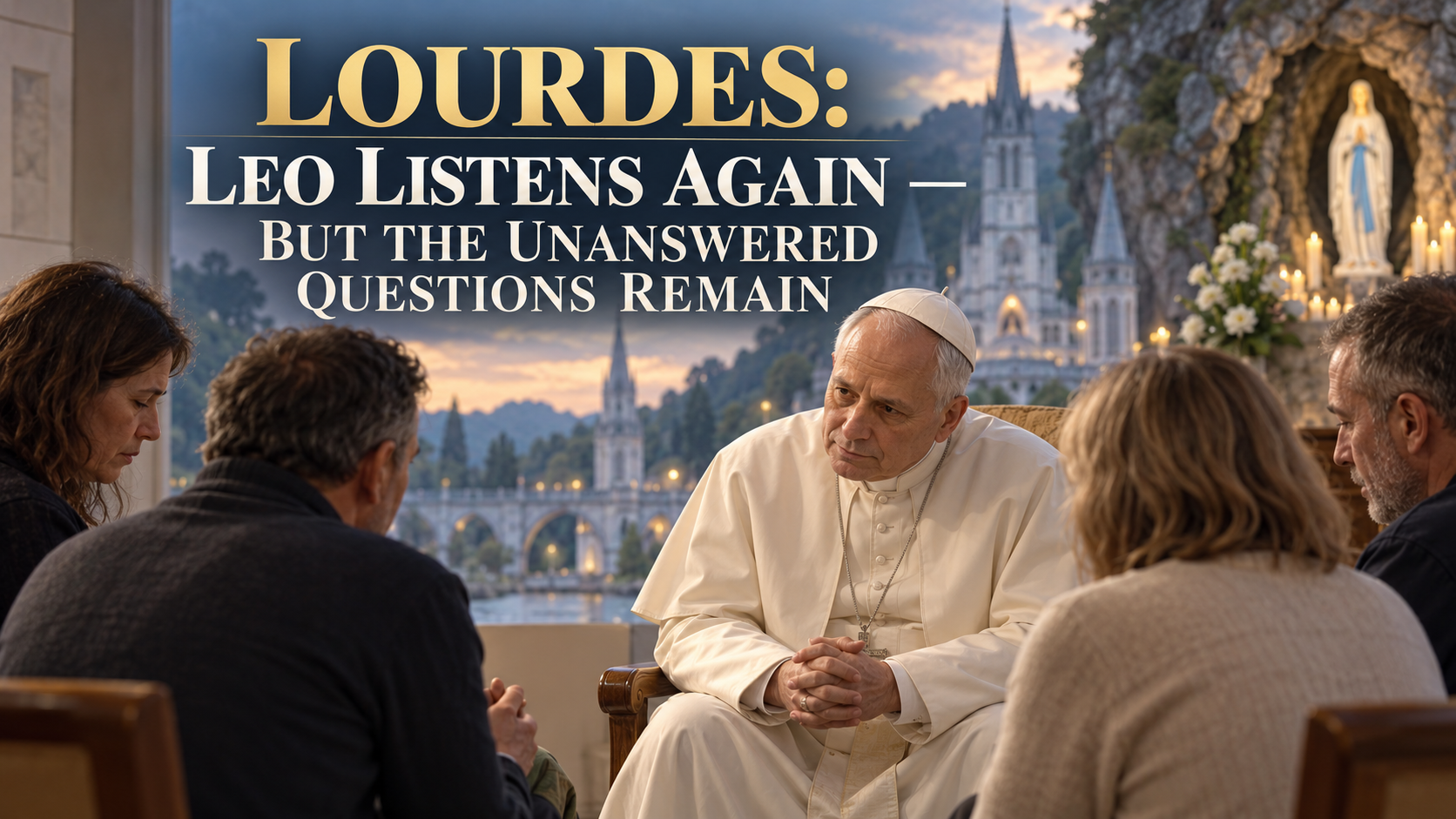
Pope Leo XIV’s two-hour meeting at Lourdes with seven victims of clerical abuse deserves recognition for what it was: an extended private encounter in which those present say they were genuinely heard. But Nuntiatoria has been here before. Since the beginning of this pontificate we have repeatedly distinguished pastoral listening from juridical accountability, while concrete questions concerning Chiclayo, the Rupnik proceedings and episcopal responsibility remain unresolved. At Lourdes, where the Blessed Virgin called for penance and Leo himself declared that the Church’s conversion must begin with herself, the question is no longer whether the Pope will listen. It is whether listening will finally become justice.
For nearly two hours on Sunday evening, 27 September, Pope Leo XIV sat with seven people who had suffered sexual abuse within the Catholic Church in France. Four were men and three were women. They came from different circumstances: parishes, boarding schools, religious congregations and ecclesial movements. The Pope received each privately, listened to what had happened to them, heard their proposals for preventing its repetition and spent time in prayer with some. He subsequently gathered the seven together, thanked them for the painful testimony entrusted to him and reaffirmed his commitment to ensuring that others should not suffer the same evil.¹
One phrase in the Holy See’s account deserves particular attention. Leo listened not merely to accounts of the original abuse but to suffering endured “sometimes, sadly, with the complicity or silence of those who could have helped them”.¹ That qualification reaches the heart of the institutional dimension of the clerical-abuse catastrophe. One evil is committed by the abuser. Another is committed when those possessing authority know, suspect, minimise, conceal, transfer, discourage, delay or simply decline to act. The crisis which has convulsed the Church for decades has never been explicable solely by the existence of sinful priests. It also concerns what ecclesiastical institutions did, or failed to do, when serious wrongdoing was placed before them.
The Lourdes encounter should not be dismissed as theatre. Those who subsequently spoke publicly described Leo as attentive and empathetic. The format itself allowed considerably more than the perfunctory collective audience which so often accompanies an official visit. The seven had met beforehand to compare experiences and formulate what they wished to place before the Pope. Although the French episcopal and religious authorities had a substantial role in assembling the eventual group, and some victim associations criticised aspects of that selection process, the participants themselves were plainly not present merely as ecclesiastical decoration. They arrived with demands, experience and questions of their own.¹ Where the Pope acts rightly, that should be acknowledged. Where victims themselves report that they were listened to seriously, their testimony should not be rewritten merely because criticism supplies a more convenient narrative.
Yet neither can Nuntiatoria write about Lourdes as though a new question has suddenly arisen, because we asked substantially the same question eleven months ago. On 22 October 2025, after Leo XIV spent an unexpectedly extended audience with representatives of Ending Clergy Abuse Global, this publication carried the title Historic Meeting, Unanswered Questions: Pope Leo XIV and the Survivors of Clerical Abuse. Survivors again spoke afterwards of a Pope who had listened sympathetically and at length. Nuntiatoria acknowledged the significance of that encounter but withheld the conclusion that a new culture of accountability had therefore arrived. The decisive question was what would follow.²
That distinction remains the governing one. Pastoral listening matters, but clerical abuse became an institutional crisis precisely because listening was so often disconnected from action. Victims were sometimes heard and then forgotten; files were opened without visible resolution; restrictions were imposed without definitive judgments; episcopal failures were acknowledged in general while responsibility in particular remained elusive. The test of reform is therefore not whether the Church has learned the language of listening, but whether that language is translated into coherent canonical process.
Leo himself has supplied the standard. Addressing the College of Cardinals in January, he called abuse a continuing wound in the life of the Church and identified another scandal alongside the original crime: victims finding the ecclesiastical door closed. Recalling one woman who told him that no bishop had wanted to hear her, Leo insisted that listening was “profoundly important”.³ Once that door is opened, however, the institution must know what to do with what has been heard.
The juxtaposition with the Rupnik case is therefore impossible to avoid. Only days before Leo sat with seven victims at Lourdes, Nuntiatoria reported that five women who accuse former Jesuit Fr Marko Ivan Rupnik of abuse had written directly to the Pope. Their complaint was not that they possessed a right to dictate a guilty verdict. This publication has consistently maintained that Rupnik remains entitled to the presumption of innocence until the competent tribunal establishes otherwise. Their complaint was procedural: according to their lawyer, they had repeatedly sought recognition and information from the Dicastery for the Doctrine of the Faith, received no substantive answer, and originally learned through the media that the canonical trial had begun.⁴
Due process for the accused and humane treatment of complainants are not competing principles. A canonical tribunal must test evidence, preserve the right of defence and reach judgment independently. Yet none of that requires those alleging grave abuse to remain uncertain even about their procedural relationship to the case. As Nuntiatoria argued on 25 September, the Church does not need a predetermined verdict in the Rupnik affair; she needs a credible one.⁴ The symbolism at Lourdes is consequently difficult to miss: Leo has condemned closed ecclesiastical doors, seven victims found his door open, yet the women in the Rupnik case say that they still do not know where they stand within the process intended to establish the truth.
Lourdes itself had already supplied an image of the same tension. Before the papal visit the sanctuary extended the covering of the mosaics created by Rupnik. Nuntiatoria examined that decision in August in Lourdes Draws the Veil: Rupnik, Scandal and the Supreme Law of Souls. We argued that concealing the mosaics did not amount to a canonical judgment upon their creator. It was a pastoral decision about a sanctuary which exists above all for souls, many of them wounded and suffering.⁵ The Holy See had already acknowledged serious deficiencies in the earlier handling of the Rupnik affair, Pope Francis had waived prescription so that the wider allegations could be judicially examined, and under Leo XIV an independent tribunal has been constituted. None of that should be prejudged. But neither does the existence of a tribunal dispose of the wider questions concerning how previous complaints were handled, where institutional failures occurred and how they will be prevented in future.⁵
The same requirement for documentary clarity applies to Chiclayo. Nuntiatoria has returned repeatedly to allegations concerning the handling of clerical-abuse complaints during Robert Prevost’s episcopate in Peru because neither of the simplistic positions offered by competing camps is justified by the presently public record. We have not concluded that the future Pope knowingly protected abusers. Evidence from the separate Sodalitium affair shows victims describing Prevost as one of the churchmen who listened to them and helped communicate their concerns to Rome, and that evidence must be given its full weight.⁶
But favourable evidence in one matter cannot answer documentary questions in another. The Diocese of Chiclayo has maintained that complaints concerning Fr Eleuterio Vásquez González were received, restrictions imposed, a preliminary canonical investigation conducted and the resulting acts transmitted to the Dicastery for the Doctrine of the Faith. Later testimony and documentary claims have raised questions about precisely what investigation occurred and how some of the restrictions were subsequently characterised. Nuntiatoria has refused to transform those discrepancies into proof of a cover-up. We have instead asked the narrower and more responsible question: if the canonical investigation occurred as the diocese says it did, where are the corresponding acts?⁷
Canon law does not envisage a preliminary investigation as an amorphous sequence of pastoral conversations. Where the requirements of canon 1717 are engaged, a juridical process produces a record. The Dicastery’s own procedural norms contemplate decrees, authenticated acts, the Ordinary’s assessment and transmission to Rome. That does not mean private testimony should be indiscriminately published, but the existence, chronology and legal character of the relevant acts should be capable of authoritative verification. For that reason Chiclayo cannot responsibly be presented either as demonstrated proof of a papal cover-up or as a controversy definitively resolved. The documentary record remains publicly incomplete.⁶ ⁷
The principle running through Rupnik and Chiclayo is the same. The Church must neither presume guilt nor allow uncertainty to become permanent administration. Removing a cleric from ministry may be necessary for protection. Dispensing him from the clerical state may resolve a disciplinary or vocational situation. Neither necessarily determines the truth of a particular allegation. Victims are failed when offenders remain in ministry, but they are also failed when grave accusations are absorbed into administrative measures without a clear juridical conclusion. The accused is likewise failed if an unresolved allegation becomes a permanent substitute for judgment.
This is why Nuntiatoria has consistently resisted the notion that “zero tolerance” can function as a complete theology or jurisprudence of safeguarding. Catholic justice demands protection of the vulnerable, but it also demands truth, evidence, due process, proportionality and the rights of defence. An allegation is not a conviction. An episcopal mistake is not automatically a conspiracy. Delay is not by itself proof of malicious concealment. Conversely, canonical confidentiality cannot become a talisman invoked whenever legitimate questions become uncomfortable, and the presumption of innocence cannot be distorted into a presumption that ecclesiastical authorities necessarily handled everything correctly.
This publication addressed that deeper pathology earlier this month in The Church Does Not Need Our Denial. The Church’s indefectibility does not depend upon the impeccability of bishops, priests or Roman officials. Catholics do not defend the Mystical Body by refusing to acknowledge documented failures among her ministers. Judas was among the Twelve; St Peter denied his Lord. The Church survives the sins of churchmen because her holiness derives from Christ, not because every holder of ecclesiastical office is immune from negligence, cowardice, corruption or grave sin. The instinct to defend the Church by defending every ecclesiastic eventually mistakes the reputation of the institution for the truth which the institution exists to serve.⁸
That error has been especially destructive in cases of clerical abuse because tribal loyalties so easily displace justice. Some critics are prepared to believe almost any allegation made against a bishop whom they dislike; some defenders are prepared to dismiss almost any allegation concerning a churchman whom they admire. Neither instinct is Catholic. The presumption of innocence, justice for victims, documentary truth, accountability for superiors, refusal of calumny and refusal of concealment belong to the same moral order.
The argument is not new to these pages. In July 2025, Hands Off the Crozier: Clericalism, Silence, and the Scandal of Inaction Under Pope Leo XIV asked whether episcopal accountability under the new pontificate would become sufficiently concrete to overcome an ingrained tendency to protect office and reputation.² ⁹ Later coverage of Rupnik, Chiclayo and safeguarding failures has returned to the same point: the credibility of reform depends not merely upon punishing proven individual offenders, but upon whether the Church can identify and correct failures of oversight, procedure and governance when they occur higher in the hierarchy.
This is the context in which Leo’s words at Lourdes acquire their real significance. Addressing the French bishops earlier on Sunday, the Pope praised measures already undertaken in response to the “painful scourge” of abuse of minors by clergy and within ecclesial settings. He referred specifically to listening, the search for truth, justice, making amends, prevention and protection, but instructed the bishops to continue with the “greatest vigilance”.¹⁰ At Mass he went further still. Preaching upon Our Lady’s summons to conversion, Leo declared that the call concerns the Church herself and that she must have the courage to begin with herself. Healing the “deep wounds, infidelities and painful errors” committed within her requires humble submission to the purifying gaze of God and recognition of fault.¹¹
At Lourdes, such language cannot remain merely administrative, because Massabielle is the place where the Immaculate Virgin called for penance. Catholic penance is more demanding than institutional regret. Contrition requires acknowledgement of wrong, sorrow for it and a firm purpose of amendment. Justice requires restitution or reparation where these are possible. Scandal requires remedy. Authority that has failed requires correction. Continued danger requires protection. Penance which laments yesterday while reproducing the conditions which made yesterday possible is not amendment.
That gives the meeting with the seven victims its proper theological measure. Listening is necessary because justice begins by learning the truth. Compassion is necessary because Christians cannot regard another person’s suffering coldly. Prayer is necessary because abuse committed in a sacred context inflicts spiritual wounds which cannot be reduced to failures of administration. Yet listening, compassion and prayer become ecclesially credible only when joined to investigation, judgment, reparation and prevention.
France knows why. The CIASE inquiry forced the Church there to confront abuse on a scale impossible to explain as an occasional aberration. The French bishops subsequently acknowledged not merely individual crimes but an institutional responsibility and a systemic dimension to the failures surrounding them.¹² That acknowledgement did not mean that the entire French clergy were guilty, still less that Catholic priesthood itself was the cause of abuse. It meant that structures, habits, deference and failures of governance had sometimes allowed wrongdoing to continue or obstructed its exposure. Institutional failure requires institutional correction.
Nor should any of this be twisted into an argument against the priesthood. Clerical sexual abuse is monstrous precisely because the priesthood is sacred. The priest who exploits spiritual fatherhood for sexual gratification does not reveal the falsity of spiritual fatherhood; he profanes it. The superior who places reputation before the vulnerable does not prove ecclesiastical authority intrinsically corrupt; he abuses an authority given for service. The answer is neither clerical defensiveness nor ideological suspicion of every priest, but an uncompromising insistence that sacred office increases rather than diminishes moral responsibility.
Justice consequently runs in both directions. Victims must be taken seriously without transforming allegation into conviction. Clergy must receive due process without transforming the presumption of innocence into institutional indifference. Confidentiality must protect legitimate rights without becoming opacity. Bishops must exercise pastoral discretion without being permitted to reduce accountability to a private matter between themselves and Rome.
This is the point at which the Lourdes meeting must be judged in continuity with everything that has preceded it. When Nuntiatoria published Historic Meeting, Unanswered Questions in October 2025, there was legitimate hope that Leo’s willingness to hear survivors might inaugurate a different culture of ecclesiastical government. Nearly a year later, another group of victims has encountered the same willingness. That deserves recognition, but the standard must now be higher than another successful meeting. The unresolved questions concern whether the Rupnik proceedings will be both just and intelligible, whether Chiclayo will receive authoritative documentary resolution, whether established episcopal negligence will carry meaningful consequences, and whether the same standards will operate when those concerned are powerful, celebrated or well connected.
Leo XIV has himself supplied the criterion. He has said that the closed door is a scandal. At Lourdes he opened it. He heard of abuse aggravated by “complicity or silence”, instructed bishops to maintain the “greatest vigilance”, preached that ecclesial conversion must begin with the Church herself, and spoke of a Church in which men and women of every age might find “comfort and healing”.¹ ¹⁰ ¹¹ Those words require a form of government in which allegations are judged rather than merely managed, the innocent are protected, the guilty are punished, negligent authority is corrected, complainants are treated as persons rather than administrative problems, and truth is placed above the reputation of every priest, prelate, dicastery and pontificate.
Only then will the Pope’s hope that the Church become a place of “comfort and healing” acquire its full Catholic meaning. At Lourdes, Our Lady did not call the Church merely to listen sympathetically to the consequences of sin; she called sinners to conversion and penance. The seven have spoken, Leo has listened, and Rome has heard these questions before. What matters now is whether what was heard becomes amendment.
¹ Salvatore Cernuzio, “Pope to abuse victims: I am committed to ensuring this evil is not repeated”, Vatican News, 27 September 2026.
² Nuntiatoria, “Historic Meeting, Unanswered Questions: Pope Leo XIV and the Survivors of Clerical Abuse”, 22 October 2025.
³ Salvatore Cernuzio, “Pope Leo: Failure to welcome abuse victims is a scandal”, Vatican News, 10 January 2026.
⁴ Nuntiatoria, “Rupnik’s accusers appeal to Leo XIV: the women are still outside the door”, 25 September 2026.
⁵ Nuntiatoria, “Lourdes Draws the Veil: Rupnik, Scandal and the Supreme Law of Souls”, 28 August 2026.
⁶ Nuntiatoria, “Chiclayo: The File Rome Must Now Open”, 18 September 2026.
⁷ Nuntiatoria, “If the Investigation Happened, Where Are the Acts? Ricardo Coronado, Pope Leo XIV and the Unresolved Chiclayo Record”, 4 July 2026.
⁸ Nuntiatoria, “The Church Does Not Need Our Denial: Truth, scandal and the false defence of ecclesiastical reputation”, 7 September 2026.
⁹ Nuntiatoria, “Hands Off the Crozier: Clericalism, Silence, and the Scandal of Inaction Under Pope Leo XIV”, 27 July 2025.
¹⁰ Pope Leo XIV, “Meeting with the Bishops of the French Episcopal Conference”, Holy See, 27 September 2026.
¹¹ Pope Leo XIV, “Holy Mass in the Prairie of the Sanctuary of Our Lady of Lourdes: Homily”, Holy See, 27 September 2026.
¹² Independent Commission on Sexual Abuse in the Church, “Final Report”, CIASE, 5 October 2021.




Leave a Reply