
France’s Bishops Warn of a Nation Forgetting Its Soul
Secularisation, laïcité, and the rising pressure against Christian symbolism in public life

France’s bishops have not issued a merely devotional reflection on a passing cultural mood. Through the Conférence des évêques de France, and in union with the episcopal conferences of Italy, Germany, and Poland, they have placed before Europe a grave diagnosis: the continent must “rediscover its soul.” The appeal, published on 13 February 2026 and later carried by COMECE under the title Christians for Europe, called Christians to a renewed surge of hope before “the fractures of the world,” explicitly recalling Christianity as one of the essential foundations of Europe.¹ That language matters. It is not the language of administrative anxiety, ecclesiastical management, or institutional self-preservation. It is the language of civilisational illness.
Nor was this an isolated episcopal flourish. When the bishops of France gathered at Lourdes for their March 2026 plenary assembly, they placed their deliberations under the witness of the nineteen martyrs of Algeria, whose thirtieth anniversary falls in 2026. The CEF described the martyrs as the spiritual thread of the assembly, from Cardinal Jean-Marc Aveline’s opening address to the final meditation by Brother Thomas Georgeon, postulator of their cause. The assembly recalled Bishop Pierre Claverie’s conviction that the Church’s mission is lived on the “lines of fracture of humanity.”² The phrase could hardly be more apt. France now stands on such a fracture line: between Christian memory and secular amnesia, public witness and enforced privatisation, authentic neutrality and ideological suspicion.
The present crisis has three layers. First, there is legal laïcité: the use of state neutrality to regulate the visibility of religious symbols. Secondly, there is cultural de-Christianisation: the loss of Christian memory, language, and symbolic literacy. Thirdly, there is actual anti-Christian hostility: measurable acts of vandalism, desecration, intimidation, and violence directed at Christian persons and sites. These three are not identical. They must not be confused. But in contemporary France they increasingly reinforce one another.
The legal layer was visible in March 2026, when the Administrative Court of Dijon upheld a measure adopted in Chalon-sur-Saône prohibiting elected officials from wearing conspicuous religious signs during municipal council meetings. The measure had been advanced by Gilles Platret, the city’s mayor, and challenged by two La France Insoumise councillors, Damien Saley and Lamia Sabrina Sari, the latter of whom wears an Islamic headscarf. The court held that the prohibition of “ostensible” religious signs in the municipal council did not constitute a grave and manifestly illegal violation of freedom of conscience.³
Although that case concerned an Islamic symbol, its implications reach every religion. It confirms a widening French tendency: neutrality is no longer confined to the institution, but increasingly presses upon the visible person. The citizen may believe; the office-holder may serve; but the visible believer is made problematic. A crucifix, a veil, a cassock, a medal, or any sign of confessional belonging becomes not merely an expression of conscience, but a test case in republican suspicion.
The same juridical pressure appears in controversies over Christian symbols on public land. In December 2025, Le Monde reported disputes in Saint-Jeannet, Montgenèvre, and Quasquara concerning newly erected crosses. In Saint-Jeannet, a mountain cross bearing the words “Ave Christus Rex” was installed and later cut down. In Montgenèvre, an unauthorised cross was removed after official intervention. In Quasquara, Corsica, the mayor resisted the removal of a calvary despite an administrative ruling.⁴ These cases involve questions of planning law, authorisation, protected land, and the 1905 separation settlement. But the deeper question is unmistakable: when does the cross cease to be the sign under which France’s villages, cemeteries, hills, and churches were shaped, and become instead an alien object to be removed?
The Conseil d’État’s nativity-scene jurisprudence exposes the ambiguity. In its 2016 decisions concerning Christmas cribs in public buildings, France’s highest administrative court held that such installations may be lawful only where their context gives them a cultural, artistic, or festive character, without expressing recognition of a cult or marking religious preference. The same principle continued to generate litigation in 2025, when disputes over municipal cribs in places such as Béziers and Beaucaire again placed the manger under the scrutiny of administrative secularism.⁵ The result is a peculiarly modern fiction: the crib may remain if it is sufficiently emptied of Bethlehem. The manger may stand if it is folklore. The Child may be displayed if He is not adored.
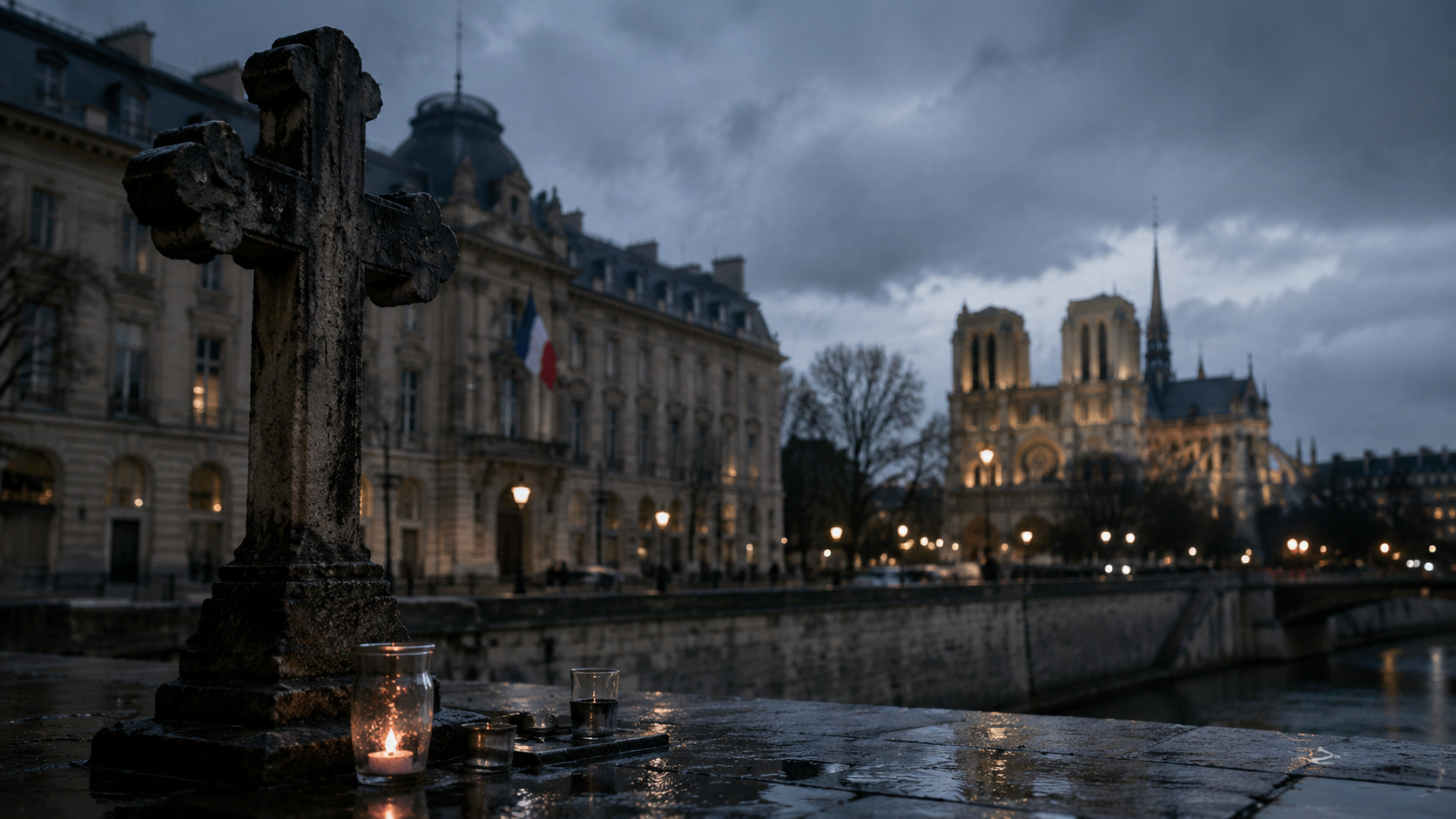
This is the second layer of the crisis: cultural de-Christianisation. France still cherishes cathedrals, abbeys, bells, processions, feast days, and saints as patrimony. Yet patrimony without belief becomes increasingly fragile. Notre-Dame may be loved as stone, but the Creed that built it is treated as a private option. The cross may be defended as heritage, but its living proclamation is treated as discomfort. The Church may be tolerated as a custodian of memory, but resisted as a bearer of truth.
That distinction became especially clear in the controversy surrounding the film Sacré-Cœur. In October 2025, MediaTransports, the advertising agency for the SNCF and RATP networks, refused a poster campaign for the film, citing the neutrality of public service and judging the campaign “confessional and proselytising.” The film, directed by Steven and Sabrina J. Gunnell, recounts the apparitions of Christ to Saint Margaret Mary Alacoque between 1673 and 1675 at Paray-le-Monial and the rise of devotion to the Sacred Heart of Jesus.⁶ Here, one of the most recognisably French Catholic devotions became suspect not because it lacked historical significance, but because it appeared as living faith.
The controversy deepened in Marseille. Mayor Benoît Payan cancelled screenings of Sacré-Cœur at the municipal Château de la Buzine, arguing that the projection would offend the principle of laïcité in a venue belonging to the city. On 25 October 2025, the Administrative Court of Marseille ordered the city to allow the film to be shown, finding that the cancellation infringed freedom of expression and artistic creation and distribution. The court expressly noted that programming the film in a municipal space did not amount to recognising a cult, preferring a religion, or granting a subsidy.⁷ This matters because it reveals how quickly the rhetoric of neutrality may become a mechanism of exclusion. The public authority begins by saying it must not endorse religion. It ends by deciding that a film about Christian devotion is too religious to be shown in a public cultural venue.
The third layer is more direct: anti-Christian hostility. On 12 February 2026, the French Ministry of the Interior published its 2025 figures for anti-religious acts. It recorded 2,489 anti-religious incidents in France that year. Of these, 1,320 were anti-Semitic, representing 53 per cent of the total; 843 were anti-Christian, representing 34 per cent; and 326 were anti-Muslim, representing 13 per cent. The ministry stressed that anti-Semitic acts remained at a historically high level, even though they had fallen by 16 per cent from 2024. Anti-Muslim acts rose by 88 per cent. Anti-Christian acts rose by 9 per cent.⁸
The Christian figures deserve particular attention. The ministry reported that 87 per cent of anti-Christian acts concerned attacks on property, including churches, cemeteries, and religious objects. Yet the smaller category of physical attacks, verbal attacks, and online hatred rose by 70 per cent in 2025. The same year was marked by the killing of Ashur Sarnaya, an Eastern Christian in the Rhône, on 10 September. The ministry itself placed that killing within its account of the year’s anti-Christian acts and noted that 2026 also marks the tenth anniversary of the terrorist murder of Father Jacques Hamel at Saint-Étienne-du-Rouvray.⁹
These figures must be treated with moral seriousness and proportion. Anti-Semitic acts remain terribly high. Anti-Muslim acts rose sharply and included the killings of Aboubakar Cissé in the Gard and Hichem Miraoui in the Var. Catholic moral seriousness does not permit indifference to Jewish or Muslim suffering. But the recognition of hatred against others cannot become the erasure of hatred against Christians. A desecrated church, a vandalised cemetery, a severed cross, an assaulted believer: these too are wounds in the body of the nation.
This is why French senators have begun to press the issue. In July 2025, Senator Sylviane Noël submitted a written question to the Interior Minister concerning the absence of a specific mechanism for reporting anti-Christian acts. When no answer had been received, the question was formally recalled in April 2026 and remained unanswered at the time of publication on the Senate’s own site.¹⁰ In September 2025, eighty-six senators went further, calling publicly for a national reporting and support system for victims of anti-Christian acts. Their appeal argued that France had created mechanisms and partnerships against anti-Semitic and anti-Muslim hatred, but that no equivalent arrangement existed for anti-Christian acts.¹¹ Their appeal was not a demand for privilege. It was a demand for equal seriousness.
That phrase — equal seriousness — should stand at the centre of the debate. If liberty means anything, Christians must be free to worship, speak, process, teach, and bear public witness. If equality means anything, anti-Christian vandalism and violence cannot be treated as a lesser species of hatred. If fraternity means anything, France must recognise that an attack on a church or a believer is not merely an internal Catholic problem; it is an injury to the common life of the Republic.
The irony is that this hardening secularism comes at precisely the moment when signs of religious renewal are appearing among the young. The French Church’s 2026 catechumenate survey recorded more than 13,000 adult baptisms and more than 8,100 adolescent catechumens. A fuller breakdown gave 13,234 adults, compared with 4,124 in 2016, meaning that adult baptisms have more than tripled in a decade. The CEF also recorded a 28 per cent annual increase in adult baptisms and a 10 per cent increase among adolescents.¹² This does not mean secularisation is over. It means the situation is more dramatic than the usual sociological clichés allow. France is not simply becoming atheist. It is becoming spiritually divided: institutionally secular, culturally forgetful, but unexpectedly porous to grace.
This is precisely why the bishops’ appeal to Europe’s soul should not be softened into vague nostalgia. Christianity is not merely one ornamental strand in the European tapestry. It formed Europe’s understanding of the human person, the sanctity of conscience, the duties of rulers, the dignity of the poor, the moral limits of power, the meaning of mercy, and the difference between law and justice. Cut Christianity away, and Europe does not become neutral. It becomes metaphysically incoherent.
The older papal warnings speak with renewed force. Pope Pius XI taught in Quas Primas that the exclusion of Christ from public life and political authority leads to social disorder, anti-clericalism, and the subjection of religion to the whim of princes and rulers. He identified the remedy in the public recognition of Christ’s kingship and the liberty of the Church from the power of the State.¹³ Pope Leo XIII warned in Immortale Dei that the Church has transformed the moral life of nations wherever she has taken root, and that civil society cannot be rightly ordered if it acts as though it owes no public duties to God.¹⁴ These teachings are not museum pieces. They describe the present European condition with painful accuracy.
France should understand this more deeply than any other nation. She gave the world Chartres and the Vendée, Saint Louis and the Cult of Reason, missionaries and martyrs, cathedrals and guillotines. Her history contains both the splendour of Catholic civilisation and the violence of anti-Christian revolution. The French drama has always been theological before it is political: what happens to a Christian nation when it tries to become a secular creed?
The answer is now visible. A cathedral may be honoured as heritage, but not obeyed as altar. A crib may be festive, but not evangelical. A cross may be ancient, but not newly planted. A Christian film may be admired by audiences, but refused by public advertising. Christian sites may be attacked in large numbers, yet Christians must still argue that their wounds count. At the same time, thousands of adults and adolescents come forward for baptism, as though the ruins themselves are beginning to speak.
This is not merely secularisation. It is a struggle over public reality. The bishops are right to speak of Europe’s soul because France’s crisis is spiritual before it is statistical, juridical before it is cultural, and theological before it is political. A civilisation can forget its prayers before it forgets its monuments. It can forget doctrine before it forgets festivals. It can forget the God who made its moral vocabulary possible and still imagine, for a time, that words such as dignity, liberty, fraternity, and conscience will keep their meaning by themselves.
They will not. Cut flowers still have colour, but they no longer have roots. France is living among the cut flowers of Christian civilisation. The bishops’ warning is that beauty without truth will not last, and memory without worship becomes archaeology.
France once called herself the eldest daughter of the Church. She need not pretend that the old order can be mechanically restored, nor that pluralism can be wished away. But neither can she survive by treating Christianity as a museum piece, a legal inconvenience, or a threat to neutrality. If France forgets the faith that formed her, she will not become more neutral. She will become more empty — and into that emptiness will come stronger, harsher, and less merciful gods.
¹ Conférence des évêques de France, “Les évêques de quatre pays européens appellent à un sursaut spirituel face aux fractures du monde,” 13 February 2026; COMECE, “Christians for Europe: Four Bishops’ Conferences Issue Appeal for a Renewed European Vision,” 16 February 2026.
² Conférence des évêques de France, “Assemblée plénière de mars 2026: votes et décisions,” 31 March 2026.
³ Le Monde, “L’interdiction du port du voile au conseil municipal de Chalon-sur-Saône validée par la justice,” 18 March 2026; Nicolas Cadène, “Jamais la laïcité n’a supposé la neutralité des élus,” Le Monde, 21 March 2026; Seban & Associés, “L’interdiction pour les élus locaux de porter des signes religieux ostensibles en conseil municipal confirmée,” 16 April 2026. The Dijon order is identified by Seban & Associés as TA Dijon, 18 March 2026, no. 2601086.
⁴ Eric Collier, “Illegal Crosses in French Public Spaces Reignite Debates over Church-State Separation,” Le Monde, 9 December 2025.
⁵ Conseil d’État, “Installation de crèches de Noël par les personnes publiques,” 9 November 2016; Conseil d’État, Assemblée, Commune de Melun, no. 395122, 9 November 2016; Conseil d’État, Assemblée, Fédération de la libre pensée de Vendée, no. 395223, 9 November 2016.
⁶ Cécile Séveirac, “La campagne d’affichage du film ‘Sacré-Cœur’ bannie des réseaux SNCF et RATP,” Aleteia, 1 October 2025; Valeurs actuelles, “La SNCF et la RATP rejettent la campagne d’affichage du film Sacré-Cœur, jugée ‘confessionnelle et prosélyte’,” 1 October 2025. No public MediaTransports communiqué was located; this claim should therefore remain attributed to press reporting.
⁷ Tribunal administratif de Marseille, “La projection du film ‘Sacré-Cœur’ annulée par le maire de Marseille, autorisée,” 27 October 2025; Tribunal administratif de Marseille, ordonnance no. 2513174, 25 October 2025; Le Monde, “La justice contraint la ville de Marseille à reprogrammer le film catholique ‘Sacré-Cœur’ dans un cinéma municipal,” 25 October 2025.
⁸ Ministère de l’Intérieur, “Actes antireligieux — Tendances 2025,” 12 February 2026.
⁹ Ministère de l’Intérieur, “Actes antireligieux — Tendances 2025,” 12 February 2026.
¹⁰ Sénat, question écrite no. 08352, Sylviane Noël, “Absence de dispositif spécifique de signalement des actes antichrétiens,” published 9 April 2026, recalling question no. 05762, published 24 July 2025.
¹¹ William Molinié, “Les actes antichrétiens en augmentation en France, 86 sénateurs appellent à protéger les chrétiens et les lieux de culte en France,” Europe 1, 30 September 2025; Le Journal du Dimanche, “Vandalisme antichrétien: 86 sénateurs appellent à protéger les églises de France,” 28 September 2025; Anna Ashkova, “‘Les chrétiens de France se sentent souvent abandonnés’: 86 sénateurs appellent à protéger les églises,” Aleteia, 28 September 2025. These sources report the 26 September 2025 senatorial appeal and its call for a national reporting and support mechanism; no official Senate publication of the collective appeal was located.
¹² Service National de la Catéchèse et du Catéchuménat, “Enquête du catéchuménat 2026: Les baptêmes adultes et adolescents en chiffres,” Conférence des évêques de France, 2026.
¹³ Pope Pius XI, Quas Primas, 11 December 1925, §§24–31.
¹⁴ Pope Leo XIII, Immortale Dei, 1 November 1885, §§1–6, 13–15.
Related Articles


Latest Articles
- Today’s Mass: November 18 Dedication of the Basilicas of SS Peter & PaulThe Feast of the Dedication of the Basilicas of St. Peter and Paul commemorates the veneration of these apostles’ tombs, with Pope Constantine’s construction of their basilicas. St. Peter’s Basilica, erected over his tomb, was completed in 1626, while St. Paul’s, restored after a fire in 1823, celebrates the apostle’s martyrdom.
- DEFENDER OF WHICH FAITH? King Charles III and the Quiet Recasting of the Established ChurchKing Charles III increasingly presents the Church of England as protecting religious pluralism, while affirming his personal Christian faith. The article questions whether this emphasis risks obscuring Christianity’s distinctive truth claims and missionary purpose. Drawing on Anglican history and Catholic teaching, it distinguishes defending religious liberty from treating religions as equally valid paths to salvation.
- When Obedience Becomes a Wound: Traditionis Custodes and the Question of Spiritual AbusePope Leo XIV has confirmed that restrictions on the traditional Roman Mass will continue, while acknowledging the dangers of spiritual abuse. The article argues that lawful authority must still be prudent and pastorally responsible, questioning whether traditionalist Catholics are unfairly treated as disloyal. It also stresses that Vatican II never explicitly mandated the comprehensive liturgical changes later introduced.
- The Formation of the Catholic Mind: A Spiritual Conference for Nuntiatoria CXXXIIThe reflection urges Catholics to let faith transform not only their beliefs but also their habits of thought, judgement and conduct. Genuine formation requires humility, careful reading, prayer, prudence, well-formed conscience and charity. Parents teach chiefly through example, while lifelong learning should unite knowledge with virtue, grace and practical fidelity.
- Today’s homily: Feast of St Hugh of LincolnThis homily reflects on St Hugh of Lincoln and St Hilda of Whitby, showing how holiness is pursued faithfully amid changing responsibilities. Their examples highlight authority as service, courage, humility and care for others. Through Christ’s eternal priesthood, the sacraments and prayer, Christians are called to remain watchful and faithful in their duties.




Leave a Reply