
Landmark Euthanasia Case in Spain: Autonomy, Suffering, and the Limits of Law
The case of Noelia Castillo Ramos and the expanding frontier of assisted death in Europe
The case of Noelia Castillo Ramos, a 25-year-old woman from Barcelona scheduled to receive euthanasia on March 26, 2026, has become one of the most consequential moral and legal flashpoints in contemporary Europe. Her story—marked by sexual violence, attempted suicide, irreversible paraplegia, and chronic pain—has been presented as both a tragedy and a test case. Yet beyond the emotive force of the narrative lies a far more significant development: the gradual expansion of euthanasia from terminal illness into the domain of complex psychological and existential suffering.
Castillo Ramos’s request for assisted death was approved under Spain’s 2021 euthanasia law, formally known as the Ley Orgánica de regulación de la eutanasia.¹ This law permits euthanasia for individuals suffering from “serious and incurable conditions” or “serious, chronic conditions” that cause “intolerable suffering.”² While her paraplegia and chronic neuropathic pain provide a prima facie qualifying condition, public discourse surrounding the case has repeatedly emphasised her depression and trauma as central motivating factors. This framing is not incidental. It signals a decisive shift in how suffering is being interpreted—not merely as physical pathology, but as a holistic, subjective experience encompassing psychological anguish.
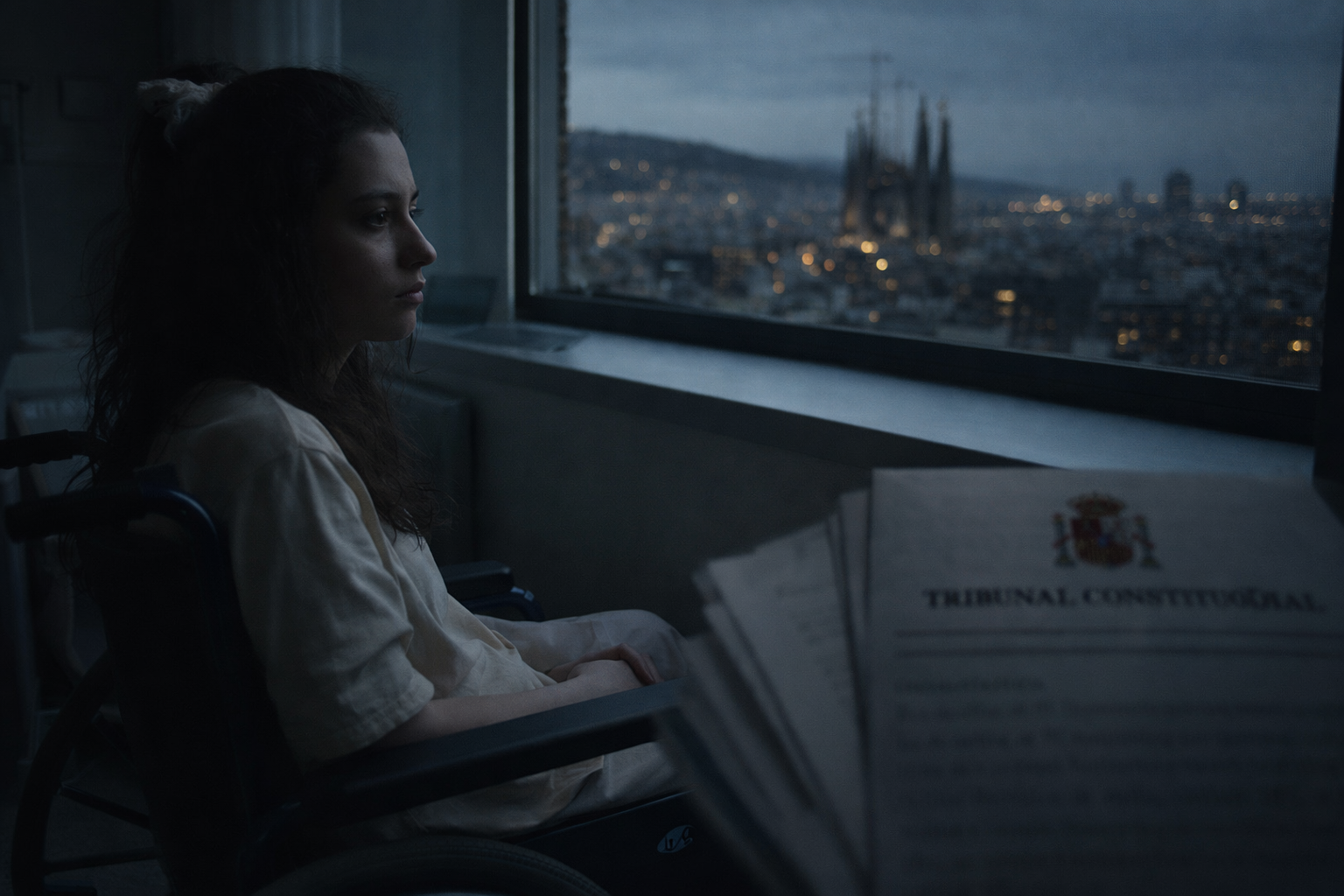
Her case proceeded through the full judicial hierarchy of Spain. After initial approval by medical assessors and the Catalan Guarantee and Evaluation Commission, her father—supported by the legal advocacy group Abogados Cristianos—filed successive appeals to prevent the procedure.³ These appeals were rejected at each stage. The High Court of Justice of Catalonia upheld her eligibility; the Spanish Supreme Court affirmed that her right to personal autonomy could not be overridden by familial objection; and the Constitutional Court dismissed the final appeal, finding no violation of fundamental rights.⁴ The case was ultimately taken to the European Court of Human Rights in Strasbourg, which declined to issue interim measures to halt the euthanasia, thereby exhausting all legal avenues.⁵
The jurisprudential principle emerging from this trajectory is clear: individual autonomy in matters of life and death has been elevated above all competing claims, including those of the family. This reflects a broader trend in European human rights law, wherein bodily autonomy is increasingly construed as an absolute or near-absolute right. The European Court of Human Rights has previously recognised that decisions concerning one’s own death fall within the ambit of private life under Article 8 of the European Convention on Human Rights.⁶ In this context, the courts’ consistent refusal to intervene is not anomalous but entirely consistent with prevailing legal doctrine.
Yet the legal clarity masks a deeper ethical ambiguity. The central question is not whether the law permits such a decision, but whether the law has drawn its boundaries in the right place. Castillo Ramos’s case is not that of a terminal cancer patient in the final stages of life. It is a case in which trauma, disability, and psychological suffering converge, raising profound questions about the nature of consent and the stability of the will under conditions of extreme distress.
The Catholic moral tradition has consistently rejected euthanasia as intrinsically disordered. Pope John Paul II, in Evangelium Vitae, teaches unequivocally:
“Euthanasia is a grave violation of the law of God, since it is the deliberate and morally unacceptable killing of a human person.”⁷
This judgment rests not on contingent circumstances but on an ontological claim: that human life possesses an inherent dignity which is not diminished by suffering, disability, or dependency. The Catechism of the Catholic Church reiterates this teaching, stating that euthanasia “constitutes a murder gravely contrary to the dignity of the human person and to the respect due to the living God, his Creator.”⁸
What is particularly striking in this case is the implicit redefinition of dignity at work. In the legal and cultural framework that has shaped Castillo Ramos’s outcome, dignity is understood as self-determination—the capacity to choose the terms of one’s existence, including its end. In the classical Christian understanding, however, dignity is inherent and inviolable, rooted in the imago Dei, and therefore not subject to negation by suffering or subjective judgment.
This divergence leads to radically different conclusions. Under the modern framework, assisting death can be construed as an act of compassion. Under the Christian framework, it is an abandonment of the suffering person at precisely the moment when care, accompaniment, and solidarity are most required.
The psychological dimension of the case further complicates the matter. The chain of events—sexual violence, suicide attempt, permanent disability, chronic pain, and depression—suggests not a single isolated condition, but a cumulative burden of trauma. Contemporary bioethics recognises that decision-making capacity may be impaired not only by cognitive deficits but by overwhelming emotional and psychological distress.⁹ The question, therefore, is not merely whether Castillo Ramos is legally competent, but whether her desire for death represents a stable and enduring judgment, or the culmination of unaddressed trauma.
This concern is not speculative. Jurisdictions such as Belgium and the Netherlands, which have permitted euthanasia for psychiatric conditions, have witnessed a gradual expansion in eligibility criteria. Cases once considered exceptional have become increasingly normalised.¹⁰ The risk, therefore, is not simply that one tragic case will be resolved in a particular way, but that it will establish a precedent—explicitly or implicitly—for future decisions.
The role of the family in this case highlights another fault line. Castillo Ramos’s father opposed the euthanasia, arguing that his daughter’s life retained value and that her decision was not final or irrevocable. His position reflects a relational understanding of the human person, in which individual choices are embedded within a network of familial and social obligations. The courts, however, rejected this perspective, affirming that family members have no legal standing to override a competent adult’s decision regarding euthanasia.
This legal position is coherent within the framework of liberal individualism, but it raises difficult questions about the erosion of communal bonds. If the individual is the sole arbiter of life and death, then the role of the family is reduced to that of observer—unable to intervene even in matters of irreversible consequence.
Finally, the media portrayal of the case deserves scrutiny. The emphasis on Castillo Ramos’s suffering—while undoubtedly real—serves to frame euthanasia as a compassionate response to an unbearable situation. Opposition, particularly from religious or pro-life groups, is often depicted as obstructive or ideological. This asymmetry in representation shapes public perception, potentially paving the way for further legal and cultural shifts.
The case of Noelia Castillo Ramos is therefore not merely a personal tragedy. It is a juridical and moral inflection point. It forces Europe to confront a fundamental question: whether the response to suffering should be the elimination of the sufferer, or the deepening of care.
The law has answered in one way. The tradition of the Church answers in another.
The consequences of that divergence will not be confined to this case alone.
¹ Ley Orgánica 3/2021, de 24 de marzo, de regulación de la eutanasia (BOE-A-2021-4628).
² Ibid., Art. 3(b)–(c).
³ Abogados Cristianos, legal filings and public statements regarding euthanasia cases in Spain (2024–2026).
⁴ Tribunal Supremo (Spain), rulings on euthanasia eligibility under LO 3/2021; Tribunal Constitucional, decision dismissing appeal (2025–2026).
⁵ European Court of Human Rights, refusal of interim measures under Rule 39 (March 2026).
⁶ Pretty v. United Kingdom (2002) 35 EHRR 1, para. 67.
⁷ Pope John Paul II, Evangelium Vitae (1995), §65.
⁸ Catechism of the Catholic Church, §2277.
⁹ Appelbaum, P.S., “Assessment of Patients’ Competence to Consent to Treatment,” New England Journal of Medicine 357 (2007): 1834–1840.
¹⁰ Kim, S.Y.H. et al., “Euthanasia and Assisted Suicide of Patients With Psychiatric Disorders in the Netherlands 2011–2014,” JAMA Psychiatry 73, no. 4 (2016): 362–368.
Related Articles


Latest Articles
- Today’s Mass: September 19 St. Januarius, Bishop and Companion MartyrsSt. Januarius and companion martyrs were martyred during the persecution under Diocletian. St. Januarius, patron of the city of Naples and bishop of Beneventum, was beheaded with his deacons and some others.
- Sermon for St. Januarius and his CompanionsToday we celebrate the feast of St. Januarius and his companions. About St. Januarius little is known except that he was among the many martyrs during the great persecution under the Emperor Diocletian.
- 20.09.26 Nuntiatoria CXXIV: QUOD ACCEPIMUS, CUSTODIMUS ET TRADIMUSThe editorial emphasises the importance of understanding our inheritance as custodians rather than owners. It highlights the obligation to preserve and transmit the Christian Faith, sacraments, and traditions to future generations. Through gratitude and fidelity, those who receive must ensure that what has been entrusted does not end with them.
- ONE LORD, ONE FAITH, ONE BAPTISM: The Seventeenth Sunday after PentecostThe Seventeenth Sunday after Pentecost emphasises the love of God and neighbour, rooted in divine justice. The Mass articulates the necessity of one faith and baptism, ensuring charity is not sentimental but deeply theological. The Gospel challenges believers to recognise Christ’s dual nature as both David’s son and Lord, reinforcing true Christian charity.
- AN AWARD IS NOT A MEETINGLambeth Palace has withdrawn the Hubert Walter Award given to Hafiz Tahir Ashrafi for reconciliation, citing previously unknown controversial comments. This raised questions about the vetting process prior to the award. While Ashrafi has defended his record of protecting minority rights, the Palace must clarify why such issues were overlooked initially.



Leave a Reply