
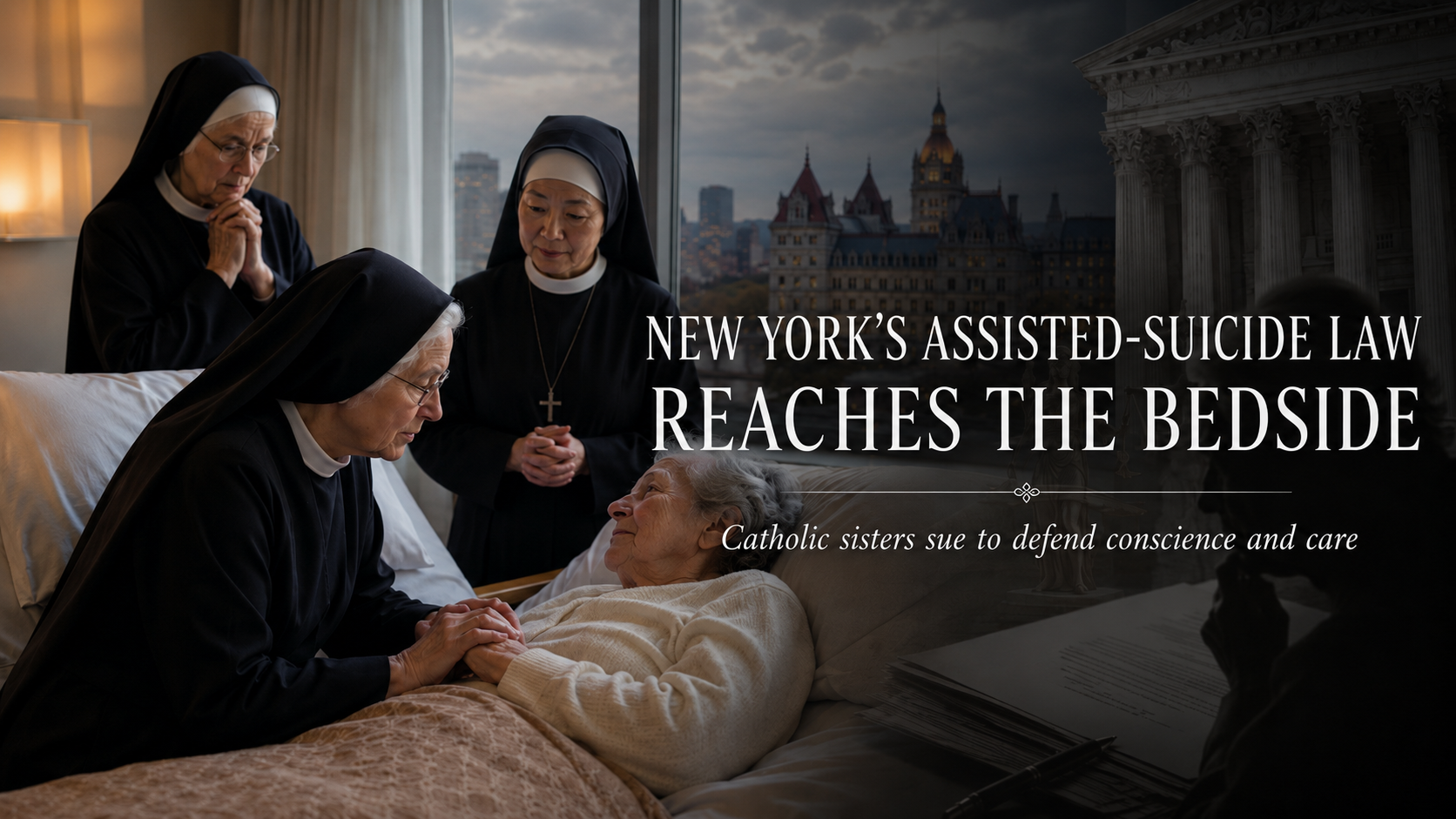
New York’s Assisted-Suicide Law Reaches the Bedsides of the Dying
Four communities of women religious and several Catholic healthcare institutions have asked a federal court to protect their ministries from New York’s Medical Aid in Dying Act. The dispute exposes the inadequacy of a conscience clause that permits Catholics to refuse the lethal prescription while requiring them to help the patient obtain it elsewhere.

At Rosary Hill Home in Hawthorne, New York, the Dominican Sisters have cared for people dying from incurable cancer for more than a century. Their work is neither glamorous nor easily reduced to a political slogan. They wash the sick, relieve pain, reassure frightened families and remain beside those whose final hours might otherwise be spent alone. The care is given without charge and without distinction of creed.
On 17 July, the sisters went to court against the State of New York.
The Dominican Sisters of Hawthorne are among thirteen Catholic plaintiffs challenging the state’s new Medical Aid in Dying Act. They are joined by the Carmelite Sisters for the Aged and Infirm, the Missionary Sisters of St Benedict, the Little Sisters of the Poor, the Diocese of Rockville Centre, Catholic Health and several nursing and residential institutions. Their complaint, filed in the United States District Court for the Northern District of New York, names Attorney General Letitia James and senior state health officials as defendants.¹
The Act, signed by Governor Kathy Hochul on 6 February, is due to come into force on 5 August. It permits an adult judged to have decision-making capacity and an illness expected to cause death within six months to obtain medication for the purpose of ending his own life. The medication is to be self-administered, making this physician-assisted suicide rather than euthanasia in the strict sense, although the moral principle concerning intentional killing remains the same.
Governor Hochul described the measure as allowing New Yorkers to “shorten not their lives, but their deaths”. She pointed to amendments requiring a waiting period, an oral request recorded on video, mental-health evaluation in specified circumstances, New York residency and safeguards against witnesses with a financial interest in the patient’s death.² These provisions may answer some of the most obvious opportunities for abuse. They do not answer the prior question: whether the state should authorise doctors to provide lethal drugs to their patients at all.
Nor do they resolve the particular injustice alleged by the Catholic plaintiffs.
New York maintains that no doctor or institution will be compelled directly to prescribe or dispense the lethal medication. The relevant conscience provision allows certain healthcare facilities to prohibit the prescription, ordering, dispensing or self-administration of assisted-suicide drugs on their premises. Presented in isolation, this appears to be a substantial protection.
The rest of the statutory scheme tells a different story. A facility invoking the exemption must arrange the prompt transfer of a patient requesting assisted suicide to another accessible institution willing to provide it. The plaintiffs argue that existing obligations under New York’s Palliative Care Information Act may also require their doctors and institutions to discuss assisted suicide as an end-of-life option, counsel patients about it, make referrals or arrange access through another provider. Some forms of assisted-living accommodation operated by the sisters may not fall within the facilities covered by the exemption at all. Refusal could expose institutions and professionals to injunctions, civil penalties and disciplinary proceedings.³
These arguments have not yet been adjudicated. They are the plaintiffs’ interpretation of how the Medical Aid in Dying Act will operate alongside existing health law, and New York will have the opportunity to dispute it. Yet the statutory transfer requirement is explicit. The state’s promise that Catholics need not supply the lethal dose themselves therefore misses the moral objection. A Christian institution cannot arrange a patient’s assisted suicide and then claim non-participation because another hand wrote the prescription.
Conscience is not preserved by dividing a wrongful act among several cooperating parties.
A doctor who believes that suicide is gravely wrong cannot be required to recommend a willing practitioner without being made professionally instrumental in the act. A nursing home founded to accompany people until natural death cannot be compelled to organise their transfer for the purpose of obtaining lethal medication without contradicting its reason for existing. The legal paperwork may place a little distance between the sisters and the death. It does not remove the causal connection.
This is particularly serious in Catholic healthcare because the objection is not an incidental scruple attached to an otherwise secular service. The care offered by these religious communities proceeds from a definite understanding of the human person, suffering, medicine and death. Their institutions were established because Christ is to be served in the sick and because a human life retains its worth when strength, independence and social usefulness have gone.
Catholic teaching does not require the artificial prolongation of life by every available treatment. A patient may refuse procedures that are excessively burdensome, dangerous or disproportionate to the expected benefit. Effective pain relief may be administered even when an unintended secondary consequence is the possible shortening of life, provided that death is neither intended nor chosen as the means of relieving suffering. There is an intelligible moral difference between permitting an illness to take its course and deliberately furnishing the means by which the patient kills himself.
The Catechism calls direct euthanasia morally unacceptable and teaches that voluntary cooperation in suicide is contrary to the moral law. Evangelium Vitae describes assisted suicide as cooperation in an injustice which cannot be excused by appeals to compassion. The Holy See’s Samaritanus bonus reiterates both the prohibition of euthanasia and the legitimacy of refusing disproportionate medical treatment.⁴ These distinctions are neither evasions nor the remnants of primitive medicine. They preserve the proper object of healthcare: the patient is cared for even when he cannot be cured, and he is never treated as a life whose destruction has become a therapeutic outcome.
Assisted-suicide legislation is commonly defended through the language of autonomy. Yet serious illness is rarely experienced in the philosophical isolation imagined by that word. Patients live among relatives, doctors, insurers and institutions. They know the cost of their care. They notice the exhaustion of a spouse and the interruption of their children’s lives. Many fear dependence more than pain.
The annual reports produced under Oregon’s long-standing assisted-suicide law are instructive. Among those reported to have died after taking prescribed lethal medication in 2025, the most frequently recorded concerns were loss of autonomy and diminished ability to participate in enjoyable activities, each cited in approximately 89 per cent of cases. Loss of dignity was recorded in 65 per cent, while concern about being a burden upon family, friends or caregivers appeared in nearly 40 per cent. Inadequate pain control, or fear of it, was reported less frequently.⁵
These figures do not prove that every request resulted from coercion, nor do they establish that no patient made a settled choice. They do show why autonomy cannot bear the moral weight placed upon it. A choice may be formally voluntary while being shaped by loneliness, fear, depression, financial pressure or the belief that one’s continued existence inconveniences others. Once suicide is presented by the medical profession as a reasonable response to dependency, vulnerable patients must decide not only whether they wish to die but whether they can justify remaining alive.
The Catholic sisters bring another answer into the room. Mother Mary Rose Heery, Prioress General of the Carmelite Sisters for the Aged and Infirm, described the purpose of their homes plainly: “We strive to bring His compassion to those entrusted to our care, ensuring that no resident ever has to die alone.” New York’s law, she said, strikes at the heart of that vocation.
The danger perceived by the sisters is shared beyond Catholic institutions. Disability-rights organisations have filed a separate federal challenge, arguing that the Act discriminates against people with terminal illnesses by treating suicide prevention as appropriate for most citizens while making lethal assistance available to a particular class of disabled patients. Those allegations also await judgement, but they prevent the controversy from being dismissed as a quarrel between Catholic morality and secular progress.⁶
A state may decide, however wrongly, to legalise physician-assisted suicide. It does not follow that every doctor, nurse and religious institution must be incorporated into the machinery by which the practice is delivered. New York will not lack willing practitioners. The refusal of a Catholic home to counsel, refer or transfer a resident for suicide does not prevent the state from implementing its policy elsewhere. Compulsion serves no necessary medical purpose; it serves the ideological purpose of establishing assisted suicide as an ordinary component of healthcare from which conscientious dissent is permitted only on the state’s narrow terms.
That is why the federal court should restrain enforcement of the Act against these plaintiffs while their claims are heard. A conscience exemption confined to the final prescription is inadequate when the same institution remains obliged to facilitate the process leading to it. The state cannot plausibly celebrate pluralism while threatening Catholic ministries with penalties unless they cooperate in conduct their faith condemns as the intentional taking of innocent life.
For generations, these sisters have accepted the patients whom fashionable society would prefer not to see: the incurably ill, the confused, the dependent and the dying poor. They have not abandoned medicine. They have preserved its humane purpose at the point where technical power can do no more and fidelity becomes the principal form of care.
New York now proposes that their continued service should depend upon their willingness to arrange what they believe to be a patient’s self-destruction. The sisters are right to refuse. Their duty at the bedside is to relieve suffering, speak truthfully and remain with the dying until death comes. No civil authority should force them to become the administrative ushers of death itself.
¹ The complaint identifies thirteen plaintiffs, including four communities of women religious, Catholic healthcare providers, the Diocese of Rockville Centre and associated residential and nursing institutions. The proceedings were filed on 17 July 2026 in the Northern District of New York.
² Governor Kathy Hochul signed the Medical Aid in Dying Act and accompanying amendments on 6 February 2026. The amended legislation is scheduled to take effect on 5 August and includes waiting, residency, recording and mental-capacity provisions.
³ The statutory facility exemption permits restrictions upon prescribing, ordering, dispensing and self-administration on institutional premises, while requiring the prompt transfer of a requesting patient to an accessible willing facility. The complaint argues that this provision, read with the Palliative Care Information Act, may also compel counselling, referral and other facilitation.
⁴ Catechism of the Catholic Church, nos. 2277–79; John Paul II, Evangelium Vitae, no. 66; Congregation for the Doctrine of the Faith, Samaritanus bonus, V.1–3.
⁵ Oregon Health Authority, Oregon Death with Dignity Act: 2025 Data Summary.
⁶ Brooklyn Center for Independence of the Disabled et al. v. Hochul et al., a separate federal action challenging the New York Act under the Americans with Disabilities Act and constitutional equal-protection principles.
RELATED ARTiCLES


LATEST ARTICLES
- Today’s Mass: October 26 St Evaristus of RomeSt. Evaristus was the son of a Greek Jew, originally from Bethlehem, and was the sixth Pope of the Catholic Church.
- Today’s homily: Christ the KingThe homily reflects on Christ’s kingship as seen in the Gospel narrative. It contrasts earthly authority with divine truth, emphasising that true allegiance to God requires genuine obedience and transformation. Believers are called to examine their personal commitments and respond to Christ’s demands in everyday life, ultimately recognising their identity as bearers of God’s image.
- Sermon for Christ the KingToday marks the celebration of Christ the King and the Twenty Second Sunday after Pentecost, a feast asserting Christ’s sovereignty against totalitarianism. St. Paul emphasised Christ’s supremacy over power and principalities, challenging early Gnostic beliefs. The early Church’s victory over evil is affirmed in Christ’s resurrection, offering hope and unity amidst contemporary struggles.
- Today’s Mass: October 25 SOVEREIGNTY OF OUR LORD JESUS CHRIST, SUPREME KINGThe Feast of the Sovereignty of Our Lord Jesus Christ celebrates Christ’s dual kingship by birth and conquest. Established by Pius XI, it aims to deepen faith and counter anti-clericalism. The liturgical observance underscores His authority as King, advocating for societal recognition of His reign to bring peace and harmony.
- TRADITION BEHIND THE FENCEThe Vatican’s prohibition of the traditional Ad Petri Sedem pilgrimage to St Peter’s Basilica has sparked controversy, especially among traditional Catholics. While some cite scheduling conflicts, the broader issue lies in the restrictive policies of Traditionis custodes, which may confine traditional liturgical practices to specific enclaves, risking the transmission and recognition of Catholic Tradition within the wider Church.
CURRENT EDITION


DAILY MASS ONLINE
One of the earliest online apostolates dedicated to the Traditional Latin Mass, Old Roman TV began broadcasting the Holy Sacrifice on the Feast of the Assumption, 15 August 2008. During the COVID-19 pandemic, additional programming — devotions, catechesis, and conferences — was added to support the faithful in prayer and formation.
Support the daily Holy Mass on Old Roman TV by offering a Mass intention — for loved ones, thanksgiving, or the repose of souls. Your intention helps sustain the sacred liturgy and brings grace to those you remember before God’s altar.
SUPPORT THE DAILY MASS ONLINE
Likely the world’s longest-running daily online broadcast of the
Traditional Latin Mass, streaming faithfully since the
Feast of the Assumption 2008.

This apostolate cannot continue without immediate help
Please support us with a contribution toward
chapel rent, sacristy supplies, operating costs, and web-hosting.
Our essential monthly costs reach £1,000.
MASS INTENTIONS
If your offering is for a Mass Intention, kindly complete the form below in full so we may correctly match it to your donation. For anniversary intentions — birthdays, wedding anniversaries, anniversaries of death — please be sure to include the relevant date.


Today’s Mass Propers
- Today’s Mass: October 26 St Evaristus of Rome
 St. Evaristus was the son of a Greek Jew, originally from Bethlehem, and was the sixth Pope of the Catholic Church.



Leave a Reply