
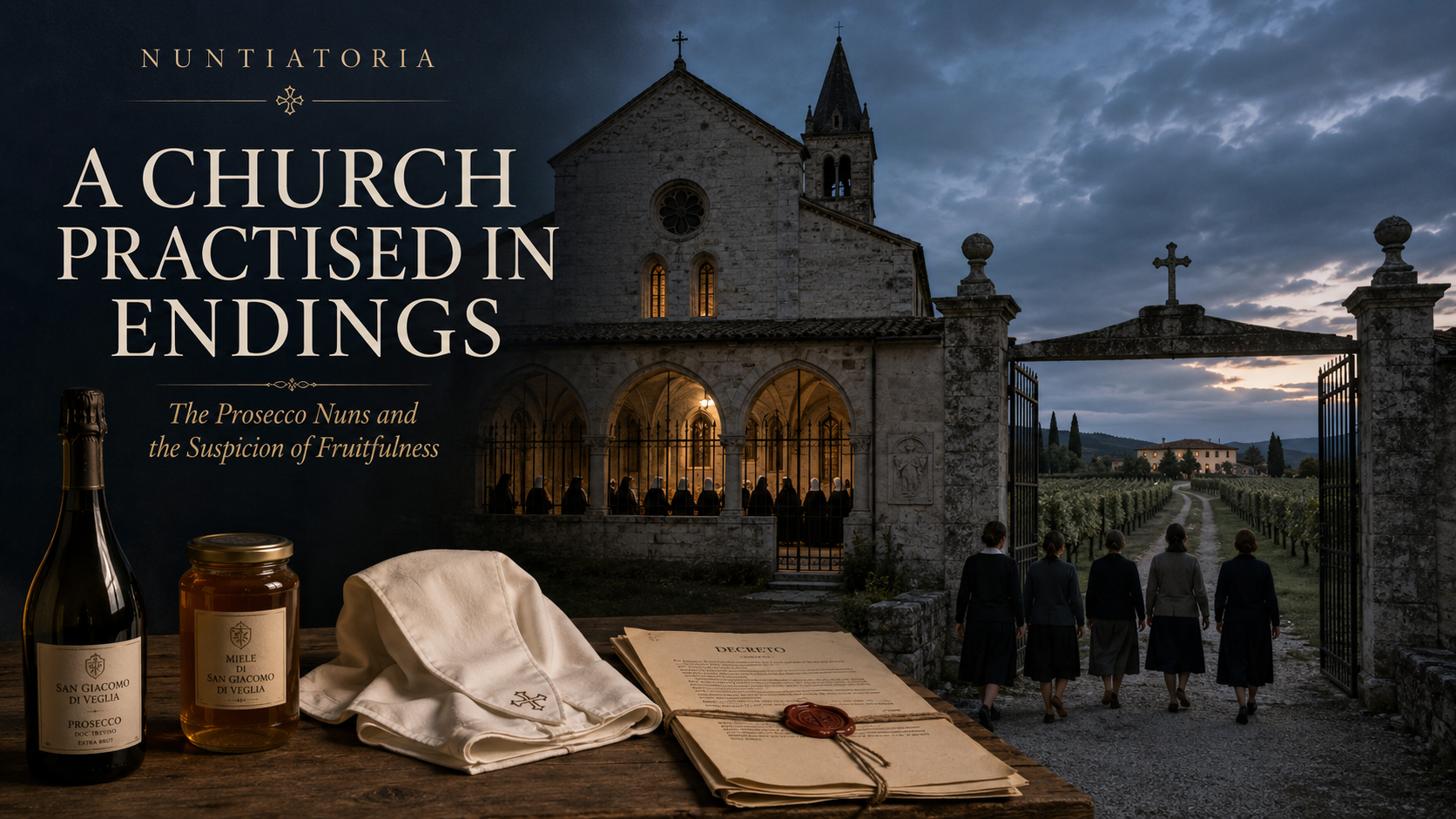
A Church Practised in Endings: The Prosecco Nuns and the Suspicion of Fruitfulness
Five Cistercian women were not expelled from Catholicism for selling wine or being “too beautiful”. They sought release from their vows after two visitations, a contested commissariation and the division of their monastery. Yet behind the caricature lies a harder question: can a Church expert at closing religious houses still correct vigorous communities without extinguishing the life it claims to seek?

The tabloid version of the story is wrong in almost every important noun and verb. Five attractive, entrepreneurial nuns were not expelled from the Catholic Church for selling prosecco. Their vows were not revoked as punishment for appearing on television. No ecclesiastical decree declared an abbess too beautiful for the cloister.
What happened at the Cistercian Monastery of Saints Gervasius and Protasius in San Giacomo di Veglia was more complicated and more serious. A young abbess revived the public and economic life of an ancient religious house. Sisters complained about her government. Two canonical investigations followed. Rome placed the monastery under a pontifical commissioner. The abbess left with permission; five other women subsequently departed the enclosure and joined her. Twenty sisters remained. A year later, five professed women requested and received an indult releasing them from the Cistercian Order and from the obligations of their vows.¹
They were not excommunicated. They remain Catholics. They are no longer Cistercian nuns.
That distinction matters, not least because the secular press instinctively translates every canonical separation into expulsion from “the Church”. Yet correcting the headline does not dispose of the story. It merely allows the real one to emerge.
This was a conflict between authority and charisma, enclosure and publicity, obedience and personal loyalty. It was also an ecclesiastical failure. Whatever judgement is eventually made about the conduct of Mother Aline Pereira Ghammachi, a community of women who had vowed to seek God together was divided by a process intended to restore its common life. Canonical order was secured. Communion was not.
The consequences reach beyond one monastery because the affair unfolded within a European Church losing religious women by the thousand. It raises a question which official statements do not answer: whether ecclesiastical institutions formed by decades of contraction have become more skilled at managing extinction than at correcting imperfect growth.
Mother Aline was not the conventional face of a cloistered abbess. Born in Macapá, in the Brazilian Amazon, she studied economics and commerce before coming to Italy in 2006. She made temporary profession in 2008, solemn profession in 2011 and was elected abbess in 2018 at the age of thirty-three.²
Her monastery stood in the Veneto, within the country of Prosecco, but its agricultural work was no modern publicity invention. The Cistercian vocation has always united contemplation with disciplined labour. Monasteries do not subsist upon incense. Buildings must be repaired, sisters fed, land maintained and heating bills paid. Cistercians helped shape the fields, vineyards, mills and waterways of medieval Europe precisely because their search for God did not absolve them from material reality.
Under Mother Aline, that material reality acquired an unusually modern presentation. The monastery cultivated vegetables, fruit, lavender, aloe, honey and vines. Its sisters made syrups, creams, ointments and essential oils. When rising energy costs threatened the house, a collaboration was established to produce organic Conegliano Valdobbiadene Prosecco Superiore from its vineyard. The grapes were harvested at night. The bottles were promoted. Journalists arrived. The monastery organised garden work involving people with disabilities. By 2024, it was being presented as an international community of twenty-six women living the Benedictine rhythm of ora et labora while making intelligent use of the land entrusted to them.³
Mother Aline understood something many ecclesiastical institutions do not: invisibility is not the same as humility. She spoke to journalists, appeared before cameras and marketed the monastery’s products with the confidence of a woman educated in business and communication. A cloistered community that might otherwise have been known only to its neighbours acquired a public identity.
That success contained risks. An abbess is not a chief executive. A monastery is not a lifestyle brand. Publicity can place personality where the rule ought to stand, and commercial work can cease to serve contemplation by gradually consuming it. Religious authority has both the right and the duty to investigate whether an influential superior has confused loyalty to herself with obedience to the institute.
The allegations against Mother Aline therefore cannot be brushed aside merely because her ventures proved successful. Four sisters objected to measures she had taken against them. The Cistercian Order later stated that those measures had not respected the law of the Church or of the Order. An extraordinary visitation was conducted, after which the Dicastery for Institutes of Consecrated Life placed the monastery under pontifical commissariation in January 2023.
Mother Aline appealed and, significantly, succeeded. The decree was suspended and annulled. Rome then entrusted a second apostolic visitation to persons outside the Cistercian Order. According to the Order’s public account, that investigation essentially confirmed the problems found by the first. A new decree followed, appointing Mother Martha Driscoll, the emeritus Trappist abbess of Gedono in Indonesia, as pontifical commissioner.⁴
These facts prevent the affair from being reduced honestly to jealous officials punishing a popular nun. The first decision was reviewed; an independent visitation followed; the concerns were judged serious enough for intervention to be renewed. No responsible editorial can declare Mother Aline vindicated simply because she is articulate, photogenic and enterprising.
Nor, however, does the bare existence of two visitations settle the matter in favour of the authorities.
The public has not been shown the evidence, the findings or the reasoning in sufficient detail to judge the proportionality of the response. The Cistercian statement speaks generally of unlawful measures and confirmed problems. Mother Aline denies the accusations and maintains that factional hostility, prejudice and resistance to her government drove the process. Her claim that the Abbot General once called her “too young and too beautiful” comes from her own account and appears to concern a remark allegedly made in jest; it was not a canonical charge. The phrase became the story because it was vivid. It explained nothing.
Confidentiality is often necessary in religious disputes. Sisters who complain against a superior must be protected, as must the good name of the accused. Yet opacity has a cost. When an authority publicly displaces a named superior while withholding the substance of the case, it asks the faithful to confuse legal competence with demonstrated wisdom. A decree may be valid without being persuasive. An intervention may be justified in principle while proving destructive in execution.
The renewed commissariation took effect in April 2025. Mother Aline asked to leave the monastery for a period and did so with the commissioner’s agreement. On 29 April, three solemnly professed sisters, one temporarily professed sister and a novice left the monastery and later rejoined her. The Order described their departure as clandestine. The women said the atmosphere had become unbearable and that they feared being separated and transferred to different houses. Twenty sisters remained at San Giacomo and accepted the commissioner.⁵
Both facts must be held together. The women who left were not the whole community. A substantial majority stayed, and their vocation, judgement and obedience cannot be written out of the story merely because the dissidents proved more attractive to the media. Yet the departure was not trivial. The intervention did not reconcile the monastery. It divided it into those who accepted restored canonical government and those who believed that remaining together required leaving the enclosure.
Mother Aline and her companions eventually settled in a villa provided by a benefactor. They formed an association called 100 Volte Melius—“one hundred times better”—continued making honey, aloe products and essential oils, and developed work intended to assist people suffering from anxiety, depression and loneliness. Laywomen and other former religious joined their household. They continued to pray and to describe their common life in spiritual and quasi-monastic terms, but they no longer constituted a recognised religious community.
That arrangement could not remain canonically ambiguous. One cannot privately recreate the state of religious life after separating from the institute whose rule, government and public vows gave that life its ecclesial form. A veil, a common timetable and personal promises of chastity do not make an autonomous monastery. Consecrated life belongs to the Church, not merely to those who experience themselves as called to it.
The professed women were reportedly given the available choices: return to San Giacomo, transfer to another monastery, or leave the Cistercian Order. They chose the third. On 11 May 2026, the competent dicastery granted an indult of departure to Mother Aline and four others. Under canon law, such an indult, once legitimately granted and communicated, dispenses the religious from her vows and from the obligations arising from profession. It is ordinarily requested by the religious herself for the gravest reasons; it is not the same juridical act as dismissal.⁶
The canonical ending was therefore not an outrage. By then it was almost inevitable. The five women had decided that they would not return to their former monastery or transfer within the Order. Their new association could not remain indefinitely suspended between lay initiative and religious profession. The indult recognised the life they had chosen.
The failure came earlier. It lay in the inability of the monastery, the Order and the dicastery to separate whatever was fruitful in the community from whatever had become disordered within it.
That is the point at which San Giacomo ceases to be merely an Italian curiosity.
The most recent global statistics record 589,423 women religious, 9,805 fewer than in the preceding reporting period. Europe alone lost 7,338. The decline is neither sudden nor temporary. Convents have closed for decades; provinces have merged; apostolates have disappeared; buildings raised through generations of sacrifice have been sold because no women remain to inhabit them.⁷
This vast contraction rarely produces scandal. A community may age towards extinction without visitation or intervention. A convent can pass year after year without a novice and still be praised for discerning its future with serenity. Its eventual closure will be announced in the gentle language of gratitude, transition and completed mission. No one is blamed. No one is investigated. Decline has become normal.
Growth is treated differently. A community that attracts younger members, develops a strong identity, recovers demanding forms of observance or gathers around an influential founder soon encounters another vocabulary: rigidity, imbalance, personality cult, insufficient integration, defective communion. Sometimes those warnings identify real dangers. Intense communities can conceal coercion; founders can demand personal allegiance in the name of God; enthusiasm can become sectarianism.
The problem is not that flourishing communities are tested. They must be.
The problem is the recurring impression that sterility is managed while fecundity is audited.
San Giacomo does not stand alone. The Franciscan Friars of the Immaculate had grown to a worldwide family of approximately six hundred members when the Holy See placed the male institute under an apostolic commissioner in 2013. There were genuine internal divisions, including complaints about government and the increasing place of the traditional Roman Rite. The visitation was not invented as a pretext. Yet the resulting decree did more than address government: it restricted the institute’s celebration of the older liturgy, intertwining the correction of administrative problems with the suppression of a visible feature of its charism and growth.⁸
The case proved neither that every flourishing institute is innocent nor that every Roman intervention is persecution. It demonstrated something subtler: once the machinery of correction begins, authorities can find it easier to neutralise the distinctive life of a community than to preserve it while remedying its faults.
The fate of the Fraternity of the Holy Apostles in Brussels was starker. Archbishop André-Joseph Léonard established it in 2013 to foster priestly vocations and a visible common life. Within three years it had six priests and twenty-one seminarians. The Archdiocese of Mechelen-Brussels acknowledged the value of the work but announced that it would no longer receive the fraternity. Its publicly stated concern was that most of the seminarians came from France, whose dioceses also suffered a shortage of priests; retaining them in Brussels was judged deficient in episcopal solidarity. The fraternity was subsequently dissolved.⁹
A Church suffering from a shortage of priests had found a community attracting them, then treated the geographical origin of those vocations as a reason to dismantle the structure that had gathered them. The scarcity remained. The successful response to it did not.
In Britain, the Marian Franciscans met a quieter ending in May 2026. The friars formally requested their own dissolution, and the Bishop of Portsmouth granted it. The legal act was voluntary. The circumstances were less so. Their own explanation stated that, despite growth in numbers and apostolic activity, they had been unable to secure the practical and canonical support required for formation, sponsorship and future priestly ordinations. Having found no workable path by which the community could continue in its existing form, they voted to cease to exist.¹⁰
The cases differ in important respects. The Franciscans of the Immaculate had internal divisions. San Giacomo faced allegations serious enough to survive an independent visitation. The Marian Franciscans petitioned for dissolution themselves. The Holy Apostles depended heavily upon foreign candidates. These are not interchangeable episodes in a conspiracy against tradition.
Their differences make the shared question more compelling. What capacity does ecclesiastical government possess to repair a young or vigorous community without first rendering its survival impossible?
The Church cannot answer by pointing only to jurisdiction. No one seriously disputes that Rome can commission a monastery, that a bishop can dissolve an association under his authority, or that religious institutes must obey their approved constitutions. The question is not whether authority possesses power. It is whether power has been exercised towards the end for which it was given.
The purpose of ecclesiastical government is not the production of administratively compliant ruins. Law serves communion, justice and salvation. A successful intervention should protect the vulnerable, correct abuses, preserve genuine vocations and rescue whatever is sound within a charism. It should not regard the disappearance of the problem as equivalent to the healing of the community.
Our Lord’s image is exact: “Every one that beareth fruit, he will purge it, that it may bring forth more fruit.” Pruning is necessary because fruitfulness matters. The branch is not purified by being severed from the vine; nor is the gardener vindicated merely because the garden has become easier to control.
This is the governing contradiction revealed at San Giacomo. A Church desperate for vocations encountered a monastery containing youth, international membership, economic imagination and public visibility. Those gifts did not prove its abbess innocent of defective government. They did mean that the stakes of intervention were unusually high.
A wise authority would have needed to do several things at once: hear the complaining sisters without prejudging the abbess; test allegations without permitting factions to govern the process; correct the superior without destroying confidence in the office; preserve the monastery’s economic work without allowing publicity to deform enclosure; protect the twenty who remained without dismissing the five who left as merely disobedient; and make every effort to prevent personal loyalty from hardening into permanent separation.
Perhaps all this was attempted privately. The outcome gives little reason to believe it succeeded.
A Church practised in endings knows how to close a convent, dissolve an association, merge a province and regularise the status of those who depart. It can produce decrees, transfer property and settle canonical obligations. These skills are necessary, but they belong to administration rather than renewal.
Renewal requires a different competence: the discernment to recognise grace within human disorder, the patience to discipline zeal without humiliating it, and the courage to let a charism remain distinctive after its excesses have been corrected. Beginnings are untidy. Young communities are rarely born with perfect constitutions, seasoned leaders and mature internal cultures. If every imperfection is treated as evidence that the experiment itself was mistaken, only institutions already old enough to be dying will appear safe.
The Church’s history does not permit such timidity. Religious life was not created by administrators discovering communities without risks. It was created by the Church recognising supernatural fruit within difficult personalities, unstable beginnings and movements that required both protection and correction. Authority served renewal when it gave those movements form without depriving them of life.
No such romantic conclusion can yet be drawn about Mother Aline. She may have been unjustly traduced. She may have governed badly. The truth may include both factional hostility and serious errors of judgement. Her media persona, new association and determination to preserve a common life outside the Order may inspire some observers and trouble others. There is insufficient public evidence to canonise or condemn her.
There is enough evidence to judge the result.
One monastery became two communities. Twenty women remained behind the enclosure. Others followed the former abbess into an unrecognised household. Five professed religious concluded that release from vows offered a more tolerable future than continued life within their Order. The Church settled their status but did not restore their communion.
That is not a victory for rebellion. It is not a victory for authority either.
The prosecco gave the press its picture. The alleged remark about beauty supplied its headline. Neither is the story.
The story is of a Church presiding over the disappearance of religious life while still uncertain how to govern communities that show signs of vitality. It is of canonical processes whose legitimacy does not guarantee their fruitfulness. It is of ecclesiastical authorities able to identify disorder but less visibly able to preserve the gifts entangled within it.
The future of religious life will not be secured by exempting vigorous communities from scrutiny. Nor will it be secured by treating every distinctive, demanding or publicly successful foundation as a problem awaiting correction. It will depend upon authority recovering the art of pruning without uprooting.
A gardener who never prunes permits disease to spread. A gardener who answers every diseased branch by removing the tree will eventually possess a perfectly ordered field in which nothing grows.
¹ Diocese of Vittorio Veneto, “Comunicato del Vescovo di Vittorio Veneto del 19 giugno 2026,” 19 June 2026; Cistercian Order, “Communication on the Situation at San Giacomo di Veglia,” 1 May 2025, published by the Alliance for International Monasticism, 3 May 2025.
² “Vittorio Veneto, è una brasiliana di 33 anni la nuova badessa di clausura del monastero,” Tribuna di Treviso, 26 February 2018.
³ “Cistercian Monastery of Vittorio Veneto: Where the Nuns Produce an Organic Prosecco by Harvesting at Night,” FIRSTonline, 8 March 2024; “‘Beautiful’ Prosecco-Selling Nuns Expelled from Church,” The Times, 22 June 2026.
⁴ Cistercian Order, “Communication on the Situation at San Giacomo di Veglia.”
⁵ Ibid.
⁶ Diocese of Vittorio Veneto, “Comunicato del Vescovo”; Code of Canon Law, canons 691–692. Canon 691 reserves an indult of departure for a perpetually professed member to the competent authority and requires the religious to petition for it for the gravest reasons; canon 692 provides that a legitimately granted and communicated indult entails dispensation from the vows and all obligations arising from profession.
⁷ Agenzia Fides, “Catholic Church Statistics 2025,” 17 October 2025.
⁸ Michael J. Miller, “The Vatican and the Franciscan Friars of the Immaculate,” Catholic World Report, 31 July 2013; “Pope Restricts Use of Latin Mass by Franciscan Friars of the Immaculate,” National Catholic Reporter, 6 August 2013.
⁹ Archdiocese of Mechelen-Brussels, “Communiqué concernant la Fraternité des Saints Apôtres,” 15 June 2016; “À Bruxelles, le diocèse cesse d’accueillir une fraternité de prêtres et séminaristes français,” La Vie, 17 June 2016.
¹⁰ Bishop Philip Egan, “The Marian Franciscans,” Diocese of Portsmouth, 27 May 2026; Edward Pentin, “Flourishing Traditional Marian Franciscan Community in UK to Be Dissolved,” National Catholic Register, 28 May 2026; Thomas Colsy, “Questions Remain after Suppression of the Marian Franciscans,” Catholic Herald, 4 June 2026.
RELATED ARTiCLES


LATEST ARTICLES
- October Beneath Our Lady’s StandardThe Feast of the Most Holy Rosary commemorates the 1571 victory at Lepanto and evolved through papal endorsements, especially under Pope Leo XIII in the late 19th century. October, dedicated to the Rosary, serves as a reminder of prayer’s significance during trials, fostering both personal and communal spiritual resilience in Catholic life.
- Marriage Endures as Britain’s Common Christian Framework RecedesRecent ONS data indicates that 83.7 per cent of couples married in 2015 remained together by their tenth anniversary. However, Britain faces declining fertility rates, increasing abortion statistics, an ageing Christian demographic, and a reliance on migration for population growth. The critical challenge lies in transmitting family, faith, and culture across generations.
- Vatican III by Stealth? When “Reception” Becomes RevisionArchbishop Anthony Randazzo warns against the misuse of synodality as a means to eliminate perceived “dead wood” from the Church, stressing the importance of faithfully interpreting Vatican II. He argues that authentic renewal relies on the continuity of the Church’s doctrine, warning that unchecked synodality may lead to revisions of established teachings rather than genuine reception.
- Today’s homily: St Jerome of BethlehemThe homily reflects on St Jerome’s profound transformation from a scholar enamoured with classical literature to a devoted servant of Christ. It highlights the necessity of allowing faith to permeate one’s life, emphasising that merely possessing knowledge of doctrine is insufficient without a corresponding internal change. Jerome’s legacy urges believers to let Scripture guide their lives authentically.
- Today’s Mass: September 30 St Jerome of BethlehemSaint Jerome, born in Dalmatia in 329, was a prominent Doctor of the Church, known for his scripture translations and contributions to Catholic teachings. He emphasised monastic life and the Divine Office. Jerome died in Bethlehem on 30 September 420. Today also marks the name day of His Grace, Jerome OSJV of Selsey.
CURRENT EDITION


DAILY MASS ONLINE
One of the earliest online apostolates dedicated to the Traditional Latin Mass, Old Roman TV began broadcasting the Holy Sacrifice on the Feast of the Assumption, 15 August 2008. During the COVID-19 pandemic, additional programming — devotions, catechesis, and conferences — was added to support the faithful in prayer and formation.
Support the daily Holy Mass on Old Roman TV by offering a Mass intention — for loved ones, thanksgiving, or the repose of souls. Your intention helps sustain the sacred liturgy and brings grace to those you remember before God’s altar.
SUPPORT THE DAILY MASS ONLINE
Likely the world’s longest-running daily online broadcast of the
Traditional Latin Mass, streaming faithfully since the
Feast of the Assumption 2008.

This apostolate cannot continue without immediate help
Please support us with a contribution toward
chapel rent, sacristy supplies, operating costs, and web-hosting.
Our essential monthly costs reach £1,000.
MASS INTENTIONS
If your offering is for a Mass Intention, kindly complete the form below in full so we may correctly match it to your donation. For anniversary intentions — birthdays, wedding anniversaries, anniversaries of death — please be sure to include the relevant date.


Today’s Mass Propers
- Today’s Mass: September 30 St Jerome of Bethlehem
 Saint Jerome, born in Dalmatia in 329, was a prominent Doctor of the Church, known for his scripture translations and contributions to Catholic teachings. He emphasised monastic life and the Divine Office. Jerome died in Bethlehem on 30 September 420. Today also marks the name day of His Grace, Jerome OSJV of Selsey.



Leave a Reply