
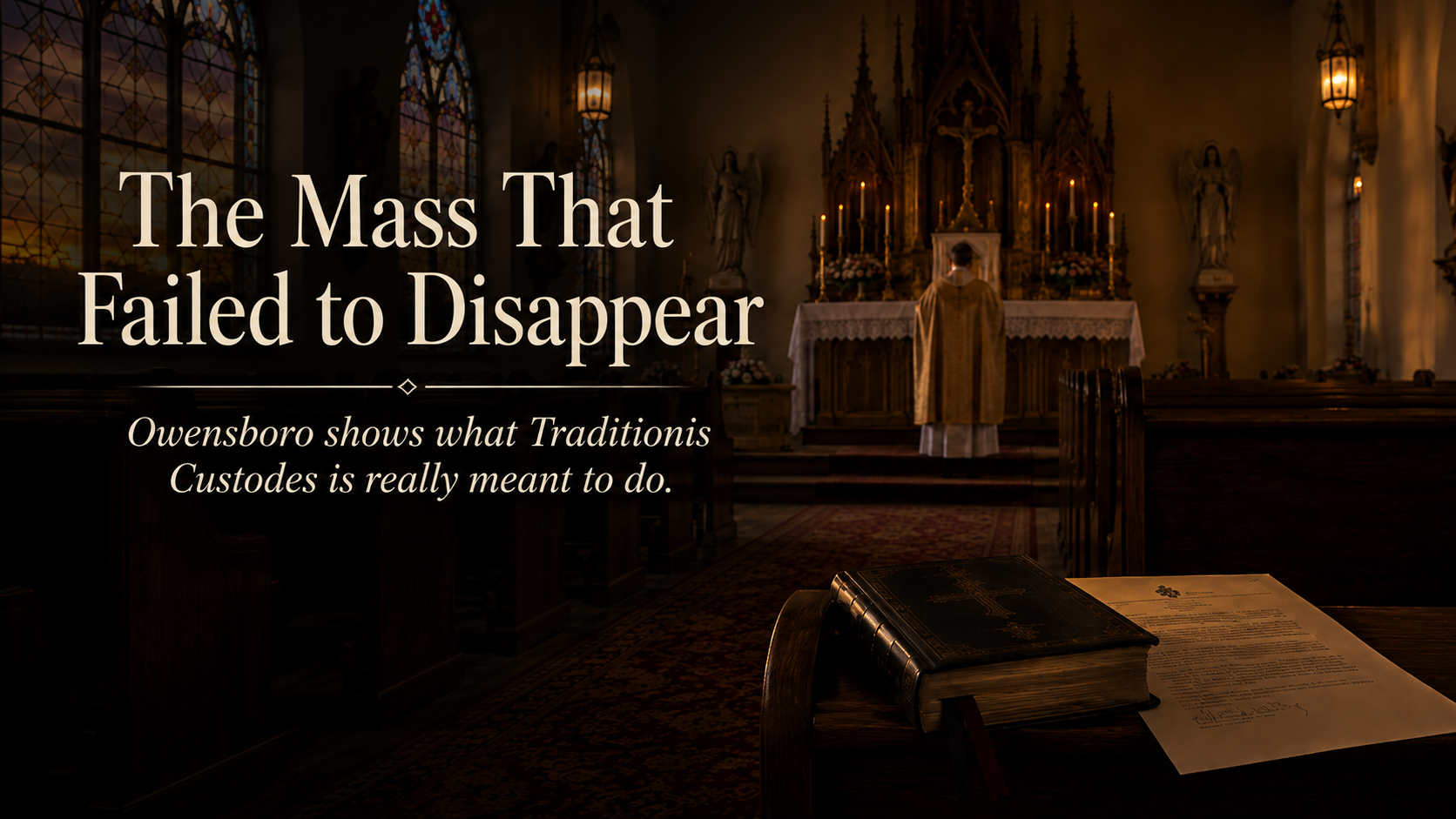
The Mass That Failed to Disappear: Owensboro exposes the administrative logic of Traditionis Custodes
In a Church that speaks incessantly of listening, accompaniment and generous inclusion, Catholics attached to the Church’s inherited Roman liturgy are being listened to only long enough to be told where they must eventually go.

The Traditional Mass at Immaculate Conception in Earlington is not being withdrawn because the congregation collapsed, the priest rebelled, or the parish became a centre of organised dissent. It is being withdrawn because the faithful remained attached to it.
On Sunday 28 June, the oldest Catholic church in Hopkins County, Kentucky, is scheduled to offer its final Mass according to the Roman Missal of 1962. The parish has celebrated it for nearly a decade. It is the only weekly Traditional Latin Mass in the Diocese of Owensboro, which covers the thirty-two westernmost counties of Kentucky. Parish staff say the church is “pretty full” for the traditional Mass, with many worshippers travelling from beyond the parish boundaries. None of that has saved it.¹
The reason is set out with unusual candour in a letter sent on 18 May by Bishop William Medley to the parish priest, Fr David Kennedy. The bishop explains that the Holy See had previously granted permission for the Mass to continue, but had stipulated that any application for renewal must include a further relatio: a report giving attendance figures and recounting the steps taken “to lead the faithful who are attached to the antecedent liturgy” towards the post-conciliar liturgical books. Bishop Medley writes that he cannot demonstrate that this condition has been met and therefore considers himself to have “no standing” to request an extension. The Mass must consequently cease after 30 June.²
That paragraph is the real story. It supplies in black and white what the language of pastoral sensitivity has so often concealed. The permission was never intended to provide a secure home for Catholics attached to the older rite. It was a temporary licence issued on the understanding that the attachment itself would be gradually overcome. Rome did not merely ask whether the community remained faithful, peaceful and in communion with its bishop. It required evidence that the community was moving away from the very liturgy for which the permission had been granted.
The arrangement is therefore designed to fail whenever the pastoral provision succeeds. A thriving community remains attached to the traditional Mass because the traditional Mass continues to nourish it. That continued attachment then becomes the reason why the provision cannot be renewed. The priest who faithfully serves the people placed in his care produces the evidence that condemns their future. The more securely the faithful find a spiritual home, the more clearly the required transition has not taken place.

This is not accompaniment. It is managed extinction.
Bishop Medley’s proposed substitute removes any lingering ambiguity about what is being suppressed. He suggests that Fr Kennedy obtain a Latin edition of the Missal of Paul VI and grants what he calls singular permission for it to be celebrated ad orientem. The faithful may therefore keep Latin. They may keep the eastward orientation. They may presumably keep chant, incense, silence and much of the outward appearance associated with traditional worship. What they may not keep is the older Roman liturgy itself.
The distinction matters. For years, Catholics attached to the traditional Mass have been told that their concerns could be met by a more reverent celebration of the reformed rite. The Owensboro letter makes clear that this is not simply an attempt to correct liturgical abuse or restore sacrality. A Latin and ad orientem Novus Ordo is acceptable precisely because it remains the Novus Ordo. The object of the policy is not the elimination of Latin, ceremonial solemnity or eastward celebration. It is the elimination of the antecedent liturgical books as a normal and enduring part of Catholic life.
Bishop Medley is not inventing this policy. He is administering it with greater honesty than many others. Traditionis Custodes declared the books promulgated by Paul VI and John Paul II to be the “unique expression” of the lex orandi of the Roman Rite. Its accompanying directives required bishops to determine whether existing traditional communities should be retained and prohibited the creation of new groups. The subsequent Responsa ad dubia stated still more plainly that the aim was to return every diocese to “a unitary form of celebration.” In 2023, Rome reserved to the Apostolic See dispensations allowing the 1962 Missal to be used in parish churches.³
The result is an extraordinary centralisation disguised as episcopal responsibility. Traditionis Custodes begins by describing the diocesan bishop as the moderator and guardian of the liturgical life of his Church. Yet a bishop who wishes to permit an existing congregation to continue worshipping in an existing parish church must seek approval from Rome, submit reports to Rome, satisfy criteria imposed by Rome and renew the arrangement when Rome’s time-limited consent expires. The local ordinary is told that liturgical governance belongs to him, then denied the competence to make the decision that matters.
Bishop Medley’s assertion that he has “no standing” is therefore as revealing as the condition attached to the relatio. He writes not as a pastor discerning the spiritual needs of his own diocese, but as the local executor of an administrative decision whose desired outcome has already been fixed. Yet the Second Vatican Council itself taught that bishops govern their particular Churches as vicars and legates of Christ, exercising authority proper to them, and “are not to be regarded as vicars of the Roman Pontiffs.” Their authority is regulated by the supreme authority of the Church, but it is not supposed to be emptied of meaningful pastoral judgement.⁴
Owensboro is not an isolated case. In Washington, Cardinal Wilton Gregory restricted celebrations according to the 1962 Missal to three designated non-parochial locations from September 2022. In Arlington, a diocese with twenty-one traditional Mass locations, Bishop Michael Burbidge’s 2022 implementation reduced provision to eight sites, with only three parish churches receiving temporary two-year dispensations. In Charlotte, Bishop Michael Martin announced in 2025 that the traditional Mass would cease in parish churches and be concentrated in a single designated chapel, describing this as the completion of an “orderly transition.”⁵
There are differences between these bishops, and they should not be flattened into a single caricature. Arlington has now provided an instructive counterexample. On 19 June, Bishop Burbidge announced that a new chaplaincy of Our Lady of Victory, administered by the Priestly Fraternity of Saint Peter, would begin on 1 July 2026 to serve Catholics seeking the older Mass and sacraments. It does not repeal Traditionis Custodes, nor restore the twenty-one locations that existed before it, but it demonstrates that a bishop determined to preserve communion can seek a constructive and recognisably pastoral arrangement.⁶
That contrast makes the Owensboro decision more painful, not less. The only traditional Mass in thirty-two counties is not being moved to a chaplaincy, entrusted to an institute established for the older rite, or given a stable non-parochial home. It is being replaced. The faithful are not being accommodated within the Church’s lawful diversity. They are being invited to retain selected aesthetic features while surrendering the liturgical inheritance to which they are actually attached.
This is happening only three months after Pope Leo XIV called upon the French bishops to find “concrete solutions” permitting the “generous inclusion” of communities attached to the Vetus Ordo. The Pope described the liturgical division as a “painful wound” affecting the Mass, the sacrament of unity. His language was markedly more paternal than that which accompanied the promulgation of Traditionis Custodes. Yet generous inclusion cannot mean allowing people to remain only while arranging for their attachment to disappear. A wound is not healed by removing the patient from the room.⁷
Bishop Medley says that he delayed acting after the death of Pope Francis and the election of Leo XIV in the hope that the new Pope might reconsider the restrictions on Masses in parish churches. He adds that the January Consistory “specifically chose not to review Traditionis Custodes.” That description requires qualification. The official Vatican account records that the cardinals, constrained by time, selected mission and synodality from four proposed subjects; liturgy and the reform of the Roman Curia were left aside. The cardinals did not conduct a review and vote to retain the policy. They chose not to discuss liturgy during that meeting.⁸
The distinction is important because administrative inertia should not be mistaken for a considered judgement. A policy capable of closing flourishing communities should not acquire quasi-permanent authority merely because the body invited to examine it ran out of time.
The omission has now become more conspicuous. The second extraordinary Consistory, meeting in Rome as the Owensboro community prepares to lose its Mass, again has no dedicated discussion of the liturgical question. Its official programme asks the cardinals to consider the divisions afflicting local Churches and the expectations of those “whom the Church is called to listen to, but perhaps does not yet hear sufficiently.” It would be difficult to devise a more exact description of Catholics attached to the traditional liturgy. Yet their situation is absent from the prescribed agenda.⁹
Here the contradiction at the centre of the contemporary Church becomes impossible to ignore. Synodality promises listening before judgement, discernment before decision and patient accompaniment rather than predetermined outcomes. It praises legitimate diversity, local experience and the sensus of communities whose voices have supposedly been neglected. But when traditional Catholics speak, the destination has already been selected. They may describe what the old Mass gives them, explain why their children love it, point to converts, vocations, confessions and growing congregations, but none of this alters the administrative objective. They are heard only as subjects of transition.
The language is pastoral; the mechanism is coercive.
This is the precise reverse of Benedict XVI’s approach. Benedict did not deny the authority of the reformed liturgical books, nor did he permit traditional communities to treat the ordinary form as invalid. He expressly said that a total exclusion of the new rite would be inconsistent with recognition of its value and holiness. But he coupled that requirement with a principle of ecclesial continuity: “What earlier generations held as sacred, remains sacred and great for us too,” and could not suddenly be wholly forbidden or treated as harmful.¹⁰
That was a genuinely reciprocal settlement. Traditional Catholics were required to acknowledge the legitimacy of the reformed books; the wider Church was required to acknowledge the sacredness of the inherited ones. Traditionis Custodes retained the first obligation and discarded the second. The traditional faithful must recognise the new liturgy, while the authorities reserve the right to remove the old. Communion has become asymmetrical: one side must accept coexistence; the other may plan its extinction.
The timing is also pastorally reckless. On 1 July, only three days after the final traditional Mass in Earlington, the Society of Saint Pius X intends to consecrate four bishops at Écône without a pontifical mandate. Rome has warned that the act would constitute a schismatic act with grave canonical consequences. Nothing about the Owensboro decision justifies disobedience or resolves the canonical and doctrinal questions surrounding the Society. But it is futile to deny the effect such decisions have upon the wider crisis.¹¹
Rome is asking traditional Catholics to remain in full canonical communion while repeatedly demonstrating that full canonical communion may offer them less security for their liturgical life than irregularity. Every diocesan Mass suppressed, every parish community displaced and every temporary permission allowed to expire strengthens the argument of those who claim that the old rite can survive only beyond the reach of ordinary diocesan structures. The Holy See condemns the conclusion while continuing to supply the evidence from which it is drawn.
A wise policy would do the opposite. It would make obedience fruitful. It would ensure that Catholics who accept the authority of the Pope and their bishop are not penalised for doing so. It would isolate separatism by demonstrating that fidelity to the traditional liturgy and visible communion with Rome are not enemies. Suppression does not weaken the canonical margins. It recruits for them.
The Owensboro letter matters, then, far beyond one small Kentucky parish. It exposes a method of government in which the language of pastoral care conceals a preselected institutional end. Reports are requested, but the decisive datum is not whether the faithful are being sanctified. It is whether they are being moved. Attendance is counted, but flourishing does not strengthen the case for continuation; it confirms that the transition has failed. Local bishops are praised as guardians of liturgical life, then required to seek Roman permission to keep open what their own pastoral judgement may tell them should remain.
Pope Leo does not need to revive every provision of Summorum Pontificum in order to end this injustice. He need only replace the criterion of extinction with the criterion of communion. Communities using the older books can reasonably be required to profess the Catholic faith, recognise the validity and legitimacy of the reformed rites, reject separatism, obey lawful authority and contribute to the life of the wider Church. What cannot reasonably be demanded is that they prove their loyalty by ceasing to exist.
The faithful at Earlington did not fail to respond to pastoral care. They continued to come. They did not reject the Church. They remained in their parish, under their priest and bishop. They did not allow the Mass to become a museum piece. They kept it alive.
That is why the report could not be written.
Their offence was not rebellion. It was fidelity.
A Church that asks the world to believe in reconciliation should not make extinction the price of communion.
¹ Tyler Arnold, “Owensboro Bishop Ends Only Traditional Latin Mass in Western Kentucky,” EWTN News, 25 June 2026; Immaculate Conception Parish was founded in 1886 and has offered the traditional Mass for nearly a decade. The report cites parish staff concerning attendance and confirms that it was the only parish offering the rite in the diocese.
² William F. Medley, Bishop of Owensboro, letter to the Rev. David Kennedy, 18 May 2026, copy supplied to Nuntiatoria. The Diocese of Owensboro subsequently confirmed that the parish would implement the transition described in the letter.
³ Francis, Apostolic Letter Traditionis Custodes, 16 July 2021, arts 1–5; Congregation for Divine Worship and the Discipline of the Sacraments, Responsa ad dubia on Certain Provisions of Traditionis Custodes, 4 December 2021; Rescript concerning Traditionis Custodes, 20 February 2023.
⁴ Second Vatican Council, Dogmatic Constitution Lumen Gentium, 21 November 1964, no. 27.
⁵ Archdiocese of Washington, “Cardinal Gregory Issues Decree to Implement Pope Francis’ Traditionis Custodes,” 22 July 2022; Diocese of Arlington, “Bishop Burbidge Publishes Instruction for the Use of the Traditional Latin Mass,” 29 July 2022; Diocese of Charlotte, “Completing the Implementation of Traditionis Custodes,” 23 May 2025, subsequently updated to defer implementation until 2 October 2025.
⁶ Diocese of Arlington, “Bishop Michael F. Burbidge Announces Chaplaincy of Our Lady of Victory,” 19 June 2026.
⁷ Message of Pope Leo XIV to the Spring Plenary Assembly of the French Bishops’ Conference, conveyed by Cardinal Pietro Parolin, 24 March 2026; Vatican News, “Pope Writes to French Bishops on Education, Abuse, and Liturgy,” 25 March 2026.
⁸ Vatican News, “Consistory: Cardinals Choose Synodality and Mission as Themes for Reflection,” 7 January 2026. The cardinals selected two subjects from four because of time constraints; liturgy was not discussed.
⁹ Holy See Press Office, “Extraordinary Consistory, 26–27 June 2026: Programme of Proceedings,” 22 June 2026.
¹⁰ Benedict XVI, Letter to the Bishops accompanying the Apostolic Letter Summorum Pontificum, 7 July 2007.
¹¹ Dicastery for the Doctrine of the Faith, statement reported by Vatican News, “Cardinal Fernández to Pius X Society: Ordaining New Bishops Is Schismatic Act,” 13 May 2026; Society of Saint Pius X, announcement of episcopal consecrations scheduled for Écône on 1 July 2026.
RELATED ARTiCLES


LATEST ARTICLES
- Today’s Mass: October 02 Holy Guardian AngelsThe concept of guardian angels, although not universally accepted as an article of faith by the Church Fathers, is supported by scripture in both the Old and New Testaments. These angels serve as divine protectors, guiding and aiding the faithful, particularly children, and emphasising their role as intermediaries between God and humanity.
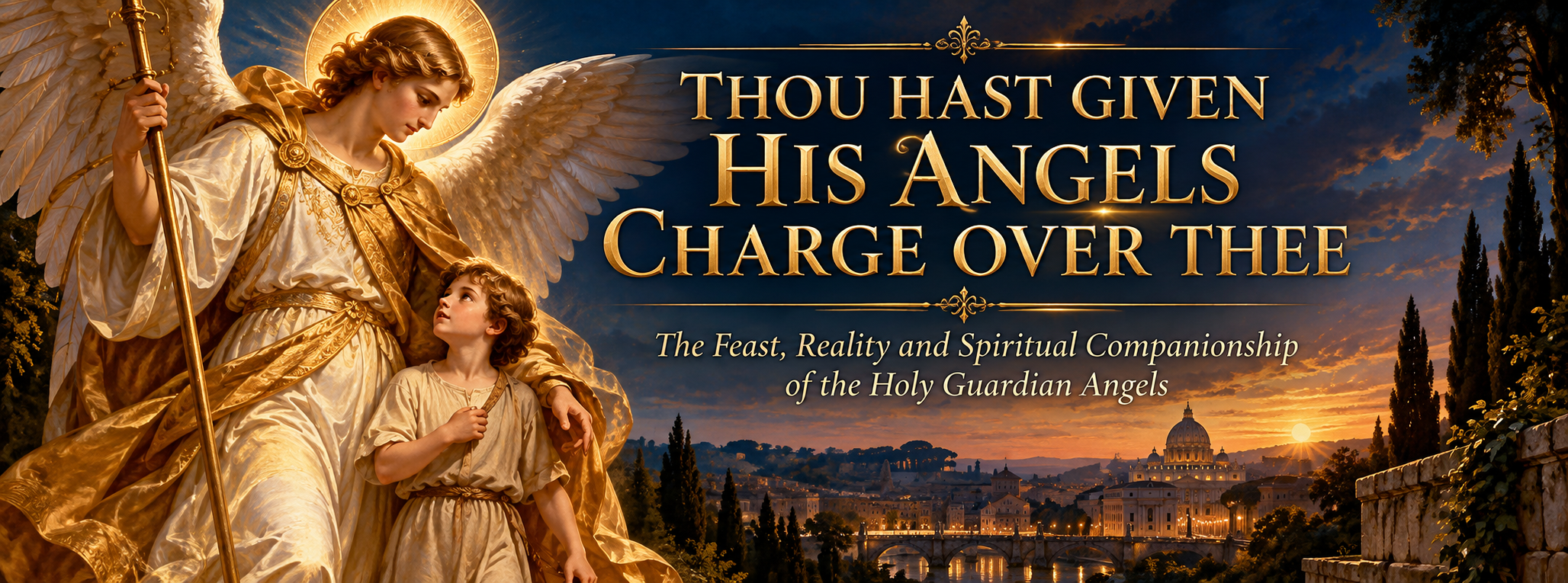
- Thou has given His angels charge over theeThe Feast of the Holy Guardian Angels on 2 October acknowledges that Divine Providence assigns a guardian angel to each individual for protection and guidance towards salvation. The theology reinforces the reality of angelic guardianship and its extension to communities, while Catholics are encouraged to integrate their Guardian Angel into various aspects of spiritual life.
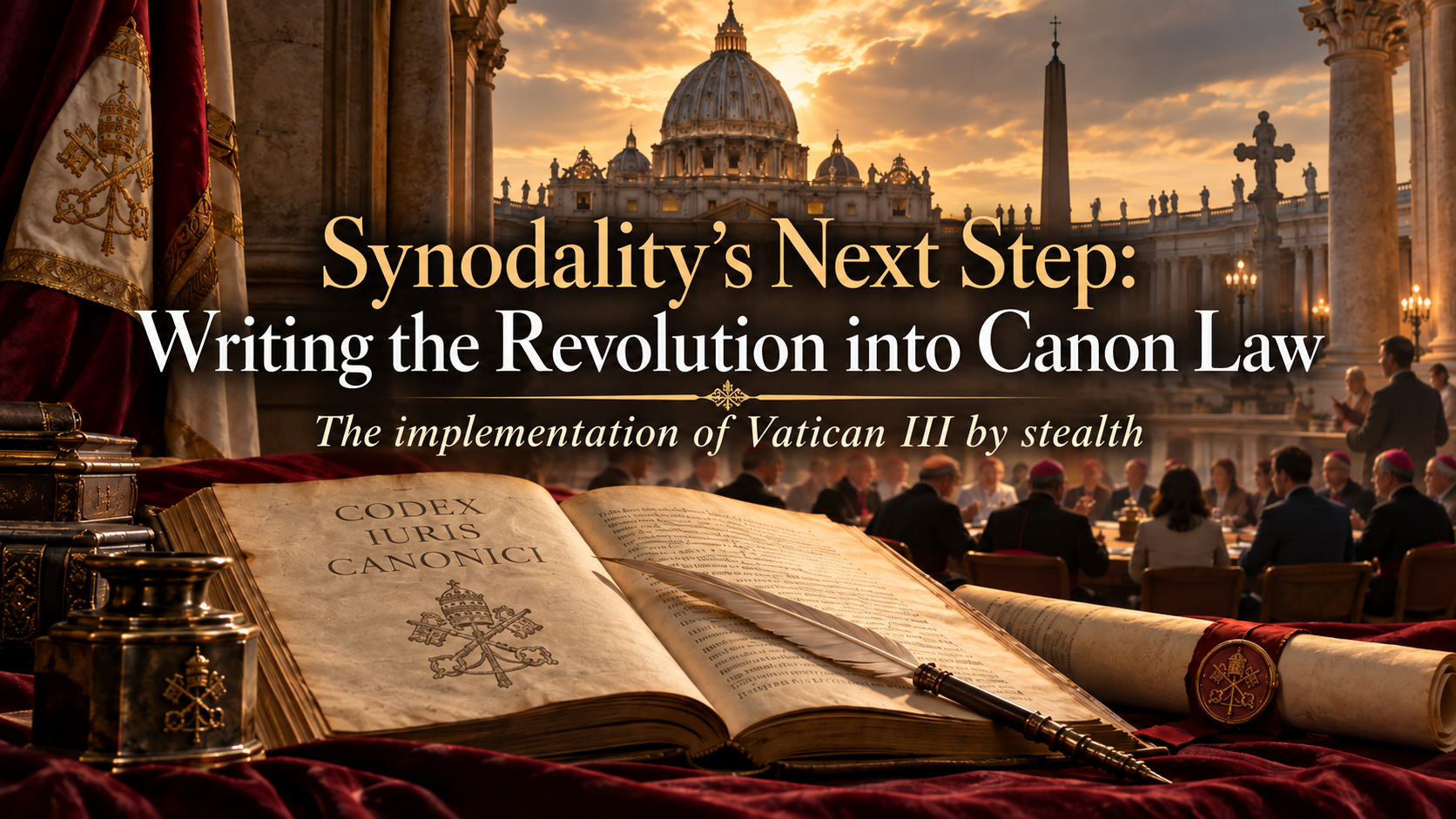
- Synodality’s Next Step: Writing the Revolution into Canon LawThe Vatican Canonical Commission’s proposals aim to embed synodal principles into law, resulting in compulsory councils and expanded lay governance. While not all amendments are unprecedented, their cumulative impact risks changing ecclesiastical authority’s practical exercise, asserting that compliance with the new structures may equate to adherence to the Church’s order.
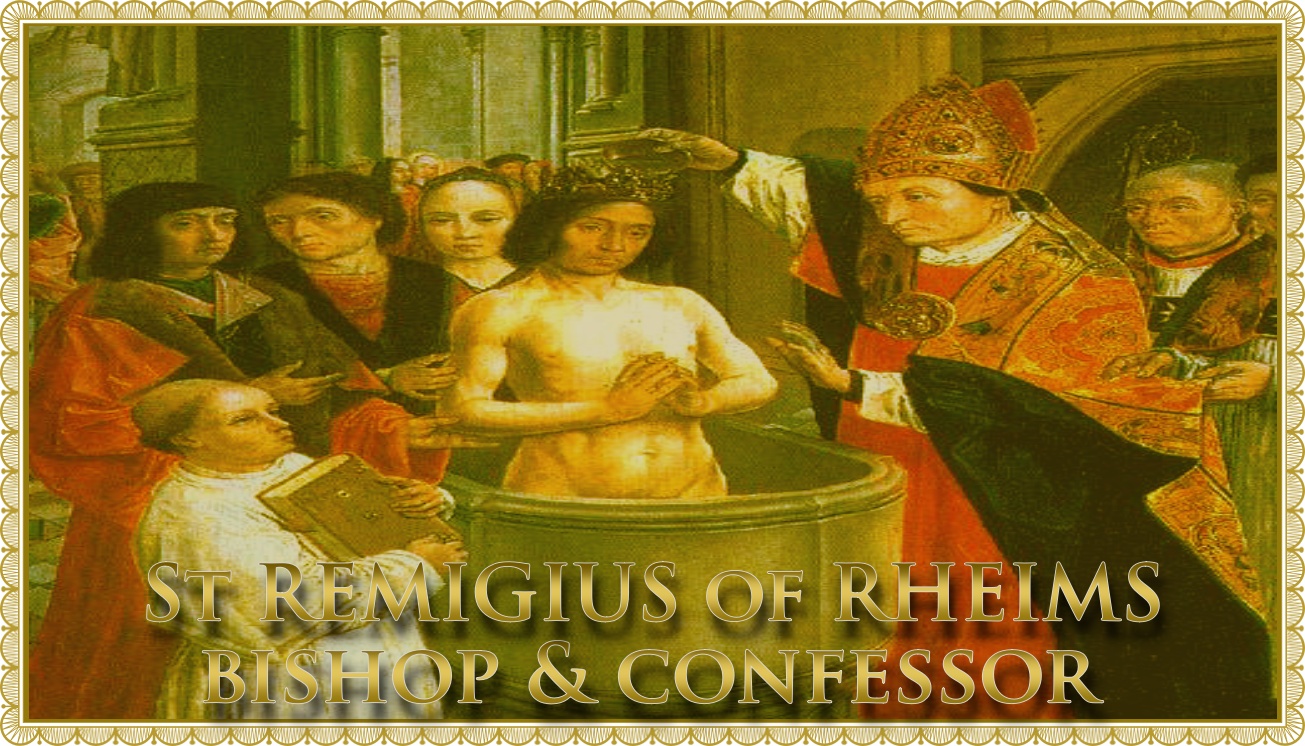
- Today’s Mass: October 01 St Remigius of RheimsSt Remigius of Rheims, a significant bishop and apostle of the Franks, was renowned for his learning, holiness, and miraculous deeds during his seventy-plus years of episcopacy. He was instrumental in spreading Christianity under King Clovis and left a lasting legacy before his death around 530.
- October Beneath Our Lady’s StandardThe Feast of the Most Holy Rosary commemorates the 1571 victory at Lepanto and evolved through papal endorsements, especially under Pope Leo XIII in the late 19th century. October, dedicated to the Rosary, serves as a reminder of prayer’s significance during trials, fostering both personal and communal spiritual resilience in Catholic life.
CURRENT EDITION


Today’s Mass Propers
- Today’s Mass: October 02 Holy Guardian Angels
 The concept of guardian angels, although not universally accepted as an article of faith by the Church Fathers, is supported by scripture in both the Old and New Testaments. These angels serve as divine protectors, guiding and aiding the faithful, particularly children, and emphasising their role as intermediaries between God and humanity.
Leave a Reply