
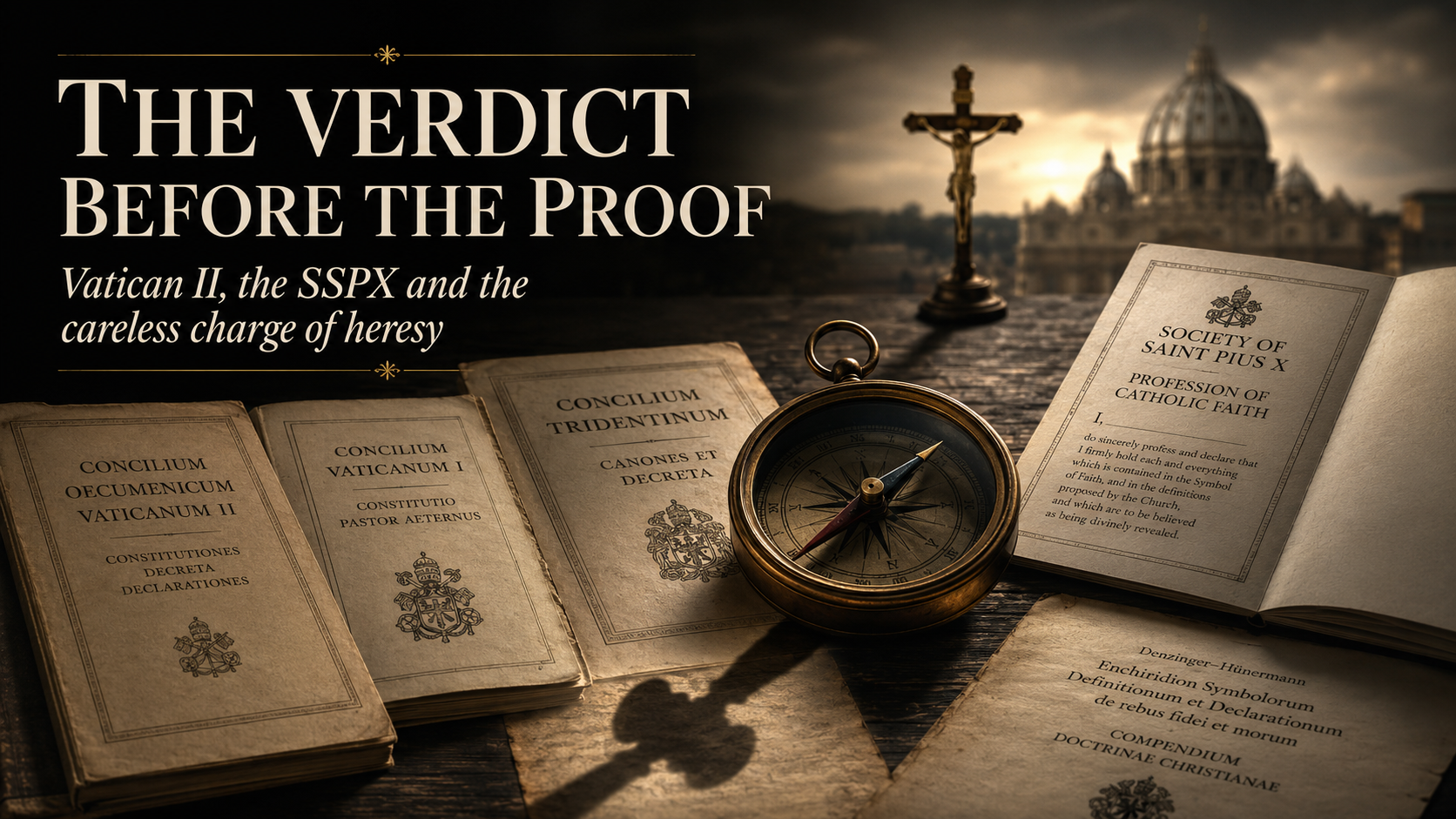
The Verdict Before the Proof
Monsignor Arthur Holquin says that a full doctrinal treatment of the SSPX Profession must wait. His verdict of heresy does not. The haste reveals a wider problem: Vatican II is increasingly defended by slogans that erase the Church’s own distinctions about authority, assent and error.

Monsignor Arthur Holquin tells his readers that a full treatment of the Society of Saint Pius X’s doctrinal claims must wait. He has confined himself, he says, to the sacraments and the liturgy, the field he knows best. He nevertheless pronounces the Society guilty of heresy before that fuller treatment has been attempted. The proof is deferred. The verdict is immediate.¹
Holquin is right about one important thing. The Society’s new Profession of Catholic Faith removes any excuse for pretending that the dispute concerns only the older Roman Missal. The text directly challenges characteristic teachings and practices of the conciliar and post-conciliar period. It rejects the claim that separated Christian communities may be used by the Holy Ghost as means of salvation, denies that non-Christian religions can be described as reflecting a ray of divine truth, opposes the civil immunity taught in Dignitatis Humanae, repudiates a particular understanding of episcopal collegiality and places the present crisis in the Church under the influence of Vatican II and the reforms that followed it.²
This is plainly a doctrinal conflict. It deserves to be called one.
It does not follow that it is heresy.
The Church has more than one word for serious religious error. She speaks of falsehood, doctrinal error, rashness, ambiguity, scandal, disobedience, rejection of authoritative teaching, refusal of religious submission, rupture of communion and schism. She also speaks of heresy. These words are not interchangeable, and “heresy” is not simply the most forceful one available.
Canon law defines heresy as the obstinate denial or doubt, after baptism, of a truth which must be believed by divine and Catholic faith.³ The definition has a precise object. Before declaring someone a heretic, one must identify the proposition denied, establish that the Church has proposed it as divinely revealed, and demonstrate obstinacy in its denial.
Holquin does none of this. He lists several conciliar teachings and assumes that their public rejection must constitute heresy because an ecumenical council taught them. Yet that is the point which requires proof. He does not state whether each disputed proposition was proposed as divinely revealed, definitively to be held, or as authentic but non-definitive teaching. He does not distinguish the denial of dogma from resistance to another exercise of the Magisterium. He gives the sentence before identifying the offence.
The omission is not a technical quibble. It is the whole theological question.
The Church’s 1998 Profession of Faith and its official doctrinal commentary distinguish three forms of teaching and assent. There are truths proposed as divinely revealed, which require the assent of theological faith. There are doctrines proposed definitively because they are necessarily connected with Revelation, which must be firmly accepted and held. There are also authentic but non-definitive teachings, which require religious submission of intellect and will.⁴
All three categories bind Catholics. They do not bind in the same way.
The obstinate denial of the first category may constitute heresy. The rejection of a definitive doctrine is gravely contrary to Catholic teaching and full communion, although it is not technically the same offence. Resistance to non-definitive teaching may be erroneous, rash or culpable; it may reveal a serious failure of religious submission. It does not become heresy merely because the teaching appears in a conciliar document.
Paul VI made the necessary distinction within weeks of Vatican II’s conclusion. Because of its pastoral character, he explained, the Council had avoided proclaiming dogmas in an extraordinary manner with the note of infallibility. He immediately added that its teachings possessed the authority of the supreme ordinary Magisterium and must be received sincerely according to the Council’s intention, taking account of the nature and purpose of each document.⁵
Both halves of that statement matter.
The Council cannot be dismissed as optional because it issued no new solemn definitions. Its authentic teachings are not mere suggestions. Catholics may not wave them aside simply by repeating the word “pastoral”.
The opposite mistake is to treat the Council as doctrinally flat, as though every statement in every constitution, decree and declaration carried the same theological note. Vatican II repeated many truths already taught infallibly, and those truths remained infallible by the title under which the Church had already proposed them. The Council’s inclusion of a proposition did not, by itself, turn every new formulation, pastoral judgment or application into revealed dogma.
This is the distinction Holquin’s accusation requires and never supplies.
Some of the Society’s rejections are more direct than others. Its paragraph on religious liberty openly opposes the civil immunity described in Dignitatis Humanae. Its treatment of separated Christian communities plainly challenges the language of Unitatis Redintegratio. Its rejection of the “ray of truth” reflected in non-Christian religions deliberately answers Nostra Aetate in language close to the Council’s own.
These are not imagined disagreements. They should not be softened or hidden.
Holquin must still show which divinely revealed dogma has been obstinately denied. It is not enough to prove that a conciliar statement has been contradicted. He must establish the theological note of that statement and the assent the Church requires. That is the work he postpones while retaining the verdict it was meant to justify.
The papal quotations now circulating in support of his position do not supply the missing argument.
Benedict XVI did indeed call Vatican II a “sure compass”. More exactly, he adopted Saint John Paul II’s image and called it eloquent. Yet Benedict also insisted that the Council’s texts must be read correctly, within the Church’s Tradition and under a proper hermeneutic. He contrasted a hermeneutic of rupture with a “hermeneutic of reform” in the continuity of the one Church, saying that the difficulties following the Council depended upon the key used to interpret and apply it.⁶
The compass quotation cannot honestly be separated from the hermeneutic.
A compass does not create north. It points towards a fixed reality outside itself. Benedict’s image makes sense because the Council is to be read within the continuous faith, constitution and identity of the Church. Asking how a conciliar text agrees with previous teaching is not a rejection of his compass. It is part of using it.
Nor does a compass assign theological notes. Benedict’s praise of Vatican II does not tell us, by itself, whether a particular proposition is revealed dogma, definitive doctrine or non-definitive teaching. It cannot do the work of canons 750–752 or of the doctrinal commentary on the Profession of Faith.
Pope Francis’s warning must also be read in its actual context. In the letter accompanying Traditionis Custodes, he criticised those who claimed that Vatican II had betrayed Tradition and produced a false Church. It was against that wholesale repudiation of a legitimate ecumenical council, gathered cum Petro et sub Petro, that he said doubting the Council finally meant doubting the Holy Spirit who guides the Church.⁷
That is a grave warning against treating Vatican II as an illegitimate assembly or the birth of a counterfeit Catholicism. It is not a technical declaration that every disputed interpretation of every conciliar statement is an article of divine and Catholic faith.
A papal defence of a council’s legitimacy does not make all its pastoral applications irreformable. Praise for its authority does not abolish distinctions within that authority. An insistence that it be received does not answer how each proposition is to be received.
To turn Francis’s pastoral rebuke into a universal theological theorem is proof-texting. To invoke the Holy Ghost whenever someone asks for a doctrinal note is worse. It uses divine assistance not to illuminate the Church’s theology of the Magisterium, but to avoid it.
Holquin’s claim about Article XIV is scarcely more persuasive. He regards the placing of the Holy Sacrifice of the Mass fourteenth in a seventeen-article profession as proof that the liturgy was never the real dispute. The observation makes an effective opening line, but very little else. The document proceeds through Revelation, God, creation, Christ, the Church, the Holy Ghost, the papacy, the Magisterium, morals, the sacraments, the Mass, Christian life and the Last Things. The Mass follows the general treatment of the sacraments because that is its natural place in the structure. Its article number proves nothing about its importance.
Holquin’s more substantial liturgical criticism is that the Profession contradicts itself. Article XIII says that the faithful offer spiritually with and through the priest. Article XIV says that the modern reform has fostered a democratic conception of worship. Holquin identifies the former with participatio actuosa and concludes that the Society condemns in one article what it professes in the other.
His historical reminder is useful. Saint Pius X called for the active participation of the faithful in the sacred mysteries. Pius XI and Pius XII continued that work. The 1958 instruction on sacred music encouraged several degrees of congregational participation in the traditional rite, including responses, the Ordinary and, at its fullest degree, the Pater noster. Traditionalists who treat complete congregational silence as the only authentic form of Roman worship cannot claim the whole pre-conciliar Magisterium in support.
That still does not establish Holquin’s contradiction.
Pius XII taught that the faithful truly offer the Sacrifice, but carefully defined the sense in which they do so. The unbloody immolation is performed by the priest alone, acting in the person of Christ. The faithful offer through the priest and unite their hearts, prayers and intentions to the sacramental action proper to him. Pius XII welcomed active participation while warning against explanations which confused the action of the ordained priest with that of the congregation or made the Sacrifice dependent upon the people’s ratification.⁸
The principle of active participation is therefore not identical with every theory proposed in its name. Nor is it identical with the entire post-conciliar reform. One may affirm spoken responses, chant, intelligent attention and the spiritual self-offering of the faithful while criticising a liturgical practice thought to obscure the essential difference between the ministerial and common priesthood.
The Society may have stated its criticism of the reform too broadly. Its claim that the reform as a whole “fostered a democratic conception of worship” demands more evidence than the Profession provides. Holquin is entitled to challenge it. He is not entitled to pretend that affirming the faithful’s spiritual offering commits the Society to accepting every later expression of active participation.
Participation is a theological principle. The Pauline reform is one historical embodiment claimed for it. They are not the same proposition.
Holquin is on firmer ground when he points to the tension between the Society’s profession of papal jurisdiction and its intended consecration of bishops without a pontifical mandate. The Profession recognises the Pope’s proper, supreme, full, immediate and universal authority, while the Society proposes to act without his permission in a matter touching the continuation of the episcopate. That tension is real and cannot be answered by pious language alone.
The Society answers by pleading a state of necessity and the preservation of Tradition. Rome rejects that assessment. Whether the plea is canonically persuasive is a serious question. It is not answered by calling the doctrinal Profession heretical.
Holquin’s strongest argument concerns the coherence of the Society’s obedience. It does not prove the denial of a revealed dogma. Disobedience, grave though it may be, is not synonymous with heresy. Neither is every unlawful exercise of episcopal power. Canonical offences have their own objects, elements and penalties. Precision becomes more necessary, not less, when communion is at stake.
The Society’s Profession deserves exacting criticism. It can appear to make the present Magisterium authoritative only after the Society has judged it compatible with its own reading of the past. Some passages turn disputed conclusions into settled certainties. Its treatment of Vatican II risks failing to distinguish the Council’s texts from later appeals to a supposed “spirit of the Council”. Its forthcoming actions must also be measured against the papal authority it professes.
None of this is helped by using “heresy” as a general term of condemnation.
The habit reveals a wider sickness in Catholic debate. Papal statements are increasingly used not as authoritative contributions requiring careful interpretation, but as conversation-stoppers. A quotation is produced, the Pope’s name is attached, and all distinctions are declared disobedient. Authority becomes a substitute for argument. The living Magisterium is reduced to the latest available soundbite.
That is not a defence of the papacy. It is hyperpapalism: an exaggerated account of papal authority which makes every forceful papal phrase perform work it was never intended to do. It weakens the very authority it claims to defend because it leaves Catholics unable to distinguish a doctrinal definition from a pastoral exhortation, a disciplinary decision from a dogma, or an authoritative non-definitive teaching from an irreformable judgment.
The answer is not to retreat into the opposite error. Vatican II cannot be treated as though it never happened. Catholics are not free simply to accept the passages they like and discard the rest. Its teaching must be received according to the authority it actually exercised, the intention it expressed and the assent properly owed to each proposition.
That requires more theology, not less.
Monsignor Holquin is right that the SSPX Profession has exposed a doctrinal divide which cannot be reduced to a preference for an older missal. He is wrong to think the existence of that divide proves heresy before the disputed doctrines have even been classified. He himself says that fuller treatment must wait. His accusation should have waited with it.
A compass is meant to guide the traveller by reference to a fixed north. Once it is lifted from the chart and used as a cudgel, it no longer guides anyone.
Benedict held up the Council as a compass. His admirers should stop using it to strike those who ask where it points.
¹ Msgr Arthur Holquin, S.T.L., “A Creed Against the Council”, Liturgy and Truth, 24 June 2026. Holquin states that he is reserving a fuller doctrinal critique while immediately describing the Society’s position as heresy.
² Society of Saint Pius X, Profession of Catholic Faith of the Society of Saint Pius X to Enlighten Souls in the Face of Modern Errors, 24 June 2026, paras 61–68, 73–87, 103–105, 118–126 and 143–150; and “Open Letter to His Holiness Pope Leo XIV and to the Cardinals of the Holy Church”, 24 June 2026.
³ Codex Iuris Canonici (1983), can. 751. See also cann. 750–752 for the distinct categories of revealed, definitive and authentic non-definitive teaching.
⁴ Congregation for the Doctrine of the Faith, Professio fidei and “Doctrinal Commentary on the Concluding Formula of the Professio fidei”, 29 June 1998, nos 5–11.
⁵ Paul VI, General Audience, 12 January 1966. Paul VI explained that Vatican II, because of its pastoral character, avoided extraordinary dogmatic definitions bearing the note of infallibility, while investing its teaching with the authority of the supreme ordinary Magisterium, to be received according to the nature and purpose of the individual documents.
⁶ Benedict XVI, General Audience, 10 October 2012; Apostolic Letter Porta fidei, 11 October 2011, no. 5; Address to the Roman Curia, 22 December 2005. The “sure compass” image originated in John Paul II, Apostolic Letter Novo Millennio Ineunte, 6 January 2001, no. 57.
⁷ Francis, Letter to the Bishops of the Whole World accompanying the Apostolic Letter Traditionis Custodes, 16 July 2021. The statement concerning doubt of the Council follows his criticism of claims that Vatican II betrayed Tradition and the “true Church”.
⁸ Pius XII, Encyclical Mediator Dei, 20 November 1947, nos 86–99, especially nos 92–96. See also Saint Pius X, Motu Proprio Tra le sollecitudini, 22 November 1903, no. 3; Pius XI, Apostolic Constitution Divini cultus, 20 December 1928; and Sacred Congregation of Rites, Instruction De musica sacra et sacra liturgia, 3 September 1958, nos 22–34.
RELATED ARTiCLES


LATEST ARTICLES
- Today’s Mass: October 02 Holy Guardian AngelsThe concept of guardian angels, although not universally accepted as an article of faith by the Church Fathers, is supported by scripture in both the Old and New Testaments. These angels serve as divine protectors, guiding and aiding the faithful, particularly children, and emphasising their role as intermediaries between God and humanity.
- Thou has given His angels charge over theeThe Feast of the Holy Guardian Angels on 2 October acknowledges that Divine Providence assigns a guardian angel to each individual for protection and guidance towards salvation. The theology reinforces the reality of angelic guardianship and its extension to communities, while Catholics are encouraged to integrate their Guardian Angel into various aspects of spiritual life.
- Synodality’s Next Step: Writing the Revolution into Canon LawThe Vatican Canonical Commission’s proposals aim to embed synodal principles into law, resulting in compulsory councils and expanded lay governance. While not all amendments are unprecedented, their cumulative impact risks changing ecclesiastical authority’s practical exercise, asserting that compliance with the new structures may equate to adherence to the Church’s order.
- Today’s Mass: October 01 St Remigius of RheimsSt Remigius of Rheims, a significant bishop and apostle of the Franks, was renowned for his learning, holiness, and miraculous deeds during his seventy-plus years of episcopacy. He was instrumental in spreading Christianity under King Clovis and left a lasting legacy before his death around 530.
- October Beneath Our Lady’s StandardThe Feast of the Most Holy Rosary commemorates the 1571 victory at Lepanto and evolved through papal endorsements, especially under Pope Leo XIII in the late 19th century. October, dedicated to the Rosary, serves as a reminder of prayer’s significance during trials, fostering both personal and communal spiritual resilience in Catholic life.
CURRENT EDITION


Today’s Mass Propers
- Today’s Mass: October 02 Holy Guardian Angels
 The concept of guardian angels, although not universally accepted as an article of faith by the Church Fathers, is supported by scripture in both the Old and New Testaments. These angels serve as divine protectors, guiding and aiding the faithful, particularly children, and emphasising their role as intermediaries between God and humanity.
Leave a Reply