
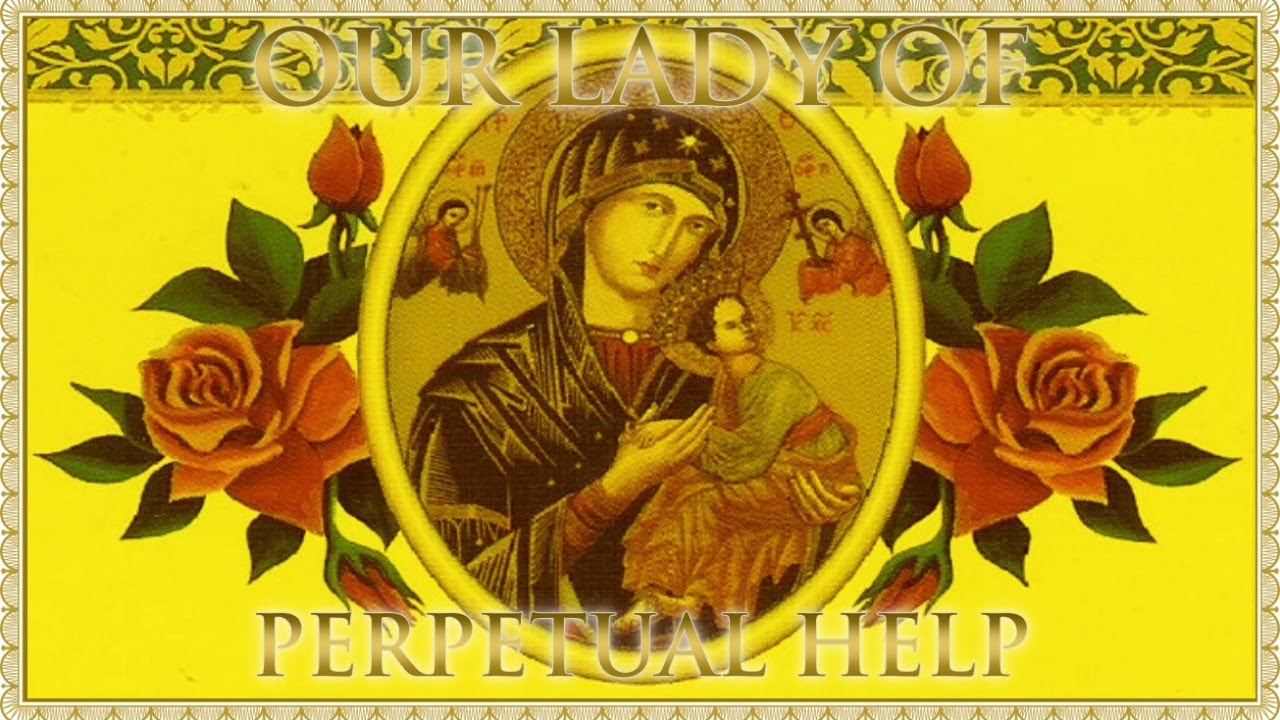
Our Lady of Perpetual Succour
Today we celebrate the feast of Our Lady of Perpetual Succour. This feast is held in honour of a 15th century Byzantine icon of the Blessed Virgin Mary. In the Eastern Church the icon is known as the Virgin Theotokos of the Passion. Tradition has it that the icon was stolen from the Keras Kardiotissas monastery in Crete in 1498 by an Italian merchant (Crete was then under Venetian rule). It was later transferred from private hands to the Church of San Matteo in Rome, where it remained for the next three hundred years. Subsequently it came into the possession of the Redemptorist order. Since the 1860s it has been under the care of the Redemptorists in the Church of St. Alfonso di Ligouri in Rome.
But what is the proper place of images and icons in the church? In the eighth and ninth centuries there was a great controversy about the place of icons within the Church. The Iconoclasts were suspicious of any religious art and demanded the destruction of icons. The Iconodules strongly defended the place of icons in the Church. In 726 the Emperor Leo III began attacking the icons, a phase which was finally ended by the Empress Irene in 780. An Ecumenical Council at Nicea in 787 strongly upheld the Iconodule position that icons should be kept in churches and honoured. However, in 815 the Emperor Leo V the Armenian began another period of iconoclasm which was only ended by the Empress Theodora in 843. This final victory of the Iconodules is known as the Triumph of Orthodoxy and is celebrated in the Byzantine liturgy on the First Sunday in Lent.
St. John of Damascus was the great champion of the iconodule position. He argued that the icons were not idols but symbols. Christians do not worship them, but it is legitimate for them to venerate them. They were also books for the unlearned and therefore a part of the Church’s teaching. However, most importantly of all he argued that they were not only legitimate and useful, but actually essential to the defence of the doctrine of the Incarnation. Since the Word was made flesh and dwelt among us material images can be made of him who took a human body. He stated that “of old God the incorporeal and uncircumscribed was not depicted at all. But now that God has appeared in the flesh and lived among humans, I make an image of the God who can be seen. I do not worship matter, but I worship the creator of matter, who for my sake became material and deigned to dwell in matter, who through matter effected my salvation. I will not cease from worshipping the matter through which my salvation has been effected”. The Christian faith is not about the disparagement of the material world in favour of an esoteric Gnostic belief in salvation by knowledge, but is rather about the redemption of the material world. God is the creator of the material world, and when the human race fell into sin, God himself entered the material world in Christ to redeem it. The destiny of material world is that it will be redeemed and sanctified, the whole man, body and soul, and also ultimately the whole creation. Seen from this perspective, the place of icons in the Church is as much a part of the Orthodox faith as the right doctrine of the Trinity and Incarnation. It is an essential part of the defence of that faith.
Likewise, for many Christians since the time of the Protestant Reformation in the sixteenth century an emphasis on the intercession of the Blessed Virgin Mary and the saints detracts from the worship of Christ as the Word made flesh. However, it is important to emphasise that we honour Mary not as a figure of independent greatness in her own right, but precisely because of her unique relation to Christ, as the theotokos, the mother of the Word made flesh. We venerate Mary precisely because of the pivotal role she played in giving birth to the Word made flesh. In the nineteenth century John Henry Newman noted that “if we take a survey at least of Europe, we shall find that it is not those religious communities which are characterised by devotion towards the Blessed Virgin Mary which have ceased to adore her Eternal Son, but these very bodies, (when allowed by law) which have renounced devotion towards her. The regard for his glory, which was professed in that keen jealousy of her exaltation, has not been supported by the event. They who were accused of worshipping a creature in his stead, still worship him; their accusers who hoped to worship him so purely, they, wherever obstacles to the development of their principles have been removed, have ceased to worship Him altogether.”
Concerning the Blessed Virgin Mary St. John Chrysostom states: “what thing greater or more famous than she, hath ever at any time been found or can be found? She alone is greater than heaven and earth…. Neither prophets, nor apostles, nor martyrs, nor patriarchs, nor angels, nor thrones, nor lordships, nor seraphim, nor cherubim, nor any other creature visible or invisible, can be found that is greater and more excellent than she. She is at once the handmaid and parent of God, at once virgin and mother. She is the mother of Him who was begotten of the Father before all ages, and who is acknowledged by angels and men to be Lord of all. Wouldst thou know how much nobler is this virgin than any of the heavenly powers? They stand before him with fear and trembling, veiling their faces with their wings, but she offereth humanity to Him to whom she gave birth. Through her we obtain the remission of sins. Hail then, O Mother, heaven, damsel, maiden, throne, adornment and glory and foundation of our Church! Cease not to pray for us to thy Son and our Lord Jesus Christ! That through thee we may find mercy in the day of judgement, and may be able to obtain those good things which God has prepared for them that love him, by the grace and goodness of our Lord Jesus Christ, to whom with the Father and the Holy Ghost be ascribed all honour and glory and power, now and for ever and ever. Amen.”
by the Revd Dr Robert Wilson PhD (Cantab), Old Roman Apostolate UK


![Today’s Mass: October 03 St Thomas [de Cantilupe] of Hereford](https://nuntiatoria.org/wp-content/uploads/2026/10/thomascantilupemasstitle.jpg)


Leave a Reply