
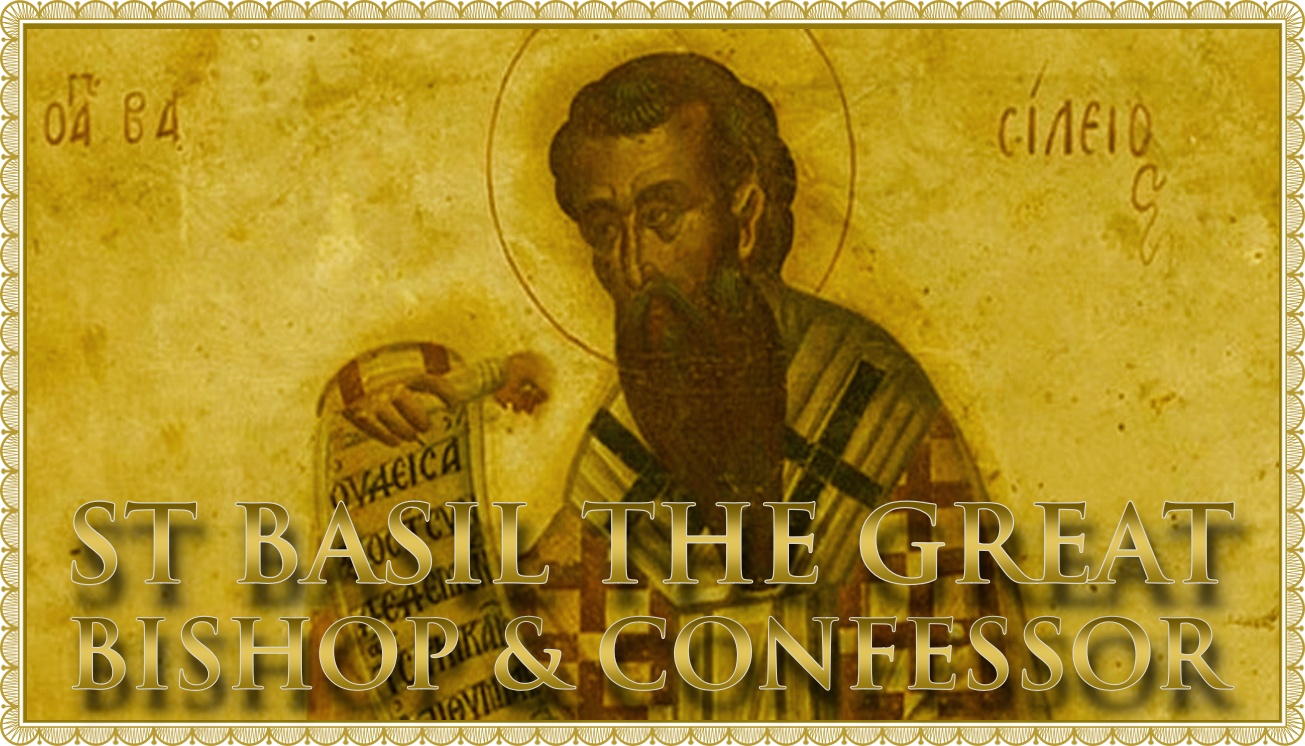
St. Basil of Caesarea/Third Sunday after Pentecost
Today we celebrate the feast of St. Basil of Caesarea, as well as commemorating the Third Sunday after Pentecost. He was born in Cappadocia in Asia Minor in the fourth century. He was one of the three Cappadocian Fathers, the other two being his brother St. Gregory of Nyssa and St. Gregory Nazianzus. He was from a Christian family and was educated at Athens, where he was a contemporary of the future pagan emperor Julian and also of St. Gregory Nazianzus, who become his lifelong friend. Despite receiving the type of classical education that would have enabled him to pursue a successful secular career, he discerned a vocation to the religious life and visited the great early monastic pioneers in Egypt, Palestine and Syria. He returned to his native Cappadocia and initially sought to imitate what he had seen by living as a hermit. Over time he was drawn to a more communal lifestyle. He was ordained to the priesthood and later in 370 became bishop of Caesarea. He sought to combine in his own person the role of bishop and monk. He played a pivotal role in the attempt to restore orthodoxy in the Church after the decades when the Arian heresy had been dominant. He was said to be the one man who was prepared to stand up to the Arian emperor Valens. He died in 379.
Whereas St. Athanasius was the great champion of orthodoxy in the first part of the fourth century, the Cappadocian fathers were the great defenders of orthodoxy in the last part of the fourth century. St. Athanasius had insisted against Arianism on the formula homoousios (of one substance) in order to safeguard the full divinity of the Son, and had said that the only difference between the Father and the Son was that the Father was Father and not Son. The problem that St. Athanasius had encountered had been that he had never devised a satisfactory terminology for describing both the unity of the Three Persons of the Trinity as well as their distinction as Father, Son and Holy Spirit. This achievement would be the work of the Cappadocian Fathers. They used the term ousia (substance or essence) to describe the unity of the Triune God and hypostasis (person) to describe the distinctiveness of the Three Persons of the Trinity. They were therefore able to assert orthodoxy against both Modalism (which denied the distinctiveness of the Father, the Son and the Holy Spirit) and Arianism (which denied that the full divinity of the Son). They spoke of the Father as the source of the Godhead, the Son as eternally begotten of the Father and the Spirit as proceeding from the Father. They had therefore successfully formulated a satisfactory terminology for defending the Orthodox faith that St. Athanasius had championed at the Council of Nicea in 325. It was this faith that was upheld at the Council of Constantinople in 381 (which was subsequently recognised as the Second of the Seven great Ecumenical Councils which defined the Orthodox faith).
The other great achievement of St. Basil was to demonstrate how the monastic life could be successfully integrated into the life of the Church. The early pioneers in the religious life like St. Anthony had withdrawn from the world in the pursuit of holiness. The first centuries of Christian history had produced martyrs who gave an example for all time of Christian dying for the faith. When the Empire finally succumbed and Constantine granted toleration for Christianity this both assisted the propagation of the faith, but also brought the danger of it becoming diluted by the false standards of the world. It was this that those who withdrew from the corruptions of the age to provide a new model of Christian living sought to combat. While many like St. Anthony lived as hermits, others like St. Pachomius formed the first monastic communities. But they were still not fully integrated into the institutional life of the Church.
It was this deficiency that St. Basil successfully overcame. He had been initially drawn to seek to reproduce in his own native Cappadocia what he had witnessed in his travels in Egypt, Palestine and Syria. But he gradually came to realise that love of God could not be divorced from love of neighbour and needed to receive institutional expression in the life of a religious community. His own order was active in teaching, learning and ministering to the sick. The excesses of individual ascetics were discouraged in favour of the building up of the common life of the body of Christ. He showed how it was possible to be a bishop who played an active role in the life of society by his forthright defence of the Orthodox faith against Arianism, but also continue to live as a monk. This provided the model for Eastern Christian monasticism to this day and was also later an important influence on the rule of St. Benedict in the West.
Concerning St. Basil it has been well said that “in him the scholar and the theologian were combined. His short episcopate of nine years had an abiding affect on the Eastern Church. He saved monasticism from degenerating into foolish extravagance and profitless asceticism, he arranged the services of the Church, he reformed the disorders of his vast province. In an age and country where inconsistency in religious principles was everywhere rife, Basil set the example of the most loyal adherence to the creed that he professed, and the courage with which he refused to bow before Valens saved the cause of Nicea in Asia Minor. Despite a certain harshness of character, and a tendency to confound the maintenance of his own dignity with the cause of Christianity, into which some saintly but less able prelates have occasionally fallen, Basil deserves the high honour which posterity has accorded to his memory.”
Let us pray that we will be given grace to follow the example of St. Basil and be witnesses to the Orthodox faith in our own time and place.
by the Revd Dr Robert Wilson PhD (Cantab), Old Roman Apostolate UK



Leave a Reply