
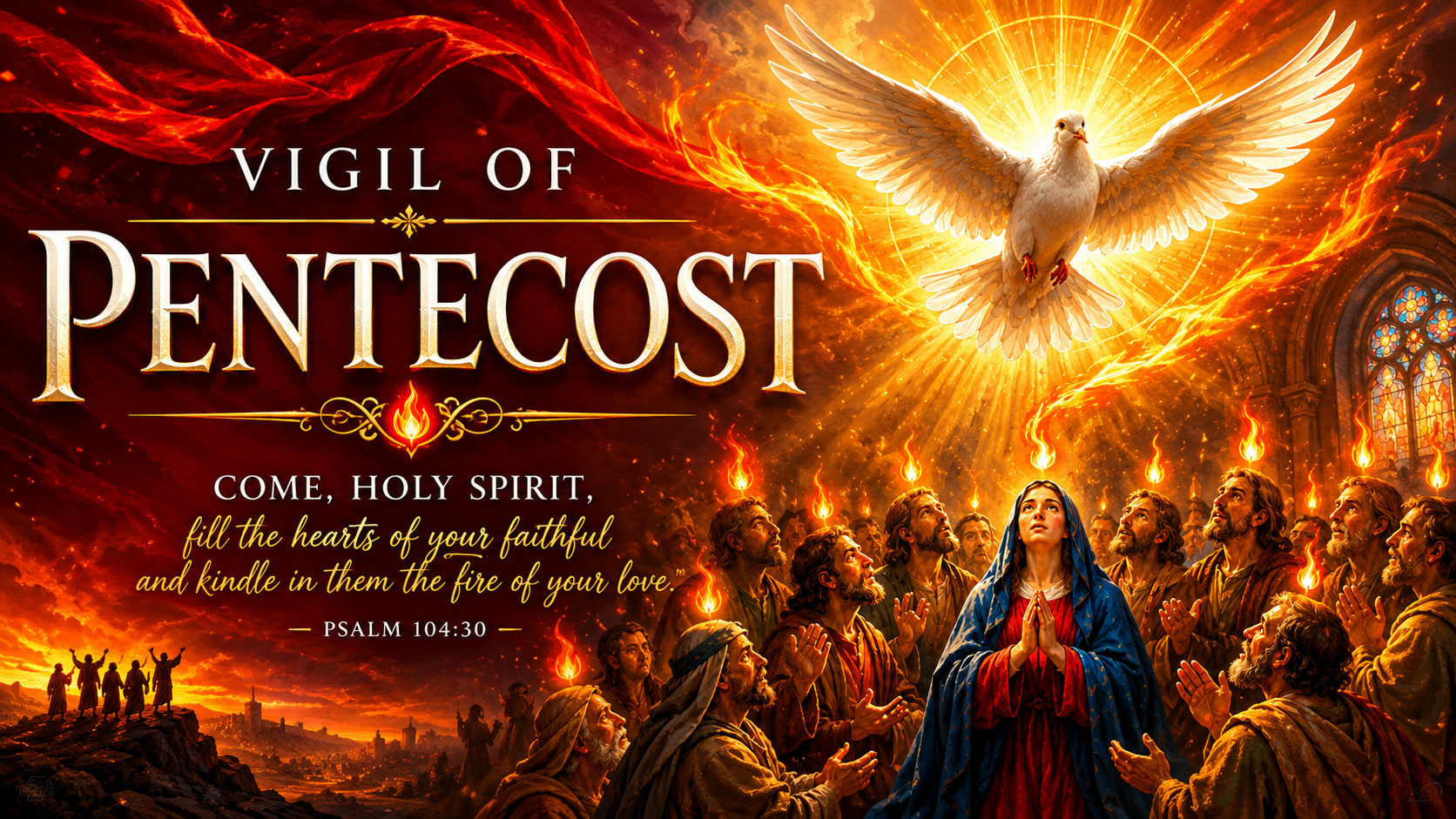
Vigil of Pentecost
Today’s liturgy has many affinities with that of Holy Saturday. In the early days of the Church those catechumens who had not been baptised at Easter received this sacrament at Pentecost instead. Consequently we hear again some of the great prophecies that were part of the liturgy on Holy Saturday, though the twelve lessons have been reduced to six. This enables us to reflect on each lesson in more detail than was possible in the liturgy on Holy Saturday.
The first prophecy is from the book of Genesis and recalls God’s command to Abraham to sacrifice his son as a test to his faith. God had made man in his own image and likeness, but the human race had succumbed to pride and consequently fallen into sin. God had therefore chosen Abraham and promised to him that in his seed all the nations of the earth would be blessed. He had left his country and kindred for the land that had been promised to him and, against all expectation, his wife Sarah had given birth to a son, whom he named Isaac. It therefore seemed extraordinary that he should be commanded by God to sacrifice his son in a manner which went against all that he had been promised. It was only at the last minute that he was told to desist and that what had happened had been intended to test his faith. He had shown by his actions that he truly feared God.
The second prophecy is from the book of Exodus and recalls how the Israelites were able to cross the Red Sea and escape slavery in Egypt. They had found refuge in Egypt some generations earlier. The powers that be had been favourable to them and had protected them, but over the course of time they had turned against them and enslaved them. God had called Moses to rescue the people from slavery, but the hostile Pharaoh who oppressed them had been reluctant to release them. Finally the people were enabled to escape across the Red Sea to journey through the wilderness to the land that they had been promised. They had experienced the actions of God in history in the shifting frontiers of social change and were called to create a new society in which all, high and low, rich and poor, would have equal access to dignity and hope.
The third prophecy is from the book of Deuteronomy. The Israelites had received the Law on Mount Sinai that would govern their lives as the chosen people of God and were now finally on the edge of the promised land. Moses therefore issued his final words to them before his death, exhorting them to remain faithful to God. He solemnly warned them that if they were unfaithful they would bring disaster on themselves and their nation.
The fourth prophecy is from Isaiah. Although the people successfully conquered the land that they had been promised and became an independent nation under the great kings David and his son Solomon, they repeatedly fell away from God into idolatry. Great prophets like Isaiah arose who preached truth to power, whether they would hear or whether they would forbear, but their words usually went unheeded. Isaiah found that there were a remnant who remained faithful, despite the apostasy of the nation as a whole. He looked forward to a future messianic age in which Jerusalem would finally dwell in safety and the nations currently sunk in idolatry would renounce their errors and come to the city to worship the God of Israel.
The fifth prophecy is from Baruch. It recalls the disaster that had befallen the nation due to apostasy from God. “Thou art grown old in a strange country, thou art defiled with the dead: thou art counted with them that go down into hell. Thou hast forsaken the fountain of wisdom. For if thou hast walked in the way of God, thou hadst surely dwelt in peace for ever. Learn where is wisdom, where is strength, where is understanding that thou mayest know also where is length of days and life, where is the light of the eyes and peace.” The people would only be redeemed if they repented and returned to living in faithfulness to God.
The sixth prophecy is from Ezekiel’s great vision of the valley of dry bones. It came at a point at which all hope seemed to be gone. The kingdom of Judah had finally fallen to the Babylonians and Ezekiel had even seen the glory of God departing from the temple, a foreshadowing of imminent destruction. Despite everything, Ezekiel saw in his vision that the dry bones would come alive again and the nation would one day be restored. “And he said to me: Son of man, all these bones are the house of Israel: they say: Our bones are dried up, our hope is lost, and we are cut off. Therefore prophesy, and say to them: Thus saith the Lord God: Behold I will open your graves, and will bring you out of your sepulchres, O my people: and will bring you into the land of Israel. And you shall know that I am the Lord, when I have opened your sepulchres, and shall have brought you out of your graves, O my people: and shall have put my spirit in you, and you shall live, and I shall make you rest upon your own land: saith the Lord Almighty.”
In the fullness of time the hope of Ezekiel for the restoration of the nation after everything seemed to be lost came true in the life, death and resurrection of Jesus. Where Israel as a whole had failed to be faithful to God and had brought judgement and disaster upon themselves, Jesus, the one true Israelite, had succeeded. He had taken the weight of the evil of the situation that confronted him upon himself and had somehow subsumed it into good. He had been raised from the dead and on the day of Pentecost the Holy Spirit had been poured out upon his followers enabling them to preach the gospel to all nations.
Today’s lesson from the Acts of the Apostles records an occasion in Ephesus where St. Paul encountered some who knew only the baptism of John and had not received the Holy Spirit. He told them that John baptised the people with the baptism of repentance, saying that they should be believe in him who was to come after him, that is in Jesus. When they heard this they were baptised in the name of Jesus. St. Paul then imposed his hands upon them and they received the Holy Spirit and spoke with tongues and prophesised. This fulfilled the hope of Ezekiel of a new heart being given to the people and a new spirit being put within them. Jesus had promised, as we heard in today’s reading from St. John’s Gospel, that he would not leave his followers orphans but would send to them the Paraclete, the Holy Spirit, to guide, to strengthen and to cheer them in the face of the trials and tribulations they would encounter in the world.
The first followers of Jesus responded to his call to repent and be baptised for the remission of their sins and received the Holy Spirit. They went out into the world to summon the nations to turn from their idols to the true and living God who had now fully revealed himself in the life, death and resurrection of Jesus.
Let us pray for grace that the love of God may be poured into our hearts by the Spirit that he has bestowed upon us, that we may remain faithful in preaching the gospel in our own time and place.
by the Revd Dr Robert Wilson PhD (Cantab), Old Roman Apostolate UK





Leave a Reply