
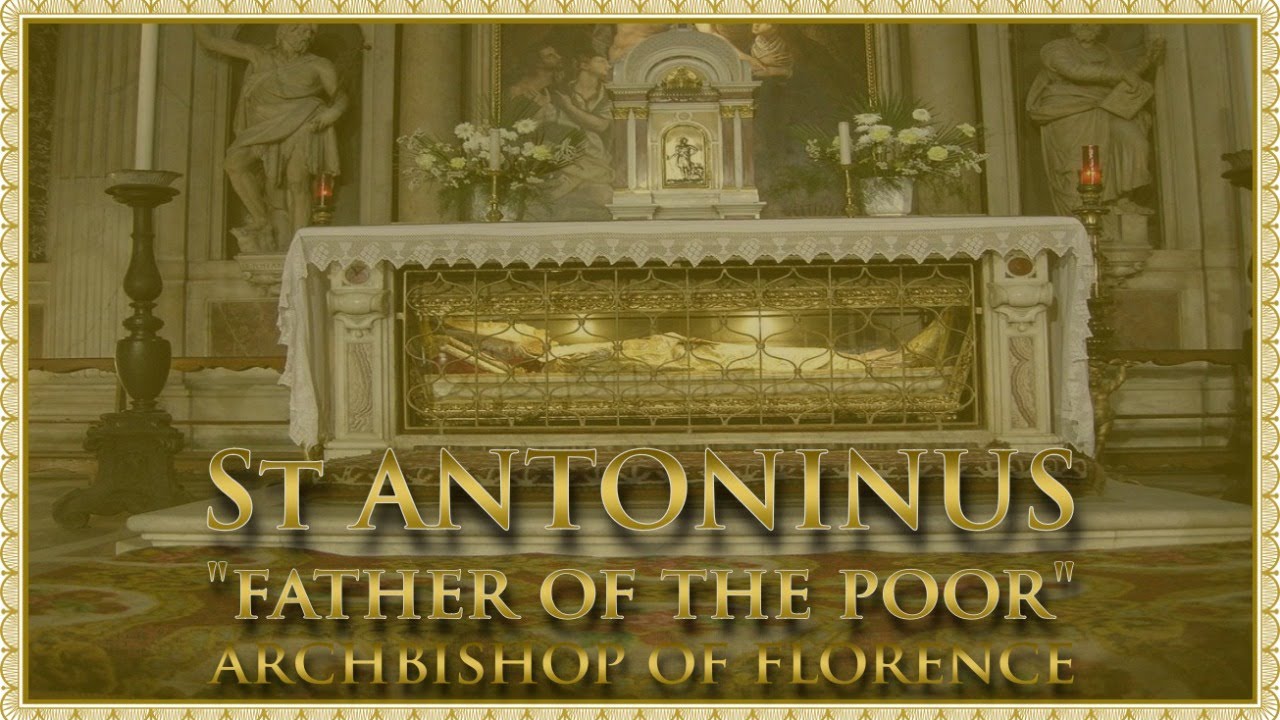
St. Antoninus/Fifth Sunday after Easter
by the Revd Dr Robert Wilson PhD (Cantab), Old Roman Apostolate UK
Today we celebrate the feast of St. Antoninus, as well as commemorating the Fifth Sunday after Easter. Antoninus was born in Florence in the late fourteenth century. He entered the Dominicans and subsequently rose to a position of prominence within the order. He was noted for his strict observance of the Dominican rule and for his austerity and charity. He was present at the Council of Florence (which achieved reunion between the Eastern and the Western Church, though the agreement was not ultimately accepted in the Eastern Church). He subsequently became Archbishop of Florence. As archbishop he did not succumb to any delusions of grandeur concerning his office but was rather noted for his continued observance of the Dominican rule and his austerity and charity. He exemplified the maxim of servus servorum dei, one who was the servant of the servants of God. He died in 1459.
The late medieval period in which Antoninus lived may seem to us to be an age of faith in sharp contrast to the present. At one level, that was indeed the case and the Church had greater influence on the ordering of society than it does now. On the other hand, it was also in many ways a period of great confusion. Antoninus was born into a world where Europe had recently been decimated by the Black Death. There was division between rival claimants to the Papacy. This undermined the belief in the Papal Supremacy and led to the rise of the conciliarist movement (the belief that a General Council of the Church rather than the Papacy was the ultimate authority in the Church, a belief that would be affirmed by the Council of Constance in 1415). As the Byzantine Empire looked on the verge of collapse in the East, there was an attempt to heal the schism between the Western and the Eastern Church at the Council of Florence (which Antoninus attended). Though agreement was reached the antagonism which the Crusaders had generated in the East through their sack of Constantinople in 1209 still lived on, and consequently led the Council to be repudiated by the Eastern Church. In the last years of Antoninus’ life the Byzantine Empire finally fell to the Ottoman Turks in 1453. In many ways, it was not only an age of faith but also one of conflict and division.
St. Matthew’s Gospel (which we heard today) records the parable of the talents that Jesus told to his disciples. A man went into a far country and called his servants and delivered to them his goods. He gave five talents to one, two to another, and to another one, each according to his ability and then went on a journey. The one who had received five talents went his way and traded with the same and gained another five. He that had received the two gained another two. But he that had received the one dug into the earth and hid his lord’s money. After a long time the lord of the servants came and reckoned with them. He said to the one who had gained five further talents: “Well done, thou good and faithful servant, because thou hast been faithful over a few things, I will place thee over many things: enter thou into the joy of thy lord.” He also said the same to the one who had gained two further talents.
St. Gregory the Great states: “This lesson from the Holy Gospel moveth us to take good heed lest we, who are seen in this world to have received more than the other, should thereby bring ourselves into greater condemnation from the maker of this world. To whom much is given, of the same is much required. Therefore, to him that receiveth much, strive to be all the more lowly, and all the more ready to do God service, for his very gifts’ sake, knowing that he will be obliged to give account thereof… What other, then, is that man travelling into a far country but our Redeemer, who is gone up from us into heaven in that flesh which he had taken into himself? For the earth is the home of the flesh, which travelleth into a far country-when our redeemer giveth it a place in heaven. But that man travelling into a far country delivered unto his servants his goods; and so doth our redeemer give spiritual gifts unto his faithful people… There are five bodily senses; that is, sight, hearing, taste, smell and touch. By the five talents therefore are signified the five senses, that is, outward knowledge. By the two, wit and work. And by the figure of the one talent, understanding, which is alone.
For some there be who, while yet they are not able to go on unto things inward and mystic, do yet so desire our fatherland which is above, that they teach all whom they can, and of those very outward things, which they have received make gain double. These are they which keep themselves clean from the unruly motions of the flesh, and from the lust of the world, and from the delight of things which are seen, and by their preaching, keep other men clean from all these things. And some there are who receive, as their two talents, the power to think and the power to work. These are they which inwardly understand dark things, and outwardly work wonders. And these, since they preach unto others, both through their understanding and their works, gain, as it were, double, for all the talents which they have received.”
Let us pray for grace to follow the example of St. Antonius and make full use of the talents that God has given us in our own time and place, so that at the last we too may hear that voice: “Well done, thou good and faithful servant.”



Leave a Reply