
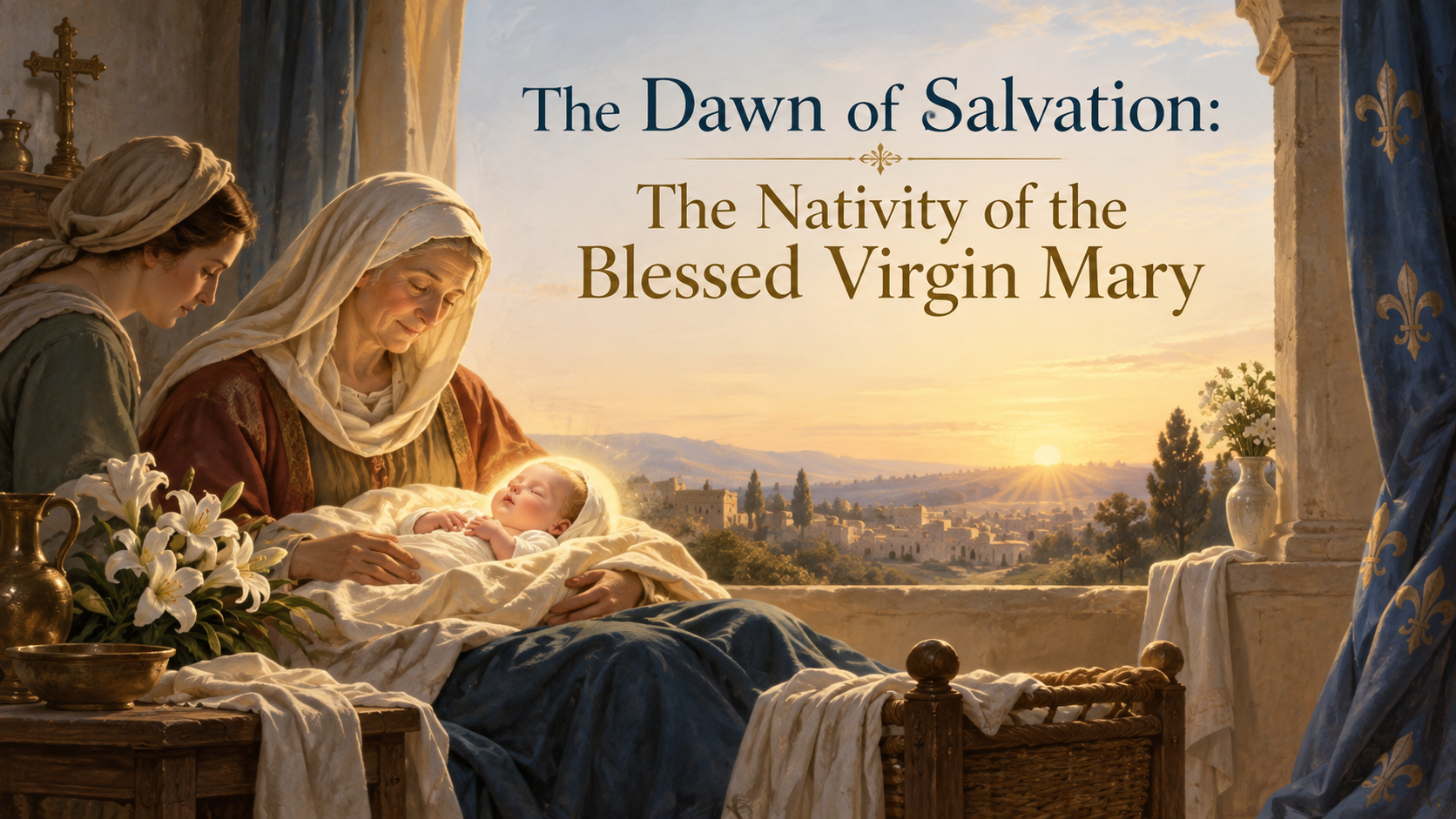
On 8 September the traditional Roman Rite celebrates the birth of the Mother of God. The Church calls it salutis exordium — the beginning of salvation — because the woman from whom the Eternal Word will take His flesh has entered the world. The Nativity of Mary is therefore not an isolated Marian anniversary, but the first visible dawn of the Incarnation itself.
The Church ordinarily celebrates the dies natalis of her saints not on the day of their earthly birth but on the day of their death, when the Christian passes from this life into eternity. The Roman calendar makes three conspicuous exceptions: the Nativity of Our Lord, the Nativity of St John the Baptist and, on 8 September, the Nativity of the Blessed Virgin Mary. Christ is holiness itself; St John was sanctified in his mother’s womb at the Visitation; Mary, by the still more singular privilege of her Immaculate Conception, was preserved from the stain of original sin from the first instant of her existence. The distinction immediately tells us what kind of feast this is. The Church is not merely remembering that Mary once had a birthday. She rejoices because the creature already prepared by grace to become the Mother of God has appeared in human history.¹
The imagery with which the older liturgy surrounds the feast must be understood in that light. Mary is the dawn because the Sun of Justice is approaching. She is the rod springing from the root of Jesse because from her comes the Flower long promised to Israel; the new Eve because her obedience belongs to the divine answer to the disobedience of the first; the living sanctuary because the Word will take flesh within her. None of these images establishes an autonomous Marian mystery existing alongside Christ. Their point is precisely the opposite. The greatness of Mary is intelligible only from the mystery of her Son. Her birth matters because the Mother of the Redeemer is born.
Sacred Scripture gives no account of Mary’s Nativity and does not name her parents. Joachim and Anne enter Christian tradition principally through the second-century Protoevangelium of James, an apocryphal work which the Church never received among the inspired Scriptures. Its narrative details therefore cannot be repeated as though they possessed the authority of the Gospel. Yet neither does their apocryphal origin justify treating the entire tradition as meaningless invention. Joachim and Anne entered very early into the common Christian memory of East and West, while Jerusalem itself preserved an ancient association between Mary’s family and the vicinity of the Pool of Bethesda, where the Church of St Anne now stands. The historical evidence requires discrimination rather than either credulity or contempt.²
The feast itself came to Rome from the Christian East. Its earliest history cannot be reconstructed with complete certainty, but by the seventh century the Nativity was known in the Roman Church, and Pope St Sergius I, who reigned from 687 to 701 and came from a Syrian family, prescribed the stational litany for the principal Marian feasts of the Purification, Annunciation, Dormition or Assumption, and Nativity. The Liber Pontificalis places the procession from the church of St Hadrian in the Roman Forum towards St Mary Major. Pius XII would later cite the same arrangement as evidence of the antiquity of these Marian observances at Rome. The Nativity of Our Lady is thus no medieval sentimental accretion. Its place in Roman worship reaches back into the first Christian millennium.³
Why 8 September itself became the date of the feast is not securely known. The Church does not claim to possess the civil record of Mary’s birth, and the older sources do not permit us to turn pious conjecture into historical certainty. What can be said is that the September Nativity is older than the Western feast of Mary’s Conception. The familiar relationship between 8 December and 8 September therefore developed from the Nativity backwards: the conception came to be celebrated nine months before the already established birthday. In the East there were variations in the dating of the Conception, but the essential liturgical logic remains clear. The Church first celebrated Mary’s appearance in the world and subsequently placed the commemoration of her conception in relation to it.⁴
The rank and octave of the feast also illustrate why it is misleading to speak of a single, unchanging “pre-1955 calendar”. In the older Roman cursus the Nativity was a Double of the Second Class with an octave in the full traditional sense: days infra octavam carried its liturgical memory until the octave day on 15 September. Pope Innocent IV had established the octave in the thirteenth century, fulfilling a vow connected with the exceptionally troubled papal election of 1241–43. The nineteenth-century Roman Breviary belongs to that older tradition. The reform associated with St Pius X subsequently reorganised the entire system of octaves; by the 1942 Breviary the Nativity remained a Double of the Second Class but had an Octava simplex, so that the intervening days no longer carried the daily office and commemoration of a full octave and only the octave day remained. The 1955 simplification then suppressed this octave altogether, together with the great majority of the surviving Roman octaves.⁵
For those who use the older Tridentine cursus this history is not merely antiquarian. An octave expresses something about the Church’s conception of sacred time. A great mystery is not simply observed and discarded when midnight comes; it inhabits succeeding days and is allowed to mature through repeated contemplation. The older treatment of Mary’s Nativity therefore placed her birth within the lived rhythm of September. The feast had an afterlife in the Office before the Church moved on. The progressive reduction and eventual abolition of such octaves shortened that liturgical memory, and with it changed the way generations of Catholics experienced the calendar.
The Mass itself, Salve, sancta Parens, is the surest guide to the theology of the feast. It begins: “Hail, holy Mother, thou who didst bring forth the King who rules heaven and earth for ever and ever.” The Church is celebrating Mary’s birth, yet the first words direct us immediately towards Christ. That is characteristic of traditional Roman Mariology. Mary is praised because she bore the King; her womb is blessed because it contained the Son of the Eternal Father; her virginity is honoured because the Incarnate Word did not diminish but consecrated it. The liturgy does not need to diminish Mary in order to preserve the sovereignty of Christ, because every genuine privilege of the Mother manifests the power of the Son.⁶
The Collect states the matter with a precision that ought to govern every Catholic treatment of the feast: beatae Virginis partus exstitit salutis exordium. The childbearing of the Blessed Virgin — in the context of the feast, her own nativity by which she enters the world — is presented as the “beginning of salvation”. Mary does not accomplish Redemption, and Catholic theology has no need to blur the unique saving office of Jesus Christ. The meaning is historical and providential. The woman from whom the Redeemer will receive His human nature is now alive upon the earth. The prophecies remain to be fulfilled, Gabriel has yet to be sent, the Fiat is still in the future, but the immediate human preparation for the Incarnation has begun.
That is also why the dogma of the Immaculate Conception belongs naturally within the theology of 8 September. Pius IX defined that Mary, from the first instant of her conception, by a singular grace and privilege of Almighty God and in view of the merits of Jesus Christ, was preserved immune from all stain of original sin. Nothing in this privilege is independent of Christ. Mary is not exempted from the need of a Redeemer; she is redeemed by Him in the most perfect manner, the merits of Calvary being applied to her preventively. Before the historical sacrifice of the Cross takes place, its saving power is already displayed in the Mother whose flesh the Victim Himself will assume.⁷
The Epistle, Proverbs 8:23–35, contributes to the same sense of divine preparation. In the highest Christian understanding, the scriptural language of Wisdom belongs properly to the Eternal Word. Marian liturgy makes an accommodated use of it in reference to the woman eternally foreknown and chosen to become His Mother. It would be a theological error to imagine that Mary herself existed before creation or participated in the act of creation. Rather, her vocation was present in the eternal knowledge and providence of God. The Incarnation did not arise as an emergency measure improvised within history. The Mother from whom the Son would take His humanity belonged to the divine ordering of that history.
The Gradual and Alleluia bring the point into sharper focus: “Happy art thou, O sacred Virgin Mary, and most worthy of all praise, for out of thee hath risen the Sun of Justice, Christ our God.” The traditional description of Mary’s birth as the dawn of salvation grows directly from this liturgical language. Dawn is luminous because the sun is approaching. Its light is real, but derived; beautiful, but anticipatory. So the splendour of Our Lady neither competes with Christ nor obscures Him. To understand what grace accomplished in Mary is to understand more fully the power of the grace that comes from her Son.
The Gospel is Matthew’s genealogy of Christ. Were the purpose of the feast simply to satisfy devotional curiosity about Mary’s infancy, the choice would be puzzling. Instead the Roman Rite gives us Abraham, Isaac and Jacob, Juda and Jesse, David and the kings, exile and restoration, until the long succession arrives at “Joseph, the husband of Mary, of whom was born Jesus, Who is called Christ”. At that point the grammatical pattern changes. Joseph does not beget Jesus. The genealogy of Israel reaches Mary, and through her the miraculous intervention of God enters the succession. The meaning of her birth is therefore placed within covenantal history. She is daughter of Israel because she is to become Mother of Israel’s Messiah.
The ancient title of Mary as the New Eve belongs here. The comparison is not a late devotional exaggeration but a deeply patristic manner of reading the economy of salvation. Eve was created innocent but joined her disobedience to Adam’s fall; Mary, preserved by grace amid Adam’s fallen race, answers God with the obedience of faith. The decisive saving antithesis remains Christ and Adam: the New Adam repairs what the first Adam lost. Yet within that same divine economy the obedient Virgin stands where the disobedient virgin had stood before. The Fathers recognised a fittingness in the fact that the coming of death through disobedience should be answered by the coming of Life through an obedient assent.
This remains subordinate to Christ at every point. Mary’s Fiat does not cause the Incarnation by its own power; it receives what God gives. Yet it is not unreal for being dependent upon grace. Catholic theology need not choose between divine sovereignty and authentic human co-operation. God so orders salvation that the Virgin’s free consent genuinely belongs to it. Her Nativity is consequently the birth of the woman who will one day speak that consent, not as an interchangeable instrument but as the person uniquely prepared for the divine maternity.
St Andrew of Crete expressed this with particular force when he called Mary’s Nativity the joyful prelude to the great gift of salvation, whose culmination is the union of the Word with flesh. The Virgin is born, grows and is prepared to become Mother of God. The sequence matters. The feast is not an anticipation of Christmas by devotional imagination; it belongs objectively to the preparation for Christmas because the human creature from whom the Word will receive His flesh now exists.⁸
Dom Prosper Guéranger understood the old liturgy in the same way. The Church’s invitation is to celebrate the Nativity of the Virgin by adoring “Christ her Son, our Lord”. For Guéranger, the Bridegroom is near because His throne has been prepared upon earth. His language is lavish, but the theological order is exact: Mary points forward. Her significance lies in the mystery that approaches through her. Traditional Marian piety becomes distorted only when that order is reversed; in the liturgy itself, it is almost impossible to miss.⁹
The Offertory brings the paradox of the divine maternity into a single sentence: Mary “broughtest forth Him Who made thee”. The creature gives a human nature to her Creator. This is why Catholic Mariology cannot ultimately be separated from Christology. The title Theotokos, Mother of God, protects the truth that the Person born from Mary is not a human person subsequently united to God but the Eternal Son Himself, one divine Person possessing both the divine and human natures. The flesh crucified on Calvary is true human flesh received through Mary; the Blood shed for the redemption of mankind belongs to that same humanity. The mystery is concrete because the Incarnation is concrete.
The Nativity of Mary therefore belongs to the sacramental realism of the Catholic religion. God works through created things rather than despising them. He sanctifies water, oil, bread and wine; He enters history through ancestry and family; He takes a human body from a human mother. There is nothing vaguely spiritual about the Incarnation. The Eternal Word has a genealogy, a Mother and, through her, genuine membership in the human race He comes to redeem.
Popular Catholic culture once allowed that realism to shape ordinary life as well as the sanctuary. The feast became known in parts of Europe as Marymas, and the season naturally gathered agricultural customs around it. The Roman Ritual itself contains a Benedictio seminum et segetum in Festo Nativitatis B. Mariae Virginis — a blessing of seeds and crops on the feast of the Nativity of the Blessed Virgin. In wine-growing regions, particularly in France, the day became associated with the grape harvest and the blessing of its fruits. Such observances were not universal laws of the Roman Rite; they were local expressions of a Catholic civilisation in which the liturgical year entered the fields, household and harvest rather than remaining confined to an hour inside the church.¹⁰
The image of seed is especially suited to 8 September. Divine Providence frequently begins in obscurity. Mary’s birth does not alter the visible balance of political power in the Roman world. No ruler understands its importance, and no contemporary chronicle known to us records the event. Yet the hidden life of this child belongs more profoundly to the history of mankind than much that occupied the attention of kings. The mystery teaches us something about the scale by which Providence must be judged. God is not obliged to make His most consequential works immediately impressive.
The traditional commemoration of St Hadrian beside the feast provides an incidental reminder of the antiquity of the Roman observance. Hadrian was associated with Nicomedia and the Diocletianic persecution at the beginning of the fourth century; the older accounts relate his conversion after witnessing the constancy of Christians under torture. The historical details of his passio contain legendary development and should be treated accordingly, but his cult was ancient, and 8 September became in the Roman Church especially associated with the translation of his relics. The very church of St Hadrian in the Forum became the gathering point from which the Marian procession of Pope Sergius set out for St Mary Major.¹¹
There is a final lesson in the old Collect. It asks that the solemnity of Mary’s Nativity should give the faithful an increase of peace. The phrase rescues the feast from sentimentality. Christian peace is not mere emotional reassurance. It is the restoration of order between God and man which reaches its definitive source in Christ. Mary’s birth announces that restoration because it belongs to the approach of the Prince of Peace. The child whose birthday the Church celebrates is already oriented entirely towards Him.
On 8 September, therefore, the Church looks at Mary’s cradle and sees much further than the circumstances of an infant’s birth. She sees the daughter of Israel in whom the promises are approaching fulfilment, the New Eve who will answer the angel, the Virgin from whom the Word will take flesh, and the Mother who will one day stand beneath the Cross upon which that flesh is offered for the world’s redemption.
The Annunciation has not yet occurred. Bethlehem remains ahead. Calvary is further still. Yet the ancient Roman prayer permits us to say that something has already begun: salutis exordium.
The dawn has appeared because the Sun is coming.
Mary is born; Christ draws near.
¹ Vatican News, “Feast of the Nativity of the Blessed Virgin Mary”; Pope Pius XII, Fulgens Corona.
² Vatican News, “Feast of the Nativity of the Blessed Virgin Mary”; Catholic Encyclopedia, “Feast of the Nativity of the Blessed Virgin Mary”.
³ Pope Pius XII, Munificentissimus Deus; Catholic Encyclopedia, “Feast of the Nativity of the Blessed Virgin Mary”; Walter Berschin, discussion of the Liber Pontificalis text on the Sergian processions.
⁴ Catholic Encyclopedia, “Feast of the Nativity of the Blessed Virgin Mary”; Catholic Answers Encyclopedia, “Marian Feast Days”.
⁵ Catholic Church, Breviarium Romanum, F. Pustet, 1888, editio prima post typicam; Catholic Encyclopedia, “Feast of the Nativity of the Blessed Virgin Mary”; Roman Breviary, 1942, calendar and tables of octaves; Sacred Congregation of Rites, De rubricis ad simpliciorem formam redigendis, 23 March 1955.
⁶ Traditional Mass propers for the Nativity of the Blessed Virgin Mary, Missa “Salve, sancta Parens”.
⁷ Pope Pius XII, Fulgens Corona, citing Pius IX, Ineffabilis Deus.
⁸ St Andrew of Crete, Homily on the Nativity of the Mother of God; Patrologia Graeca, vol. 97.
⁹ Dom Prosper Guéranger OSB, The Liturgical Year, Time after Pentecost, 8 September.
¹⁰ Catholic Church, Rituale Romanum — Benedictio seminum et segetum in Festo Nativitatis B. M. V.; Francis X. Weiser SJ, traditional customs associated with Marymas and the harvest.
¹¹ J. P. Kirsch, Catholic Encyclopedia, “Hadrian”; Martyrologium Romanum tradition for 8 September.




Leave a Reply