
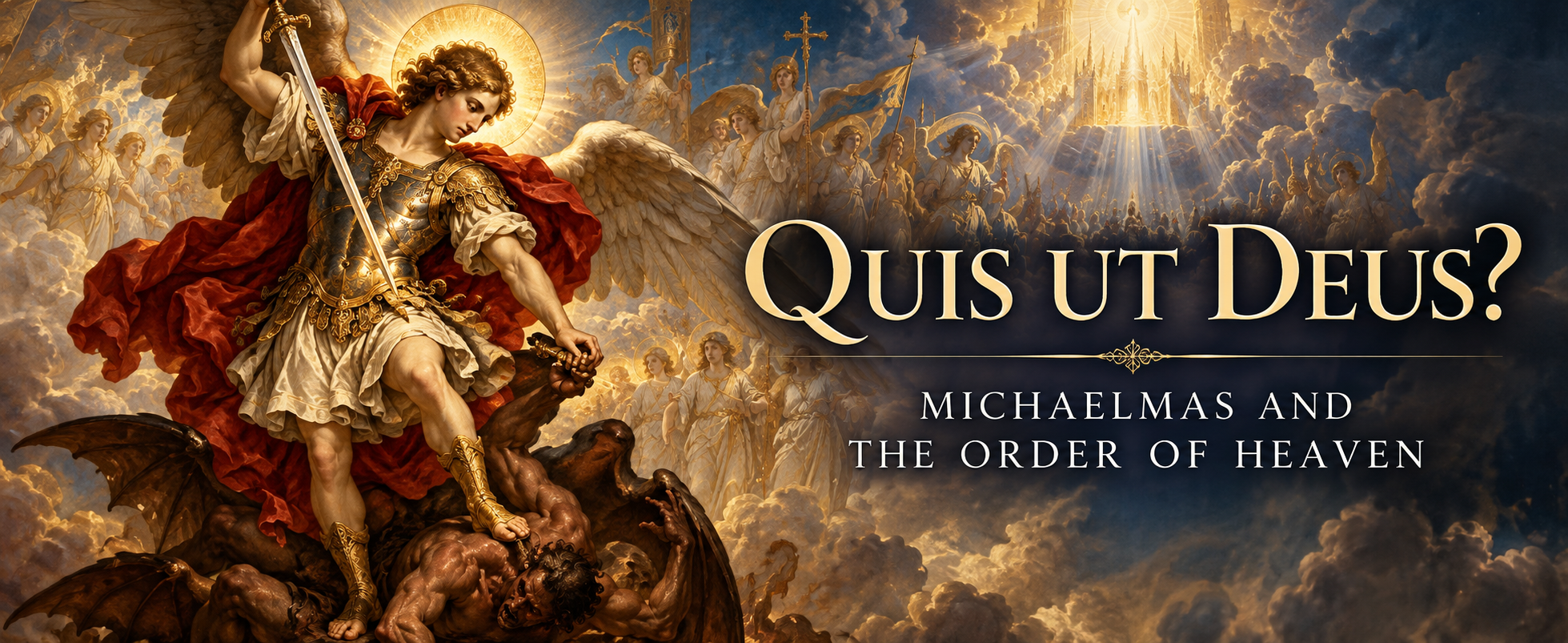
The Dedication of Saint Michael is commonly remembered for the Archangel’s warfare against Satan. Yet the ancient Mass reveals something more fundamental. Michaelmas is first a feast of order: of creatures rightly ordered to their Creator, angels and men assigned their places within divine Providence, and earthly worship joining the worship of heaven. Only when that order is understood can we understand the rebellion of Lucifer, the battle of Michael, and the enduring force of the question contained in the Archangel’s name: Quis ut Deus? — Who is like unto God?
The traditional Roman calendar gives 29 September a title richer and historically more precise than the familiar “Michaelmas”: the Dedication of Saint Michael the Archangel. The title is ancient. It refers not to the sanctuary on Monte Gargano, as later medieval tradition sometimes supposed, but to the dedication of a church of Saint Michael on the Via Salaria outside Rome. The church itself disappeared centuries ago, but its dedication survived it in the Roman liturgy. There is something profoundly Roman in that survival. The Church does not begin each generation by inventing herself anew: she remembers, receives and hands on. A vanished sanctuary outside the walls of Rome continues to summon the faithful to contemplate realities considerably more permanent than stone: the angelic creation, the government of Providence, the warfare between fidelity and rebellion, and the eternal worship of Almighty God.¹
The chronology deserves to be recovered because Michaelmas did not begin as an abstract celebration of “angels” subsequently placed upon a universal calendar. Devotion to Saint Michael was already ancient in the Christian East before the Roman feast assumed the form by which the Latin Church came to know it. In Rome, the collection traditionally known as the Leonine Sacramentary, transmitted from the sixth century, records the Natale Basilicae Angeli via Salaria on 30 September. The Gelasian Sacramentary of the following century records the feast as S. Michaelis Archangeli, while the Gregorian Sacramentary gives the Dedicatio Basilicae S. Angeli Michaelis on 29 September. The ancient evidence thus allows us to see the commemoration developing from the anniversary of a particular Roman basilica into the established feast of Saint Michael in the Roman liturgical year. The traditional title is likewise found in the early Roman lectionary tradition and endured long after the church whose dedication occasioned it had fallen into ruin.¹²
Alongside this Roman history developed the distinct tradition of Monte Gargano in Apulia, where the Archangel’s apparition was associated with the establishment of the celebrated sanctuary at the end of the fifth century. The chronology surrounding the apparition traditions is not entirely uniform: older accounts variously date them, while the later Roman observance of 8 May acquired a history of its own. The Catholic Encyclopedia notes that the people of Sipontum attributed their victory over the Greek Neapolitans on 8 May 663 to Saint Michael’s intercession, and that a local feast associated with that victory subsequently spread more widely. By the Tridentine period it bore the familiar title Apparitio S. Michaelis Archangeli, so that the traditional Roman calendar came to preserve two distinct Michaelic observances: the Apparition on 8 May and the Dedication on 29 September.²
Their historical origins are distinct, but their liturgical affinity is striking. In the traditional Roman books before the suppression of the May feast from the General Calendar in 1960, both observances use the Missa “Benedicite Dominum”.³ Thus Gargano and Rome, apparition and dedication, lead into substantially the same liturgical contemplation of Saint Michael and the angelic world. The distinction therefore needs to be maintained historically without manufacturing a liturgical opposition which the traditional books themselves do not make.
More significantly, the September feast is not narrowly concerned with Michael alone. The Introit does not address the Archangel individually but summons the entire celestial host: “Benedicite Dominum, omnes Angeli ejus” — “Bless the Lord, all ye His Angels.” The Gradual returns to the same angelic summons, while the Communion gives “Benedicite, omnes Angeli Domini, Domino” — “All ye Angels of the Lord, bless the Lord.” Michael stands prominently before us, but behind him is the angelic hierarchy, and above them all is God.³ The feast is historically the Dedication of Saint Michael; liturgically, it opens upon the whole celestial court.
That wider angelic character is not a modern reinterpretation imposed upon the feast. It belongs to the older texts themselves. Indeed, the traditional Collect does not mention Michael by name at all. Instead, Almighty God is addressed as He who disposes the ministries of angels and men in a “wondrous order” — miro ordine, and the Church asks that those who continually stand before Him and minister in heaven may guard our life upon earth.³ In 1670 Clement X extended the separate feast of the Guardian Angels to the universal Roman calendar, assigning it to 2 October, the first free day after Saint Michael. In 1917 Benedict XV raised Michaelmas to the highest liturgical rank then employed, and in 1921 he placed separate feasts of Saints Gabriel and Raphael upon the General Calendar. The Apparition of Saint Michael on 8 May was removed from the General Calendar in 1960; the later reform joined Gabriel and Raphael to Michael on 29 September and abandoned the ancient title of the Dedication.¹ For the traditional Roman Rite, however, the historical identity of Michaelmas remains explicit in its very name.
The governing idea of the feast appears with particular clarity in that Collect. Before Michaelmas is a feast about warfare, it is a feast about order. The angels exist within an order they did not create. They possess natures they did not give themselves, powers whose source lies beyond themselves, offices assigned by Providence, and an end which consists in the possession and praise of God.³ Catholic doctrine is correspondingly sober about them. Angels are neither poetic personifications nor the impersonal “energies” of contemporary spirituality. They are real spiritual creatures: personal, intelligent, endowed with will, immortal, and surpassing visible creatures in perfection. Yet the decisive word remains creatures.⁴
However exalted Michael may be, he is infinitely less than God. The distance between man and angel is a distinction within creation; the distance between Michael and his Creator is the abyss between finite being and Being Himself. The splendour of the angels therefore gives no competition to God but, properly understood, magnifies Him, since the greater the creature, the more astonishing is the Creator from whom its excellence proceeds. Here the name Michael becomes a theological statement: Quis ut Deus? — Who is like unto God? Christian tradition has long understood those words against the background of the primordial angelic rebellion. Pride takes what has been received and treats it as possessed independently; humility recognises gift, source and end. Lucifer turns created excellence towards self-exaltation; Michael refers everything to God. The one grasps upwards and falls, while the other bows before the Creator and stands. The fundamental contrast is therefore not between two approximately equal supernatural warriors, but between order and disorder, reception and usurpation, adoration and self-exaltation.
The Gospel appointed by the traditional Roman Rite for the feast is Matthew 18:1–10, and the immediate liturgical reason for its selection becomes explicit in its concluding verse. Having placed a little child among the disciples, warned against scandal and commanded the ruthless removal of occasions of sin, Our Lord declares: *“See that you despise not one of these little ones: for I say to you, that their Angels in heaven always see the face of My Father who is in heaven.”*³ The passage is therefore particularly appropriate to an angelic feast because Christ Himself reveals both the ministry of the angels towards men and their simultaneous contemplation of God. The same heavenly spirits who exercise a providential guardianship over those committed to their care “always see” the Father: their ministry proceeds from adoration rather than distracting from it.
Yet the Church’s choice of the complete passage permits an even richer correspondence with Saint Michael. The Gospel begins when the disciples ask Our Lord, “Who, thinkest thou, is the greater in the kingdom of heaven?” Christ answers by placing a child in their midst and commanding them to become little. Thus, in the very Gospel which culminates in Christ’s teaching about the angels, the feast of the Archangel whose name asks “Who is like unto God?” begins with fallen man’s question, “Which of us is greatest?” The disciples measure creature against creature; Lucifer’s rebellion makes the creature its own point of reference; Christ restores the proper order by directing man away from self-exaltation and towards humility. Greatness in the Kingdom is discovered not by constructing or magnifying the self but by receiving everything from God. Michael is mighty precisely because he has no ambition to be God. Michaelmas is therefore a feast against pride before it is a feast about demons.
That gives it peculiar significance in a civilisation which has made autonomy one of its governing assumptions. The primordial temptation has not disappeared because men no longer speak explicitly of becoming gods. It reappears whenever created freedom is treated as though it were sovereign over created nature, whenever desire is expected to determine truth, whenever power assumes that what can technically be done may therefore morally be done, and whenever the individual regards reality as something to be accepted only after it has received his consent. Michael’s Quis ut Deus? restores proportion. Neither the individual nor the collective possesses divine sovereignty. Political authority, scientific knowledge, technological power, economic strength and personal conscience all possess real and legitimate spheres, but none creates the fundamental order of being. Man receives existence before he exercises choice and discovers reality before he can act within it. Even conscience, properly understood, does not manufacture good and evil but judges human acts according to a moral order which precedes it. Michael’s humility is therefore not servility but sanity.
There is, however, an opposite error to modern materialism. Having expelled the supernatural from respectable public thought, contemporary culture repeatedly invites it back through superstition. Angels become comforting abstractions, private spirit-guides or objects of esoteric curiosity, while demons become either horror entertainment or the focus of unhealthy fascination. Catholic teaching permits neither trivialisation. The supernatural world is real, but it remains God’s creation and is governed by God. The Church specifically warns against imagining human life as though it were trapped within a quasi-dualistic struggle between good and evil spirits in which man is merely helpless before superior powers. She likewise discourages the practice of inventing or assigning names to angels beyond Michael, Gabriel and Raphael, whose names are contained in Sacred Scripture. Authentic devotion produces neither credulity nor obsession but gratitude, confidence, moral seriousness, humility and prayer.⁵
This sobriety is especially important when speaking of Saint Michael as defender of God’s people. The Book of Daniel presents him within an extraordinary unveiling of the invisible dimension of history. In Daniel 10 Michael appears as “one of the chief princes” coming to the assistance of the angelic messenger and as the prince associated with God’s people; in Daniel 12 he appears again as “Michael the great prince, who standeth for the children of thy people.” Earthly kingdoms rise and contend, but Scripture permits us to glimpse a supernatural conflict which cannot be reduced to diplomacy, economics or military power. The Apocalypse develops the imagery still further in its vision of Michael and his angels fighting against the dragon. Catholicism therefore refuses both the superstition which discovers direct demonic causation behind every human event and the materialism which supposes that visible causes exhaust reality. Human choices remain human choices; political decisions possess political causes; wars have historical origins; psychological and social explanations retain their validity. Yet creation includes more than what can be weighed, photographed or measured. Providence, grace, temptation, angelic ministry and demonic malice are realities within the created order, while above all of them stands the sovereign God who alone is Creator.
This prevents spiritual warfare from becoming dualism. Satan is not the dark equivalent of God but a creature in rebellion; Michael is not a lesser deity of goodness but a creature in obedience. Christ alone is Lord. The Church describes Christ as the centre of the angelic world: the angels belong to Him because they were created through Him and for Him, and their ministry serves His saving design.⁴ The Epistle appointed by the traditional Missal for Michaelmas, Apocalypse 1:1–5, makes precisely this movement. Revelation is communicated to Saint John through angelic ministry, but the reading does not culminate in the angel; it culminates in Jesus Christ, *“Who hath loved us, and washed us from our sins in His own Blood.”*³ That sentence protects the whole theology of the feast. Michael did not redeem mankind; Christ did. Michael possesses no independent supernatural jurisdiction standing alongside that of Christ. His victory belongs entirely within Christ’s victory. The Cross and Resurrection have already decided the fundamental issue. The devil remains capable of temptation and destruction, and the Church therefore remains militant, but Christianity is not waiting anxiously to discover whether God or Satan will finally prevail. The battle is fought within the victory of the Crucified and Risen Lord.
This also explains why the feast-day Gospel moves from humility directly into the terrible language of scandal and occasions of sin. Our Lord warns that it would be better for a man to have a millstone placed about his neck and be drowned than to scandalise one of His little ones; He then commands that the hand, foot or eye which becomes an occasion of sin be cut away.³ Here spiritual warfare becomes uncomfortable because it becomes personal. It is easier to denounce the dragon than to surrender the habitual sin, and easier to speak of demonic forces acting upon civilisation than to remove the near occasion of one’s own impurity, resentment, vanity, dishonesty or intemperance. Yet the Gospel of Michaelmas refuses to permit spiritual warfare to become an explanation for everybody else’s wickedness. The battlefield passes through the human heart. The struggle against the Evil One demands moral commitment, fidelity to the Gospel, humility, vigilance and prayer.⁵
The Gospel then returns explicitly to the angelic world in one of the most consoling sentences in Scripture: *“Their Angels in heaven always see the face of My Father who is in heaven.”*³ The angels’ contemplation of God does not remove them from concern for man but establishes the supernatural context of their ministry to him. Scripture shows angels protecting, guiding and strengthening God’s servants and serving His providential designs. The Church consequently teaches that human life is surrounded from infancy until death by angelic care and intercession.⁴ This is neither sentimental ornament nor licence for speculation. The Guardian Angel points towards the same divine order manifested by Michael: a Providence in which higher creatures minister according to God’s will for the salvation and good of those entrusted to their assistance.
The liturgy makes that invisible companionship almost tangible. At the Offertory of Michaelmas, Stetit Angelus, taken from Apocalypse 8:3–4, an angel stands beside the altar with a golden censer, while the smoke of the incense ascends before God.³ Shortly afterwards the earthly Church takes upon her lips the song which belongs to heaven itself: Sanctus, Sanctus, Sanctus. The Church understands her worship as joining the adoration of the angels, while her wider liturgical tradition repeatedly invokes their assistance. Even at burial the Roman Rite places upon the lips of the Church the ancient petition, “In paradisum deducant te Angeli” — “May the Angels lead thee into Paradise.”⁶ The Holy Mass is therefore not an earthly assembly attempting to manufacture a religious experience and hoping that heaven will take notice. It is the sacramental participation of the Church militant in the worship of Christ and His heavenly court. The sanctuary opens upon a reality which precedes the congregation and infinitely surpasses it.
Here the significance of Michaelmas reaches far beyond angelology. The crisis of worship and the crisis of creaturely identity share the same root: forgetfulness of order. Man who no longer receives himself as creature will eventually attempt to reconstruct himself as creator, while worship which no longer understands itself as received participation in heavenly realities will tend to turn towards the preferences and activities of the assembled community. The angels represent the contrary principle. Their astonishing power produces no self-assertion; their intelligence produces no scepticism towards divine truth; their hierarchy produces no competition for sovereignty; their liberty reaches perfection in obedience because their wills are ordered towards the Good for which they were created. Their response to divine Majesty is not self-expression but adoration.
Saint Michael therefore confronts the modern world not primarily with his sword but with his genuflection, for only after that act of adoration can the sword be properly understood. The great battle of the Apocalypse is the consequence of a more fundamental division: rebellion refuses the order of creature to Creator, while Michael’s Quis ut Deus? confesses it. Every subsequent spiritual conflict belongs somewhere within that choice. The sword of Michael defends an order which his adoration has already acknowledged, and this is why reducing the feast to dramatic imagery of angelic warfare misses its deepest significance.
That is also why this ancient feast remains so necessary. Michaelmas restores the proportions of the Catholic universe. It tells us that reality extends beyond the visible, that creation possesses an order which human preference did not establish, that evil is personal without being sovereign, that history possesses a supernatural dimension without ceasing to have natural causes, that every human soul possesses an eternal destiny, and that earthly worship opens upon the worship of heaven. Above all, it reminds us that neither man nor angel occupies the centre, because that place belongs to God alone.
The question contained in Michael’s name therefore remains an examination of conscience for every civilisation and every soul. It stands against the pride which would make power absolute, appetite authoritative, autonomy sovereign and human desire the measure of reality; it stands equally against religious superstition, because even the mightiest Archangel points beyond himself. Quis ut Deus? — Who is like unto God? Michael’s whole existence supplies the answer, as do the order of creation, the Sacrifice of the altar and the faith of the Church: no one.
¹ New Liturgical Movement — “Liturgical Notes on the Feast of St Michael and All Angels”
² Catholic Encyclopedia — “St Michael the Archangel”
³ Catholic Church — “The Missal in Latin and English: Being the Text of the Missale Romanum”, 1958; In Dedicatione S. Michaelis Archangeli, 29 September, and Apparitio S. Michaelis Archangeli, 8 May, Missa “Benedicite Dominum”
⁴ Catechism of the Catholic Church — “Heaven and Earth: The Angels”, nn. 328–336
⁵ Congregation for Divine Worship and the Discipline of the Sacraments — “Directory on Popular Piety and the Liturgy: The Holy Angels”, nn. 213–217
⁶ Rituale Romanum — “De Exsequiis: In paradisum deducant te Angeli”





Leave a Reply