
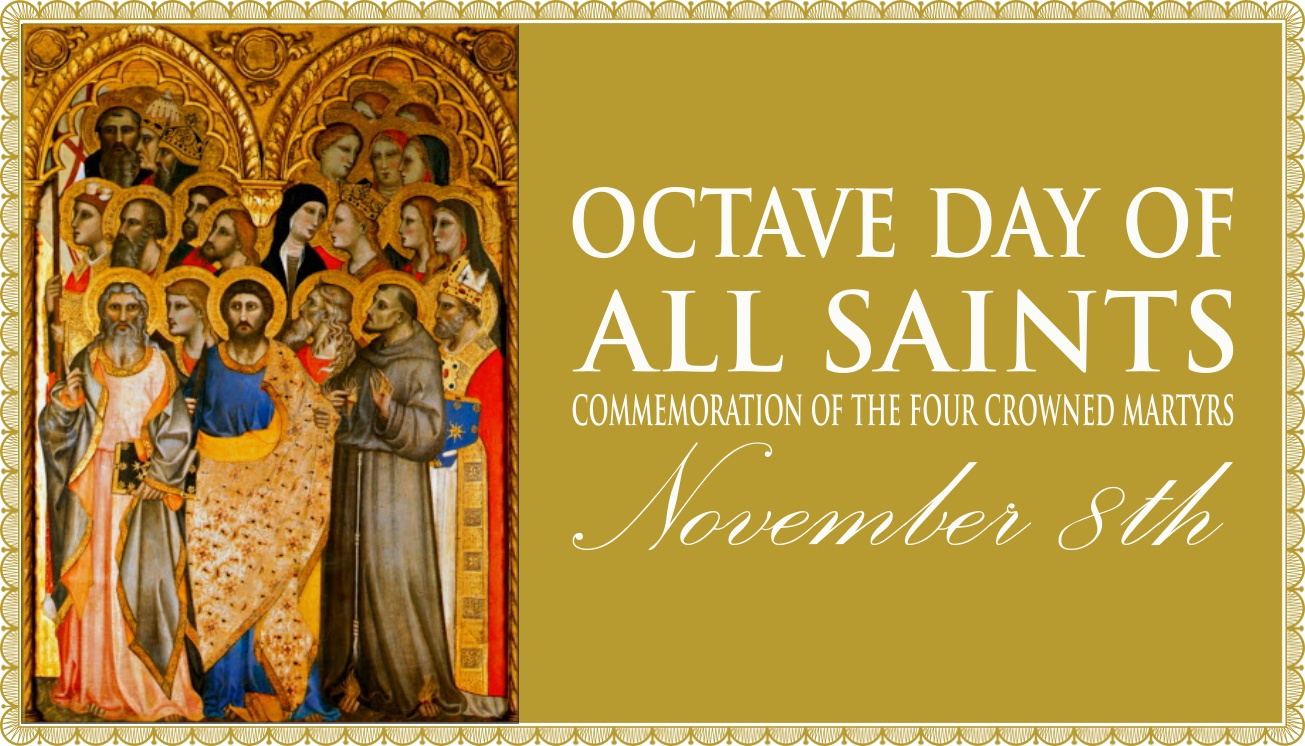
Octave of All Saints
After this, I saw a great multitude which no man can number, of all nations, and tribes and peoples and tongues, standing before the throne, and in sight of the Lamb, clothed with white robes with palms in their hands, and they cried with a loud voice saying: Salvation to our God who sitteth upon the throne and to the Lamb. And all the angels stood round about the throne, and the ancients, and the four living creatures; and they fell down before the throne upon their faces, and adored God, saying: Amen. Benediction, and glory, and wisdom, and thanksgiving, and honour, and power, and strength, to our God for ever and ever. Amen.
Today is the Octave of the feast of All Saints. Last week we focused on the question of what it means to say that we are called to be saints. Today we will consider the epistle from the Book of Revelation, and the great vision of the multitude which no man can number, of all tribes and nations and kindreds and tongues, clothed in white robes, with palms in their hands.
The Book of Revelation is based on visions given to St John on the isle of Patmos. It gave assurance to the faithful who were suffering from persecution of the ultimate triumph of the rule of the saints, who follow the Lamb wherever he goes, and now rest on another shore and in a greater light. St Irenaeus states that the vision was given to St John towards the end of the reign of the Emperor Domitian, though there is some evidence to suggest that at least part of it, if not the whole book, may reflect the earlier persecution under the Emperor Nero. The story of the escape of St John in Rome from a cauldron of burning oil reported by Tertullian (which we celebrate on the feast of St John before the Latin Gate) was thought by St Jerome to refer to the time of Nero (though St Jerome believed on the basis of what St Irenaeus says that Revelation itself belongs to the time of Domitian). The exact dating of the book can probably never be known with certainty. What is clear is that it offers a powerful message of hope to the persecuted Church, that the kingdom of this world would ultimately become the kingdom of our Lord and of his Christ.
The interpretation of the Book of Revelation was the subject of controversy in the early Church, and it remains a matter that is disputed to this day. Some of the early Church Fathers such as St Justin Martyr and St Irenaeus deduced from the twentieth chapter of the book the doctrine of the thousand year reign of Christ with his saints on earth before the final coming of the new heaven and the new earth, wherein dwelleth righteousness. Other early Christian writers disputed this doctrine and consequently questioned the place of the Book of Revelation in the Canon of Scripture. However, the place of Revelation within the Canon of Scripture was championed by St Augustine, though he opposed the doctrine of the thousand year reign of Christ with his saints on earth as too this worldly. Instead, he interpreted the passage as referring to the present era of the Church on earth before the final coming of the Kingdom, when God’s will would finally be done on earth as it is in heaven.
However, whatever may be the truth of the matter regarding the detailed interpretation of Revelation, the central importance of the book lies in the conviction that despite the apparently triumphant power of evil in this world, good will triumph in the end.
In this it is the heir of the hope of the Hebrew prophets that the present conflict between what is and what ought to be will one day be overcome. The wolf would live with the Lamb and the earth would be filled with the knowledge of the glory of God, as the waters cover the sea. As time passed, and the conflict between the Kingdom of God and the suffering of his people in this present world only became more apparent, a new form of literature called apocalyptic developed. The word apocalypse means unveiling, and it refers to the unveiling of the ultimate significance of the events in this world, when seen from the perspective of the heavenly world (the world which is disclosed in symbolic visions to the seer). In the short term the conflict between good and evil will be brought to a head and there will be increased persecution and suffering for the faithful. The faithful are exhorted to endure under persecution and are given the assurance that, despite the present appearance to the contrary, the truth will ultimately prevail. For example, in the Book of Daniel, the reign of the beasts (the pagan rulers of this world) will be eventually replaced by the reign of the kingdom of the saints of the most high (the faithful remnant of the people of God) who will inherit the kingdom and possess it for ever.
The Book of Revelation is a Christian apocalypse. It clearly belongs to the apocalyptic genre of literature. However, it not only looks forward, like the Jewish apocalypses, to the final triumph of good over evil at the end of this present age. It also proclaims the good news that in the coming of Christ into this world, and especially through his death and resurrection, the decisive victory in the battle between good and evil has already been won. The saints do not only cry “How Long” for the final coming of the kingdom. They already belong to the new Jerusalem that will finally be revealed in God’s new heaven and new earth at the end of the age. They already share in the victory of the Saviour over sin and death. Their victory comes not through their own strength, but through the blood of the Lamb.
Let us make our own the words of the hymn:
Who are these, like stars appearing,
These before God’s throne who stand?
Each a golden crown is wearing;
Who are all his glorious band?
Alleluya, hark! They sing,
Praising loud their heavenly King.
These are they who have contended
For their Saviour’s honour long,
Wrestling on till life has ended,
Following not the sinful throng;
These who well the fight sustained,
Triumph through the Lamb have gained.
These are they whose hearts were riven,
Sore with woe and anguish tried,
Who in prayer full oft have striven
With the God they glorified;
Now their painful conflict o’er,
God has bid them weep no more.
These like priests have watched and waited,
Offering up to Christ their will,
Soul and body consecrated,
Day and night to serve him still:
Now, in God’s most holy place
Blest they stand before his face.
by the Revd Dr Robert Wilson PhD (Cantab), Old Roman Apostolate UK



Leave a Reply