
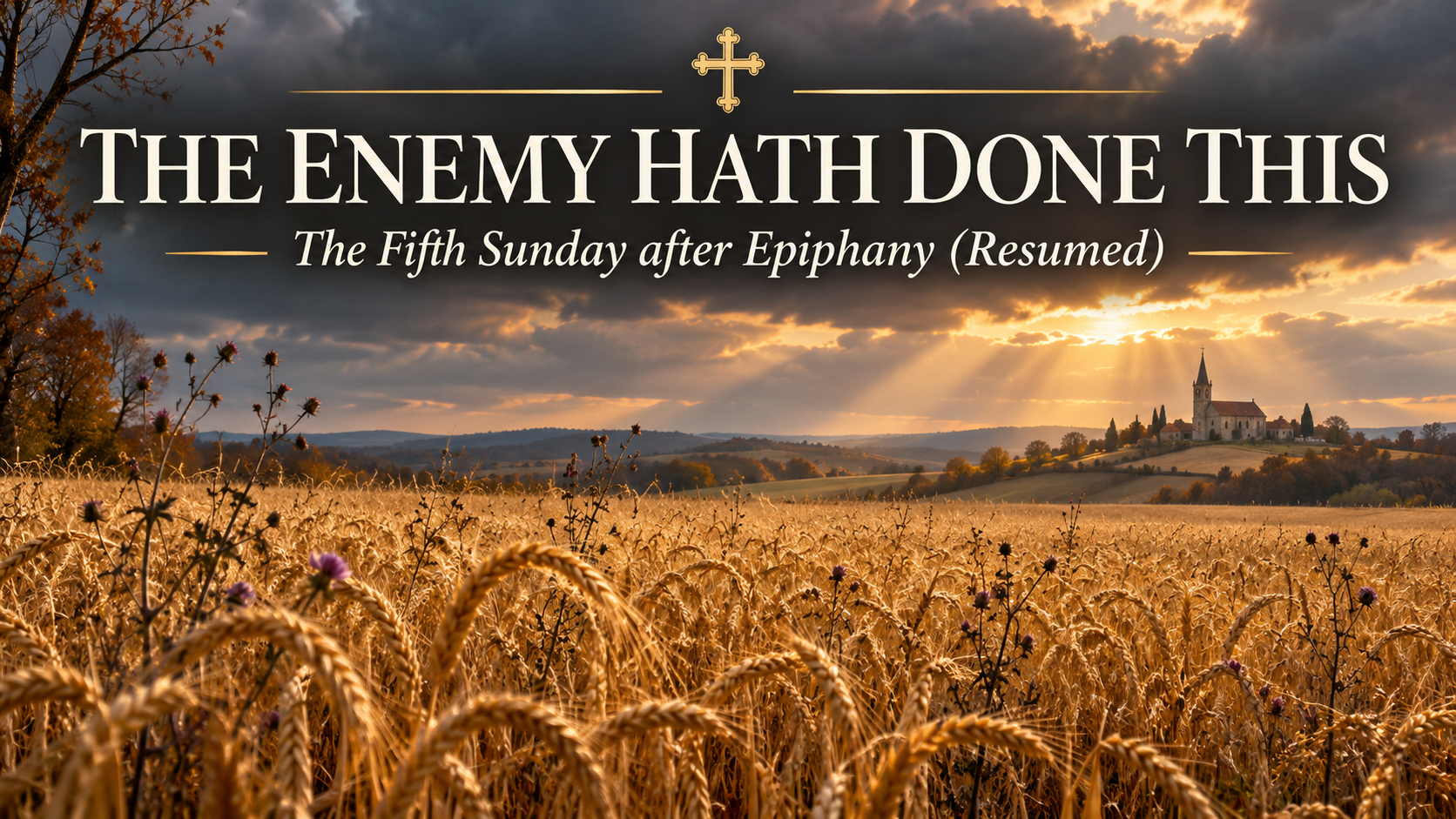
Why does Almighty God permit evil to flourish in a world which He created good? The parable of the wheat and the cockle confronts this ancient question through the patience of the divine Husbandman, who knows what has corrupted His field yet refuses to bring forward the harvest. Resumed towards the conclusion of the ecclesiastical year, the Fifth Sunday after Epiphany acquires particular force from the Roman Mass’s prayers for protection, reconciliation and perseverance. The Fathers and traditional liturgical commentators reveal a profound unity between God’s mercy towards sinners, the Church’s duty to defend the truth, and the certainty of Christ’s final judgement.
Epistle: Colossians 3:12–17
Gospel: St Matthew 13:24–30
Mass: Dicit Dominus
There is a detail in this Sunday’s Gospel which deserves rather more attention than it ordinarily receives. The servants discover that their master’s field has been deliberately corrupted. They are naturally concerned, perhaps even indignant. Someone has interfered with a crop which was growing perfectly well, introducing weeds amongst the wheat. Their master knows precisely what has happened and who is responsible. Yet when they offer to remove the offending plants, he forbids them. They must allow both to grow until the harvest. One can readily understand the servants’ bewilderment. Why should a good husbandman knowingly permit what threatens his own crop to remain?
The question is considerably older than the parable, and it has troubled mankind ever since the Fall. If Almighty God created all things good, whence comes evil? If He governs creation by His providence, why does He permit wickedness to prosper, falsehood to spread and the innocent to suffer? Why does He not intervene more decisively, especially when those responsible for evil appear to escape its consequences? Our Lord’s answer is unlikely to satisfy anyone who expects divine providence to operate according to the immediate demands of human impatience. The harvest will come, but it will come at the appointed time, and its judgement will belong to the Master of the field.
The Fifth Sunday after Epiphany is one of those Sundays which, when prevented by the early arrival of Septuagesima from being celebrated in its original position, is resumed towards the end of the ecclesiastical year. In the older Roman reckoning, 8 November 2026 is the Twenty-fourth Sunday after Pentecost, employing the prayers and readings of the Fifth Sunday after Epiphany. The Mass accordingly retains its Collect, Epistle, Gospel, Secret and Postcommunion, whilst the Introit, Gradual, Alleluia, Offertory and Communion are taken from the Twenty-third Sunday after Pentecost. The final Sunday before Advent retains its own appointed Mass, whatever the number of intervening Sundays.¹
This arrangement is more than an expedient means of accommodating the variable date of Easter. The same Gospel, heard in the weeks following Epiphany, directs attention towards the manifestation of Christ’s Kingdom and the conditions under which it grows upon earth. Heard in November, with Advent approaching and the ecclesiastical year drawing to its conclusion, the emphasis naturally falls upon the harvest which will bring that earthly condition to an end. Michael P. Foley, writing in New Liturgical Movement, has examined this relationship between the resumed readings and their November chants, observing how the latter bring the Last Things into particularly sharp relief. The Church does not alter the words of Christ. She places them within the unfolding sequence of her worship, where they acquire a renewed significance.²
There is also a continuity with last Sunday’s meditation upon the Twenty-third Sunday after Pentecost. As Nuntiatoria observed in its examination of the raising of Jairus’s daughter, the Mass Dicit Dominus speaks to a people who must learn to trust the promises of God even in circumstances which appear to contradict them. The same Introit and chants now accompany a Gospel in which the promised deliverance is no less certain, although its accomplishment must be awaited. Last Sunday Christ was revealed as the Lord of life and death. This Sunday He is revealed as the Lord of history, whose final judgement will expose the truth of everything which has taken place within it.³
The Introit is drawn from Jeremias 29:11–14: Dicit Dominus: Ego cogito cogitationes pacis, et non afflictionis — the Lord declares that His thoughts are of peace, and not of affliction. His people shall call upon Him, He will hear them, and He will bring them back from captivity. The accompanying verse from Psalm 84 recalls the restoration of Jacob and the Lord’s blessing upon His land. These are words addressed originally to a people who knew the consequences of infidelity. Israel’s captivity was real, its suffering grievous, and its restoration dependent upon the providence of the God whose covenant it had repeatedly broken. Yet the promise remained. Divine judgement had not extinguished divine mercy.
That is precisely the assurance required before hearing the Gospel. The presence of evil in the world can appear to call God’s goodness into question. Jeremias reminds us that His purposes have not changed. The disorder which He permits is neither the object of His approval nor evidence that His providence has failed. He can permit the consequences of human rebellion whilst continuing to direct history towards the fulfilment of His promises. The difficulty for creatures who see only a fragment of that history is that they are inclined to mistake the present condition for the final outcome.
The Collect then identifies the source of the Church’s confidence:
Familiam tuam, quaesumus, Domine, continua pietate custodi: ut, quae in sola spe gratiae caelestis innititur, tua semper protectione muniatur.
Keep Thy family, we beseech Thee, O Lord, with Thy continual mercy, that, relying solely upon the hope of heavenly grace, it may always be defended by Thy protection.
The prayer has a considerably greater richness than its apparent simplicity suggests. It is one of those ancient Roman orations whose careful construction rewards close attention to the Latin. Father John Zuhlsdorf, in his What Does the Prayer Really Say? studies, devoted substantial analysis to this Collect, particularly the relationship between familia, pietas, innititur and muniatur. He also noted its preservation in the Roman Missal of 1474 and in the edition promulgated by St Pius V in 1570. Its continued use witnesses to the Church’s attachment to a remarkably concentrated expression of the necessity of grace and the protection of divine providence.⁴
The opening word, familia, embraces more than the modern understanding of parents and children. In Roman usage, it could signify the entire household under the authority of its head, including those dependent upon him for their security and maintenance. Applied to the Church, the term is especially appropriate. Through Baptism the faithful are incorporated into Christ and received into the household of God. They have become members of a supernatural society whose life is sustained by the grace of their heavenly Father. The Church therefore prays as a household whose very existence depends upon the One to whom it belongs.
The accompanying request, continua pietate custodi, asks for His constant and faithful care. Pietas possesses associations with duty, fidelity and the fulfilment of obligations arising from a relationship. Fr Zuhlsdorf draws attention to its classical usage, particularly the Roman understanding of the duties owed to family, country and the gods. When employed of Almighty God, however, it must be understood analogically. The Creator is under no obligation to creatures which could bind Him independently of His own will. He is faithful because He is good, and because He freely fulfils the promises which His mercy has established. The Church depends upon that faithful mercy at every moment.
The language becomes more striking in the second half of the prayer. The household of God is described as resting upon the sole hope of heavenly grace: in sola spe gratiae caelestis innititur. Fr Zuhlsdorf observes that inniti can signify leaning upon something for support, including the classical image of soldiers resting upon their spears or shields. The concluding muniatur, from munire, brings the related idea of fortification and defence. The Church is asking to be guarded and strengthened as a people exposed to danger, but confident in the protection of its Lord.
Two images consequently emerge from the same short prayer. The faithful are the children and servants of God’s household, dependent upon His paternal care; they are also the Church Militant, engaged in a spiritual warfare which cannot be won through unaided human strength. Their confidence rests upon heavenly grace, while their obligations require them to cooperate actively with it. The language is particularly fitting for a Sunday whose Gospel reveals the work of an enemy within the field of the divine Husbandman.
The expression in sola spe also deserves to be understood correctly. The Church’s exclusive reliance upon grace does not dispense with human freedom, obedience or effort. Catholic doctrine has always maintained both the necessity of prevenient grace and the reality of man’s free cooperation with it. Grace moves, heals and elevates the will; it does not make the will irrelevant. The Christian must freely respond to the assistance which God supplies, exercising the virtues and fulfilling the obligations of his state of life. The Pelagian suggestion that fallen man can attain supernatural righteousness by his own powers is excluded, but so too is any account of salvation which renders human cooperation meaningless. The Collect brings these truths together without requiring a theological treatise to express them.
St Paul’s Epistle to the Colossians develops precisely what such cooperation ought to produce. The Apostle instructs the faithful to put on mercy, kindness, humility, modesty and patience, bearing with one another and forgiving injuries as Christ has forgiven them. Above everything else they must possess charity, quod est vinculum perfectionis — which is the bond of perfection.
The words induite vos, put ye on, have a particular significance in the Apostle’s teaching. Earlier in the chapter, he has commanded Christians to put off the old man with his deeds and to put on the new, renewed according to the image of his Creator. The supernatural life received through Baptism is intended to transform the conduct of those who have been incorporated into Christ. It is possible to possess the name of Christian whilst failing grievously to exhibit the virtues which ought to accompany that profession. St Paul therefore addresses the baptised as persons who have received a gift whose proper fruits must become evident in their lives.
The connection with the Gospel is unmistakable. The good seed is expected to bear good fruit. A field may contain wheat and cockle, but the difference between them is eventually disclosed by what they produce. In the supernatural order, charity is the principle by which the Christian virtues receive their proper direction towards God. Patience, humility and mercy are not merely useful dispositions for maintaining agreeable social relations. They belong to the life of grace and the fulfilment of the divine commandments.
Father Leonard Goffine, in his traditional instructions upon the Sunday Epistles and Gospels, draws particular attention to the Apostle’s description of charity as the bond of perfection. He explains that charity unites the virtues because the love of God and neighbour supplies the governing principle of Christian conduct. It is also significant that St Paul concludes by commanding that the word of Christ should dwell abundantly amongst the faithful, expressed through instruction, admonition, psalms, hymns and spiritual canticles. The supernatural life requires the formation of the intellect as well as the affections. A Christian people cannot preserve the Faith simply by inheriting its vocabulary. They must understand what the Church believes and why she believes it.⁵
St John Chrysostom, commenting upon this passage in his homilies on Colossians, insists that the responsibility for learning and transmitting the Scriptures extends beyond the clergy. The Christian household ought to become a place in which the word of God is known, discussed and applied. Parents have a responsibility to instruct their children, and the faithful should possess sufficient familiarity with revealed truth to strengthen one another. There is an obvious relevance to the Gospel which follows. The enemy’s seed is most likely to flourish where the good seed has been neglected.⁶
Our Lord describes the corruption of the field with considerable economy. Whilst the servants sleep, an enemy comes, oversows cockle amongst the wheat and departs. The discovery is made only when the crop has begun to grow. The servants naturally ask their master whether he had not sown good seed, and whence the weeds could possibly have come. His answer is immediate: Inimicus homo hoc fecit — an enemy hath done this.
Christ subsequently explains that the field is the world, the good seed the children of the Kingdom, the cockle the children of the wicked one, and the enemy the devil. The harvest is the consummation of the world, and the reapers are the angels. The explanation is given to the disciples later in the same chapter, beyond the verses appointed for this Sunday’s Gospel, but it is essential to a proper understanding of the parable.
The evil in the field has an identifiable origin. It is the work of an adversary, not an imperfection in the good seed planted by the master. This reflects the Catholic understanding of evil as a privation of good rather than an independent principle possessing an existence comparable to God. St Augustine, whose rejection of Manichaeism involved a profound examination of this question, came to understand that evil cannot be attributed to some rival creative power. St Thomas Aquinas develops the same doctrine in the Summa Theologiae: evil exists as a defect in something which, considered according to its created nature, is good. The devil cannot create another order of being. He can corrupt what God has made, exploit the weakness of fallen man and persuade rational creatures to misuse the freedom which they have received.⁷
This is why the cockle is such an apt image. It resembles the wheat sufficiently closely during its early growth to make immediate separation difficult. Chrysostom sees in this resemblance a characteristic method of the devil, who introduces error under the appearance of truth. False doctrine frequently borrows familiar religious language, adopts plausible arguments, and presents itself as the correction of some supposed deficiency in the Faith. It need not begin with a wholesale repudiation of Christianity. It may proceed by altering the meaning of terms, obscuring necessary distinctions or persuading the unwary that some established doctrine has become an obstacle to the Gospel itself.
Cornelius a Lapide, in his commentary upon St Matthew, similarly examines the properties of the zizania, commonly understood as darnel, and the resemblance which enables it to grow unnoticed amongst the wheat. He draws upon the Fathers to explain how doctrinal and moral corruption may become established before its effects are fully apparent. Yet he is careful to preserve Our Lord’s own explanation that the field is the world. The parable concerns the final judgement of mankind; its application to the visible Church must respect that universal scope.⁸
There is another detail which the Fathers considered especially significant. The enemy sows his seed whilst the servants sleep. Chrysostom interprets this as a warning particularly to those entrusted with the oversight of souls, although the duty of vigilance belongs to the whole Christian people. Goffine makes the application explicit. Ecclesiastical superiors who neglect their responsibilities, parents who fail to instruct their children, and Christians who abandon the ordinary means of sanctification all expose themselves or others to dangers which ought not to be underestimated.
It would be unreasonable to suggest that every instance of evil arises because someone charged with preventing it has been negligent. Human freedom remains capable of rebellion even under the most conscientious care. Nevertheless, the warning cannot be dismissed. The Church possesses a responsibility to defend the deposit of Faith, to instruct those committed to her care, and to correct what endangers their salvation. To assume that error will disappear merely because it is ignored would be an extraordinary misunderstanding of the parable.
The servants, having discovered what has happened, propose an immediate remedy. They will enter the field and gather up the cockle. Their master refuses: Non: ne forte colligentes zizania eradicetis simul cum eis et triticum. No, lest perhaps, gathering up the cockle, you root up the wheat also together with it.
The instruction exposes the limitations of human judgement. The servants know that the weeds are harmful, and they are right to be concerned. What they cannot safely determine is whether their proposed intervention will destroy the good crop they wish to preserve. Their master possesses a knowledge of the field and its eventual harvest which they do not.
St John Chrysostom provides a particularly important interpretation of this passage. He understands the prohibition as directed against the violent destruction of those who have fallen into error. Such measures could injure the innocent and, more importantly, prevent the conversion of persons who might subsequently abandon their errors and embrace the truth. The distinction between plants and human beings is decisive. A weed cannot become wheat through an act of repentance. A sinner can cease to be a sinner through conversion and the grace of God. A man presently opposed to the Faith may yet become one of its defenders.⁹
St Augustine makes the same point in his sermon upon the parable, numbered Sermon 73 in the Benedictine collection. He reminds his hearers that the present mixture of good and evil must not be confused with the final state of the Kingdom. Those who are presently identified with the cockle may yet become wheat. The judgement of men remains fallible, and their knowledge of another person’s future conversion is necessarily limited. God knows both the present condition of the soul and the graces which may yet bring it to repentance.¹⁰
Augustine’s interpretation is especially illuminating when considered against his controversy with the Donatists. They had sought to identify the true Church with a separated communion whose supposed purity distinguished it from those whom they regarded as compromised. Augustine answered that Christ had promised the continuance of His Church throughout the world and that the presence of sinful members could not invalidate her divine constitution or the sacraments entrusted to her. The Church is holy because Christ is holy, because her doctrine and means of sanctification proceed from Him, and because the Holy Ghost continues to sanctify her members. The failures of individual Christians cannot extinguish that supernatural reality.
His argument remains important wherever the moral condition of particular ecclesiastical persons is confused with the essential holiness of the Church herself. A minister may sin gravely without rendering the sacraments invalid. A prelate may exercise poor judgement without destroying the divine constitution of the episcopate. A local community may fall into serious disorder without thereby disproving Christ’s promises concerning His Church. The distinction does not excuse wrongdoing or eliminate the duty of correction. It prevents the sins of men from being treated as though they possessed greater power than the grace of God.
It is equally necessary to understand what the parable does not authorise. Our Lord’s instruction to allow the plants to grow until harvest has occasionally been invoked as though it prohibited the Church from correcting error, exercising discipline or distinguishing between truth and falsehood. Such a conclusion would contradict the explicit instructions of Christ and His Apostles elsewhere in the New Testament. St Paul commands the correction of those who persist in grave wrongdoing, whilst the pastoral Epistles require bishops to preserve sound doctrine and reprove those who contradict it.
Chrysostom is particularly clear that the prohibition against destroying those in error does not forbid the Church from opposing heresy and protecting the faithful. The distinction between condemning a proposition and condemning a person to eternal punishment is fundamental. The Church possesses the authority and duty to judge public teaching and external conduct according to the law of Christ. She does not possess the divine knowledge required to pronounce the final destiny of every soul. That judgement belongs to God.
The patience of the householder therefore establishes no principle of doctrinal indifference. On the contrary, the danger of the cockle is taken seriously throughout the parable. The master refuses the servants’ proposal because he intends to preserve the wheat. His concern is for the good crop and for the proper accomplishment of the harvest.
Here the distinction between divine patience and human negligence becomes especially important. God may permit a sinner to remain alive because He wills to offer him the opportunity of repentance. A pastor who neglects to instruct or correct that sinner cannot claim to be imitating divine patience merely because he has avoided an unpleasant responsibility. Patience is a virtue when governed by charity, prudence and justice. It becomes a vice when its name is employed to excuse cowardice or indifference.
St Thomas Aquinas, examining whether sinners ought to be loved through charity, explains that the person must be loved according to the good of his nature and his capacity for salvation, whilst the sin which corrupts him must be hated. The sinner’s conversion is the proper object of Christian charity. Consequently, correction and mercy are not necessarily competing obligations. A man may require correction precisely because his salvation matters.¹¹
The final sentence of the Gospel must also be given its full weight. Sinite utraque crescere usque ad messem — suffer both to grow until the harvest.
The word until is indispensable. The present coexistence of good and evil is temporary. The master’s patience does not represent an indefinite postponement of judgement, still less its abandonment. At the harvest, the cockle will be gathered and bound for burning, whilst the wheat will be brought into the master’s granary. Christ later identifies this harvest as the consummation of the world, when the angels will separate the wicked from the just.
The doctrine of the Last Judgement is therefore inseparable from the doctrine of divine patience. God permits time for repentance because the present life is the period in which men may respond freely to grace. Death concludes that period of earthly probation, and the particular judgement determines the soul’s eternal destiny. At the general judgement, Christ will manifest publicly the justice of His divine government, the consequences of human actions, and the final triumph of His Kingdom.
The judgement will disclose what human appearances have so often concealed. Those who seemed powerful may be revealed as spiritually impoverished. Virtues practised without recognition, sacrifices known only to God, and acts of charity long forgotten by those who received them will be brought into the light of divine justice. No genuinely good act is lost to His knowledge. Neither is any evil concealed from Him.
The Roman liturgy has already prepared the faithful for this revelation through the Gradual and Alleluia. Psalm 43 supplies the declaration Liberasti nos, Domine, ex affligentibus nos — Thou hast delivered us, O Lord, from those who afflict us. The Church recalls the protection which God has extended to His people, even as she recognises that the struggle continues.
The Alleluia then introduces the opening words of Psalm 129: De profundis clamavi ad te, Domine: Domine, exaudi orationem meam. Out of the depths have I cried to Thee, O Lord: Lord, hear my prayer.
There is something particularly affecting about the Church singing Alleluia before immediately crying to God from the depths. Joy and supplication are not incompatible. The Christian who believes in the promises of God may nevertheless acknowledge his own helplessness and implore assistance. The assurance of salvation does not consist in pretending that the dangers of sin have ceased to exist.
Nuntiatoria’s recent examination of the De Profundis considered the psalm’s long association with penitence, the Office of the Dead and the Christian hope of redemption. Its appearance in this Sunday’s Alleluia and Offertory deserves to be read in the same light. The soul which recognises its need of mercy turns towards the Lord who alone can deliver it. The psalm is singularly appropriate to the approaching conclusion of the ecclesiastical year, when the Church increasingly directs attention towards death, judgement and eternal life.¹²
At the Offertory the cry is repeated, now accompanying the preparation of the Eucharistic sacrifice. The movement from the Gospel to the altar is theologically profound. The Church has heard of the enemy who corrupts the field and of the judgement which will distinguish the just from the wicked. She now approaches God through the sacrifice of Christ, by which sinners are reconciled and the faithful strengthened in grace.
The Secret gives precise expression to this purpose:
Hostias tibi, Domine, placationis offerimus: ut et delicta nostra miseratus absolvas, et nutantia corda tu dirigas.
We offer Thee, O Lord, sacrifices of propitiation, that Thou mayest mercifully forgive our offences and direct our wavering hearts.
The language is unmistakably sacrificial. The plural hostias refers to sacrificial offerings, whilst placationis expresses their propitiatory character. The Church approaches Almighty God through the sacrifice of the altar, which sacramentally makes present the one sacrifice offered by Christ upon Calvary. The Council of Trent solemnly affirmed that the Mass is truly propitiatory, since the same Christ is both Priest and Victim, offered in an unbloody manner through the ministry of His priests. The fruits of His Redemption are thus applied to souls, obtaining mercy and the grace of repentance for those properly disposed to receive them.¹³
The prayer asks for two gifts: forgiveness for sins already committed and direction for hearts still exposed to weakness. The distinction is worthy of careful attention. Absolution restores the sinner to divine friendship when received with the necessary dispositions, but the need for grace does not end with forgiveness. The human will remains capable of hesitation and disorder. It must be continually strengthened if it is to persevere in the good.
The expression nutantia corda is especially revealing. It describes hearts which waver, hesitate or fail to remain steady. Such instability is familiar to anyone who has seriously examined the workings of his own will. A person may know perfectly well what he ought to do and yet struggle to do it. He may resolve to abandon a particular sin, only to discover that habit has made resistance difficult. He may sincerely desire holiness whilst remaining fearful of the sacrifices which fidelity will require.
The Church asks God to direct these wavering hearts. The verb dirigere conveys the idea of setting something straight or guiding it upon its proper course. Foley, in his study of the Sunday orations, draws attention to the contrast between the instability expressed by nutantia and the direction sought from God. The prayer recognises that the will requires divine assistance if its good resolutions are to become persevering action.¹⁴
There is an important connection here with the Gospel. The opportunity for repentance which divine patience affords must be used. A sinner cannot presume that the mere passage of time will produce conversion. Nor may he assume that a good intention, indefinitely postponed, is equivalent to obedience. The Secret asks precisely for the grace by which the heart may cease wavering and begin to act according to the truth it has received.
The request is made in the presence of the sacrificial Victim. The Lord who will one day judge the living and the dead is the same Lord who has offered Himself for their redemption. The Church’s confidence in His mercy rests upon that objective act of divine charity, not upon an optimistic assessment of human nature.
The Communion antiphon, drawn from St Mark 11:24, follows with Christ’s promise concerning prayer: Amen dico vobis, quidquid orantes petitis, credite, quia accipietis, et fiet vobis. Whatever the faithful ask in prayer, they are commanded to ask with confidence.
The promise presupposes the proper purpose of Christian prayer, which is to obtain what is good according to the will and wisdom of God. It cannot reasonably be interpreted as a guarantee that every passing desire will be granted in the manner or at the time preferred by the petitioner. The Christian prays to a Father who knows both his needs and the consequences of what he requests.
The application to this Sunday’s Gospel is especially clear. The servants wished to remove the cockle immediately. Their master knew that their proposed remedy would endanger the wheat. The Christian may similarly pray for deliverance from circumstances which God permits to continue for reasons not yet apparent. Such prayer is neither futile nor unheard. The Lord’s providence may accomplish through patience what human impatience would prevent.
The sacramental context gives this confidence a firmer foundation. Those who receive Holy Communion worthily receive the true Body and Blood of Christ, the food of supernatural life and the source of graces which strengthen them against sin. The Church does not merely invite her members to endure the present struggle through a commendable exercise of determination. She nourishes them with the sacrament instituted by the Redeemer Himself.
The Postcommunion brings the whole Mass towards its conclusion:
Qua esumus, omnipotens Deus: ut illius salutaris capiamus effectum, cujus per haec mysteria pignus accepimus.
We beseech Thee, almighty God, that we may obtain the effect of that salvation of which we have received the pledge through these mysteries.
The word pignus signifies a pledge or guarantee, something already received which assures the recipient of a promised fulfilment. In the Eucharist the faithful truly receive Christ, although their participation in His glorified life has not yet attained its eternal consummation. The sacrament gives real grace in the present and directs the soul towards the heavenly glory for which it has been created.
This distinction between present possession and future fulfilment is central to Catholic sacramental theology. The supernatural life begins here, through grace, and is destined to reach its perfection in the Beatific Vision. Holy Communion strengthens that life and anticipates the eternal union with God promised to those who persevere. The Eucharist is therefore traditionally described as the pledge of future glory.
The Postcommunion asks that the salvation pledged through the sacred mysteries should attain its proper effect. It is no assurance that the mere external reception of Holy Communion guarantees eternal life regardless of the recipient’s dispositions or subsequent conduct. The sacrament must be received worthily, and the grace which it communicates must be preserved through fidelity to Christ. The Church asks that what has been sacramentally begun may reach its appointed perfection.
Here the Gospel’s final image returns with particular force. The wheat is destined for the master’s granary. It has been sown, cultivated and preserved for a harvest which will bring its growth to fulfilment. The Christian soul, regenerated through Baptism and nourished by the Eucharist, is likewise intended for an eternal destiny which exceeds every earthly good.
Dom Prosper Guéranger, in The Liturgical Year, approaches the Fifth Sunday after Epiphany through the Church’s confidence in the divine government of her history. The troubles which accompany her earthly pilgrimage cannot overthrow the promises of Christ. Persecutions, doctrinal controversies and the failures of individual members belong to the history of the Church Militant, but they do not abolish the holiness derived from her divine Founder. The parable warns against confusing the present condition of the field with the final condition of the harvest.¹⁵
That distinction has considerable importance for the proper understanding of ecclesiastical history. There have been periods when the Church appeared outwardly powerful and yet suffered grievously from internal disorder. There have been others when she seemed politically insignificant, persecuted or dispossessed, yet produced saints whose lives bore extraordinary witness to the truth of the Gospel. The outward prosperity of institutions is no certain measure of supernatural fruitfulness, just as their material poverty is no evidence that divine grace has departed.
The Church’s indefectibility rests upon the promise of Christ. It does not require that every ecclesiastical officeholder should be prudent, every pastor faithful, or every local institution preserved from decline. It means that the Church will continue to possess the essential constitution, doctrine and means of sanctification established by her divine Founder until the end of time. The faults of men may obscure her beauty, injure souls and demand correction, but they cannot annul the promises of God.
Nor should Christians confuse fidelity with an attempt to anticipate the judgement which belongs to Christ alone. The Church must teach the truth, correct error and exercise legitimate discipline. Her members must strive to preserve the Faith and protect those entrusted to their care. Yet none of these duties confers upon human beings the omniscience of the divine Judge.
The distinction is particularly necessary when considering the conversion of sinners. Christian history contains innumerable examples of those who once opposed the Faith and subsequently became its defenders. St Paul himself provides the most obvious instance. The persecutor who consented to the death of St Stephen became the Apostle whose Epistle is proclaimed at this Sunday’s Mass. Had the judgement of human impatience determined his destiny before the road to Damascus, the history of Christianity would have been very different.
There is surely something deliberate in the providential irony. The Apostle who instructs the faithful to put on mercy, patience and charity had himself once breathed threats against the disciples of Christ. He knew from personal experience that divine grace could accomplish what no merely human assessment of his previous conduct would have anticipated.
The Gospel consequently requires a sober appreciation of both the seriousness of evil and the possibilities of grace. It forbids complacency concerning falsehood and sin, but it also forbids despair concerning the sinner. The master knows who has planted the cockle. He knows also why the harvest must not be brought forward.
As the ecclesiastical year draws towards Advent, the Church increasingly directs the faithful towards that harvest. The concluding Sundays after Pentecost contemplate the final realities towards which the whole history of salvation is moving. What has been sown will bear its fruit. What has been concealed will be revealed. The patience which now affords time for repentance will yield to the judgement which establishes justice.
There is no contradiction between the mercy of God and the certainty of His judgement. Mercy makes conversion possible; judgement reveals whether that mercy has been accepted or rejected. The same divine holiness governs both. God cannot be indifferent to evil, because He is perfectly good. Neither can He be accused of injustice because He grants sinners time to repent. His providence embraces the whole history of the soul, including opportunities which human judgement cannot foresee.
The Church therefore prays in the Collect for protection, in the Secret for forgiveness and direction, and in the Postcommunion for the fulfilment of salvation. These petitions are the proper response of the Christian people to the Gospel. They acknowledge the danger of the enemy’s work, confess dependence upon divine grace, and seek the perseverance necessary to reach eternal life.
The servants saw the cockle and wished to remove it. The master saw the field and considered the harvest. Their concern was understandable, but his knowledge was greater. The Church hears this parable because she too must labour amidst circumstances which she cannot wholly understand, preserving the truth entrusted to her whilst awaiting the justice which only Christ can accomplish.
The final harvest will vindicate neither human impatience nor human indifference. It will reveal the perfect wisdom of the Lord who permitted time for repentance, furnished His people with the means of salvation, and warned them that the appointed day would come.
The enemy may have sown his seed, but he has neither purchased the field nor appointed the harvest. Both remain in the hands of God.
¹ Calendar for the Traditional Roman Rite, November 2026, according to the pre-1951 rubrics of St Pius X; Missale Romanum, Fifth Sunday after Epiphany, resumed November propers.
² Michael P. Foley, “Holy Leftovers: The Twenty-Fourth Sunday after Pentecost (quasi-Fifth Sunday after Epiphany)”, New Liturgical Movement, 5 November 2021.
³ Nuntiatoria, “They Laughed Him to Scorn: The Twenty-Third Sunday after Pentecost”, 30 October 2026.
⁴ Fr John Zuhlsdorf, “5ht Sunday of Ordinary Time: Collect (1)”, What Does the Prayer Really Say?, 5 February 2006; “5th Sunday of Ordinary Time: Collect (2)”, 4 February 2007.
⁵ Fr Leonard Goffine, Goffine’s Devout Instructions, “Fifth Sunday after Epiphany”, Benziger Brothers edition.
⁶ St John Chrysostom, Homilies on the Epistle to the Colossians, Homily IX.
⁷ St Thomas Aquinas, Summa Theologiae, I, q. 48, aa. 1–4, “The Nature of Evil”.
⁸ Cornelius a Lapide, Commentary on the Gospel of St Matthew, chapter XIII.
⁹ St John Chrysostom, Homilies on the Gospel of St Matthew, Homily XLVI, Matthew 13:24–30.
¹⁰ St Augustine, Sermon 23 on the New Testament (Sermon LXXIII in the Benedictine collection), on Matthew 13; Letter 76, concerning the Donatist interpretation of the wheat and cockle.
¹¹ St Thomas Aquinas, Summa Theologiae, II–II, q. 25, a. 6, “Whether we ought to love sinners out of charity?”.
¹² Nuntiatoria, “De Profundis: The Prayer That Will Not Leave the Dead Behind”, 1 November 2026.
¹³ Council of Trent, Session XXII, Doctrine on the Sacrifice of the Mass, chapters I–II, 17 September 1562.
¹⁴ Michael P. Foley, “The Orations of the Reconfigured Fifth Sunday after Epiphany”, New Liturgical Movement, 11 November 2023.
¹⁵ Dom Prosper Guéranger OSB, The Liturgical Year, “The Fifth Sunday after the Epiphany”.



Leave a Reply