
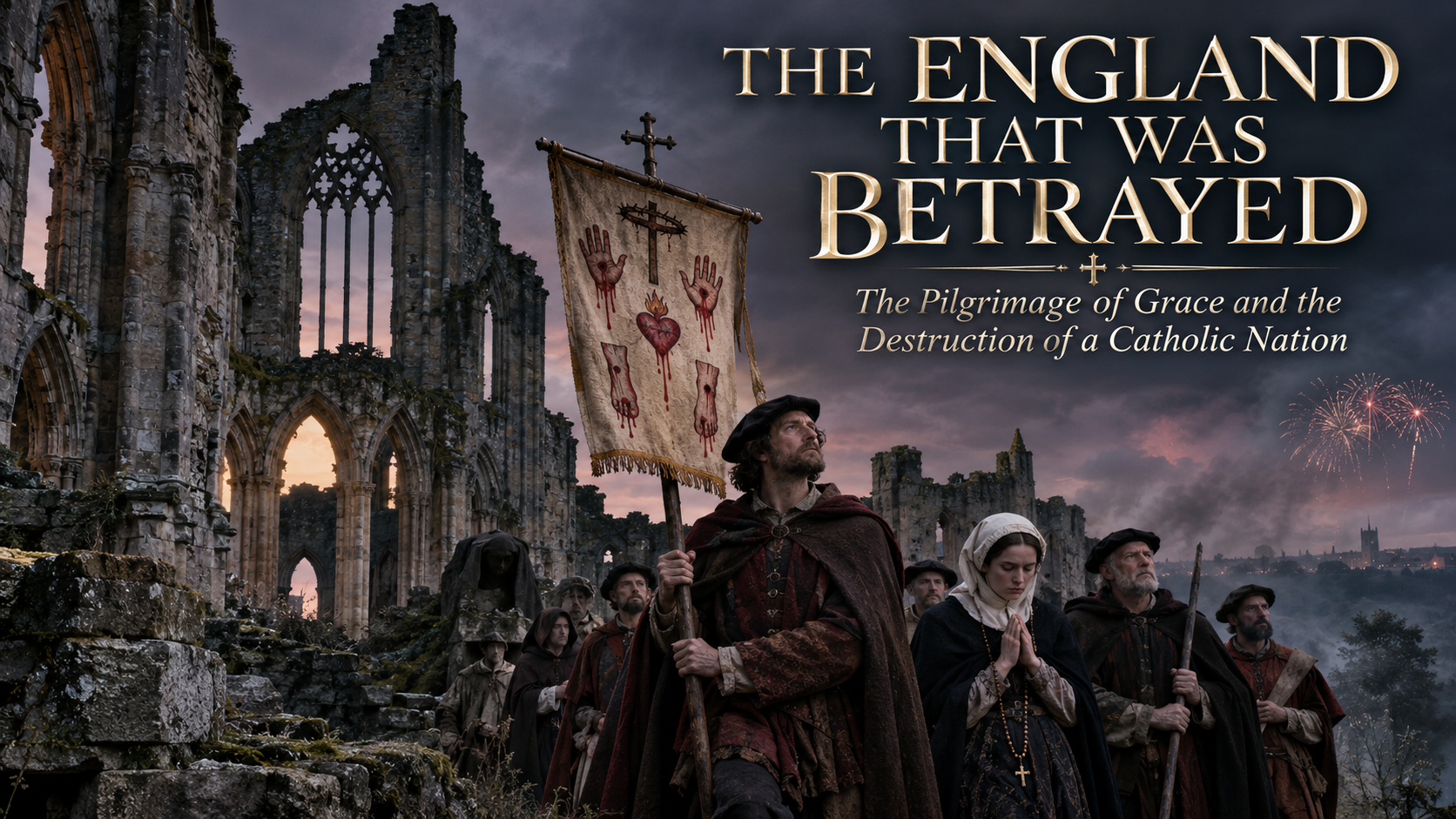
While England commemorates the defeat of the Gunpowder Plot with fireworks and bonfires, the Pilgrimage of Grace recalls an earlier and far greater Catholic resistance to Tudor religious policy. In 1536, tens of thousands rose against Henry VIII’s repudiation of papal authority and the suppression of their monasteries. They carried the Five Wounds of Christ upon their banners, demanded the restoration of the Church’s liberties and accepted assurances from a King who subsequently sent their leaders to the scaffold. Their defeat helped determine the religious future of England, while the ruins of the institutions they sought to defend remain among the most familiar monuments of its landscape.
Every fifth of November, England celebrates the preservation of a Protestant king and his Parliament from the conspirators of 1605. Fireworks and bonfires have long since become a largely secular entertainment, their original significance scarcely considered by most of those attending. The observance was established by Parliament in January 1606 as an annual thanksgiving for deliverance from Catholic treachery, with prescribed services and sermons. The burning of papal effigies subsequently became a familiar feature, especially during periods of renewed hostility towards Catholics. The statutory thanksgiving survived until 1859, although its religious purpose gradually disappeared beneath the festivities. That its origins have largely been forgotten does not make them any less revealing of how Protestantism became associated with English national identity.¹
The intended destruction of Parliament by Robert Catesby’s conspirators, among whom Guy Fawkes remains the most notorious, was an act which no Catholic understanding of moral law can justify. Whatever the persecutions endured by English Catholics, the deliberate killing of innocent people could never become legitimate through the righteousness of a religious cause. Fawkes was tortured following his arrest and executed on 31 January 1606, while the annual celebration of the conspiracy’s failure became an occasion for affirming the religious settlement against which his associates had rebelled. The circumstances which had reduced English Catholics to an increasingly precarious existence under successive penal statutes were rather less prominent in the national remembrance.
Almost seventy years earlier, the English Crown had faced a Catholic rising of a vastly different character. In October 1536, thousands of men assembled in the northern counties to demand that Henry VIII reverse the religious policies by which he and Thomas Cromwell were dismantling England’s Catholic institutions. The Pilgrimage of Grace, as the movement became known, extended through November and reached its decisive negotiations in December. Its principal leader was Robert Aske, a Yorkshire lawyer whose ability to organise the insurgents and secure the support of local gentlemen helped produce an army estimated at around thirty thousand. Norfolk’s royal forces were substantially outnumbered. The pilgrims carried banners bearing the Five Wounds of Christ, proclaimed their loyalty to the King and demanded the restoration of what they regarded as the ancient religious and constitutional order of the kingdom.²
The rising followed Henry’s repudiation of papal jurisdiction, given statutory force by the Act of Supremacy of 1534. Sir Thomas More and Bishop John Fisher had been executed in 1535 after refusing to accept the royal supremacy. In 1536, Parliament authorised the suppression of smaller monasteries, enabling the Crown to appropriate their property. Cromwell’s commissioners visited religious houses and gathered evidence of alleged abuses, while the government pursued a policy whose financial advantages were considerable. By 1540, the monastic establishment which had developed over centuries of English Catholic life had effectively ceased to exist.
Nuntiatoria examined Henry’s religious policy in its January editorial, Henry VIII and the Myth of Pious Reform, considering the disparity between the King’s earlier defence of Catholic doctrine against Luther and his subsequent assumption of ecclesiastical authority. His breach with Rome was driven by dynastic concerns and a determination to overcome the restraints imposed by the existing ecclesiastical order. The confiscation of monastic property also yielded substantial resources to the Crown. The Pilgrimage of Grace supplies evidence of how these policies were received by Catholics whose communities depended upon institutions which the government had resolved to abolish.³
The monasteries were deeply embedded in the religious and material life of medieval England. Their endowments, accumulated through centuries of benefaction, supported the Divine Office, the offering of Masses, charitable provision, hospitality and education. Their lands sustained tenants and labourers, their buildings provided employment, and their churches preserved the tombs and memorial foundations of generations of benefactors. Some houses were poorly governed, others had fallen into debt, and the ordinary failures of religious life were certainly present. Easby Abbey itself had been subject to visitation and disciplinary concerns long before the dissolution. Such circumstances might justify correction, the replacement of negligent superiors or the reform of particular communities. They supplied no general justification for confiscating the property of religious foundations and extinguishing the purposes for which that property had been given.
At Richmond, where the canons of Easby were restored during the rising, townsmen told a visiting religious that they would sooner die than permit the destruction of their house. The testimony survives in the abbey’s documented history. It reveals something frequently lost in accounts of the Reformation which concern themselves principally with parliamentary legislation, theological disputation and the policies of the Crown. The people who lived around these foundations understood their value in ways which neither the King’s commissioners nor subsequent purchasers of monastic property were obliged to share. A religious house was a permanent part of the community’s existence, with obligations towards the living and the dead which could not be transferred without consequence to a new private landlord.⁴
The fullest statement of the pilgrims’ demands was presented in the Twenty-Four Articles prepared at Pontefract in early December 1536. The first article concerned the suppression of teachings which the insurgents regarded as heretical. The second demanded the restoration to the See of Rome of spiritual supremacy concerning the cure of souls, including papal authority over episcopal consecrations. The fourth called for the return of suppressed abbeys, together with their lands and goods. The restoration of the Observant Franciscans, the legitimacy of Princess Mary, ecclesiastical privileges and the repeal of recent treason legislation were also demanded. Cromwell and other royal officials were identified as responsible for the upheaval and marked out for punishment. Alongside these religious grievances appeared complaints about taxation, parliamentary representation, enclosures, customary tenures and the administration of justice.⁵
The ordering of these articles is instructive. The pilgrims had assembled to defend a religious inheritance which they believed the King was unlawfully destroying, while the accompanying economic and constitutional grievances demonstrated how widely the consequences of royal policy were felt. These were Englishmen who understood the religious settlement they wished to preserve sufficiently well to identify the jurisdiction which had been repudiated and the institutions requiring restoration. The familiar suggestion that the Reformation represented the spontaneous liberation of an oppressed population from Roman authority encounters a considerable difficulty in their testimony. A movement of this magnitude, explicitly demanding the restoration of papal jurisdiction, cannot be reconciled with the notion that English Catholicism had already exhausted its popular allegiance.
Henry’s own theological position makes the events more revealing. His opposition to Luther had earned him the title Defender of the Faith, and he continued to maintain substantial elements of traditional Catholic doctrine even after repudiating Rome. The more comprehensive Protestant transformation of worship and doctrine would follow under Edward VI, with the subsequent Marian restoration and Elizabethan settlement. Yet the essential ecclesiological rupture had already occurred. By claiming supremacy over the Church in England, Henry asserted an authority which the Catholic understanding of the Church’s divine constitution could not concede to any temporal sovereign.
The principles involved were familiar to the pilgrims, even if they could not all have expressed them in the language of scholastic theology. The King possessed legitimate authority over the temporal government of his kingdom, but his office did not confer the spiritual jurisdiction of the successor of St Peter. Christian kingship carried obligations towards the Faith and the Church which no royal proclamation could discharge by simply redefining them. The pilgrims’ oath professed loyalty to Henry while affirming their intention to defend Holy Church. Their resistance rested upon the conviction that royal authority remained subject to divine law and that the sovereign could be petitioned, and if necessary resisted, when he exceeded its limits.
Here lay the weakness which would prove fatal to the movement. Aske and his companions believed that the King had been misled by evil counsellors and might yet be persuaded to restore the institutions which his government was destroying. They sought redress from the sovereign rather than his deposition. Their loyalty was sincere, and Aske repeatedly endeavoured to prevent the rising from developing into a war against the Crown. Henry, however, had deliberately embraced the ecclesiastical supremacy which they wanted him to abandon. Cromwell was an instrument of royal policy, although his methods and influence contributed substantially to its execution. Removing the minister would not necessarily reverse the intentions of the monarch.
The Duke of Norfolk’s negotiations with the insurgents consequently possessed an advantage which the royal army could not immediately secure. The government’s forces were too weak to confront the whole northern movement with confidence, while the pilgrims remained reluctant to employ their strength against the King. At Doncaster, Norfolk offered assurances of pardon and consideration of their grievances, together with the prospect of a Parliament in the North. The demands were assembled and presented, and Aske eventually persuaded the commons to accept the settlement. On 8 December, following further difficulties over the precise terms, the pardon was publicly read and the principal rebel forces dispersed. The Crown had recovered freedom of action without defeating the assembled insurgents in battle.⁶
The surviving correspondence makes the subsequent events particularly disturbing. Henry summoned Aske to court in December, extending assurances of royal favour and safe conduct. Aske travelled south, apparently believing that his negotiations had succeeded in securing a genuine hearing for the northern grievances. He supplied the King with information concerning the organisation and causes of the rebellion. The monarch thus obtained from the movement’s principal leader an account of the very resistance which had threatened his government.
The renewed rising under Sir Francis Bigod in January 1537 altered the political circumstances. Aske had opposed the fresh disturbance and attempted to prevent it, but the government subsequently treated activities attributed to former leaders as grounds for new proceedings. The distinction between offences covered by the earlier pardon and alleged subsequent treason became central to their prosecution. To describe Henry as having simply revoked the pardon would obscure the legal mechanism employed. The result was no less severe. Men whose submission had enabled the original movement to disperse were arrested, tried and executed when the Crown had regained the capacity to punish them.
Robert Aske was hanged in chains at Clifford’s Tower, York, on 12 July 1537. Lord Darcy was beheaded on Tower Hill, and Sir Robert Constable was executed at Hull. Other participants suffered the same fate in different parts of the kingdom. The proceedings were not identical in every case, and the evidence concerning individual responsibility deserves to be examined separately. Their collective effect was to destroy the leadership of the movement which had compelled Henry’s government to negotiate only months before.⁷
Nor was the King’s determination confined to the secular leaders. In a letter to Norfolk dated 22 February 1537, Henry ordered that monks at St Agatha’s, Easby and other religious houses which had resisted suppression should be hanged without delay or pity. English Heritage preserves the instruction in its history of Easby Abbey. The surviving evidence does not establish that every execution contemplated by the order was carried out, but the royal intention is plain enough. Religious men whose communities had been restored during the rising were to suffer exemplary punishment for resisting the government’s policy. The King who had appropriated the supreme government of the Church in England was prepared to execute its religious for defending their houses against his commissioners.⁸
The destruction of monastic life proceeded, accompanied by a redistribution of wealth which helped secure the new ecclesiastical order. Religious property passed into secular ownership, creating a body of beneficiaries whose fortunes became increasingly dependent upon the survival of the dissolution. The change had consequences which theological argument alone might never have accomplished. Landowners who remained attached to traditional religion could nevertheless find compelling reasons to oppose the restoration of the monasteries when such restoration threatened the estates they had acquired. A religious revolution which enriched powerful interests acquired defenders whose convictions need not have been especially Protestant.
The confiscations also extinguished obligations imposed by generations of Catholic benefactors. Lands given for worship, hospitality, charity and perpetual prayers for the dead were diverted from their intended purposes. This was especially consequential in a society whose religious understanding of property included duties towards the souls of departed benefactors and the poor who depended upon ecclesiastical provision. The financial transformation did not simply accompany the Reformation as an unfortunate incidental development. It helped determine the political conditions under which the subsequent religious settlement became established and maintained.
The religious consequences would endure considerably longer than the reign of Henry VIII. The suppression of the monasteries, followed by the destruction of shrines and the transformation of traditional worship under successive Tudor governments, interrupted the transmission of a Catholic culture which had developed through centuries of English history. The recusant families and missionary priests of Elizabethan England preserved the Faith under conditions which would have been scarcely conceivable to their grandparents. They inherited a country whose ancient religious foundations had disappeared, whose ecclesiastical property had been transferred to new owners and whose public institutions increasingly required conformity to a settlement established without the jurisdiction of Rome.
The Archbishop of Selsey’s earlier Nuntiatoria reflection, From Ruin to Restoration: The Story of Catholic England, followed the endurance of Catholicism through persecution, recusancy and the eventual restoration of the hierarchy by Pius IX in 1850. The Pilgrimage of Grace belongs to an earlier and particularly revealing stage of that history, when the destruction of England’s established Catholic institutions might still conceivably have been resisted. Its failure deprived subsequent generations of much of the religious and material inheritance which had sustained their ancestors.⁹
The implications also bear upon Nuntiatoria’s more recent examination of the Oxford Movement and its claim to recover the Catholic identity of the Church of England. The continued possession of ancient church buildings, episcopal titles and elements of traditional ceremonial could not, of itself, restore the ecclesiastical communion repudiated by the Tudor settlement. The nineteenth-century Catholic Revival encountered a difficulty which the pilgrims of 1536 had understood without the elaborate ecclesiological theories subsequently devised to circumvent it. The jurisdiction of the Apostolic See was no incidental administrative arrangement, capable of being discarded while the Church’s visible Catholic unity remained unaffected.¹⁰
The Pilgrimage nevertheless deserves to be understood in its own historical circumstances. Its participants were men of the sixteenth century, whose articles included demands for severe punishment of those they regarded as heretics. Their political programme cannot be represented as an anticipation of modern religious liberty, nor should the religious divisions of Tudor England be reduced to a simple contest between an entirely Catholic population and an entirely Protestant government. Protestant teaching acquired genuine adherents, and its progress was neither uniform nor wholly dependent upon coercion. The evidence establishes something sufficiently substantial without such exaggeration: a formidable body of English subjects resisted the repudiation of Rome and the destruction of Catholic institutions, and the Crown ultimately suppressed that resistance.
The ruins left by the dissolution are now treated as treasures of England’s architectural inheritance. Fountains, Rievaulx, Whitby and the lesser religious foundations scattered throughout the country attract visitors whose admiration for medieval craftsmanship seldom extends to much consideration of the religion which inspired it. Their broken walls have acquired a picturesque dignity, almost as though generations of monks had devoted themselves to constructing suitable scenery for future tourists. The buildings were erected for the worship of Almighty God, endowed by men and women who expected their benefactions to sustain religious life and prayers for their souls. Their destruction was neither inevitable nor the consequence of their having outlived their original purpose.
The contrast with Bonfire Night is therefore worth preserving, provided the historical distinction is properly made. The Gunpowder Plot was a conspiracy whose intended violence threatened innocent lives and whose failure could legitimately be welcomed. The Pilgrimage of Grace was a much larger movement seeking redress for religious, constitutional and economic grievances. Its leaders negotiated with the Crown, accepted assurances and dispersed their followers. Their subsequent executions helped extinguish organised resistance to policies which would transform the religious character of the kingdom.
England’s annual commemoration of 1605 became part of the Protestant national identity established after the Reformation. The northern rising of 1536, which had sought to preserve the country’s communion with Rome, received no comparable place in popular remembrance. The disparity is unsurprising. National commemorations frequently reflect the convictions of those who inherited political authority, and the institutions established by the Tudor settlement possessed little reason to celebrate men who had challenged its foundations.
Nor did England’s Catholic inheritance disappear because its people unanimously repudiated the religion of their ancestors. The Reformation required legislation, the enforcement of conformity, the confiscation of ecclesiastical property and, when challenged, the exercise of royal power against those who resisted. It brought genuine religious change, including the conversion of many Englishmen to Protestantism, but its institutional victory was inseparable from the coercive capacities of the Tudor state. The Pilgrimage of Grace remains among the clearest surviving demonstrations of how vigorously that transformation was opposed.
The fifth of November is therefore an appropriate occasion for Catholics to recall the northern pilgrims, although their rising began in October and continued into December. Their cause belonged to a much longer history than the later conspiracy against James I. It concerned the religious identity of England, the liberties of the Church and the proper limits of royal authority. Robert Aske and his companions believed that their sovereign could be persuaded to preserve what his government was destroying. Henry’s response exposed the fatal inadequacy of that expectation.
The monasteries were suppressed, their lands dispersed and their communities extinguished. The Catholic Faith survived through centuries of persecution and recovered a public institutional life, but the civilisation which had formed medieval England was never restored in its former character. The Pilgrimage of Grace deserves remembrance because its participants recognised the magnitude of the loss while the outcome remained uncertain, and were prepared to defend what they had received.
England has become accustomed to admiring the ruins. It has been rather less willing to remember those who tried to prevent their creation.
1. UK Parliament, Commemoration of the Gunpowder Plot; Frequently Asked Questions: The Gunpowder Plot.
2. R. W. Hoyle, The Pilgrimage of Grace and the Politics of the 1530s (Oxford University Press, 2001); Claire Ridgway, Tudor Society, The Pilgrimage of Grace: A Timeline.
3. Nuntiatoria, Henry VIII and the Myth of Pious Reform, 30 January 2026.
4. English Heritage, History of Easby Abbey.
5. Letters and Papers, Foreign and Domestic, Henry VIII, vol. XI, pp. 506–507, edited by James Gairdner (HMSO, 1888), Twenty-Four Articles of the Pilgrimage of Grace Rebels (1536).
6. Madeleine Hope Dodds and Ruth Dodds, The Pilgrimage of Grace, 1536–1537, and the Exeter Conspiracy, 1538, vol. II (Cambridge University Press, 1915), chapter on the negotiations at Doncaster.
7. Tudor Society, 12 July 1537: The Execution of Robert Aske; English Heritage, History of Clifford’s Tower; Dodds and Dodds, The Pilgrimage of Grace, vol. II.
8. English Heritage, History of Easby Abbey.
9. Archbishop of Selsey, Nuntiatoria, From Ruin to Restoration: The Story of Catholic England, 2 October 2025.
10. Nuntiatoria, The Catholic Church That Anglicanism Imagined Itself to Be, 6 November 2026.



Leave a Reply