
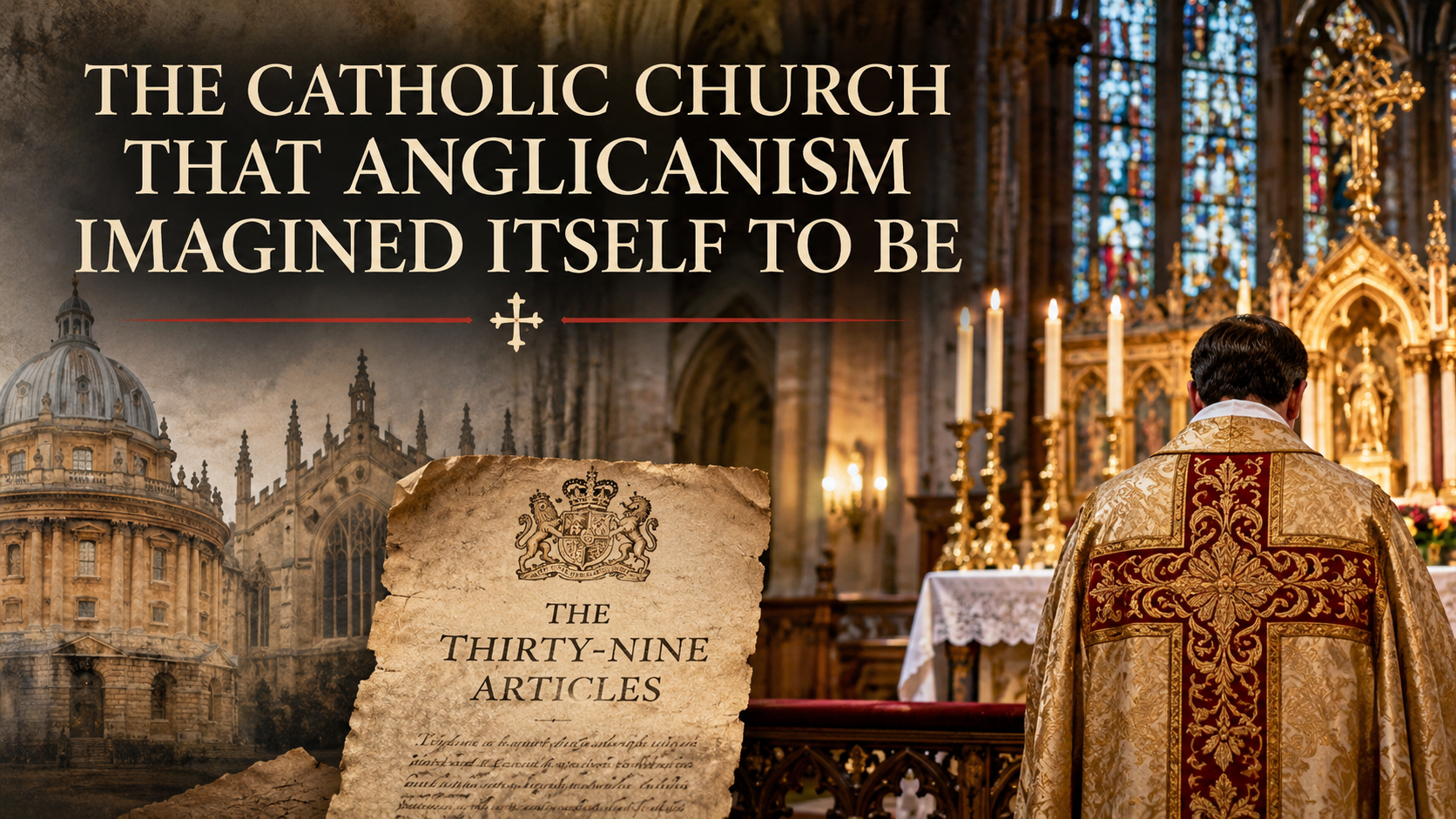
The Oxford Movement claimed to have rediscovered the Catholic identity of the Church of England. Its successors became so successful in reproducing Catholic worship that the claim itself increasingly escaped examination. But the “Catholic” Revival could neither undo the English Reformation nor establish the ecclesiology upon which its claims depended. The result is an Anglo-Catholic tradition whose appearance of Catholicity has sometimes obscured the very questions its founders sought to answer.
There are churches in England where a visitor unfamiliar with the intricacies of ecclesiastical history might reasonably conclude that the Reformation had never occurred. The altar is furnished with candles, a tabernacle contains what the congregation believes to be the Blessed Sacrament, statues of Our Lady and the saints occupy their accustomed places, and the priest celebrates in vestments which would be entirely at home in a Roman Catholic sanctuary. The Mass may follow a form recognisably derived from the Roman Rite, while the sermon might expound the Real Presence, the intercession of the saints or the sacrificial priesthood with a conviction that would satisfy many a traditional Catholic congregation. Yet the building belongs to the Church of England, the minister is ordained according to its rites, and the ecclesiastical authority under which he functions is that of a Church whose constitutional and doctrinal identity was deliberately established in opposition to Rome.
For many Anglo-Catholics this presents no particular difficulty. They regard themselves as Catholics, their clergy as Catholic priests, their worship as Catholic worship, and their separation from Rome as essentially a matter of jurisdiction. Some will acknowledge historical disagreements about the validity of Anglican orders while regarding them as either obsolete or capable of resolution through contemporary theological dialogue. Others, particularly among those committed to traditional doctrine and the male priesthood, consider themselves the custodians of an authentic Catholic inheritance within an Anglican establishment which has progressively abandoned its own foundations. Their sincerity is not in question. Indeed, it is precisely because such convictions are sincerely held that the historical assumptions supporting them deserve examination.
Nuntiatoria has previously considered the validity of Anglican orders in The Form, the Rite, and the Reality: Why Apostolicae Curae Still Stands, the consequences of the English Reformation in The Illusion of Continuity: The Church of England and the Break with Catholicity, and the confusion arising from contemporary ecumenical gestures in From the Clementine Chapel to Walsingham. Those examinations concerned the sacramental and doctrinal rupture of the Reformation, the judgement of Leo XIII, and the increasingly ambiguous public relationship between Catholic and Anglican ecclesiastics. There remains, however, another difficulty which helps explain why these questions continue to be treated with such apparent bewilderment among some contemporary Anglo-Catholics. It is the assumption that the remarkable success of the nineteenth-century “Catholic” Revival somehow vindicated the ecclesiastical claims from which that Revival originated.¹
The Oxford Movement did not begin with incense, lace or the imitation of Roman ceremonial. It began with a crisis concerning the nature and authority of the Church of England. The political reforms of the early nineteenth century, particularly parliamentary interference in ecclesiastical affairs, exposed an uncomfortable question for those Anglicans who regarded the Church as possessing a spiritual authority independent of the state. If Parliament could reorganise the Church according to political expediency, by what authority did its bishops govern? Was the established Church merely the religious expression of the English constitution, or did it possess an apostolic authority which neither Crown nor Parliament could confer or withdraw?
John Keble’s sermon on National Apostasy in July 1833 expressed the alarm which animated the early movement. Newman, Pusey, Froude and their associates sought to recover an understanding of the Church rooted in apostolic succession, the Fathers and the ancient Christian inheritance. Their enterprise was serious, intellectually ambitious and, in certain respects, a necessary challenge to the complacency of the religious establishment. Yet it was also an attempt to defend the Catholic character of an institution whose Reformation history presented considerable difficulties for precisely such a defence. The Tractarians were not demonstrating that the Church of England had remained the Roman Catholic Church in England, temporarily deprived of communication with the Pope. They sought to establish that the Church of England possessed Catholicity independently of Rome.²
This distinction is fundamental, though it is frequently lost in accounts which treat the Oxford Movement as a simple rediscovery of Catholicism. The early Tractarians did not generally argue that the English Reformation had merely interrupted administrative relations between two parts of the same ecclesiastical institution. Rather, they developed an understanding of the Catholic Church which allowed Anglicanism to claim an authentic place within it notwithstanding its separation from Rome and its acceptance of Reformation formularies. The so-called branch theory, given systematic expression by William Palmer in his Treatise on the Church of Christ of 1838, envisaged the Roman, Eastern and Anglican communions as distinct branches of the one Catholic Church. Each was supposed to possess essential characteristics of the ancient Church, and their separation, however regrettable, did not deprive them of Catholic identity.³
There was considerable convenience in this arrangement. It enabled Anglicans to reject what they regarded as the doctrinal deficiencies of Protestant Nonconformity while resisting the claims of Roman jurisdiction. The ancient Church could be invoked as the standard against which both Rome and Canterbury were to be judged, with Anglican theologians deciding which elements of the Catholic inheritance were essential and which constituted subsequent developments or corruptions. But the arrangement assumed what it was intended to prove. It required acceptance of an ecclesiology which the Catholic Church herself did not recognise.
The Catholic Church has never understood herself as one denomination among several which together constitute a larger Catholic Church. Her claim is that the Church founded by Christ continues visibly in the communion of faith, sacraments and legitimate pastors united with the successor of Peter. This does not mean that everything outside her visible boundaries is devoid of Christian truth or sacramental grace; the Catholic recognition of Orthodox orders and sacraments demonstrates otherwise. But the existence of valid sacraments outside full communion is not proof that the Church of Christ was constituted as several independent branches, each entitled to determine Catholic doctrine for itself. Even if every Anglican ordination since the Reformation could be demonstrated to have been sacramentally valid, that would not establish the branch theory. The question of orders would have been answered, but the question of the Church’s visible constitution would remain.
Leo XIII addressed precisely this understanding of ecclesiastical unity in Satis Cognitum, published in 1896. The Church, he taught, is one in visible constitution as well as in faith, and its unity is not something subsequently arranged between otherwise independent religious societies. One may dispute the Catholic understanding of that constitution, as Anglican theologians have done, but one cannot claim to have established Anglican Catholicity merely by proposing a different definition of what the Catholic Church is. That is the central weakness of the Tractarian case. The Church of England could be declared Catholic only after Catholicity had been defined in a way which accommodated the Church of England.⁴
It is worth remembering what the Church of England actually was before the Oxford Movement. The English Reformation was not an obscure theological episode whose consequences had somehow escaped the notice of succeeding generations. The repudiation of papal jurisdiction, the royal supremacy, the Edwardine liturgical reforms, the Elizabethan settlement and the Thirty-Nine Articles formed the legal, doctrinal and religious foundations of the established Church. Its clergy were educated within a Protestant theological culture, its public worship had been deliberately reshaped, and much of the ceremonial associated with the medieval Catholic religion had been suppressed or abandoned. Catholic altars had been replaced with communion tables, images destroyed or removed, shrines dismantled, and the traditional sacrificial understanding of the Mass repudiated in its formularies. These changes were not accidental blemishes upon an otherwise Catholic institution. They expressed the religious convictions of those who established and defended the Reformed Church of England.
There were, naturally, differences within Anglicanism. The Elizabethan settlement itself accommodated competing tendencies, while seventeenth-century High Churchmanship preserved an understanding of episcopacy, liturgical order and patristic authority which differed considerably from the more thoroughly Calvinist positions of other English Protestants. The Caroline Divines, among them Lancelot Andrewes, William Laud and Jeremy Taylor, provided later generations with a substantial body of theological and devotional writing. The Nonjurors and eighteenth-century High Churchmen maintained further elements of that inheritance. Yet none of this establishes that Anglicanism had retained the Catholic identity subsequently claimed by the Oxford Movement. The existence of a High Church tradition is evidence of theological diversity within the Protestant establishment, not proof that the establishment itself secretly remained Roman Catholic.
Indeed, the Caroline Divines were not Tractarians before their time. Their theology reflected the disputes of their own century, their understanding of Church and Crown, their defence of episcopacy and their varying attitudes towards the Reformation. Many remained firmly opposed to Roman claims while drawing extensively upon the Fathers and the practices of Christian antiquity. To treat their writings as if they represented an uninterrupted tradition of nineteenth-century Anglo-Catholicism is to read history backwards. Peter Nockles, whose scholarship has examined the relationship between old High Churchmanship and the Oxford Movement, has demonstrated both the genuine inheritance upon which the Tractarians drew and the significant respects in which they departed from it. The later assumption that Anglo-Catholicism was simply the natural development of an ancient Anglican tradition is not sustained by the historical evidence.⁵
The distinction becomes still clearer when we consider the Ritualist movement which followed. The original Tractarians were principally concerned with ecclesiology, doctrine, authority and the spiritual life. They were not generally enthusiastic promoters of the elaborate ceremonial which later became synonymous with Anglo-Catholic worship. Newman himself was cautious about conspicuous ritual innovation, while Pusey’s attitude towards its later development was considerably more complicated than popular accounts sometimes suggest. The restoration of Eucharistic vestments, incense and more elaborate ceremonial accelerated particularly during the late 1850s and 1860s, alongside developments in church architecture, Eucharistic theology and liturgical scholarship. George Herring’s examination of the movement is especially instructive here. He argues that Ritualism was not the inevitable fulfilment of Tractarianism, but a development which in important respects departed from the earlier movement’s own principles.⁶
This matters because the ceremonies now so readily accepted as evidence of an ancient Catholic Anglican identity were frequently introduced in circumstances of bitter controversy. Vestments, candles, incense, reservation of the Eucharist and sacramental confession were not simply restored to universal approval by grateful congregations delighted to recover their forgotten inheritance. They were resisted by clergy, parishioners and ecclesiastical authorities who believed that such practices contradicted the Reformation principles of their Church. Litigation, prosecutions and parliamentary intervention followed. The Public Worship Regulation Act of 1874 was directed against precisely the kind of ritual innovations which later generations came to regard as distinctive features of Anglo-Catholicism. Nigel Yates has described the nineteenth-century transformation of Anglican worship as a liturgical upheaval of exceptional magnitude.⁷
One must ask why such a struggle was necessary if the Church of England had always understood itself in the Catholic sense subsequently asserted by the Ritualists. The answer is surely that it had not. Those resisting the innovations were not merely ignorant Protestants interfering with an essentially Catholic institution. They were Anglicans defending the religious settlement and understanding of worship which their Church had inherited from the Reformation. They might have been wrong about the Catholic faith, but they were hardly mistaken in recognising the Protestant character of much of their own ecclesiastical tradition.
The “Catholic” Revival therefore accomplished something rather different from what its later admirers sometimes suppose. It transformed the worship and religious culture of substantial parts of Anglicanism. Churches were restored, religious communities established, devotional practices recovered and sacramental theology brought into renewed prominence. Many of these achievements were impressive, and some have exercised a lasting influence beyond the Church of England itself. But the transformation was an achievement of the nineteenth and subsequent centuries. It cannot retrospectively establish that the Church of England had possessed the same theological identity throughout the preceding three hundred years.
There is an irony here which ought not to be overlooked. The original Tractarians knew that they had a case to make. Their claim to Anglican Catholicity required an elaborate defence against the apparent consequences of the Reformation, and the branch theory supplied the ecclesiology necessary to sustain it. Their Ritualist successors then devoted themselves increasingly to the practical expression of Catholic belief and worship. Later generations inherited the resulting churches, liturgies, religious communities and customs as the ordinary furniture of their ecclesiastical lives. What had once been a controversial proposition gradually acquired the familiarity of an established fact. The appearance of Catholicity became so convincing that its underlying claim was no longer always thought to require proof.
The Oxford Movement sought to demonstrate that the Church of England was Catholic. The Ritualists succeeded in making parts of it look Catholic. Some of their modern successors appear to regard the second achievement as sufficient evidence for the first.
This is not intended as an accusation against every contemporary Anglo-Catholic priest. There are Anglican scholars and clergy thoroughly acquainted with the historical difficulties of their position, and some have wrestled with them at considerable personal cost. Nevertheless, a recognisable tendency exists within contemporary Anglo-Catholic discourse to speak as though the Church of England were substantially identical to the Catholic Church in doctrine and sacramental life, with the remaining differences belonging principally to jurisdiction, historical misunderstanding or the more recent innovations of liberal Anglicanism. The assumption is understandable in those whose entire religious experience has been formed by the devotional culture of the “Catholic” Revival. It is much less convincing when tested against the Church of England’s own history and authoritative formularies.
Consider the position of an Anglican priest who sincerely believes in transubstantiation, the sacrificial character of the Mass, the intercession of Our Lady and the saints, and the sacramental priesthood as understood by the Catholic Church. Such a priest may be intellectually and devotionally much closer to Catholic teaching than an Evangelical colleague who rejects these doctrines. Yet both belong to the same ecclesiastical institution, and both exercise ministry under the authority of its bishops. The Church of England has not formally repudiated its Thirty-Nine Articles, in which transubstantiation is rejected and the sacrifices of Masses condemned in language which is impossible to reconcile straightforwardly with the Council of Trent. Its modern Declaration of Assent identifies those Articles, together with the Book of Common Prayer and the Ordinal, as historic formularies which bear witness to the Christian faith.⁸
That declaration is itself revealing. It affirms that the Church of England is part of the One, Holy, Catholic and Apostolic Church, while retaining as authoritative witnesses documents which embody its Protestant Reformation. The language permits considerable latitude in individual theological interpretation, but it does not explain how mutually contradictory understandings of the Eucharist, priesthood and ecclesiastical authority can together constitute one determinate Catholic profession of faith. The Anglo-Catholic may interpret the Articles in ways intended to reconcile them with Catholic doctrine, or maintain that their original polemical language must be understood within its historical context. Yet that interpretation remains his interpretation. It cannot be substituted without argument for the historical meaning of the formularies or the theological identity of the institution which continues to recognise them.
Nor are Evangelical Anglicans intruders into what should properly be regarded as an exclusively Catholic Church. Their understanding of Anglican identity possesses substantial roots in the English Reformation itself. Indeed, the Evangelical who embraces the Protestant doctrines of the Reformation may have a more straightforward explanation of his relationship to the Thirty-Nine Articles than the Anglo-Catholic who must reconcile their language with doctrines the reformers intended to reject. This is not to suggest that Anglicanism has ever been doctrinally uniform or that its present formularies require every cleric to reproduce the theology of the sixteenth century. It is simply to recognise that the Protestant inheritance belongs to the Church of England’s constitution and cannot be dismissed as an unfortunate misunderstanding perpetrated by those who failed to appreciate its supposedly Catholic nature.
The point was made with considerable public solemnity at the coronation of King Charles III in May 2023. The King was required to promise that he would maintain the Protestant Reformed Religion established by law and preserve the settlement, doctrine, worship, discipline and government of the Church of England. In his Accession Declaration he expressly professed himself a faithful Protestant. These obligations belong to the continuing constitutional arrangements of the British monarchy and the established Church. They do not determine the personal convictions of every Anglican, but they certainly establish something about the religious settlement which the Crown is required to maintain.⁹
There is something remarkable about an ecclesiastical situation in which an Anglo-Catholic priest may insist that he belongs to a Catholic Church essentially distinguished from Rome only by jurisdiction, while the Supreme Governor of that same Church solemnly undertakes to preserve its Protestant religious establishment. Both claims may be sincerely made, but they cannot simply be treated as interchangeable descriptions of the same ecclesiastical reality. The difference is not one of ceremonial preference or historical vocabulary. It concerns the doctrinal and constitutional identity of the institution itself.
The contemporary difficulties surrounding women’s ordination and moral doctrine make the contradiction still more apparent. Traditional Anglo-Catholics have often resisted developments which they believe incompatible with apostolic teaching, maintaining the historic male priesthood and Catholic sacramental discipline against substantial opposition within their own communion. Their fidelity to those convictions deserves acknowledgement. But the fact that they must preserve them within structures which have adopted contrary practices demonstrates the limitations of their position. A Catholic ecclesiology cannot be established simply by identifying a constituency within an ecclesiastical body which professes Catholic doctrines while the body itself recognises incompatible theological positions.
The question of orders remains distinct, though related. Nuntiatoria’s earlier examinations of Apostolicae Curae addressed the defects identified by Leo XIII in the Edwardine Ordinal, the intention expressed by the Reformation rites, and the inadequacy of assuming that subsequent revisions or participation by bishops of recognised succession had automatically resolved the original judgement. Those arguments need not be rehearsed in full here. What matters for the present discussion is that even demonstrable validity would not prove the branch theory. Apostolic succession is indispensable to a valid episcopate, but the Catholic Church does not define her identity merely by the presence of bishops whose orders can be traced through an historical succession. She professes a determinate faith and possesses a visible constitution. Valid orders cannot supply ecclesiastical unity where the latter is denied, nor can they make contradictory doctrinal professions equally Catholic.
This distinction was increasingly apparent to Newman himself. His movement towards Rome arose from sustained investigation into the nature and development of the Church, and the growing conviction that the Anglican via media could not provide the ecclesiastical authority which its own claims required. The ancient Church could not simply be reconstructed as an ideal tribunal before which Rome and Canterbury appeared as equal parties, with the Anglican theologian deciding which had most faithfully preserved antiquity. Newman came to recognise that the Church’s historical development and living authority could not be separated in that manner. His reception into the Catholic Church in 1845 exposed a difficulty at the heart of the original Tractarian argument which the later success of the “Catholic” Revival did nothing to remove.¹⁰
It is perhaps this aspect of the Oxford Movement which has been most thoroughly obscured by its subsequent achievements. The churches, ceremonial, devotional practices and religious communities survived, and in many cases flourished. The theoretical difficulty remained. Indeed, the more thoroughly parts of Anglicanism adopted Catholic worship, the easier it became to suppose that their Catholic identity had already been established. One might attend Mass in an Anglo-Catholic parish for many years without encountering anything in its ordinary ceremonial life which required serious consideration of the Thirty-Nine Articles, the royal supremacy, the Reformation Ordinal or the ecclesiological assumptions of the branch theory. Yet those matters have not vanished. They are integral to understanding why the Catholic Church has not recognised Anglicanism as another Catholic communion merely awaiting a convenient settlement concerning jurisdiction.
None of this diminishes the genuine spiritual good which may have arisen from the “Catholic” Revival. Its recovery of ancient Christian devotion and sacramental language has undoubtedly encouraged many Anglicans to study the Fathers, the liturgy and the doctrinal inheritance of the Church more seriously. For some, that enquiry has led ultimately to communion with Rome. For others, it has strengthened their conviction that Catholic life can be sustained within Anglicanism. What cannot reasonably be concluded is that the latter conviction has been proved by the existence of the devotional culture which sustains it.
The problem with contemporary Anglo-Catholic self-understanding, where this confusion occurs, is therefore more profound than an imperfect appreciation of ecclesiastical history. It is a failure to distinguish the achievements of a movement from the truth of its original premises. The “Catholic” Revival succeeded in transforming much of Anglican religious life while leaving unresolved the question whether Anglicanism possessed the Catholic identity which justified that transformation. The result is a tradition whose inherited forms can make its ecclesiastical claims seem self-evident, although those claims remain subject to the same historical and theological objections which confronted its founders.
And here the Catholic position must be understood on its own terms. The Catholic Church cannot accept the branch theory without adopting a conception of herself different from that which she has consistently professed. She cannot recognise Anglican orders merely because Anglican clergy now express a Catholic understanding of the priesthood, nor can she regard the recovery of Catholic ceremonial as equivalent to restoration of communion. Such conclusions would not be acts of generosity towards Anglicans. They would require the abandonment or alteration of principles which belong to the Catholic understanding of the Church and her sacraments.
The appropriate response to Anglo-Catholicism is therefore neither contempt for its genuine achievements nor acquiescence in its ecclesiological assumptions. Its clergy and faithful ought to be treated with the seriousness due to Christians who have recovered much that is true and venerable in the Catholic inheritance. But genuine respect also requires an honest account of what remains unresolved. The desire for reunion cannot be served by pretending that the English Reformation was merely an administrative separation, or that nineteenth-century devotional renewal somehow repaired its doctrinal and sacramental consequences.
The Oxford Movement raised questions which were never adequately answered by the branch theory. The Ritualists subsequently accomplished a transformation of worship which was impressive, sometimes heroic, and often beneficial. But the latter achievement could not establish the former claim, however persuasive its outward expression became.
The Church of England was deliberately reconstituted as a Reformed and Protestant establishment. Its later “Catholic” Revival altered important aspects of its worship and self-understanding, but did not erase that history or provide an alternative foundation for the Catholic Church’s visible unity. Indeed, the extraordinary success of the Revival may have made it more difficult for some of its inheritors to recognise the contradiction.
The tragedy is not that Anglo-Catholics recovered too much of the Catholic inheritance. It is that the recovery has sometimes encouraged them to believe that nothing essential remained to be reconciled. Yet a Church is not made Catholic by resembling one, any more than a priest acquires Holy Orders by performing the ceremonies of a priest. The Catholicity claimed by the Oxford Movement must still be judged according to the faith, sacraments and visible constitution of the Church whose inheritance it sought to possess.
One may restore the altar, the vestments and the ceremonies. One may even recover the doctrine which gives them meaning. But the question remains whether the ecclesiastical body in which they are employed is what its adherents believe it to be. The “Catholic” Revival answered many questions about how Anglicans might worship. It never established that Anglicanism was Catholic in the sense understood by the Catholic Church herself.
That is the unresolved inheritance of the Oxford Movement, and the difficulty which its outward success has too often concealed.
- Nuntiatoria, “The Form, the Rite, and the Reality: Why Apostolicae Curae Still Stands,” 15 April 2026; “The Illusion of Continuity: The Church of England and the Break with Catholicity,” 17 April 2026; “From the Clementine Chapel to Walsingham: Apostolicae Curae and the Problem of Ecclesiastical Symbolism,” 5 June 2026.
- Peter B. Nockles, “The Oxford Movement in Context: Historiographical Introduction,” Cambridge University Press, 1994; Stewart J. Brown, Peter B. Nockles and James S. Pereiro, eds., The Oxford Handbook of the Oxford Movement, Oxford University Press, 2017.
- William Palmer, A Treatise on the Church of Christ, 2 vols., London: J. G. F. & J. Rivington, 1838; “The Oxford Movement (1833–1845),” Catholic Encyclopedia.
- Leo XIII, “Satis Cognitum,” 29 June 1896.
- Peter B. Nockles, “Conclusion,” in The Oxford Movement in Context: Anglican High Churchmanship, 1760–1857 (Cambridge University Press, 1994), 307–327.
- George Herring, “Novelties of External Worship,” in The Oxford Movement in Practice (Oxford University Press, 2016), 191–196; “Teaching by Ear or Eye? Tractarianism and Ritualism,” 210–224.
- George Herring, “Devotional and Liturgical Renewal: Ritualism and Protestant Reaction,” in The Oxford Handbook of the Oxford Movement (2017), 398–409; Nigel Yates, “The Liturgical Impact of the Oxford Movement,” in Buildings, Faith, and Worship (Oxford University Press, 1993), 127–149.
- Church of England, “The Declaration of Assent,” Canon C 15; “Articles of Religion,” Articles XXVIII, XXXI and XXXVII.
- The Coronation Roll, “Presentation of the Holy Bible and Oath Taking,” 6 May 2023.
- John Henry Newman, “Apologia Pro Vita Sua,” 1864; Peter B. Nockles, The Oxford Movement in Context, Cambridge University Press, 1994.






Leave a Reply