

A Diocesan Priest Accuses the Vatican of Betraying the Gospel While Punishing Tradition
An anonymous diocesan priest has accused influential authorities in Rome of departing from the Catholic Faith while excommunicating those who seek to preserve it. His allegations are sweeping and some of his canonical conclusions are seriously mistaken. Yet the controversy he has exposed cannot be dismissed. As the Society of St Pius X continues its appeal against Rome’s July decrees, the Church must confront a question which ecclesiastical authority alone cannot answer: why does fidelity to inherited Catholic teaching sometimes appear to attract stricter discipline than public departures from it?
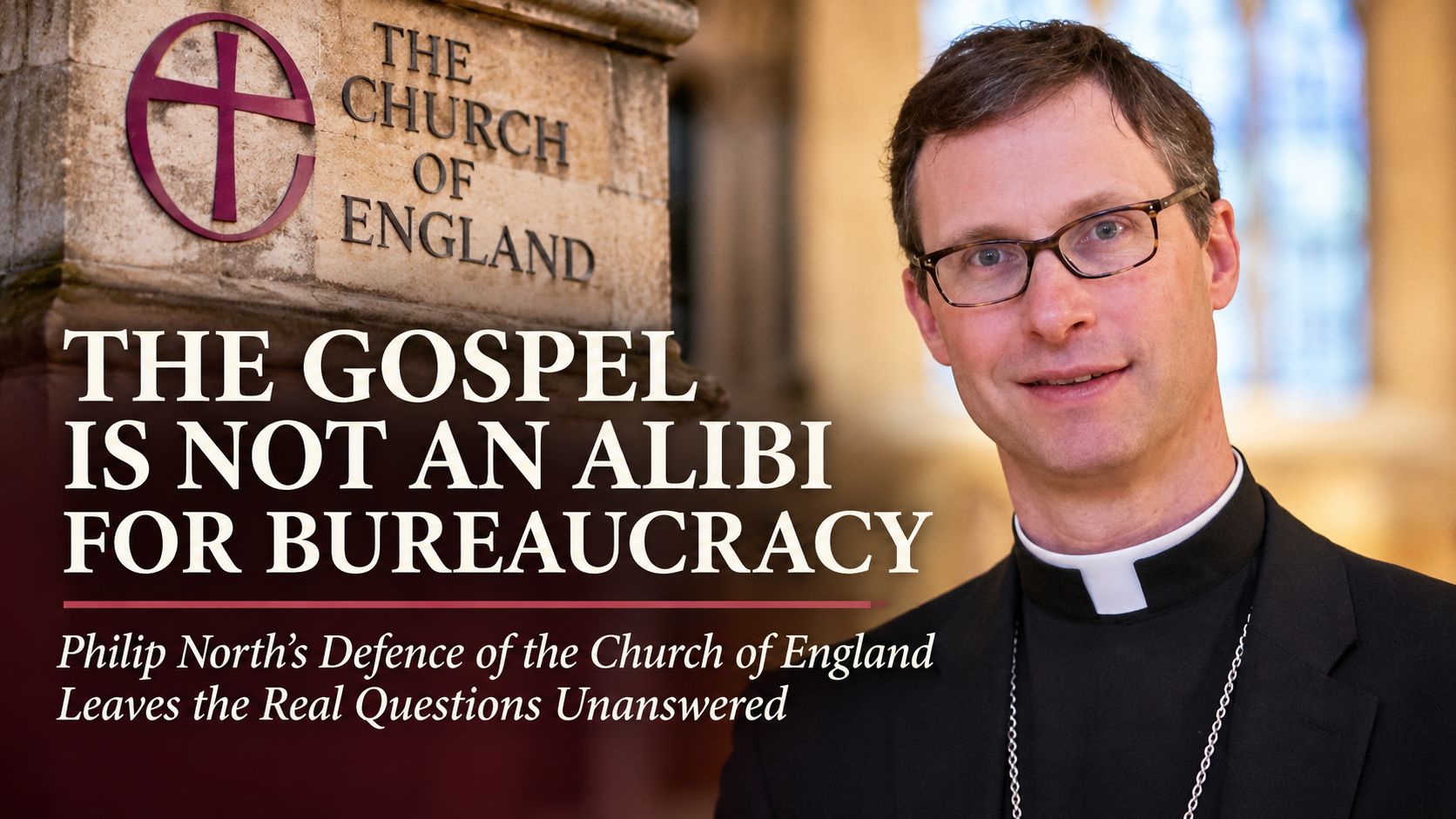
A Catholic priest has publicly accused Rome of betraying the religion it was established to defend. Not a priest of the Society of St Pius X, nor a sedevacantist cleric claiming that the papal throne is vacant, but a priest described by The Remnant as belonging to the ordinary diocesan clergy. Writing anonymously under the name Fr Celatus, he has challenged the Vatican’s excommunications following the Society’s episcopal consecrations of 1 July 2026. His accusation is extraordinary. He believes that powerful men within the contemporary Roman establishment have themselves departed from Catholic doctrine and should answer for their conduct before presuming to condemn others.¹
The article, published on 8 July under the title Physician, Heal Thyself, deserves attention for reasons considerably more important than its confrontational language. Fr Celatus has reversed the direction of the usual accusation. For decades, Catholics attached to the traditional Roman liturgy have been instructed to justify their loyalty to Rome. Now a diocesan priest is asking whether the men exercising authority in Rome can demonstrate the same loyalty to the Faith which the Apostolic See was established to preserve.
It is a question with which ecclesiastical authorities ought to be uncomfortable. Not because their authority is doubtful, but because possessing authority carries responsibilities which cannot be evaded by invoking the office itself.
Fr Celatus goes much further. He claims that “Modernist Rome lacks not only the grounds for excommunicating SSPX but also the ecclesiastical authority to excommunicate anyone (except themselves).” He invokes canon 1364, concerning the automatic excommunication of apostates, heretics and schismatics, and argues that prominent ecclesiastical figures have already incurred the very penalties they threaten against traditionalist Catholics.¹
That is a grave accusation. It also contains a serious error.
The existence of doctrinal error, even publicly expressed, does not automatically establish every element of the canonical offence of heresy. Nor does a bishop’s imprudent conduct, theological ambiguity or failure to correct scandal necessarily mean that he has lost jurisdiction. The Church has never taught that her visible government ceases whenever its ministers govern badly. If that were so, every controversy concerning doctrine or discipline could become an argument for declaring the hierarchy illegitimate.
Such a conclusion would destroy the ecclesiology which traditional Catholics ought to be defending. Yet correcting Fr Celatus on this point does not answer his underlying accusation. It merely establishes the proper terms in which that accusation must be examined.
The real question is not whether ecclesiastical authorities possess jurisdiction, but whether they are exercising it faithfully.
There is an important difference. A bishop may possess legitimate authority and exercise it unjustly. A prefect may issue a decree which is legally effective yet open to legitimate challenge. A pope may make prudential decisions which prove damaging without thereby ceasing to be pope. None of these propositions contradicts Catholic doctrine. They follow from the distinction between the divine institution of ecclesiastical authority and the fallibility of the human beings who exercise it.
The Church is not preserved from every error of administration, every act of episcopal negligence or every imprudent decision of a Roman dicastery. She is preserved in the Faith entrusted to her by Christ. That promise is not a guarantee that her rulers will always act wisely. It is a guarantee that the Church will not cease to be the Church.
Fr Celatus’s catalogue of accusations should therefore be examined rather than accepted wholesale. He cites the blessing of same-sex couples, changes concerning capital punishment, religious indifferentism, the reception of Holy Communion by those persisting in grave sin, the Pachamama controversy, syncretistic worship and proposals affecting the Church’s understanding of ordained ministry. He treats these as examples of heresy, apostasy or schism within the contemporary hierarchy.¹
Some of these controversies raise serious questions of doctrinal continuity. Others concern the interpretation of ecclesiastical documents or the distinction between what has formally been authorised and what particular clergy have subsequently done. They cannot all be treated as identical offences. Nevertheless, neither can they be dismissed as insignificant simply because their promoters or defenders enjoy recognised ecclesiastical standing.
Consider the controversy surrounding Fiducia supplicans. The Dicastery for the Doctrine of the Faith expressly permits certain non-liturgical blessings of couples in irregular situations and same-sex couples while denying that their unions are thereby being approved. That distinction is essential to an accurate account of the document. But it does not eliminate the theological difficulty identified by critics: how is a blessing given to a couple to be distinguished publicly from apparent approval of a relationship which the Church cannot recognise as morally legitimate?²
The objection concerns the intelligibility of the sign itself. Catholic sacramental and liturgical life depends upon outward actions expressing the truth. An ecclesiastical document may insist upon a distinction, but the faithful are entitled to ask whether that distinction remains apparent when translated into public pastoral practice.
Likewise, the suggestion that all religions are equally salvific would contradict the Church’s teaching concerning the uniqueness and necessity of Jesus Christ. That does not mean every ambiguous expression of respect for other religions constitutes the canonical offence of heresy. It does mean that ambiguity on so fundamental a question deserves correction rather than elaborate attempts to explain away its consequences.
The Church has a duty to distinguish between an erroneous formulation, a non-definitive judgement, a legitimate development of doctrine and a proposition which contradicts revealed truth. If her authorities refuse to make those distinctions clearly, they cannot be surprised when Catholics begin questioning their fidelity to the Deposit of Faith.
Fr Celatus is correct to demand that doctrinal consistency matter. He is incorrect to suppose that the necessary canonical judgement can be supplied simply by assembling allegations and invoking automatic excommunication. His article even contains a mistaken reference to canon 1634, which concerns judicial appeals rather than the punishment of heresy. The relevant provision is canon 1364. The error is comparatively small, but revealing. Canon law cannot become a weapon to be directed against whichever ecclesiastical figures one considers insufficiently orthodox. It exists to secure justice according to established principles.³
Those principles apply to Rome no less than to the Society.
On 1 July 2026, Bishops Alfonso de Galarreta and Bernard Fellay participated in the consecration of four new bishops for the Society of St Pius X at Écône, without a pontifical mandate and contrary to the express wishes of Pope Leo XIV. The Society maintained that necessity required the act to ensure the continuation of its sacramental and priestly ministry. The Holy See rejected that justification.
The following day, the Dicastery for the Doctrine of the Faith declared six bishops excommunicated. Its formal decree identified Bishop de Galarreta, the four newly consecrated bishops and Bishop Fellay. It invoked canon 1387, concerning episcopal consecration without pontifical mandate, and canon 1364 §1, concerning schism. In the case of Bishop Fellay, the declaration specifically invoked his participation as co-consecrator in what the Dicastery regarded as a schismatic act.⁴
There is no reason to minimise the gravity of episcopal consecration without pontifical mandate. The authority of the Roman Pontiff concerning episcopal communion is not an optional element of Catholic ecclesiology. It belongs to the divine constitution of the Church. The Society cannot claim to preserve Catholic Tradition while treating the Roman primacy as a merely honorary institution.
But the law also distinguishes the offence of consecrating a bishop without mandate from the offence of schism. The former is an objectively identifiable prohibited act. The latter concerns refusal of submission to the Supreme Pontiff or communion with those subject to him. A grave act of disobedience may constitute evidence of schism, particularly where episcopal consecration is concerned, but the canonical requirements governing each offence cannot simply be discarded because the conduct is exceptionally serious.
The 2021 revision of the Code expressly provides for automatic excommunication in cases of episcopal consecration without pontifical mandate. Canons 1323 and 1324 nevertheless establish provisions concerning necessity, fear, grave inconvenience, personal culpability and erroneous judgements about such circumstances. These provisions do not guarantee that the Society’s defence must succeed. They do require its arguments to be examined according to law.⁵
This was the central concern of Nuntiatoria’s earlier editorial, The Verdict Before the Hearing. A lawful authority may ultimately reject an appeal. It must not treat the availability of that appeal as an inconvenience or its outcome as settled before the relevant arguments have been heard.
The explanatory note accompanying the decree raises further difficulties. Whereas the decree names six bishops, the note makes categorical statements about the Society’s sacred ministers, describing them as schismatics subject to excommunication. It further declares that confessions administered by Society priests and marriages at which they assist are invalid. Regarding the laity, it invokes the conditions governing formal adherence to schism.⁶
These are not minor observations. They concern the ecclesiastical standing of priests who did not perform the episcopal consecrations, the validity of sacramental acts and the consciences of ordinary Catholics whose attachment to the traditional liturgy has brought them into contact with the Society.
A lay Catholic who attends a traditional Mass because the inherited Roman rite is otherwise unavailable does not thereby demonstrate an intention to reject the Pope. A family seeking traditional catechesis does not become schismatic simply because it receives instruction from a Society priest. Those questions concern the individual’s actual profession of faith, intention and conduct.
Indeed, the 1996 explanatory note of the Pontifical Council for Legislative Texts, expressly invoked by the Dicastery in July, acknowledged that participation in Society liturgical celebrations was not an unequivocal indication of formal adherence to schism. It required consideration of the person’s intention and circumstances. Occasional participation alone was insufficient.⁷
That distinction is indispensable. One may regard particular episcopal consecrations as unlawful and still recognise that Catholics who attend Society chapels are not thereby automatically excommunicated. The Church does not administer collective guilt. Her penal law requires personal culpability.
The sacramental assertions present an additional problem. In November 2016, Pope Francis extended the faculty permitting Society priests to administer sacramental absolution validly and licitly. The concession was explicitly pastoral. Its purpose was to ensure that Catholics seeking confession would not be deprived of sacramental reconciliation because of the Society’s unresolved canonical position.
The language of Misericordia et misera was particularly significant. Francis extended the faculty beyond the Jubilee Year until further provisions were made. This was a deliberate pontifical decision, not an informal expression of tolerance.⁸
In March 2017 the Pontifical Commission Ecclesia Dei made further arrangements concerning marriages. Local Ordinaries were authorised to provide for marriages involving the Society’s faithful, normally through a diocesan priest receiving matrimonial consent, or through the delegation of the necessary faculty to a Society priest where circumstances required. The arrangements did not grant every Society priest universal marriage faculties. They did, however, establish a recognised means of securing sacramental validity while the Society remained canonically irregular.⁹
The July 2026 assertion of invalidity therefore demands careful explanation. Were the previous faculties withdrawn? If so, by what juridical act, with what effective date and with what consequences for delegations already granted? Does the explanatory note itself constitute the further provision anticipated in 2016, or does it presuppose some other legal consequence of the declaration of schism?
There may be arguments supporting the Dicastery’s conclusion. The canonical consequences of excommunication, including the restrictions established by canon 1331, are certainly relevant. But those consequences must be applied to the persons and juridical situations actually covered by the law. The distinction between a penalty declared against six bishops and an assertion concerning the faculties of all Society priests cannot simply be left unexplained.¹⁰
For the faithful, the question is painfully practical. A Catholic enters the confessional to seek forgiveness, not to resolve a dispute between canonists. A couple approaching marriage must be able to know whether the Church recognises the assistance of the priest receiving their consent. Where Rome judges that faculties have ceased, it must provide the necessary juridical clarity and practicable pastoral alternatives.
The Code itself recognises extraordinary circumstances, including absolution in danger of death, supplied faculties in defined situations of common error or positive and probable doubt, and extraordinary forms of marriage where lawful assistance cannot be obtained under the conditions specified. These are carefully limited provisions, not a general licence to disregard canonical discipline. Their existence nevertheless demonstrates the Church’s consistent concern that souls should not be deprived of sacramental care where the law provides a remedy.¹¹
The same concern appears in the canonical tradition preceding the present Code. The 1917 discipline similarly distinguished ordinary faculties, supplied jurisdiction, extraordinary necessity and the validity of sacramental acts. The Church has never taught that every instance of irregular ministry is necessarily invalid, or that the absence of ordinary canonical standing extinguishes every possibility of lawful sacramental recourse.
This is where Rome’s approach must be judged against its own stated pastoral principles. One cannot repeatedly invoke mercy, accompaniment and the protection of consciences while leaving Catholics uncertain about the juridical status of sacraments for which a previous Pope made explicit provision.
Nor is the Society’s continuing appeal irrelevant. On 13 October its General House confirmed that it had pursued the avenues of canonical recourse available against the July documents and was seeking examination of its juridical and doctrinal objections. It invited prayer for the Holy Father and the Church, without claiming that its challenge had already succeeded.¹²
Canon 1353 provides that appeals or recourse against decrees imposing or declaring penalties have suspensive effect. The application of that provision to the specific proceedings, and the relationship between the decree and explanatory note, requires careful juridical determination. Suspensive effect is not an annulment. It does not establish the merits of the Society’s arguments or automatically settle every consequential question concerning faculties.
But the law has not ceased to matter because the controversy concerns traditionalists. An ecclesiastical government which expects obedience to its decrees must itself observe the provisions regulating those decrees.
There is an ecclesiological significance to the appeal which should not be overlooked. The Society has not responded simply by declaring that the Holy See possesses no authority over it. It has appealed through Roman procedures and requested that the competent ecclesiastical authority examine its case.
That conduct does not settle the accusation of schism, but it must form part of any serious assessment of the Society’s position. An organisation which continues to recognise the Roman Pontiff, pray for him and seek judgement through the Church’s own canonical institutions cannot be described adequately without acknowledging those facts.
Fr Thomas Crean OP made the wider theological point in his intervention of 22 October, examined recently in Nuntiatoria’s Rome, the Society and the Limits of Obedience. He observed that the Society has not denied the dogmas defined by the Church or taught by her ordinary and universal Magisterium. His argument did not excuse every action of the Society. On the contrary, he challenged certain assumptions concerning its sacramental practice and its attitude towards the wider Church. But he insisted that reconciliation must begin with a truthful examination of what the Society actually believes.¹³
This offers a more promising approach than competing accusations of disobedience and heresy. Rome must recognise that criticism of disputed postconciliar propositions is not automatically a rejection of the Magisterium. The Society must recognise that preserving Tradition does not confer authority to establish an independent ecclesiastical order or regard the Church’s ordinary hierarchy as presumptively unreliable.
Neither can abandon the Church’s visible constitution. Neither may replace the Deposit of Faith with its own preferences.
The First Vatican Council established the proper relationship between these duties in Pastor Aeternus. The Holy Ghost was promised to Peter’s successors so that they might faithfully preserve and expound the revelation received from the Apostles, not disclose another doctrine. The same council solemnly affirmed the Roman Pontiff’s true and supreme jurisdiction over the universal Church. Both teachings must be maintained.¹⁴
The Pope is not merely the chairman of an international religious organisation. Nor is he the proprietor of divine revelation. His authority is real, supreme and instituted by Christ. Precisely for that reason, its purpose cannot be reduced to the enforcement of whatever theological or pastoral settlement happens to enjoy official favour.
St Thomas Aquinas recognised that a subject may have a duty to correct a superior where danger to the Faith makes correction necessary. His discussion of St Paul’s resistance to St Peter establishes an important distinction between reverence for ecclesiastical office and unquestioning acceptance of every action undertaken by its holder. Such correction must respect the order of the Church. But respect does not require silence in the face of genuine scandal.¹⁵
Leo XIII expressed the corresponding principle in Satis Cognitum. The Church is united in faith and government. These are not competing loyalties. A Catholic cannot preserve unity of faith by denying the authority established to safeguard it. Neither may that authority demand assent to propositions contrary to the revelation it exists to transmit.¹⁶
This remains the necessary foundation for Catholic resistance to defective ecclesiastical decisions. It is not sedevacantism, which resolves the difficulty by denying the legitimacy of the authority concerned. Nor is it an exaggerated papalism which treats every administrative decision as though it enjoyed the protection of an infallible definition. It is the recognition that ecclesiastical authority and Catholic doctrine come from the same divine institution and must remain ordered to the same supernatural end.
The present controversy has become especially revealing because of a development on 22 October. The Dicastery for the Doctrine of the Faith published Venite ad me, a document addressing the serious difficulties now surrounding the transmission of Catholic belief. Among its observations is an acknowledgement that the West is experiencing a progressive loss of collective memory concerning rites and ritual practices. Paragraph 94 recognises the enduring need for ritual and the richness of the Church’s inherited spiritual resources.¹⁷
That acknowledgement deserves to be considered alongside the restrictions imposed upon traditional Catholic worship.
For generations, Catholic belief was transmitted not principally through conferences, programmes or documents, but through the ordinary rhythm of religious life. Children learnt the Faith through the Mass, the saints’ days, the prayers and blessings of the Church, the seasons of fasting and feasting, the sacred ceremonies of Holy Week, the devotions of their families and the visible example of clergy who understood themselves as custodians of an inheritance.
Much of that culture has disappeared. The reasons are complex, but ecclesiastical decisions concerning worship and devotional life cannot reasonably be excluded from the examination. The Church cannot dismantle or marginalise inherited religious practices and then profess astonishment that successive generations have lost the memory of them.
Indeed, the Dicastery’s own document recognises that liturgy communicates faith through gestures, silence, symbols and participation in an inheritance received from earlier generations. It quotes Romano Guardini’s account of contemplative participation in the sacred ceremonies at Monreale. This is a welcome acknowledgement that the faithful need not be constantly speaking or visibly active in order to participate deeply in the worship of God.
Yet the traditional Roman liturgy, which preserves precisely such a conception of sacred worship, remains subject to restrictions which have deprived many Catholics of regular access to it.
The contradiction is not resolved by praising the Church’s liturgical heritage in general while continuing to treat attachment to one of its principal expressions as a problem requiring close administrative control.
It is particularly difficult to justify when those seeking the inherited liturgy are frequently young Catholics, converts and families who have discovered within it a seriousness of religious purpose which they had struggled to find elsewhere. Their experience deserves to be heard on its own terms. It cannot be dismissed merely because their preferred form of worship does not correspond to current institutional priorities.
The Society of St Pius X has undoubtedly benefited from this situation. So too have other traditionalist communities. But the fundamental question is why the ordinary structures of Catholic life have so often failed to provide what these Catholics were seeking.
Fr Celatus’s testimony is therefore significant. He credits the Society with helping him recover his attachment to traditional Catholic doctrine and worship. Such testimony cannot establish the canonical legitimacy of every action the Society has undertaken. It does, however, reveal the predicament of a priest who has come to regard an institution under Roman censure as an important instrument in his own recovery of the Catholic inheritance.
That should trouble those responsible for the ordinary pastoral life of the Church.
It should also trouble those who believe that the Society’s difficulties can be resolved principally through increased penalties. A bishop can prohibit a particular ministry. He cannot force Catholics to regard an impoverished liturgical or doctrinal experience as adequate merely by denying them access to alternatives.
There is no justification for schism in the shortcomings of ecclesiastical administration. But there is an obligation to examine whether those shortcomings have contributed to the alienation which ecclesiastical authorities now seek to correct.
The answer requires something more demanding than another appeal to obedience.
The Church must recover confidence in the objective character of her own teaching. What she taught as divinely revealed cannot become optional because contemporary culture finds it unacceptable. What she defined as binding upon the faithful cannot be replaced by the preferences of a later generation of administrators. Her law must distinguish between a priest who denies a doctrine of the Faith and one who disputes the prudence or continuity of a reform.
The Church must also apply discipline with recognisable consistency. If public departures from doctrine warrant correction, that duty cannot depend principally upon whether the offender belongs to a fashionable theological circle or an unfashionable traditionalist one. A priest who openly contradicts Catholic moral teaching is not rendered harmless by possessing ordinary faculties. A priest whose faculties are disputed is not thereby proved doctrinally unsound.
The responsibilities are different, but the standard of fidelity must be the same.
It would be a serious error to conclude that ecclesiastical authority is legitimate only when exercised by those with whom we agree. That is the weakness in Fr Celatus’s more sweeping assertions. The Church’s government cannot become dependent upon private assessments of orthodoxy. Such an ecclesiology would eventually consume the very Tradition it claims to defend.
But it is equally erroneous to suggest that the possession of office settles every question concerning the rightness of its exercise. Catholic obedience is not the suspension of reason. The faithful possess both the duty to remain in communion with the Church and the right to receive her authentic doctrine and sacramental life.
The supreme law remains the salvation of souls. Canon 1752 does not abolish the rest of canon law. It declares the purpose for which that law exists. The salvation of souls requires the preservation of doctrine, sacramental integrity, lawful ecclesiastical government, justice, charity and communion. It is not served by sacrificing one of these permanently to another.
The same principle governs the purpose of excommunication. A medicinal penalty is intended to bring the offender back to communion, not simply to remove an inconvenient dissenter from ecclesiastical life. If a penalty is just, its grounds should be clear. If its application is disputed, the law must provide genuine remedies. If it risks depriving the faithful of sacramental assistance, the consequences should be examined with particular care.
And if those administering the penalty are themselves responsible for doctrinal confusion or pastoral failures, their conduct must not be placed beyond scrutiny.
The words which give Fr Celatus’s article its title come from Our Lord’s Gospel: Medice, cura teipsum. Physician, heal thyself.
They ought to be understood as a call to ecclesiastical examination of conscience, not as a declaration that Rome has ceased to possess authority. The physician does not lose his medical qualifications because he becomes ill. But his illness must not prevent him from recognising his condition or seeking its remedy. Still less should he insist that his office places his own health beyond examination.
So too with those entrusted with the care of souls.
Fr Celatus may have overstated his canonical case. He has not thereby made the underlying problem disappear. The existence of orthodox doctrine outside ordinary canonical structures, the public toleration of disputed teaching within them, the treatment of traditional liturgical communities and the unresolved questions surrounding the Society’s sacramental faculties all demand serious consideration.
The Society’s actions must be judged according to Catholic doctrine and law. So must the actions of the ecclesiastical authorities who condemn them.
There should be nothing subversive in that proposition. Indeed, it ought to be the most natural expectation of any Catholic who believes that the Roman See was instituted by Christ.
The Church does not belong to the Pope, the bishops, the dicasteries, the Society of St Pius X or any particular traditionalist movement. She belongs to Jesus Christ. Her doctrine is His revelation. Her sacraments are His gifts. Her authority is exercised in His name and for the salvation of those whom He has redeemed.
No ecclesiastical office confers the right to alter that inheritance. No private judgement confers the right to reject the Church’s divinely established government.
Rome must therefore do more than insist that the Society submit to its authority. It must demonstrate that its decisions serve the Catholic Faith, that its disciplinary judgements observe the law, that its treatment of the faithful is just, and that its professed desire for reconciliation is matched by a willingness to address the doctrinal difficulties which have sustained this controversy for decades.
The Society, for its part, must demonstrate that its resistance remains ordered towards communion with the very Apostolic See whose authority it professes to recognise.
Neither task is easy. Both are necessary.
But the heavier responsibility belongs to those entrusted with the government of the Church. They possess the authority to correct, to reconcile, to provide for the faithful and to bring this painful dispute towards a lawful settlement. That authority was not given so that they might prevail in an institutional contest. It was given so that the brethren might be confirmed in the Faith.
The Church’s rulers are entrusted with the Gospel. They are not empowered to substitute another.
Before Rome condemns those whom it judges disobedient, it must be prepared to answer the question which Fr Celatus has placed before it: has the Faith been guarded with the same determination with which ecclesiastical authority has been defended?
For the final judgement upon every shepherd will not concern how successfully he protected the prestige of his office, but how faithfully he cared for the flock entrusted to him.
And the flock belongs to Christ.
¹ Fr Celatus, “Physician, Heal Thyself: Why this Diocesan Priest Rejects the Vatican’s SSPX Excommunications”, The Remnant, 8 July 2026.
² Dicastery for the Doctrine of the Faith, Fiducia supplicans, 18 December 2023; Press Release on Its Reception, 4 January 2024.
³ Catholic Church, Code of Canon Law, canons 751, 1364–1365 and 1634.
⁴ Dicastery for the Doctrine of the Faith, Decreto, 2 July 2026.
⁵ Catholic Church, Code of Canon Law, canons 1321–1324; Nuntiatoria, “The Verdict Before the Hearing”, 17 July 2026.
⁶ Dicastery for the Doctrine of the Faith, Nota esplicativa, 2 July 2026.
⁷ Pontifical Council for Legislative Texts, Nota esplicativa sulla scomunica per scisma in cui incorrono gli aderenti al movimento del Vescovo Marcel Lefebvre, 24 August 1996, nos. 5–8; Nuntiatoria, “Attendance Is Not Schism”, 3 July 2026.
⁸ Francis, Misericordia et misera, 20 November 2016, no. 12.
⁹ Pontifical Commission Ecclesia Dei, “Letter to the Ordinaries of the Episcopal Conferences Concerned on the Faculties for the Celebration of Marriages of the Faithful of the Society Saint Pius X”, 27 March 2017, published 4 April 2017.
¹⁰ Catholic Church, Code of Canon Law, canon 1331.
¹¹ Catholic Church, Code of Canon Law, canon 144, canon 976 and canon 1116.
¹² Society of St Pius X, “Communiqué from the General House: The Appeal Against the Decree of Excommunication Is Ongoing in Rome”, 13 October 2026; Catholic Church, Code of Canon Law, canon 1353.
¹³ Nuntiatoria, “Rome, the Society and the Limits of Obedience: Peace Cannot Be Bought at the Price of Truth”, 23 October 2026; “The Bishops Who Defied Rome — and Still Appeal to It”, 16 October 2026.
¹⁴ First Vatican Council, Pastor Aeternus, 18 July 1870, chapters III–IV.
¹⁵ St Thomas Aquinas, Summa Theologiae, II–II, q. 33, arts. 3–4.
¹⁶ Leo XIII, Satis Cognitum, 29 June 1896.
¹⁷ Dicastery for the Doctrine of the Faith, Venite ad me: Considerations on the Transmission of the Faith in an Epochal Change, 22 October 2026, nos. 90–94.




Leave a Reply