
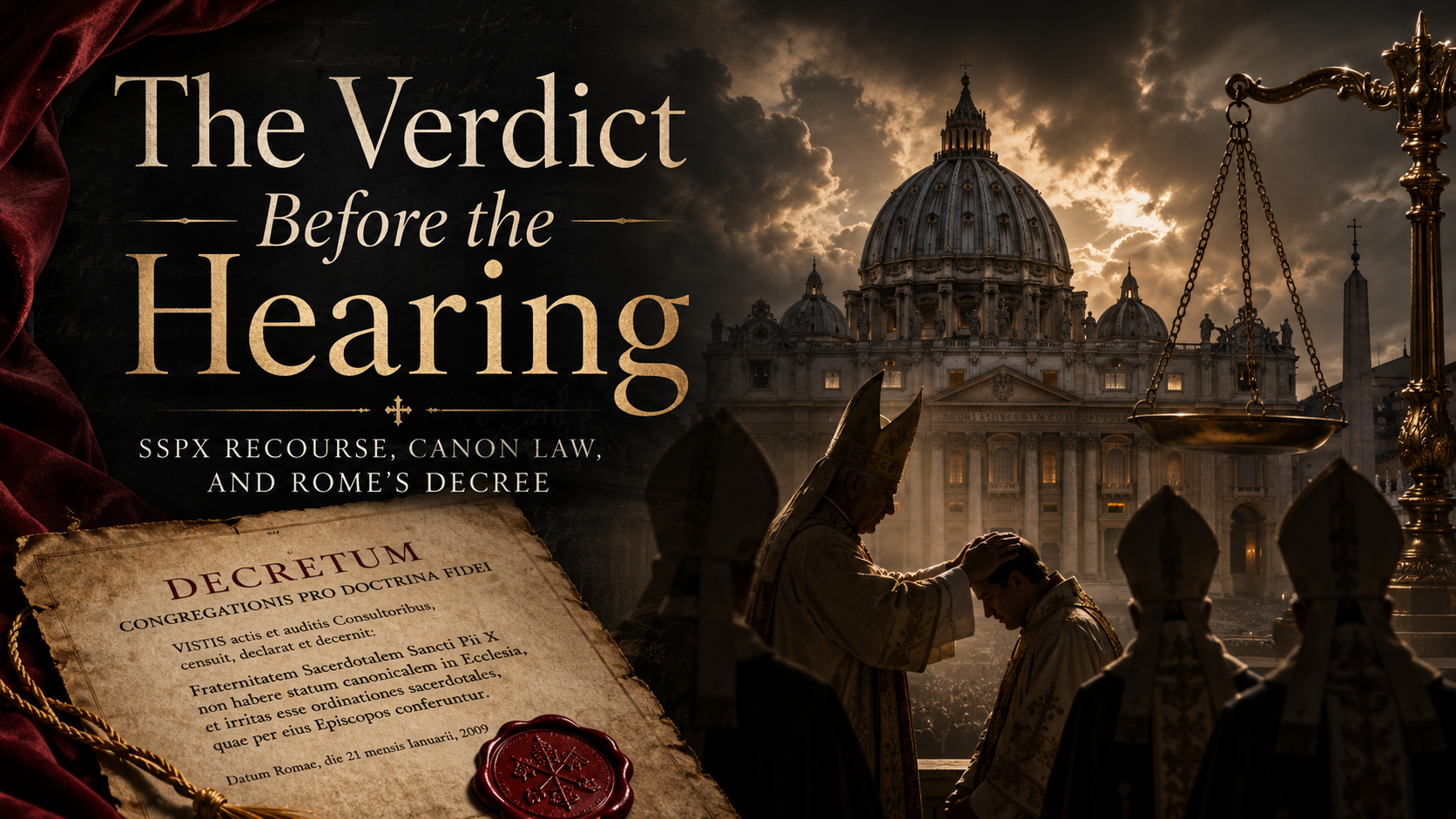
The Verdict Before the Hearing
The Society of Saint Pius X may not prevail in its canonical challenge to the Dicastery for the Doctrine of the Faith. That does not justify treating the outcome as predetermined, inventing defects in an unpublished petition, or reducing the Church’s penal law to whatever conclusion the Dicastery has already announced.

The Society of Saint Pius X announced that on 11 July 2026 it submitted a preliminary recourse against the Dicastery for the Doctrine of the Faith’s decree of 2 July, which declared six bishops excommunicated following the episcopal consecrations at Écône. The Society stated that its petition was made under canon 1734 and that, in accordance with canon 1353, it suspended the execution of the decree.¹
An analysis published by The Pillar accepts that the recourse has suspensive effect, but then devotes most of its argument to explaining why the petition is supposedly doomed. It speculates that the Society probably lacks standing, that the petition may have been signed by the wrong person, that the arguments will probably be deemed “merely dilatory”, and that it is ultimately “hard to conceive” of any different result.²
That may reflect a realistic assessment of what the Dicastery is likely to decide. It is not, however, a satisfactory analysis of what canon law requires it to consider.
The distinction matters. Canon law is not merely a vocabulary with which ecclesiastical authority describes a conclusion already reached. It is supposed to regulate the exercise of authority, protect the rights of the faithful, distinguish offences from one another, and ensure that penalties are imposed or declared only after the relevant facts, intentions, defences and degrees of imputability have been examined.
The first defect in The Pillar’s account is comparatively small but revealing. It describes the ten “useful days” allowed for the preliminary petition as the canonical equivalent of “working days”. They are not. Canon 201 defines useful time as time which does not run while the person entitled to act is “unaware or unable to act”. Sundays and ecclesiastical holidays are not automatically removed from the calculation.³ In any event, a petition filed on 11 July against a decree dated 2 July was plainly filed within ten days when the initial day is excluded in accordance with canon 203.
More importantly, the Society’s assertion concerning suspension is not some adventurous interpretation of the law. Canon 1353 says that recourse against a decree imposing or declaring a penalty “has a suspensive effect”. Canon 1734 provides that the written request for revocation or amendment itself includes a request for suspension, while canon 1736 states that where the subsequent recourse suspends execution by law, the preliminary petition has the same effect.⁴
The execution of the penal decree is therefore suspended while the prescribed process is followed. This does not mean that the decree has already been annulled, nor does it necessarily suspend every assertion made in the separate explanatory materials published by the Dicastery. On that narrow point, The Pillar is correct. It does mean, however, that the declared penalties cannot simply be treated as though the recourse had never been filed.
The article’s principal argument concerns standing. It observes that the SSPX presently lacks recognised canonical status and concludes that a petition submitted by “the Society” may be “likely to be met with summary rejection”. Yet neither The Pillar nor the public has seen the petition. We do not know who signed it, in whose names it was presented, what mandates were attached, whether a procurator acted for the bishops, or how the petitioners were juridically identified.
The SSPX communiqué naturally describes the action as one taken by the Society. That is a public description, not a certified account of the petition’s canonical form. It is entirely possible that the document was submitted in the names of the six bishops, jointly or individually, through an advocate or procurator. It may also have been transmitted by the Superior General acting under their mandates. Until the text or its signatures are disclosed, predictions of summary rejection are conjecture presented as analysis.
Even the broader assertion that a body without juridic personality cannot participate collectively in canonical proceedings is too absolute. Canon 310 recognises that an association without juridic personality cannot itself be the subject of rights and duties, but immediately adds that its members can exercise their rights “through an agent or a proxy”.⁵ Whatever the precise canonical classification of the SSPX after the suppression of its original juridical structure, the lack of corporate personality does not extinguish the personal rights of the bishops named in the decree or prevent their acting jointly through a properly mandated representative.
The DDF’s own special norms anticipate precisely such a challenge. Article 24 provides that recourse against singular administrative acts of the Dicastery in cases of reserved delicts is presented to the same Dicastery within sixty useful days. The accused must employ a canonically qualified advocate, and the petition must state both the requested remedy and the grounds in iure and in facto.⁶ The route is therefore not nearly as mysterious as The Pillar suggests. The Dicastery which issued the act is also competent to judge the recourse against it, subject to its own procedural norms.
That arrangement may not inspire great confidence in institutional independence, but it is the procedure the Holy See has established. It also explains why the absence of a papal signature matters. The decree published on 2 July bears the signatures of Cardinal Víctor Manuel Fernández and the secretaries of the Dicastery’s disciplinary and doctrinal sections. It contains no papal signature and does not state that it was approved by Pope Leo XIV in forma specifica.⁷ It is consequently a dicasterial administrative act susceptible to recourse, not an unappealable personal act of the Roman Pontiff.
The strongest potential ground of recourse is not the standing question but the apparent absence of a disclosed penal process. Canon 1342 permits a penalty to be declared by extrajudicial decree only while observing canon 1720, “especially in what concerns the right of defence”.⁸ Canon 1720 requires the authority to inform the accused “of the accusation and the proofs”, allow an opportunity for defence, consider the evidence and arguments with two assessors, reach certainty that the delict has been established, and provide reasons in law and fact.
The public decree of 2 July does not show that these requirements were fulfilled. It does not identify an investigation, summons, canonical accusation, communication of proofs, written defence, advocates, assessors or examination of exculpatory and mitigating circumstances. It offers only the Dicastery’s conclusion that the penalties were incurred.
That does not prove that no procedure took place. Some or all of the relevant acts may remain confidential. But repeated warnings against proceeding with the consecrations are not, by themselves, a substitute for the procedural safeguards required when declaring a penal sanction. A warning tells someone not to perform an act. A penal process determines whether the act constitutes the particular offence alleged, whether it is gravely imputable, whether a canonical defence applies, and whether the penalty was actually incurred.
This is especially important because canon law does not permit the Dicastery to stop at the external fact of an episcopal consecration without pontifical mandate. Canon 1387 certainly establishes a latae sententiae excommunication for the consecrating bishop and those receiving consecration.⁹ The objective act is undisputed. The question is whether the automatic penalty was incurred after the general norms concerning imputability, necessity and mitigating circumstances are applied.
Canon 1321 begins with the principle that a person is considered innocent until the contrary is proved and cannot be punished unless the violation is gravely imputable through malice or culpability. Canon 1323 exempts from punishment one who acts from necessity or grave inconvenience, unless the act is intrinsically evil or tends to harm souls. It also exempts someone who, without personal fault, believed that such a circumstance existed. Canon 1324 provides for mitigation where the belief was culpably erroneous and adds the decisive provision that, in such circumstances, the offender “is not bound by a latae sententiae penalty”.¹⁰
This does not mean that invoking necessity automatically succeeds. The SSPX must establish the factual and juridical basis of its claim. The Dicastery may conclude that no true necessity existed, that the consecrations tended to harm souls, that the bishops’ assessment was culpable, or that aggravating circumstances outweighed mitigation. Those are legitimate questions.
What it cannot legitimately do is pretend that the questions do not exist.
The SSPX’s case does not require the Dicastery to agree that every theological criticism made by the Society is correct. It requires the Dicastery to determine whether the bishops genuinely acted under an asserted necessity, whether that belief affected their imputability, whether it was inculpable or culpable, and what consequence canon 1324 §3 has for an automatic penalty. To describe that defence merely as an invitation for the Church to declare herself doctrinally wrong is to caricature a penal-law argument which the Code itself expressly permits.
The separate accusation of schism demands still greater precision. Canon 751 defines schism as the “refusal of submission to the Supreme Pontiff” or refusal of communion with those subject to him.¹¹ An unlawful consecration may be evidence of such a refusal, but unlawful consecration and schism are not identical canonical offences. If they were, canon 1387 would be redundant.
Disobedience is punished under one provision, illicit episcopal consecration under another, and schism under another. Each has its own juridical elements. It is not enough to prove that a prohibited act occurred and then attach the gravest possible ecclesiological description to it. The authority must establish the external act and the requisite intention corresponding to the delict alleged.
This distinction is particularly relevant to Bishop Bernard Fellay. The decree did not declare him excommunicated under canon 1387 as the principal consecrator or recipient of consecration. It declared him excommunicated under canon 1364 because his participation as a co-consecrator supposedly constituted public adherence to a schismatic act.¹² That is a distinct personal and juridical conclusion requiring its own evidential and canonical basis. Physical participation in a consecration does not eliminate the need to establish the elements of schism as defined by the Code.
The decree’s terminology also risks assuming what it was required to prove. It calls the consecration an “act of a schismatic nature” and treats Bishop Fellay’s participation as adherence to that act. Yet the juridical question is precisely whether the conduct amounted to schism rather than grave disobedience, illicit consecration or some other canonical offence. Labelling the act schismatic cannot substitute for demonstrating the offence.
The Pillar is entitled to believe that the bishops will lose. Given that the DDF will effectively review its own act, such a prediction may prove correct. But an assessment of institutional probability is not a canonical refutation. The possibility that an authority will reject an argument does not make the argument legally frivolous.
The analysis further suggests that the Pope could end the matter by approving the decree in forma specifica, thereby transforming it into an unappealable papal act. That may describe a juridical possibility, but it would be an extraordinary answer to allegations that the original process denied the accused an adequate defence. The proper response to a procedurally questionable decree is not to place it retrospectively beyond review. It is to examine whether justice was done.
Canon 1739 grants the authority hearing recourse broad power to confirm, invalidate, revoke, amend, replace or modify the contested decree.¹³ The law therefore does not regard recourse as a decorative exercise whose only function is to ratify the original decision. It contemplates the possibility that an administrative authority may have erred in law, fact, procedure, proportionality or remedy.
The recourse may ultimately fail. The bishops may be unable to establish necessity. The DDF may produce evidence that all procedural guarantees were observed. The petition may contain some technical defect presently unknown to the public. The Pope may eventually intervene personally.
None of that is known at present.
What is known is that the decree has been challenged within the canonical period; that the challenge suspends its execution; that the text of the petition has not been published; that the public decree does not demonstrate compliance with the procedural requirements of canons 1342 and 1720; that canons 1323 and 1324 expressly regulate necessity and erroneous belief in necessity; and that illicit consecration, disobedience and schism remain distinguishable offences.
A fair canonical analysis would begin with those facts. The Pillar instead begins with the desired destination and constructs a road towards it out of assumptions: perhaps the wrong party signed; perhaps standing is absent; perhaps the grounds are dilatory; perhaps the Dicastery’s reasoning was sufficient; perhaps the result is inconceivably otherwise.
That is not the dispassionate application of law. It is a verdict written before the pleadings have been seen.
The importance of the SSPX recourse extends beyond the six bishops concerned. It tests whether canon law is genuinely law when applied to unpopular defendants, or merely the ceremonial language in which ecclesiastical power announces its decisions. Authority is not weakened when it observes justice, hears a defence and distinguishes carefully between offences. Authority is weakened when the conclusion is treated as certain before the process has been allowed to begin.
The Society may lose its recourse. Rome must nevertheless answer it according to law.
- Society of Saint Pius X, “General House Communiqué: The Society Files a Recourse Against the Decree of 2 July 2026,” 13 July 2026; Code of Canon Law, cann. 1353 and 1734–1736.
- Ed Condon, “The SSPX’s Unappealing Canonical Prospects for Recourse,” The Pillar, 15 July 2026.
- Code of Canon Law, cann. 201 §2 and 203.
- Code of Canon Law, cann. 1353, 1734 §1 and 1736 §1.
- Code of Canon Law, can. 310.
- Dicastery for the Doctrine of the Faith, Norms regarding Delicts Reserved to the Congregation for the Doctrine of the Faith, arts. 24 §§1–3 and 25, 11 October 2021.
- Dicastery for the Doctrine of the Faith, “Decree,” Prot. N. 99/2009, 2 July 2026.
- Code of Canon Law, can. 1342 §1.
- Code of Canon Law, can. 1387.
- Code of Canon Law, cann. 1321–1325, especially cann. 1323 nn. 4 and 7 and 1324 §§1 and 3.
- Code of Canon Law, can. 751.
- Dicastery for the Doctrine of the Faith, “Decree,” 2 July 2026; Code of Canon Law, cann. 751 and 1364 §1.
- Code of Canon Law, can. 1739.
RELATED ARTiCLES


LATEST ARTICLES
- Today’s Mass: September 05 Saint Lawrence JustinianSaint Lawrence Justinian, the first Patriarch of Venice, dedicated his life to the poor and the establishment of monasteries, rejecting noble marriage. Renowned for his humility and pastoral dedication, he emphasised the spiritual integrity of Venice’s safety. He was a precursor to the reforms of the Council of Trent, dying on 8 January 1455.
- 06.09.26 Nuntiatoria CXXII: NOMEN MANET, RES DEESTThis edition of Nuntiatoria explores the disconnect between the names of Catholic institutions and the realities they signify. Despite retaining their titles, many aspects of Catholicism—such as episcopal authority in China and religious practice in Poland—exhibit deteriorating substance. The piece cautions against superficial continuity, stressing the importance of genuine faith and practice over mere nomenclature.
- ORDO w/c 06.09.26The document outlines the liturgical schedule for the week of 6 to 13 September 2026, highlighting significant religious observances such as the Fifteenth Sunday after Pentecost and the Nativity of the Blessed Virgin Mary. It reflects on themes of compassion, holiness, fidelity, and humility, underscoring their importance in Christian life.
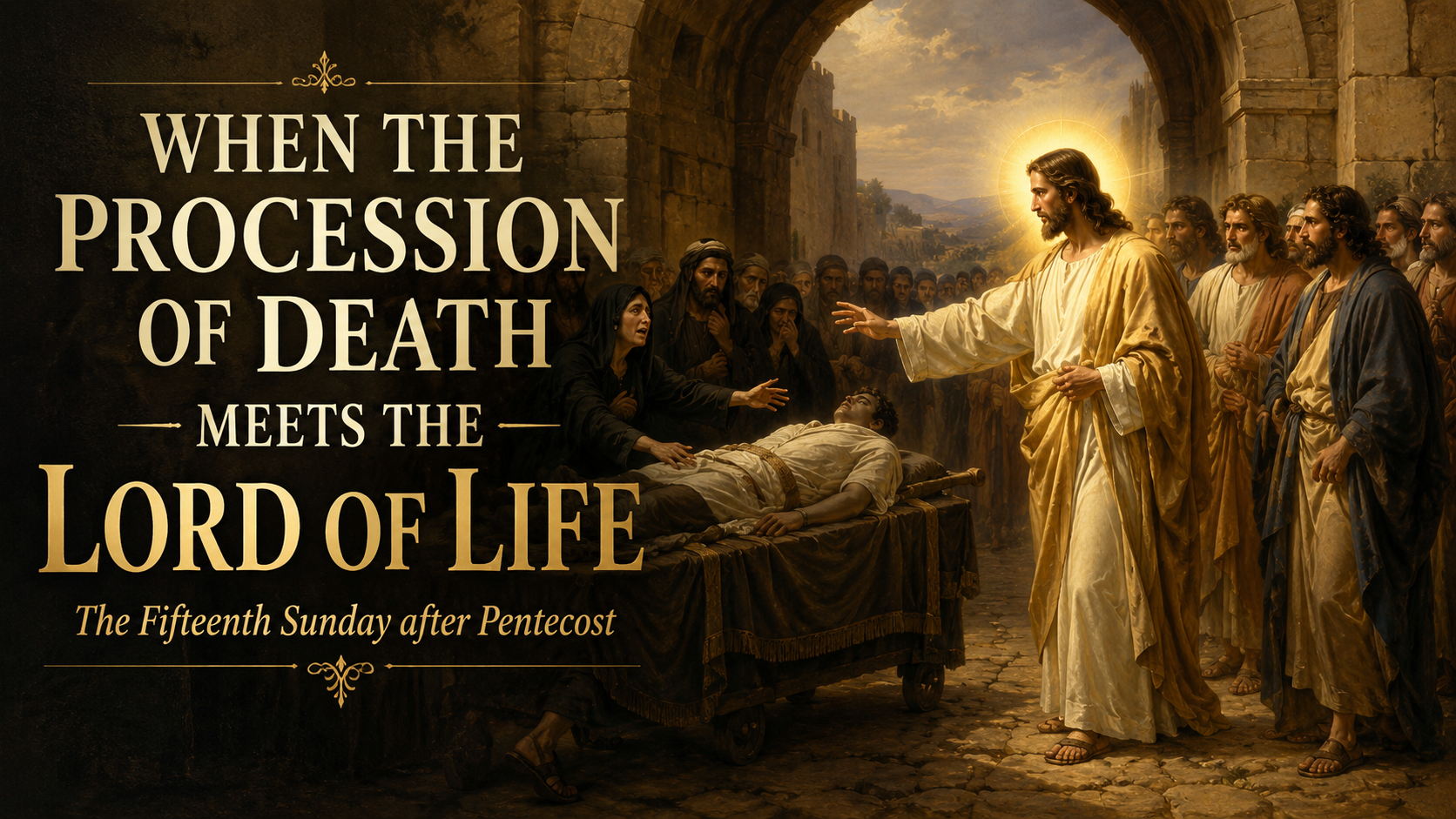
- The Fifteenth Sunday after Pentecost: When the Procession of Death Meets the Lord of LifeThe Fifteenth Sunday after Pentecost focuses on the transformative power of Christ, emphasising the supernatural life granted through grace. The liturgy highlights the Church’s role as a nurturing mother, mourning the spiritually dead while seeking their restoration. Christ’s compassion leads to resurrection, demonstrating that true life is found in dependence on Him.
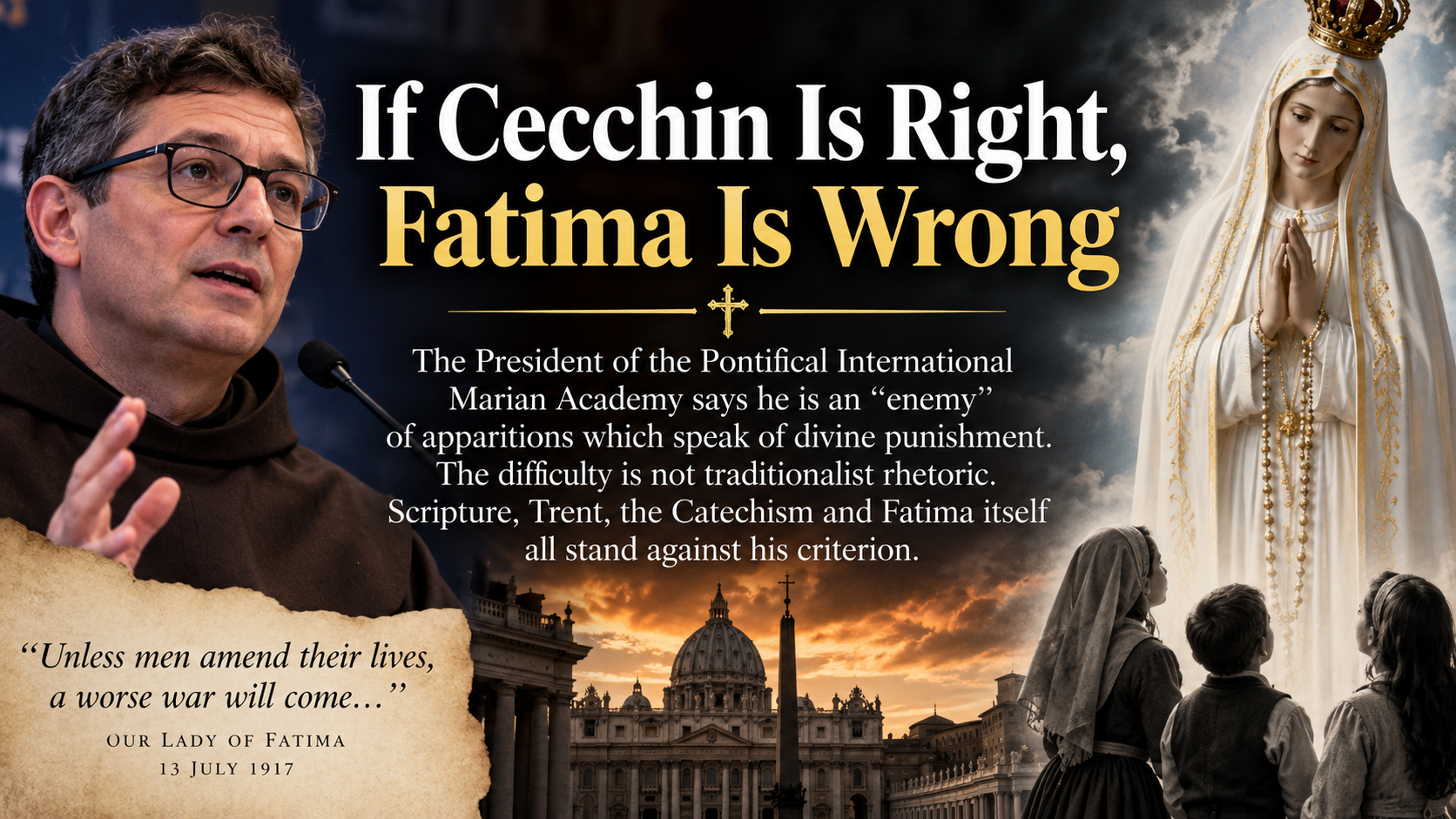
- If Cecchin Is Right, Fatima Is WrongFr Stefano Cecchin, President of the Pontifical International Marian Academy, has declared opposition to apparitions that speak of divine punishment, suggesting they are false. This stance contradicts fundamental Catholic doctrine, including teachings from Scripture, the Catechism, and specifically the Message of Fatima, which warns of divine consequences for sin.
CURRENT EDITION


Today’s Mass Propers
- Today’s Mass: September 05 Saint Lawrence Justinian
 Saint Lawrence Justinian, the first Patriarch of Venice, dedicated his life to the poor and the establishment of monasteries, rejecting noble marriage. Renowned for his humility and pastoral dedication, he emphasised the spiritual integrity of Venice’s safety. He was a precursor to the reforms of the Council of Trent, dying on 8 January 1455.



Leave a Reply