
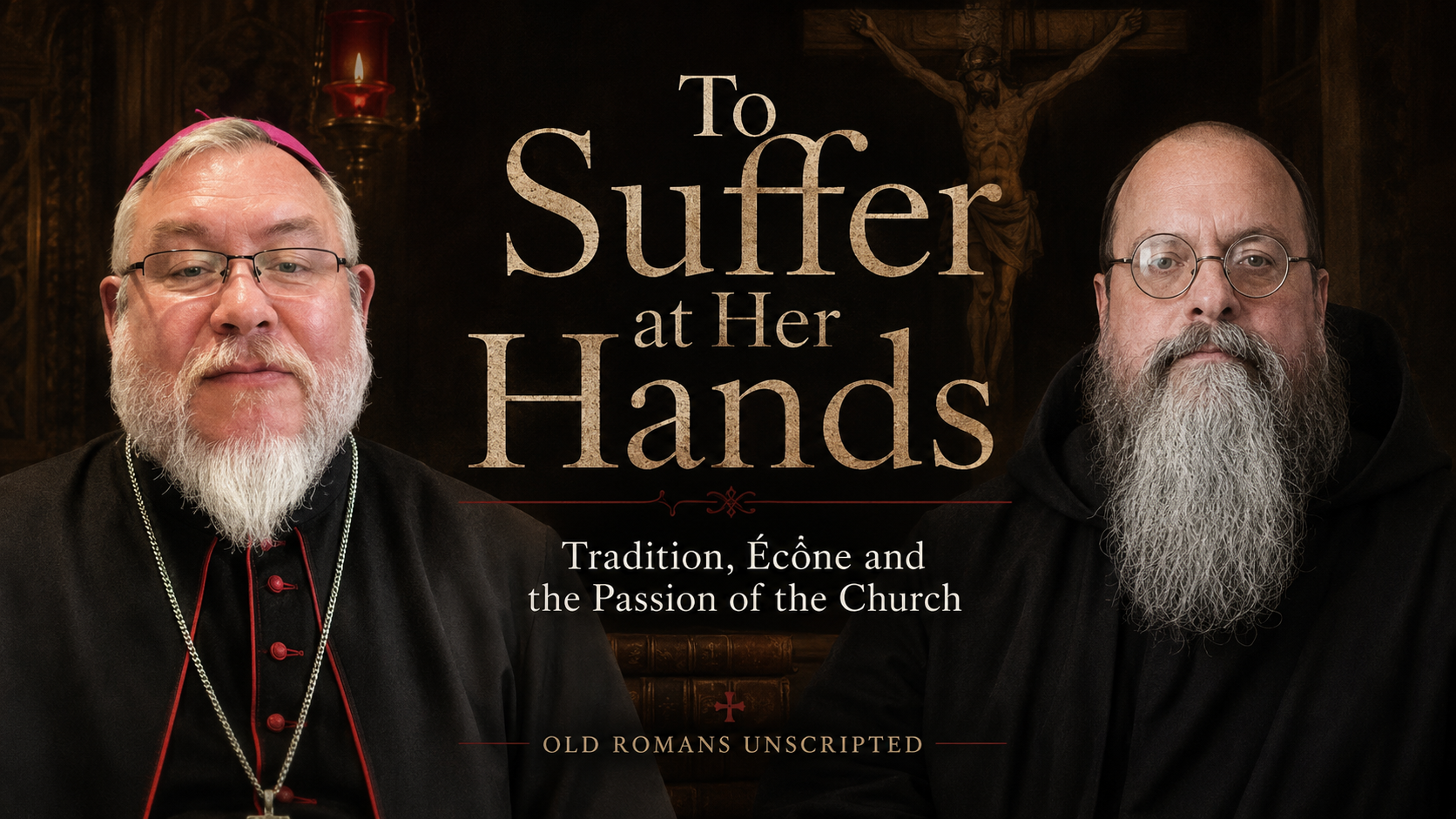
Old Romans Unscripted: “To Suffer at Her Hands” Tradition, Écône and the Passion of the Church
The latest episode of Old Romans Unscripted moved beyond the canonical controversy surrounding the Écône consecrations to confront the deeper spiritual crisis afflicting the Church—and the burden fidelity places upon every Catholic.

The latest episode of Old Romans Unscripted, featuring HE ✠Jerome Lloyd and Father Stanislaus, began with the canonical repercussions of the recent episcopal consecrations at Écône, but developed into something considerably more substantial. What might have remained another discussion about decrees, excommunications and competing interpretations of canon law became a sustained meditation upon fidelity, suffering, grace and the salvation of souls.
That development was the episode’s greatest strength. The discussion did not dismiss the canonical questions. HE ✠Jerome carefully distinguished between an act of the Roman Pontiff himself and an administrative decree issued by a dicastery, explaining why the Society of Saint Pius X had chosen to pursue canonical recourse. The significance of that response, he argued, was not merely procedural. A body truly intending to separate itself from the Church would scarcely appeal to the Church’s own law for redress. The Society’s recourse therefore contradicts the facile claim that its bishops simply repudiated Roman authority and departed into schism.
Yet the conversation repeatedly returned to a more important question: why did the Society proceed when it knew that canonical penalties would follow? The answer proposed during the programme was that the controversy cannot finally be understood as a dispute about episcopal mandates alone. It concerns the preservation and transmission of the Catholic Faith, the continuation of traditional priestly formation, and the availability of the sacraments for future generations. The consecrations were presented not as an end in themselves, but as an act performed under the claimed necessity of securing the salvation of souls.
This shifted the episode from legal analysis into ecclesiology. Modern Catholic commentary, the speakers observed, often treats obedience as though it were an exclusively mechanical relationship: Rome commands, the Catholic submits, and no further moral or theological reasoning is permitted. Against this exaggerated papalism, the episode insisted that the Pope is not an oracle whose every opinion, prudential judgement or administrative decision becomes indistinguishable from the will of God. The dogma of papal infallibility is precise and limited; it does not abolish reason, conscience, tradition or the antecedent obligations of the Faith.
The force of this argument lay not in any denial of papal authority, but in the insistence that authority must serve the purpose for which Christ instituted it. Authority exists to defend revelation, govern the Church and lead souls to eternal life. It does not possess the power to transform contradiction into truth or to make the received Faith disposable. The episode therefore refused both sedevacantism and passive papal absolutism. Its position was recognisably that of Catholics who continue to claim membership of the Church while resisting what they regard as destructive departures from her perennial doctrine and worship.
Father Stanislaus gave this conflict a vivid personal dimension. He described his own discovery of the traditional Mass after time spent within a post-conciliar seminary environment. His account of a pilgrimage to the shrine of Our Lady of Guadalupe was especially affecting. Having travelled to Mexico City while uncertain of his vocation and future, he recounted an experience before the miraculous image in which he understood Our Lady to tell him that he must work very hard for the answers he sought. Only later, through encountering the traditional Roman liturgy, did he recognise the direction in which that pilgrimage had been leading him.
Whether heard as private mystical experience or personal testimony, the account illuminated the programme’s central theme: the truth is not always encountered as an immediate solution. Sometimes it becomes an obligation whose demands unfold slowly. The discovery of tradition did not remove Father Stanislaus’s difficulties. It gave those difficulties meaning. His fidelity has brought isolation, ill health and uncertainty, yet he spoke without regret. The traditional Mass was described as the “pearl of great price”—something whose possession entails sacrifice precisely because of its value.
HE ✠Jerome’s recollection of his episcopal consecration provided the episode’s defining image. During the traditional rite, the open Book of the Gospels is placed across the neck and shoulders of the bishop-elect. He recalled the physical pressure of the book being held so firmly that he felt he might collapse beneath it. In moments of difficulty, he said, he can still feel that weight.
The image condensed the entire discussion into one sacramental symbol. The episcopate is not principally honour, ornament or institutional advancement. It is the weight of the Gospel: the burden of preaching it, preserving it and suffering for it. The bishop carries the Gospel because the Gospel must govern him before he can govern others. In an age when ecclesiastical authority is frequently discussed in terms of jurisdiction, recognition and institutional legitimacy, this recollection restored the language of vocation, sacrifice and judgement.
The personal candour of both priests prevented the discussion from becoming abstract. Each admitted that reconciliation with the prevailing ecclesiastical establishment could offer an easier life. HE ✠Jerome spoke of the temptation to retire into a monastery, accept whatever conditions might be imposed, and disappear into the quiet life he would naturally prefer. Yet precisely because this would fulfil his own desire, he questioned whether it could be the will of God. Father Stanislaus expressed the same conviction from within his own circumstances: survival, recovery and continued ministry impose obligations which cannot be evaded simply because retreat would be more comfortable.
From this emerged the episode’s deepest theological argument: the present crisis must be understood through the Passion of Christ and, consequently, through the passion of His Mystical Body. The Church cannot be separated from the Cross of her Founder. Fidelity does not guarantee institutional approval, personal security or visible success. The faithful Catholic may be required to endure rejection from the very men and institutions whose duty it is to defend the Faith for which he suffers.
This reality was expressed in the anonymous priest’s maxim recalled by Archbishop Marcel Lefebvre in the documentary Priests for Tomorrow:
“To be a true son of the Church, one must not only be prepared to suffer for her sake, but by her hand also.”
Those words supplied both the title and spiritual centre of the episode. It is comparatively easy to imagine suffering for the Church when her enemies are plainly outside her walls. It is considerably harder to remain faithful when the suffering is inflicted by ecclesiastical superiors, Roman departments, diocesan structures or fellow Catholics claiming to act in the Church’s name. Yet this has repeatedly been the experience of saints, reformers and confessors who loved the Church too deeply to identify her divine constitution with every prudential decision of those temporarily governing her.
The distinction must nevertheless be maintained carefully. The immaculate Bride of Christ does not persecute truth or contradict her Divine Founder. Churchmen can do so. To suffer “by her hand” therefore means suffering through the human authorities, offices and institutions of the visible Church when they are misdirected or abused. It does not mean that the Church herself has ceased to be holy, indefectible or the divinely appointed ark of salvation.
Such suffering does not automatically justify every act of resistance. Neither, however, does the possession of ecclesiastical office automatically sanctify every command. The saints repeatedly endured suspicion, restriction, condemnation and punishment from churchmen while remaining profoundly devoted to the Church herself. Their suffering was not evidence of schism, but sometimes the price of refusing to abandon truths which later generations would recognise that the institution itself had failed adequately to defend.
This gives the quotation its particular relevance to Écône. The Society does not claim to suffer because it wishes to escape the Church, but because it believes fidelity to what the Church has always taught and practised has placed it in conflict with those presently exercising authority within her. Its canonical recourse expresses the paradox. The Society contests an ecclesiastical penalty by appealing to ecclesiastical law because it continues to claim the rights—and accept the obligations—of sons of the Church.
The conversation’s most important development came when it turned from ecclesiastical controversy to spiritual remedy. The crisis, HE ✠Jerome argued, is not sustained merely by defective documents, compromised bishops or institutional programmes. It is also sustained by the disappearance of prayer, penance, confession, sacramental devotion and the pursuit of sanctifying grace.
This was where the episode became more than commentary. It challenged traditional Catholics not merely to identify Modernism, criticise synodality or analyse Roman decrees, but to ask whether they themselves pray morning and evening prayers, examine their consciences, use holy water, say the Rosary, make acts of reparation, attend confession and receive Holy Communion in a state of grace. The institutional crisis and the personal spiritual crisis cannot be entirely separated. A Church whose members no longer pray cannot expect to produce holy priests, courageous bishops or faithful institutions.
The comparison between the traditional Mass and the reformed liturgy was made primarily in terms of prayer and the invocation of grace. The traditional rite contains blessings, psalms, gestures and private sacerdotal prayers that were removed or reduced in the later rite. The argument was not simply aesthetic. Every omitted prayer represents an intention no longer explicitly offered; every abandoned blessing represents grace no longer sought in that particular form. The old liturgy surrounds the sacrificial action with a dense architecture of supplication because Catholic worship understands man’s radical dependence upon God.
This discussion extended naturally to the collapse of contemplative religious life. Monasteries and convents were described as spiritual powerhouses whose hidden prayer sustained the visible apostolate of the Church. Their disappearance was therefore not merely an institutional or demographic loss. It represented the silencing of millions of hours of intercession, penance and praise. The decline of the Church cannot be measured only in closed parishes, reduced attendance or falling vocations. It must also be measured in Rosaries no longer said, Offices no longer sung, confessions no longer heard and tabernacles before which no one keeps watch.
The critique of synodality followed from this spiritual diagnosis. The synodal establishment speaks constantly of participation, inclusion, listening, process and mission, yet rarely of mortal sin, judgement, reparation, conversion or eternal salvation. It encourages activity while neglecting contemplation. It invites Catholics to discuss everybody’s experiences while seldom asking whether the participants themselves are living in friendship with God.
Against this bureaucratic activism, the episode proposed the ordinary disciplines of Catholic life: prayer at fixed hours, frequent confession, worthy Communion, the Angelus, the Rosary, sacramentals, reparation and the sanctification of the home. These are not escapes from the crisis. They are the foundations of any genuine restoration. The reminder that Old Roman TV broadcasts the Angelus three times each day was particularly apt. Its interruption of the viewer’s social-media feed is intentional. Modern technology, usually designed to distract man from God, is made to summon him back to the mystery of the Incarnation.
As an unscripted programme extending beyond two hours, the episode inevitably contained repetitions and occasional diversions. Its opening conversation about the weather was relaxed, while some later arguments might have benefited from tighter definition, particularly where theological assertions about grace, liturgical prayer and private revelation require careful distinctions. The unscripted format sometimes allowed rhetorical intensity to outrun precision.
Yet the same informality produced the episode’s finest moments. The discussion moved organically from public controversy to priestly conscience, from canon law to the Cross, and from the failures of the hierarchy to the neglected duties of the individual Catholic. It did not permit viewers to remain spectators of the crisis. It demanded that they examine their own lives.
The episode ultimately advanced a simple but formidable proposition: the crisis of the Church will not be remedied merely by winning arguments against Modernists or obtaining favourable decrees from Rome. It will be remedied when Catholics once again seek holiness, fear mortal sin, desire the salvation of their neighbours and place God at the centre of every day.
The strongest image of the programme was therefore not an accusation against Rome or a defence of Écône. It was the recollection of the Gospel resting heavily upon the shoulders of a bishop. That weight belongs, in different measure, to every Christian. Baptism makes the faithful citizens of Heaven; Confirmation commissions them to bear witness; the commandments define their duties; and charity requires them to desire not merely the comfort, but the eternal salvation, of those around them.
The anonymous priest’s maxim brings the whole discussion into focus. A true son does not abandon his mother when she is wounded, nor cease to love her when those governing her household treat him unjustly. He remains, suffers, protests when necessary, and continues to serve—not because every injury is defensible, but because the Church remains his mother and outside her there is no salvation.
This episode of Old Romans Unscripted was at its best when it made that burden visible. The Faith is not an ecclesiastical faction, an aesthetic preference or an online controversy. It is the truth by which men must live, for which they may have to suffer, and by which they will finally be judged.
RELATED ARTiCLES


LATEST ARTICLES
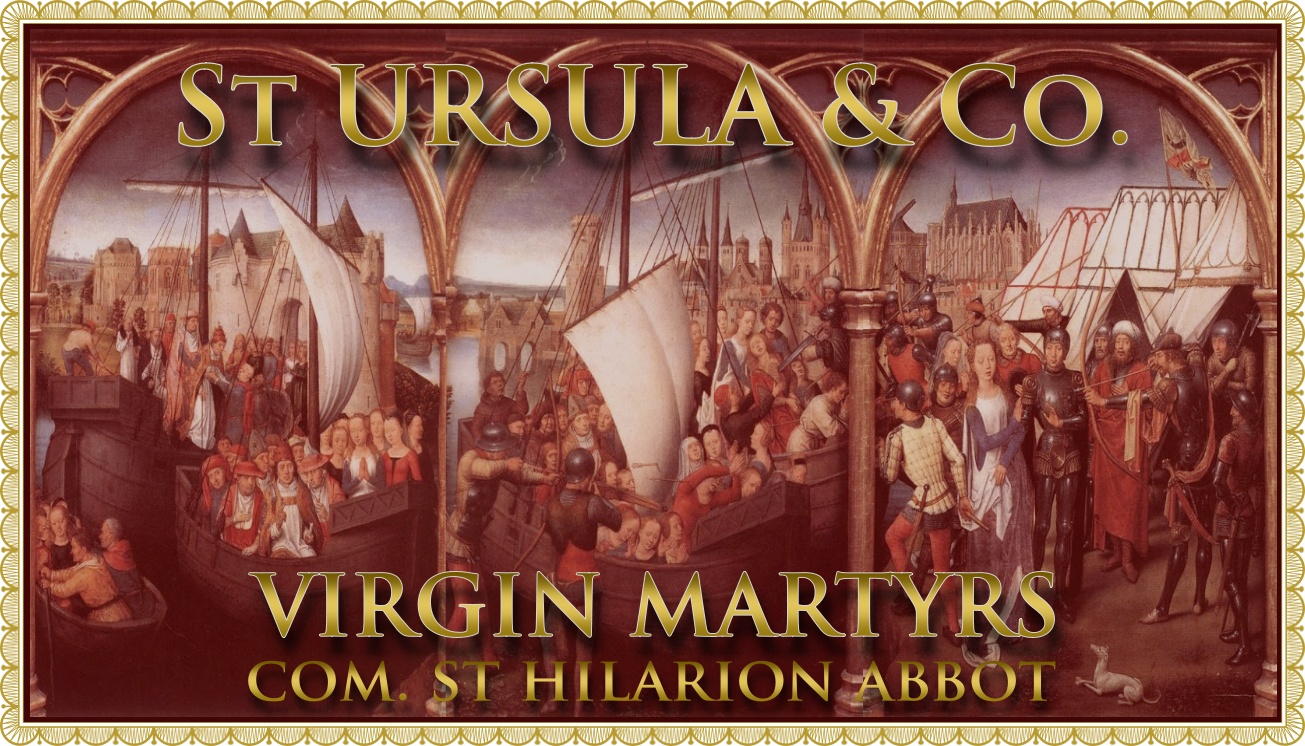
- Today’s Mass: October 21 St Ursula, Virgin Martyr & CompanionsSt Ursula and Companions, Virgins and Martyrs; Commemoration of St Hilarion, Confessor. Though legends concerning Ursula and eleven thousand virgins are historically uncertain, early Christian martyrs were venerated at Cologne. St Hilarion, Palestinian hermit and disciple of St Anthony, embraced severe penance and solitude, dying in 371 aged eighty.
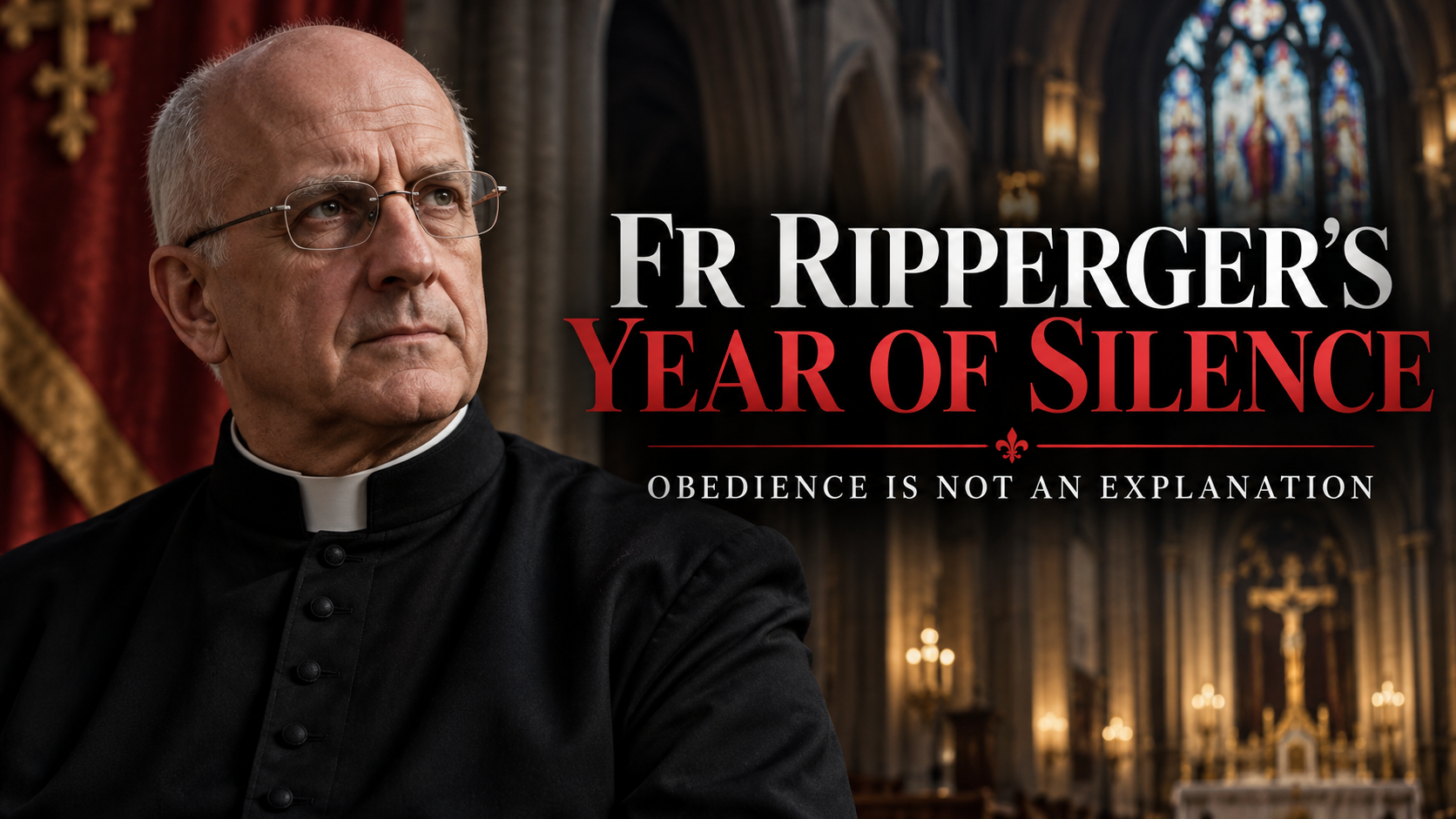
- FR RIPPERGER’S YEAR OF SILENCE: Obedience is not an explanationFr Chad Ripperger has accepted a year-long withdrawal from public speaking as requested by Archbishop Golka of Denver, aimed at focusing on his priestly community. This decision, following the removal of another exorcist, raises concerns about the Church’s balance between discretion and public witness regarding exorcism and supernatural matters.
- Today’s Mass: October 20 Octave Day of St Edward, King & ConfessorEdward the Confessor, England’s last Saxon king, ruled from 1042 until his death in 1066. Born in 1003, he fled to Normandy during Danish rule and returned to take the throne. His reign is debated, seen as both weak and a time of peace. Edward’s legacy includes the establishment of Westminster Abbey, where he is buried.
- SYNODALITY CANNOT SUBSTITUTE FOR GOOD BISHOPSCardinal José Cobo has highlighted the extensive process behind episcopal appointments, which includes numerous consultations and documentation, yet questions the effectiveness of this method in selecting suitable bishops. He stresses the need for reform in canon law and cautions against equating thorough procedures with genuine ecclesiastical wisdom and accountability.
- GAZA’S DEAD and the Claims Made in Their NameWestern politicians and media vilify Israel with double standards, while ignoring massacres of Christians across the Middle East. A century ago Christians were 20% of the region; now less than 4%, with persecution “close to genocide.” Yet Israel is the only state where Christians grow and worship freely. The Vatican mobilises diplomacy for Palestine, climate, and migration, but whispers for its own martyrs. Truth, then justice, then peace — anything less is counterfeit.
CURRENT EDITION


Today’s Mass Propers
- Today’s Mass: October 21 St Ursula, Virgin Martyr & Companions
 St Ursula and Companions, Virgins and Martyrs; Commemoration of St Hilarion, Confessor. Though legends concerning Ursula and eleven thousand virgins are historically uncertain, early Christian martyrs were venerated at Cologne. St Hilarion, Palestinian hermit and disciple of St Anthony, embraced severe penance and solitude, dying in 371 aged eighty.

Leave a Reply