
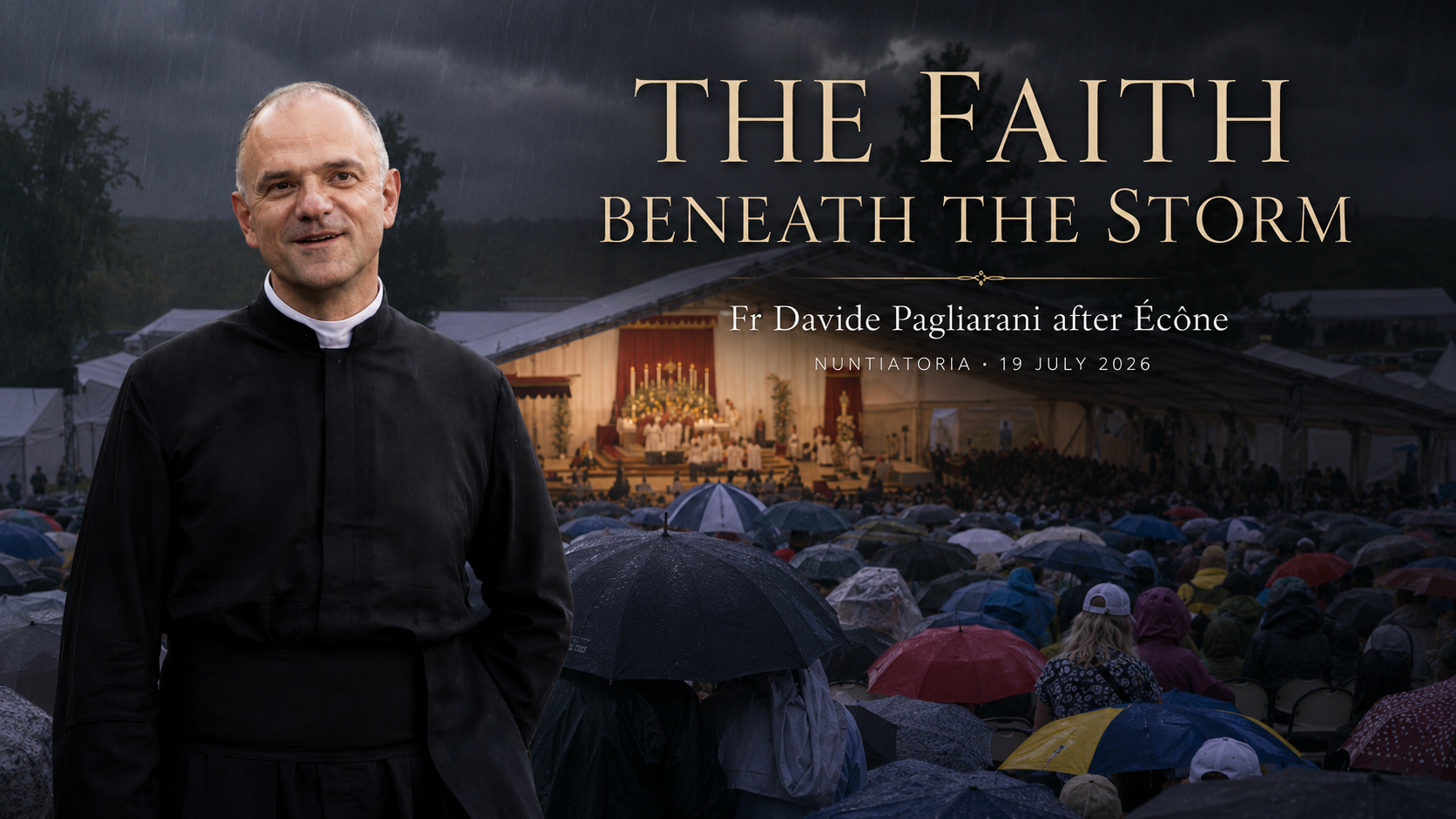
The Faith Beneath the Storm: Fr Davide Pagliarani’s first pastoral letter after the Écône consecrations
Fr Davide Pagliarani’s first pastoral letter after the Écône consecrations does not attempt a technical defence of the Society’s canonical position. Instead, it places before Rome a more disturbing question: what kind of ecclesiastical government punishes priests and faithful for preserving the doctrine, worship and sacramental life that the Church herself formed them to love?

The storm that broke over Écône on 1 July has already acquired an almost providential symbolism. Thunder sounded above the ceremony, rain fell upon the assembled multitude, and thousands of faithful remained where they stood. Elderly women knelt in the downpour. Mothers held infants in their arms. Priests, families and young people continued to pray for the new bishops, for the Church and for the Pope.
In his letter of 19 July, Fr Davide Pagliarani identifies that scene as the truest image of the Society of Saint Pius X. It is also the image that most seriously challenges Rome’s account of what occurred.
Those who remained beneath the storm were not assembled to found another Church. They had not gathered to proclaim the Roman See vacant, to renounce the papacy or to invent a new religion. They had come for the traditional Roman liturgy, the Catholic priesthood and the continuation of a sacramental life that they believe to be gravely endangered. When the storm came, they remained at the altar. When the sanctions came, they continued to pray for the Pope.
Menzingen, 19 July 2026
Dear faithful,
A few days after the ceremony of 1 July, I wish to address these few words to you.
First of all, I wish to thank you. For several years, I had been praying to the Most Holy Virgin that she would prepare hearts for this historic event. I confess that I have been deeply moved to see how all of you have accompanied the episcopal consecrations with your prayer and your gratitude towards divine Providence.
On 1 July, numerous faithful from all over the world were present at Écône, and they represented all of you. It was an immense joy to see them so numerous and so fervent. As you certainly know, a storm broke out during the ceremony: “At the brightness that was before him the clouds passed… And the Lord thundered from heaven, and the highest gave his voice” (Ps. 17:13–14). At that moment, my joy redoubled. On the one hand, I was the privileged witness of a liturgy of exceptional beauty; on the other, I had before my eyes another beauty, just as touching: that of an immense crowd of faithful remaining in their places throughout the storm, praying to Our Lady for the new bishops, for the Church, and for the Pope. Among them were elderly ladies, on their knees, as well as young mothers carrying their infants in their arms. It was the most beautiful image that could be given of the Society: faithful animated by an unshakeable faith that nothing could trouble; souls for whom the Holy Sacrifice of the Mass is truly the centre of their lives. You cannot imagine the consolation that was mine at that moment. This scene has been deeply engraved on my memory, and I shall never be able to forget it.
Right up until the last day, I hoped for a gesture of goodwill, or at least of simple understanding, on the part of the Holy See. But the consecrations were condemned, and the harshness of the sanctions imposed is unprecedented. They are directed first at the bishops, but also at the members of the Society. Even the faithful are affected. This condemnation, wholly unjust, represents an immense humiliation for people who have no other aim than to defend the true Faith and to work for the salvation of souls. But I want you to know that this profound humiliation, which touches the members of the Society first, has a meaning in the eyes of God that must not escape you. In the final analysis, these consecrations were carried out for each one of you, dear faithful. Your souls are the true treasure entrusted to the Society, that which it cherishes most. A single soul possesses infinite value. If such a humiliation is the price that must be paid to secure the teaching of the true Faith and the administration of the true sacraments, then it is worth it, because a soul has no price. The feast of the Most Precious Blood of Our Lord, the price of our salvation, reminded us of this forcefully on 1 July.
The sanctions are intended to strike you too, in a rather cruel way. This is certainly painful, but do not be too surprised by it. Ultimately, it is Tradition itself, which we cherish above all else, that is excommunicated in all those who embody it. It is evident that, before God, such a condemnation cannot be valid, for it would condemn what lies at the very heart of the life of the Church.
But then, in the midst of this new storm, a question arises: what does Our Lord expect of you now? It is in the soul of each one of you that the Faith must remain whole and alive. If Providence permits such a crisis that the teaching of the Faith becomes mysteriously obscured, that same Faith must continue to live in souls, despite all the contrary winds that seek to extinguish it. If the outward brightness of the official profession of Faith should disappear, the little candle that each of you received on the day of your baptism must remain lit in your heart and mind until your last day. That is, in the end, the only thing that matters. This little flame is the first thing we received at the beginning of our Christian life, and it is also the only thing we shall keep until the end.
I entrust you all to the Most Holy Virgin Mary, to whom the Society of Saint Pius X has been consecrated in a most particular way. May she always protect you amid all storms and all difficulties, and may she keep this little flame alive in your souls when all the contrary winds are unleashed. All graces come to us through her hands. It is her we must thank for the grace of the consecrations, and it is to her we must pray that the new bishops may be instruments ever more docile to her inspirations, and that they may persevere in this fidelity to the end.
The Society will never abandon you. Never will your souls lose their value and their worth in the eyes of its priests.
God bless you!
That fact does not, by itself, resolve every canonical question arising from the consecrations. It does, however, expose the inadequacy of describing the crisis merely as an act of disobedience followed by its proper punishment. The conflict cannot be understood apart from the doctrinal, liturgical and pastoral circumstances that produced it. Rome may condemn the act. It cannot reasonably demand that Catholics ignore the history that made the act conceivable.
Pagliarani’s letter is powerful because it does not begin with institutional self-defence. It begins with gratitude and ends with the value of souls. “Your souls are the true treasure entrusted to the Society,” he writes. “A single soul possesses infinite value.” The consecrations are therefore presented not as an assertion of ecclesiastical autonomy, but as an act undertaken to secure the continued transmission of the Faith and administration of the sacraments.
That is the heart of the Society’s case. It does not claim that episcopal consecration without pontifical mandate is ordinarily lawful, desirable or insignificant. Its argument is that ecclesiastical law exists for the supernatural end of the Church, and that the supreme law remains the salvation of souls. If the ordinary exercise of authority appears to endanger the transmission of Catholic doctrine, priesthood and worship, then the invocation of authority alone cannot settle the moral question. It must first be shown that obedience to the command would genuinely serve the purpose for which obedience is owed.
This is precisely what Rome has failed to demonstrate.
For decades, the Society has insisted that its irregular canonical condition is the consequence of a prior crisis of Faith. Rome has repeatedly sought canonical reconciliation without first resolving the doctrinal dispute. The Society has consistently demanded that the doctrinal questions be faced before institutional normalisation is treated as the solution. The disagreement is not, at root, about paperwork, personalities or diplomatic formulas. It concerns the relation between the pre-conciliar Magisterium and later teaching, the theological status of the reformed liturgy, religious liberty, ecumenism, collegiality and the practical consequences of the post-conciliar settlement.
To demand submission before those questions are answered is not reconciliation. It is the administrative suspension of the dispute.
Pagliarani states that he hoped until the final day for “a gesture of goodwill, or at least of simple understanding” from the Holy See. None came. The consecrations were condemned, the bishops sanctioned, the priests placed under suspicion, and even the faithful were warned that their attachment might expose them to ecclesiastical penalties. The response was framed as the defence of unity. Its practical effect was to deepen alienation among Catholics who already believe that the Roman authorities regard their inherited religion as a problem to be managed.
The disproportionality is impossible to overlook. Across the Catholic world, bishops and priests publicly contradict settled moral teaching, facilitate liturgical abuse, tolerate intercommunion, promote religious indifferentism and permit the language of revelation to be subordinated to contemporary ideology. Their errors are frequently met with dialogue, accompaniment, silence or procedural delay. Yet when traditional bishops are consecrated to preserve a priestly and sacramental apostolate, the machinery of condemnation moves with exceptional speed and severity.
This contrast is not a peripheral grievance. It strikes at the credibility of ecclesiastical discipline. Law commands reverence when it is recognisably ordered towards justice and the common good of the Church. When penalties descend most heavily upon those who preserve the old religion while innovators are protected by institutional patience, the faithful inevitably conclude that the governing priority is not doctrinal integrity but conformity to the prevailing ecclesiastical order.
Pagliarani’s most provocative sentence is therefore also the sentence Rome most urgently needs to understand: “It is Tradition itself, which we cherish above all else, that is excommunicated in all those who embody it.”
Strictly speaking, Tradition cannot be excommunicated. The deposit of Faith cannot be removed from the Church by an administrative act, nor can the worship, doctrine and sacramental order received from the saints become alien to Catholicism. Pagliarani is not proposing otherwise. He is identifying the practical meaning perceived by the faithful when censures are imposed upon those who continue to live according to what the Church herself taught, prayed and commanded for centuries.
The Roman authorities will answer that the penalty concerns an illicit act, not Tradition. Yet that distinction becomes less convincing when the same authorities restrict the traditional liturgy, marginalise traditional clergy, deny stable provision to traditional faithful and demand acceptance of contested post-conciliar propositions as the price of regularisation. The faithful are not unreasonable when they perceive a coherent policy rather than a sequence of unrelated disciplinary decisions.
The traditional Mass has never been condemned as doctrinally deficient. The traditional rites of ordination and consecration remain valid expressions of the Roman Church’s sacramental tradition. The catechesis taught in Society schools and chapels is drawn from the councils, Fathers, Doctors, catechisms and papal teaching that formed generations of Catholics. The families attached to the Society are not sustained by novelty but by continuity. They do not travel long distances, finance chapels and accept social stigma because they desire rebellion. They do so because they have found within Tradition the doctrinal certainty, liturgical reverence and spiritual seriousness increasingly absent elsewhere.
A hierarchy concerned for unity would begin by asking why.
Why have dioceses containing thousands of Catholics attached to the traditional rites so often failed to provide adequately for them? Why are young families prepared to drive past numerous parish churches to reach a Society chapel? Why do vocations continue to arise in traditional communities while seminaries, religious houses and parishes elsewhere close? Why have appeals for the old Mass been treated as threats rather than pastoral needs? Why have Catholics been expected to abandon communities that nourish their Faith when the local Church has so often refused to supply a comparable spiritual life?
To condemn the destination while refusing to examine the road that led there is not pastoral governance. It is institutional evasion.
Pagliarani’s letter, however, does not permit resistance to collapse into resentment. Its spiritual centre is not the Society’s grievance but the baptismal candle. If the public profession of Faith becomes obscured, he tells the faithful, the flame received at baptism must remain alive in the heart and intellect until death. This is the most important passage in the letter because it prevents the present crisis from being interpreted merely as a contest between rival authorities.
The first duty of the Catholic in a time of confusion is not to win an argument. It is to keep the Faith.
That duty demands more than correct opinions. Traditionalism may itself be corrupted when attachment to the Faith becomes inseparable from anger, contempt or factional pride. A Catholic may accurately diagnose the crisis and yet lose charity. He may defend the papacy against modernism while speaking as though every occupant of the Roman See were an enemy. He may preserve the rubrics of the Mass while permitting bitterness to deform his interior life. He may become so consumed by ecclesiastical conflict that prayer, penance, humility and the duties of his state in life are neglected.
Pagliarani avoids that temptation. He directs the faithful to the Blessed Virgin, the Precious Blood, divine Providence and perseverance. He speaks of humiliation not as a political injury to be avenged, but as a suffering that may be offered for souls. He insists that the faithful pray for the Church and the Pope. Whatever Rome may claim concerning the canonical meaning of the consecrations, the letter’s spiritual language is not the language of separation. It is the language of Catholics who believe themselves punished by the authorities of the Church but who refuse to cease loving the Church.
That distinction is decisive. Schism delights in separation. The Society presents its suffering as the cost of refusing separation from the Faith of the Church.
Rome possesses the juridical power to impose penalties. Power, however, is not self-authenticating. Ecclesiastical authority is credible only insofar as it serves the revelation, worship and salvation entrusted to it. The Church is not an arbitrary monarchy in which the command of a superior transforms contradiction into truth or injustice into virtue. Authority is ministerial. It exists to guard what it did not create and cannot alter.
The central question raised by the Écône consecrations is therefore not whether authority matters. It is whether authority has fulfilled its own obligations towards those now condemned for acting without its permission.
Has Rome protected the traditional priesthood? Has it secured the unrestricted transmission of the traditional Roman liturgy? Has it answered the doctrinal objections that have remained unresolved for more than half a century? Has it treated traditional Catholics as sons and daughters of the Church rather than as an ideological problem? Has it exercised the same vigilance against doctrinal corruption that it has now exercised against canonical disobedience?
Until those questions receive credible answers, the sanctions will not heal the crisis. They will confirm the judgment that Rome is prepared to discipline the preservation of Tradition more decisively than its destruction.
“The Society will never abandon you,” Pagliarani tells the faithful. That assurance will be interpreted by critics as institutional defiance. To those who have spent decades seeking the traditional Mass, sound catechesis and dependable sacraments, it will sound like a pastoral promise: your souls will not be treated as expendable, your spiritual inheritance will not be bargained away, and your fidelity will not be dismissed as pathology.
The faithful at Écône remained beneath the storm because the Holy Sacrifice remained before them. Their clothes were soaked, the thunder sounded and the ecclesiastical consequences were already visible. Yet they prayed for the Church and for the Pope.
That is the image Rome cannot easily explain.
The people accused of abandoning communion were kneeling in the rain, praying for the very authority that would condemn them. They did not remain because they believed the Church no longer mattered. They remained because they believed the Church mattered too much to surrender her Faith, her priesthood and her Mass.
The storm has not passed. The censures have not resolved the dispute. The doctrinal questions remain unanswered. Yet the baptismal flame still burns.
Rome may condemn the hands that shelter it. It cannot make the flame cease to be Catholic.
RELATED ARTiCLES


LATEST ARTICLES
- Today’s Mass: September 07 Feria of Sunday XV Post PentecostThe Sunday XV Post Pentecost Mass emphasises the importance of living a life governed by the Holy Spirit, encouraging Christians to act with grace, charity, and humility. St Paul’s teachings remind believers to bear one another’s burdens and avoid self-deceit, ultimately striving for spiritual growth and communion with God through the Eucharist.
- Crisis is the Cause; Necessity is the EffectThe SSPX has clarified its rationale for episcopal consecrations, arguing that a crisis in the Church has led to a “state of necessity” for preserving the Catholic Faith. This distinction stresses the need to prove the necessity and proportionality of their measures against church law, highlighting a significant theological and canonical issue that requires serious examination from both SSPX and Rome.
- A Name on the Letterhead: Grech, Farrell and the Synodalisation of Amoris LaetitiaAdVaticanum reports that Cardinal Farrell’s dicastery might lack substantial input into the October Amoris Laetitia meeting, with Cardinal Grech’s Synod Secretariat effectively leading preparations. This raises concerns about the balance of roles, highlighting potential tensions in handling doctrinal issues, particularly regarding the sacramental practice stemming from Amoris Laetitia.
- Today’s homily: Fifteenth Sunday Post PentecostIn the Gospel of Naim, two processions converge—one of life led by Christ and another of death following a young man. Christ’s compassion interrupts the funeral, symbolising hope amid despair. This message resonates today as Catholics face challenges, encouraging perseverance in faith, tradition, and prayer for revival in families and community.
- Today’s Mass: September 06 Sunday XV Post PentecostThe Fifteenth Sunday After Pentecost’s Mass emphasises the importance of living in accordance with the Holy Spirit, cultivated through the Eucharist. It reflects on Jesus’ compassion for humanity, recalling His miracles. The readings encourage believers to prioritise spiritual matters over worldly anxieties and to embody love for one another, resonating with St. Paul’s teachings.
CURRENT EDITION


Today’s Mass Propers
- Today’s Mass: September 07 Feria of Sunday XV Post Pentecost
 The Sunday XV Post Pentecost Mass emphasises the importance of living a life governed by the Holy Spirit, encouraging Christians to act with grace, charity, and humility. St Paul’s teachings remind believers to bear one another’s burdens and avoid self-deceit, ultimately striving for spiritual growth and communion with God through the Eucharist.




Leave a Reply