
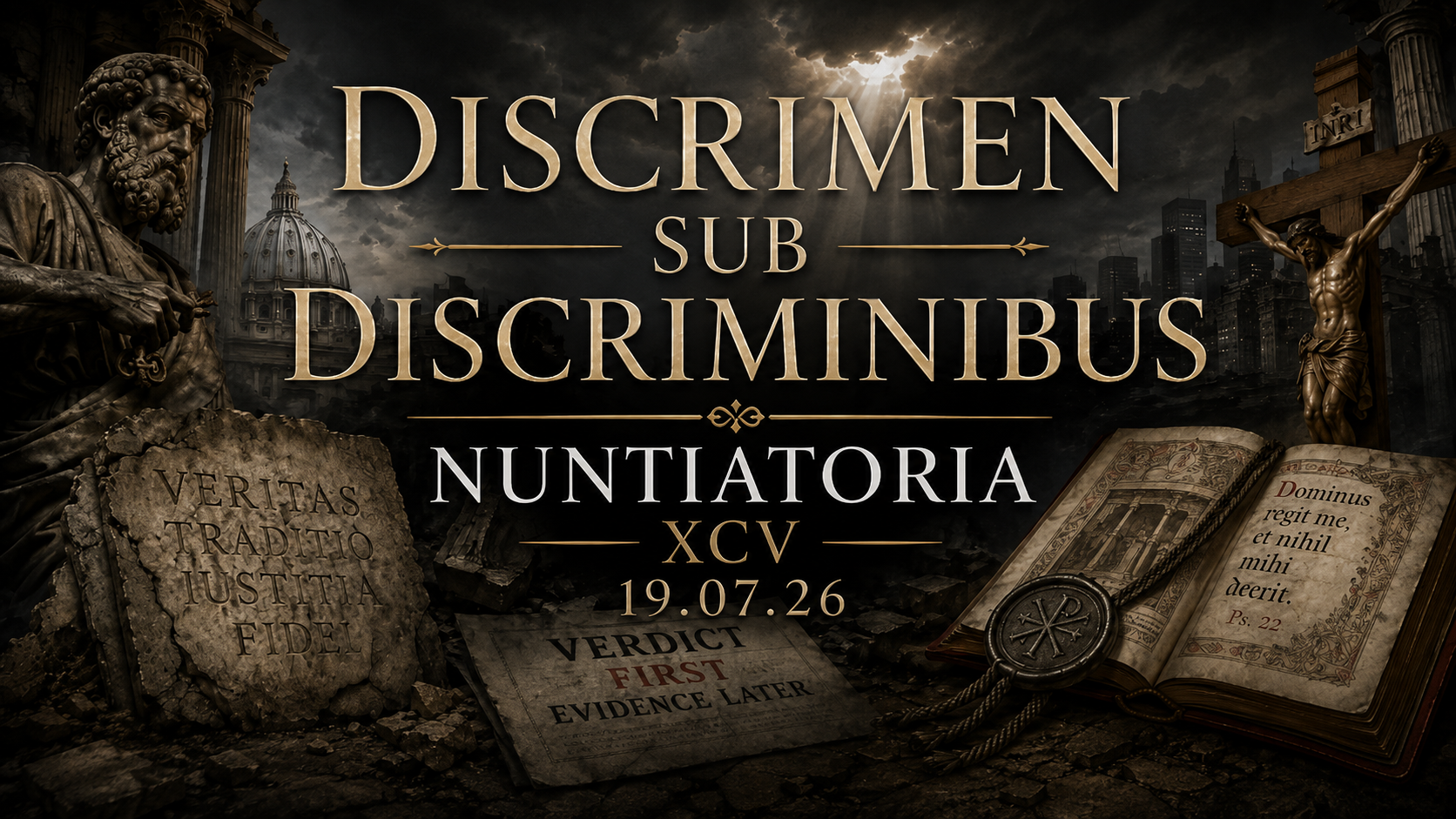
Editorial: The Crisis Beneath the Crises
This edition of Nuntiatoria examines the deeper crisis beneath contemporary disputes in Church and society: the loss of sound judgement. From synodality, liturgical reform and episcopal responsibility to ideological blacklisting, school curricula, euthanasia and due process, the articles expose institutions increasingly detached from truth, tradition and reality. The edition calls Catholics to recover clarity, courage and the capacity to judge all things according to the faith.

The individual controversies examined in this edition may at first appear unrelated. A cardinal criticises synodality while remaining unwilling to confront the deeper ecclesiological revolution from which it emerged. A professor describes the manipulation concealed beneath the language of listening and participation. Amnesty International constructs an ideological blacklist of Christian organisations. Schools prepare to introduce new curricula while governors and parents struggle to discover precisely what children will be taught. A French bishop reminds Catholic politicians that public support for euthanasia has sacramental consequences. Traditional Catholic communities grow while diocesan structures attempt to restrict the liturgy that sustains them. Ancient Christian objects, forgotten prayers and inherited ceremonies testify to a faith more deeply rooted than the modern reformers who presumed to reconstruct it.
Yet beneath all these stories lies a single crisis: the collapse of judgement.
Modern institutions have not ceased to issue judgements. On the contrary, they classify, condemn, exclude and regulate with extraordinary confidence. What they increasingly lack is the willingness to submit their judgements to objective truth, inherited principle and rational scrutiny. Authority remains, but accountability to reality diminishes. The verdict frequently precedes the evidence; the process is designed to produce the desired conclusion; and disagreement is treated not as an argument to be answered but as evidence of moral or psychological defect.
Nowhere is this more apparent than in the continuing campaign for “synodality”. Several articles in this edition approach the subject from different directions, but their conclusions converge. The contemporary synodal project is not merely an administrative programme intended to improve consultation. It represents a profound alteration in the Church’s understanding of how doctrine, authority and ecclesial government are received and exercised.
The interview examined in our principal editorial exposes the carefully managed character of a process routinely advertised as spontaneous, inclusive and inspired by the Holy Ghost. The central deception consists in presenting predetermined theological and pastoral objectives as though they had arisen organically from the faithful. Participation has been extremely limited, frequently involving only a minute proportion of practising Catholics, yet the resulting documents are invoked as expressions of what “the People of God” have discerned.
The language is democratic, but the machinery is controlled. The vocabulary is pastoral, but the implications are doctrinal. The process appears open-ended, yet its recognised conclusions almost invariably travel in one direction: towards the weakening of inherited discipline, the relativisation of settled teaching and the redistribution of authority into structures that can be more easily managed by permanent ecclesiastical bureaucracies.
Archbishop Paul Coakley’s defence of synodality therefore requires more than a discussion of participation rates or consultation methods. The present experiment is not simply a more ambitious development of the episcopal synods envisaged by the Second Vatican Council and instituted by Paul VI. Those synods were intended to assist the Roman Pontiff through the counsel of bishops. They were not conceived as an alternative constitution for the Church, still less as a means by which doctrine could be continually reopened through facilitated conversations, selected testimonies and manufactured consensus.
The controversy also raises the older question of collegiality. Traditional criticism of collegiality was never merely an objection to bishops consulting one another. It concerned the danger that the divinely constituted authority of the Roman Pontiff and the proper jurisdiction of individual bishops might be obscured by a permanent collective structure claiming an authority greater than either. Synodality intensifies that ambiguity by adding a further layer of consultative bodies, lay delegates, experts, facilitators and continental assemblies whose precise theological status is rarely defined but whose conclusions are nevertheless treated as morally binding.
Cardinal Raymond Burke’s recent warning that synodality “has to be stopped” is consequently important, but it is not sufficient. His criticism identifies genuine procedural and theological dangers, particularly the suppression of frank debate and the replacement of deliberation by tightly controlled discussion groups. Yet one cannot credibly oppose the mature fruits of the post-conciliar settlement while declining to examine its roots.
The cardinal’s predicament illustrates a wider weakness within conservative Catholicism. Ceremonial attachment to tradition, however admirable, cannot substitute for theological diagnosis. It is possible to vest magnificently, celebrate isolated traditional ceremonies and condemn the latest excesses while continuing to accept the principles and reforms that made those excesses possible. The crisis cannot be resolved merely by opposing its most embarrassing manifestations. The premises themselves must be examined.
This problem appears with particular clarity in the liturgical articles contained in this edition. “The Invention of Antiquity” considers the strange similarity between the Protestant reformers of the sixteenth century and the Catholic liturgical reformers of the twentieth. Both distrusted the prayers and ceremonies that had actually descended through the centuries. Both sought to leap backwards over the organic inheritance of Christendom in search of a supposedly purer primitive age. Both ultimately produced not recovered antiquity but modern constructions shaped by the preoccupations of their own times.
The paradox deserves emphasis. The historic Roman liturgy was condemned for being insufficiently ancient by men who replaced it with newly composed prayers. Ceremonies whose development could be traced across centuries were discarded in favour of speculative reconstructions assembled by committees. The inherited worship of the Church was treated as an archaeological obstruction, while modern inventions were presented as restorations.
Our examination of the Catholic liturgy and “supersessionism” further demonstrates why the Church’s prayers cannot be treated as incidental or infinitely malleable. The Divine Office, the traditional Roman Missal and even portions of the reformed rites preserve theological claims concerning Israel, the Church and the covenants that cannot simply be rewritten according to contemporary political sensitivities. The liturgy is not a diplomatic communiqué. It is one of the principal witnesses to what the Church believes.
The recovery of authentic Catholic judgement therefore requires the recovery of liturgical memory. A Church uncertain about the meaning of her own prayers will eventually become uncertain about the meaning of her own doctrine.
The growth of the Society of Saint Pius X in the Diocese of Charlotte offers a practical demonstration of this reality. While episcopal and Roman authorities continue to restrict the traditional Mass, ordinary Catholics are providing millions of dollars to acquire land and construct churches in which that Mass may be offered. Whatever one’s canonical assessment of the Society, the contrast cannot be ignored. Communities centred upon traditional doctrine, disciplined worship and large families are expanding, while many officially favoured pastoral programmes preside over empty churches and demographic decline.
Institutional authority cannot indefinitely demand that Catholics disregard what they can see. Fruitfulness is not the sole test of truth, but sterility is not evidence of renewal.
Bishop Marc Aillet’s intervention in the French euthanasia debate supplies a very different example of episcopal responsibility. His insistence that Catholic parliamentarians who vote for euthanasia should not approach Holy Communion is neither political interference nor sacramental punishment. It is the necessary recognition that public acts possess public moral consequences.
A politician cannot facilitate the killing of the vulnerable and then present himself at the altar as though his legislative conduct were religiously irrelevant. Holy Communion is not a ceremonial affirmation of social respectability. It is the sacrament of unity in the faith and life of Christ. To receive it while publicly repudiating the moral law is to introduce contradiction into the sacramental order itself.
The same refusal to recognise contradiction characterises much of contemporary public life. Amnesty International’s labelling of Christian organisations as “anti-rights” is examined in this edition not as an isolated piece of activist rhetoric but as an example of how ideological classifications become instruments of institutional power.
The danger is circular. Amnesty labels an organisation “anti-rights”; funders, officials, regulators and journalists then treat that description as independent evidence; exclusion from public consultation or financial support follows; and the exclusion is subsequently cited as proof that the organisation stands outside respectable civil society. An activist judgement acquires the appearance of an objective fact simply through repetition.
This mechanism will have serious consequences as Parliament, regulators and campaigners continue to press for restrictions upon so-called conversion practices. Organisations defending Christian teaching on the body, sexuality, marriage or repentance may find themselves excluded from the debate precisely because campaigners have already declared their beliefs harmful. Those who define “rights” are then permitted to decide who may participate in discussions about them.
The impending revision of school policies and curricula before the new academic year belongs within the same struggle. Governors and parents must not assume that materials carrying the approval of a local authority, educational association or external provider are therefore legally, medically or morally sound. Recent developments in safeguarding guidance, equality law and the treatment of biological sex require careful scrutiny of lessons previously introduced under the banner of inclusion.
The examples considered in this edition demonstrate why such scrutiny is necessary. Children have been presented with disputed concepts of gender identity as settled fact. Social transition has been treated as an uncomplicated act of kindness. Traditional religious and gender-critical convictions have sometimes been framed as obstacles to wellbeing rather than protected beliefs entitled to fair representation.
The task is not to manufacture conflict within schools but to restore professional seriousness. Governors should know what is being taught. Parents should receive accurate information. Teachers should not be required to affirm contested ideological propositions. Pupils should be protected from both bullying and indoctrination. None of these demands is extreme. Their presentation as extreme is itself evidence of how far institutional judgement has deteriorated.
The tragic case of Owen Poirier, also considered in this edition, reveals the human cost of a culture in which allegation, publicity and institutional panic can overwhelm due process. Justice requires compassion for complainants, but compassion cannot abolish the presumption of innocence or the responsibility to test accusations fairly. A society that treats an accusation as a verdict does not protect the vulnerable; it merely creates new victims.
Other contributions turn towards the quieter witnesses of Christian continuity. The account of the ancient amulet provides a tangible reminder that the early Christian world was not the minimalist, demythologised community imagined by modern reformers. Its believers prayed, invoked sacred names, carried signs of protection and understood themselves to inhabit a cosmos in which spiritual realities were active and immediate. Archaeology repeatedly complicates the tidy narratives by which modernity seeks to recreate primitive Christianity in its own image.
Our review of the recent spiritual conference on the Écône consecrations likewise considers the crisis not solely as a canonical dispute but as a test of supernatural judgement. Canon law matters profoundly, but law cannot be interpreted in abstraction from the end for which it exists: the salvation of souls. Neither can necessity become an all-purpose excuse for private judgement. The Catholic response must resist both papal maximalism and ecclesiastical anarchism, holding authority, tradition, conscience and necessity within the full theological constitution of the Church.
The edition concludes, as Nuntiatoria properly should, not with institutional analysis alone but with the liturgical and spiritual vision by which all human affairs are finally judged. The Eighth Sunday after Pentecost presents the parable of the unjust steward, whose worldly prudence becomes an indictment of spiritual negligence. The children of this world often labour more urgently for passing advantage than Christians labour for eternity.
That Gospel supplies the examination of conscience underlying this entire edition. Those who seek to transform the Church and society possess organisation, funding, vocabulary and strategic patience. They understand institutions, cultivate networks and impose their categories upon public discourse. Too often, those entrusted with the defence of truth respond with vagueness, timidity or ceremonial gestures unaccompanied by decisive action.
Catholics are not called to imitate the dishonesty of the unjust steward. They are, however, commanded to recover seriousness, foresight and courage. They must learn once again to distinguish authority from manipulation, consultation from manufactured consensus, compassion from moral surrender, antiquity from archaeological fantasy, justice from accusation, and pastoral care from doctrinal evasion.
The crises examined in these pages are therefore not separate. They are manifestations of a civilisation, and at times an ecclesiastical establishment, that has lost confidence in its ability to name reality truthfully. Recovery begins when Catholics refuse the managed vocabulary of decline and regain the courage to judge all things according to the faith received from the Apostles.
Institutions may retain their offices, committees, declarations and public reputations. Yet authority proves itself not by the possession of machinery but by fidelity to truth. When that fidelity is lost, the recovery of judgement becomes not an intellectual luxury but a moral and spiritual duty.
That duty animates this edition of Nuntiatoria.
IN THIS EDITION
- Sermon for St. Apollinaris
 Today marks the feast of St. Apollinaris, an early Christian martyr linked to Ravenna. His martyrdom’s dating is debated, with implications for Ravenna’s historical significance. St. Peter’s epistle to Asia Minor warned Christians of persecution and redefined leadership through service, urging humility and self-sacrifice, a lesson relevant in today’s church context.
 - Chifeng, Écône and Rome’s Uneven Measure of Ecclesial Communion
 The ecclesial dynamics between Rome and the Chinese Catholic Church reveal a complex relationship. While Pope Leo XIV’s endorsement of Bishop Chang’s ordination at Chifeng affirms canonical legitimacy, it simultaneously highlights issues with the state-controlled ecclesiastical framework, contrasting sharply with the disobedient yet doctrinally consistent actions of the Society of Saint Pius X at Écône.
 - Sermon for St. Mary Magdalen
 Today marks the feast of St. Mary Magdalen, a key female disciple of Jesus. Despite traditional views categorising her as a sinner, she demonstrated profound love and gratitude. Jesus’ teachings challenged the Pharisees’ self-righteousness, emphasising forgiveness and reconciliation. Christianity’s distinct message offers salvation, highlighting the importance of humility over pride.
 - Prebunking Dissent: How Whitehall’s Misinformation Framework Could Turn Gender-Critical Speech into Wrongthink
 A recent Government-commissioned report categorises discussions on gender ideology and related topics as misinformation, aiming to suppress dissenting views. While it acknowledges the challenge of distinguishing between false claims and legitimate opinions, the report promotes intervention strategies that may undermine free speech. This raises concerns about potential ideological conditioning in education and public discourse.
 - MUNUS OR MANUS? Three Priests, One Recorded Word, and the Church’s Duty to Establish Moral Certainty
 A recent ordination ceremony by Cardinal Müller has sparked debate over the pronunciation of a crucial Latin word, raising questions about the validity of the ordinations of three priests. The allegations suggest an error that could compromise the sacramental form. Clarification from the Church is necessary to resolve the uncertainty surrounding the validity of their ministry.
 - Cathedral, Guest List and Cathedra: How Pride Activism Gains Sacred Space, Papal Proximity and Episcopal Power
 The article discusses the evolving acceptance of LGBT activism within the Catholic Church, highlighted by events in Munich, Madrid, and Eichstätt. It argues that these changes, while not overtly altering doctrine, subtly redefine ecclesiastical legitimacy and authority, blurring the lines between welcoming individuals and endorsing ideologies contradicting traditional teachings.
 - The Faith Beneath the Storm
 Fr Davide Pagliarani’s letter following the Écône consecrations highlights the faithful’s resilience during imposed sanctions from Rome. He questions ecclesiastical governance punishing adherence to traditional teachings while encouraging unity among Catholics. His message underscores the importance of preserving the Faith in challenging times, asserting that the value of souls remains paramount.
 - Four Years Old and Already on a Gender Pathway: The Pipeline Begins Before the Clinic
 The article discusses concerns about early referrals of preschool children, aged four to six, to gender provision services, highlighting how these children are influenced by societal narratives on gender identity before they can fully comprehend them. It critiques the use of gender theory in education and stresses the need for cautious, comprehensive evaluation by clinicians to avoid reinforcing potentially transient feelings. Adult interpretation of children’s behaviours may lead to premature conclusions about gender identity, emphasising the importance of respecting childhood innocence and freedom from stereotypes.
 - Reality Is Not Discrimination
 A recent investigation revealed over sixty children’s books that convey contentious theories of sex and identity through seemingly benign narratives. It questions the role of schools in promoting such ideologies disguised as storytelling, highlighting the need for careful selection of literature that fosters genuine understanding without endorsing disputed concepts as fact.
 - The Reading List as Manifesto: When Children’s Books Become Ideological Instruction
 A recent investigation revealed over sixty children’s books that convey contentious theories of sex and identity through seemingly benign narratives. It questions the role of schools in promoting such ideologies disguised as storytelling, highlighting the need for careful selection of literature that fosters genuine understanding without endorsing disputed concepts as fact.
 - Sermon for St. Vincent de Paul/Eighth Sunday after Pentecost
 The feast of St. Vincent de Paul coincides with the Eighth Sunday after Pentecost, celebrating his life dedicated to charity and service. Born in 1576, he founded the Lazarists and the Sisters of Charity, focusing on alleviating suffering during a time of religious conflict. His legacy teaches the power of action over words in evangelism.
 - The Empty Altar: Bolzano Cathedral and the Synodal Substitution of the Priesthood
 On 14 March 2026, Bolzano Cathedral replaced a scheduled Mass with a lay-led celebration of the Word, led by Maja Clara, marking a significant moment in female ministry. This substitution reveals issues regarding priestly identity and church structures amid a developing crisis in priesthood, raising concerns about the proper role of lay leadership in liturgical settings.
 - Sermon for St. Camillus de Lellis
 Today, we honour St. Camillus de Lellis, born in 1550. A former soldier turned saint, he devoted his life to serving the sick, founding a religious order for their care. The current climate has revealed society’s misplaced priorities, urging a return to personal responsibility and divine guidance in facing life’s realities, including death.
 - 19.07.26 Nuntiatoria CXV: Discrimen sub Discriminibus
 This edition of Nuntiatoria highlights a profound crisis in the Church and society: the erosion of sound judgement. It critiques issues such as synodality, liturgical reform, and ideological manipulation, insisting that authority must align with objective truth. The call to restore clarity and courage in Catholic judgement is imperative for the faith’s integrity.
 - ORDO w/c 19.07.26
 From 19 to 26 July, the Church commemorates various saints including Saint Vincent de Paul, known for his charity, Saint Jerome Emiliani, dedicated to orphans, and Saint Mary Magdalen, a symbol of repentance. The week concludes with the feast of Saint Anne, mother of the Blessed Virgin Mary, highlighting the importance of familial devotion.
 - Saint Vincent de Paul: The Saint Whom Charity Conquered
 The Eighth Sunday after Pentecost reflects on the duality of being both heirs and stewards in the Christian faith. While believers are granted divine gifts and mercy, they are also held accountable for their stewardship. The liturgy signifies that grace obliges Christians to act faithfully, acknowledging their debt to God and living in alignment with His will.
 - The Steward and the Heir: Grace, Judgment and the Eighth Sunday after Pentecost
 The Eighth Sunday after Pentecost reflects on the duality of being both heirs and stewards in the Christian faith. While believers are granted divine gifts and mercy, they are also held accountable for their stewardship. The liturgy signifies that grace obliges Christians to act faithfully, acknowledging their debt to God and living in alignment with His will.
 - Looking at Christ in the Storm: A review of HE ✠Jerome Lloyd’s spiritual conference on Écône, Peter and the Passion of the Church
 HE ✠Jerome Lloyd’s spiritual conference addressed the Écône controversy with depth, emphasising that Christ, not the papacy, is the source of the Church’s life. The conference distinguished between resistance to authority and schism, arguing that attending SSPX Masses doesn’t equate to denying papal authority. Ultimately, Lloyd called for spiritual conversion over factionalism.
 - Reason Before Anathema: Q&A with ✠Jerome Lloyd
 In a live Q&A, Archbishop Jerome Lloyd addressed ecclesiastical controversies surrounding the Écône consecrations, excommunication, and the wider Catholic crisis. He emphasised the necessity of precise distinctions and fair judgments when discussing canonical matters, highlighting that penalties are individual, not collective, and that reason should guide Catholic discourse amidst emotional responses.
 - Old Romans Unscripted: “To Suffer at Her Hands” Tradition, Écône and the Passion of the Church
 The latest episode of “Old Romans Unscripted” delves into the spiritual crisis within the Church, transcending legal controversies over the Écône consecrations. It explores themes of fidelity, suffering, and the importance of traditional Catholic practices while emphasising the necessity of personal prayer and devotion in overcoming contemporary challenges to the Faith.
 - The School That Chose Before It Knew
 Fifteen-year-old Owen Poirier died after being accused of sexual assault, questioned without his parents and removed from school. His family’s lawsuit alleges that institutional self-protection and sex bias displaced evidence, due process and basic care. The case is a warning that safeguarding fails when authorities choose whom to believe before establishing the truth.
 - The Verdict Before the Hearing
 The Society of Saint Pius X has filed a canonical recourse against the Dicastery for the Doctrine of the Faith, challenging a decree of excommunication for six bishops. Critics argue the petition’s likelihood of success is low due to questions around standing and procedural compliance. However, the legitimacy of the recourse hinges on a thorough examination of canon law rather than assumptions about its potential outcome.
 - The Invention of Antiquity: How Liturgical Reform Became the Worship of the Present
 The text discusses how both Protestant Reformation and post-Vatican II Catholic liturgical reforms attempted to recover early Christian worship, yet ultimately rejected traditional prayers in favour of new compositions reflecting contemporary concerns. This led to a disconnection with genuine antiquity, creating modern practices disguised as historical authenticity.
 - You Cannot Vote for Death and Receive the Bread of Life
 Bishop Marc Aillet has reminded Catholic parliamentarians that voting to legalise euthanasia has consequences for their reception of Holy Communion. His intervention is not a political threat but a defence of sacramental coherence: a Catholic cannot knowingly facilitate the intentional killing of innocent human beings and then approach the Eucharist as though faith and public conduct were morally unrelated.
 - The Bishop Closed Four Doors: Tradition Bought Twenty-Six Acres
 Bishop Michael Martin’s restrictive policies towards traditional Catholics in the Diocese of Charlotte have led to significant discontent and the creation of a new ecclesial complex by the Society of Saint Pius X. This reflects a growing divide within the Church as traditional worshippers seek permanence amid liturgical suppression.
 - Cardinal Burke and the Limits of Conservative Resistance
 Cardinal Burke critiques the concept of synodality, arguing it lacks theological clarity and historical roots. He warns that synodal processes often suppress dissent, prioritising consensus over genuine counsel. While he defends tradition and criticises contemporary developments, he inconsistently resists scrutinising the historical context shaping synodality, limiting his critique’s effectiveness.
 - Before September: English Schools Must Audit the Curriculum, Not Merely Rewrite the Policy
 Schools in England must conduct in-depth audits of their Relationships, Sex and Health Education materials before the new guidance takes effect on 1 September 2026. This requires examining actual teaching resources, ensuring compliance with updated statutory requirements, and engaging parents transparently about content, particularly concerning sensitive topics like gender identity and sexual education.
 - The Liturgy Has Not Forgotten Israel
 The Catholic Church continues to pray for the conversion of the Jewish people, affirming that the Mosaic covenant is fulfilled in Christ rather than abandoned. Despite contemporary claims of supersessionism, the liturgy and Church teachings highlight the enduring significance of Israel in salvation history, recognising Christ as the fulfilment of the promises made to Abraham.
 - The Great Deception: Synodality and the Church of “Nice Men”
 Professor William A. Thomas critiques contemporary synodality within the Church, arguing that it prioritises agreement over authority and dilutes doctrinal integrity. He warns this shift towards “nice” bishops, who favour consensus and facilitation, threatens to replace traditional teachings with subjective experiences, undermining the Church’s foundational mission to proclaim the faith.
 - Synodality for the Initiated: How Collegiality Became Permanent Process
 Archbishop Paul Coakley’s concerns highlight the complexities of synodality within the Catholic Church, suggesting it risks becoming overly bureaucratic and accessible only to a select group of specialists. Despite efforts to enhance participation, evidence reveals that less than one per cent of Catholics engaged in the process, revealing a disconnect between ecclesiastical language and ordinary faith practices.
 - Amnesty’s Selective Blacklist: Christians Named, Islam Ignored
 Amnesty International UK’s withdrawn report labelled various Christian organisations as part of an “anti-rights ecosystem”, notably omitting any Muslim groups. Critics argue this reflects bias and a failure to apply criteria consistently across different faiths. The report’s implications raise concerns over ideological blacklisting and the integrity of human rights discourse.
 - The Law That Binds Peter
 The Society of Saint Pius X has formally responded to the Holy See’s decree regarding the excommunication of certain bishops by invoking canon law. This recourse challenges the decree’s validity under ecclesiastical law, emphasizing a return to lawful procedures. The outcome may significantly impact the relationship between SSPX and Rome, focusing on adherence to canon law and the nature of authority within the Church.
 - Who Refused What? Archbishop Pozzo, Rome’s Revised Terms, and the Law after Écône
 Archbishop Pozzo affirmed that the Society of Saint Pius X (SSPX) rejected Rome’s revised settlement in 2018. However, the SSPX proposed continued dialogue and the refusal pertains to specific revised terms, not a complete rejection of theological exchange. Key distinctions in law surrounding illicit consecrations and schism were also highlighted.




Leave a Reply