
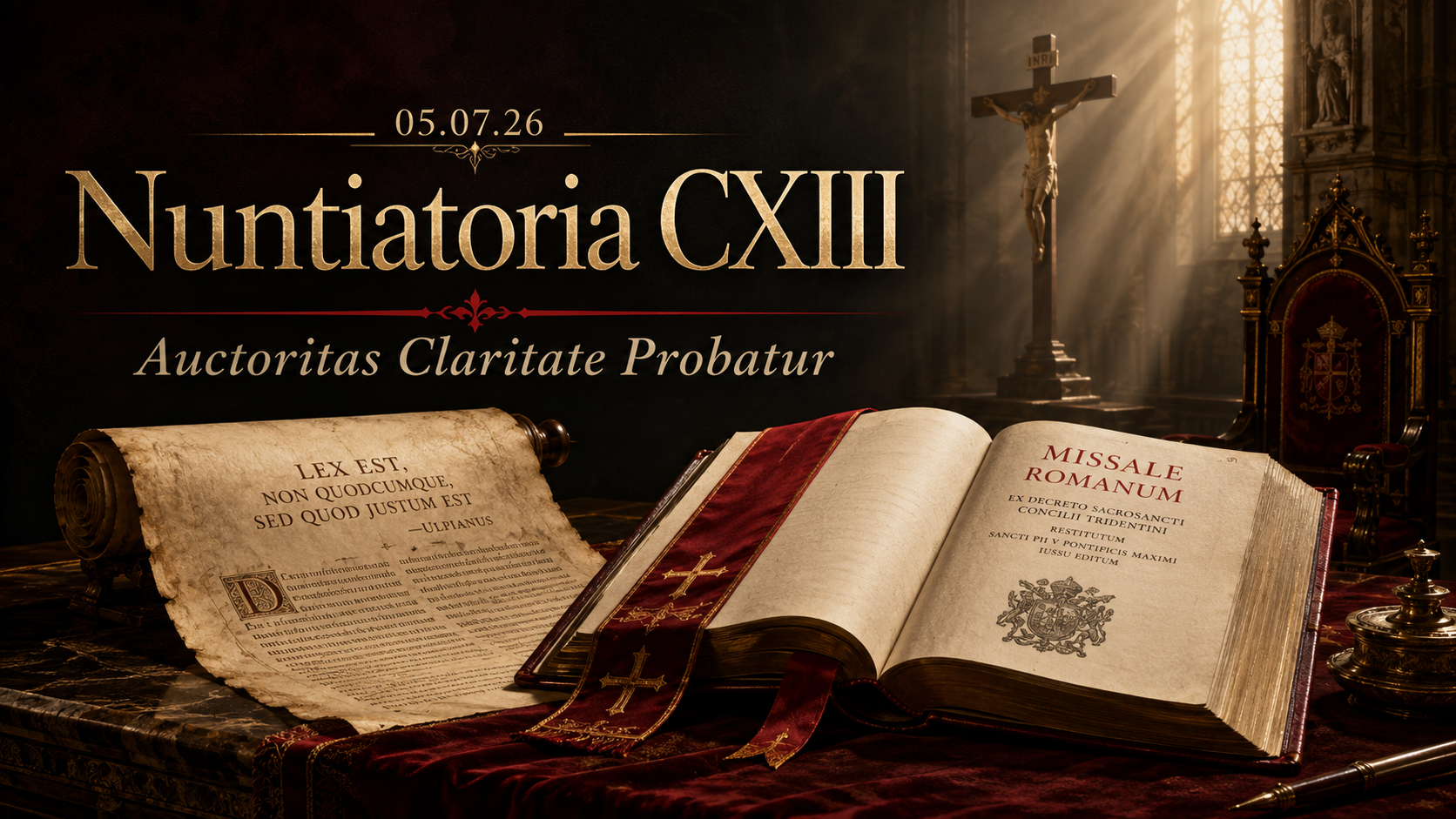
Editorial: Authority is proved by clarity
This edition examines a Church and a public culture increasingly inclined to treat submission as unity, procedure as truth and dissent as guilt. From Écône and Rome to Oslo, Brighton and the persecuted missions of Africa, the same question returns: what becomes of authority when it demands trust while refusing dialogue, memory and correction?

This edition of Nuntiatoria is gathered beneath a principle at once juridical, theological and moral: Auctoritas claritate probatur — authority is proved by clarity. Office may confer power, and power may secure outward compliance, but neither alone establishes the moral credibility of government. Authority vindicates itself by speaking truthfully, defining its terms, distinguishing what must be distinguished, giving reasons for its judgements and accepting responsibility for the consequences of its acts.
The liturgical essays for the Feast of the Most Precious Blood and the Sixth Sunday after Pentecost place that principle within its proper supernatural order. The Church is not sustained by administrative force, institutional reputation or the ingenuity of her rulers. She is redeemed by the Blood of Christ, nourished by His sacrifice and governed according to the truth entrusted to the Apostles. In the multiplication of the loaves, Our Lord reveals the pattern of pastoral authority: He sees the hunger of the multitude, has compassion upon them and gives them bread. The apostolic ministry receives from Him what it must distribute; it does not invent the gift, alter its nature or obscure the source from which it came.
All authority in the Church is ministerial in this sense. It is real, sacred and binding, but it remains ordered to a truth higher than itself. The shepherd does not create revelation, nor does office confer a right to blur doctrine, manipulate law or treat the faithful as instruments of policy. Authority is proved not by the severity of its commands but by the fidelity with which it teaches, sanctifies and governs.
The Holy See’s response to the episcopal consecrations undertaken by the Society of Saint Pius X at Écône provides the most immediate example considered in this edition. The decree issued afterwards employs the gravest canonical language: schism, excommunication, adherence and sacramental invalidity. Yet the gravity of a penalty increases rather than diminishes the need for precision. Ecclesiastical law must identify the person accused, the act committed, the norm violated and the degree of personal responsibility upon which punishment depends.
The decree does not adequately distinguish the position of the consecrating bishops, the newly consecrated bishops, the Society’s priests and the faithful attending its chapels. Its language concerning those who “adhere” to the alleged schism is especially troubling. Does adherence mean the formal rejection of the Roman Pontiff, participation in a separate ecclesiastical government, habitual reception of the sacraments, financial support, attendance at Mass or sympathy with the Society’s criticism of the post-conciliar crisis? Unless the term is defined, it ceases to function as a juridical category and becomes instead an atmosphere of suspicion.
The ordinary faithful cannot justly be left to wonder whether seeking the traditional Mass or receiving the sacraments has placed them beyond the Church. Schism is not a liturgical preference, a cultural association or the mere act of entering a particular chapel. It is the refusal of submission to the Roman Pontiff or of communion with those subject to him. Such a refusal must be established in the person concerned; it cannot simply be inferred from sacramental attendance. The faithful possess rights and consciences of their own. They are not collateral material in an institutional conflict.
The same lack of precision lies behind the repeated demand that the Society “accept Vatican II”. The phrase is treated as though it possessed one clear and universally agreed meaning, yet the disputed propositions are rarely identified, their respective theological authority is not distinguished and the interpretation required by Rome is not supplied. The Society has professed the Catholic faith, acknowledged the reigning Pope and maintained that conciliar texts must be interpreted in continuity with the perennial Magisterium. If something further is required, justice demands that it be stated.
No conscience can be bound merely by naming an entire council and leaving the object of assent undefined. Vatican II contains reiterations of settled doctrine, pastoral judgements, historical assessments and non-definitive formulations whose interpretation remains disputed. To demand undifferentiated “acceptance” collapses distinctions by which Catholic theology has always identified the weight of ecclesiastical teaching. It risks replacing intelligible obedience with an ambiguous test of submission.
This problem is sharpened by Pope Leo XIV’s recent praise of liberty of conscience. Catholic conscience is not sovereign private judgement and cannot lawfully set itself against revealed truth. It must be formed by revelation, right reason and the authentic Magisterium. Yet conscience must also be bound by something intelligible. It cannot be required to assent to an unidentified proposition, to accept an apparent contradiction without authoritative resolution or to treat every prudential and non-definitive statement as though it carried the authority of dogma.
The Church has never taught that obedience consists in suspending reason or denying evident difficulty. She has distinguished divine faith, definitive doctrine, authoritative but non-definitive teaching, discipline and prudential policy. When authority blurs those categories, it may compel silence, but it cannot thereby produce informed assent. The result is not strengthened communion but a deepening uncertainty about what, precisely, the faithful are being required to believe.
The Society’s response to Rome places the controversy within the pastoral responsibility of the Roman Pontiff. Its appeal to Our Lord’s words concerning the father who is asked for bread and does not give his son a stone is more than rhetorical. It asks whether Rome acted as a father while the crisis developed in full public view. The proposed consecrations were announced months beforehand; correspondence was sent; a profession of Catholic faith was submitted; the claimed necessity was explained; and the candidates were named. Appeals for direct intervention were made, yet no sustained personal engagement by the Pope was publicly acknowledged before his final appeal of 29 June, followed by the consecrations on 1 July and the decree on 2 July.
That chronology does not by itself settle every canonical or moral question surrounding the consecrations. It does, however, prevent the Holy See from presenting the crisis as though it erupted without warning. The Pope is not merely the authority who punishes division after it occurs. He is the visible guardian of unity, charged with confirming his brethren and employing every proportionate pastoral means by which rupture may be prevented. Penal action cannot substitute for government, and a decree cannot answer the question of whether the opportunities for direct paternal intervention were fully used.
The same principle governs the edition’s treatment of the Church of England’s forthcoming General Synod motion concerning “committed, faithful, intimate same-sex relationships”. The proposal insists that such relationships may be compatible with Christian discipleship while denying that it concerns marriage. Yet once the moral substance of the relationship is affirmed, the theological meaning of marriage cannot remain untouched. The motion disclaims the conclusion while accepting the premises that lead to it.
A comparable method has appeared within the Catholic Church through Fiducia supplicans and the blessing practices promoted in Germany and Flanders. Doctrine is said to remain unchanged while pastoral acts are authorised that ordinary observers will inevitably understand as ecclesial approval of the relationship presented for blessing. The distinction between blessing persons and blessing unions is preserved in theory but repeatedly dissolved in ritual, publicity and implementation. Ambiguity thus becomes the bridge by which an innovation enters practice while its doctrinal significance is officially denied.
Related questions arise when women are appointed to positions exercising substantial authority within the Roman Curia while assurances are given that the sacramental constitution of the Church remains unaltered. The issue is not whether women may possess expertise, responsibility or genuine influence in ecclesiastical administration; historically, they have done so in many forms. The question is whether offices intrinsically connected with episcopal jurisdiction can be detached from Holy Orders by bureaucratic reclassification. Where the relationship between sacramental order and ecclesiastical government is being changed, the nature and implications of that change must be stated rather than obscured.
The call by lay Catholics for an apostolic visitation in Sweden likewise concerns the credibility of ecclesiastical government. A visitation is not a presumption of guilt, nor should it be dismissed as factional agitation. It is a recognised means by which facts may be established, grievances heard and confidence restored when local structures are no longer trusted to investigate themselves. Authority worthy of confidence does not fear scrutiny. It recognises that accountability can strengthen legitimate government by separating substantiated complaint from rumour and genuine abuse from partisan accusation.
The appointment of Father Stephen Wang as Bishop of Arundel and Brighton offers a more hopeful counterpoint. In contrast with appointments frequently interpreted as ideological signals, his nomination is notable for the apparent absence of activism or factional provocation. His public record has been associated principally with priestly formation, teaching, evangelisation and pastoral ministry. None of this guarantees the character of his episcopate, but it permits the hope that he may govern through the ordinary virtues of episcopal office rather than through ecclesiastical culture war.
Such clarity will be especially necessary in a diocese marked by substantial theological, liturgical and cultural differences. Its bishop must teach Catholic doctrine intelligibly, protect the sacramental life of his people and govern without subordinating permanent episcopal duties to fashionable causes. A bishop does not preserve unity by cultivating uncertainty between incompatible positions, but by combining charity in manner with precision in doctrine.
The wider political essay in this edition shows that the same habits of imprecision are increasingly visible in civil legislation. Hate-crime laws, equality policies and restrictions upon expression often depend upon broad and subjective concepts such as hostility, harmful speech, perceived identity and emotional impact. Their declared purpose may be benevolent, but benevolent intention cannot compensate for uncertain law. Citizens must be able to know in advance what conduct is prohibited, while courts and officials must be constrained by standards capable of consistent application.
When the boundary between lawful disagreement and punishable hostility depends upon ideological fashion, institutional preference or the subjective response of another person, the rule of law is weakened. The citizen is governed not by a known rule but by uncertainty concerning how his words may later be interpreted. Such uncertainty enlarges the discretion of authority while diminishing the subject’s ability to understand, obey or challenge it.
The danger common to Church and state is therefore not merely poor drafting. Ambiguity can become an instrument of power. It permits institutions to pursue incompatible positions simultaneously: to affirm doctrine while authorising practices that undermine it; to praise conscience while refusing to identify the proposition to which conscience must assent; to proclaim equality before the law while enforcing elastic standards selectively; or to invoke unity while declining the dialogue necessary to preserve it.
The answer is not contempt for authority, still less the exaltation of private judgement. It is the recovery of authority’s proper nature. Authority is not raw power, nor is obedience the mere outward submission of the governed to whoever possesses office. Authority is a moral relation ordered to truth, justice and the common good. Within the Church, it is ordered supremely to the preservation of revelation and the salvation of souls. It commands obedience because it serves an order higher than itself.
For that reason, authority must distinguish, define and explain. It must acknowledge the limits of its competence, the varying weight of its pronouncements and the rights of those whom it governs. It must correct ambiguous texts rather than exploiting their ambiguity, and it must not treat requests for clarification as proof of disloyalty. The more serious the obligation imposed, the greater the ruler’s duty to make its object and extent clear.
The Precious Blood supplies the final measure. Christ governs by bearing witness to the truth and by giving Himself for those whom He rules. His sacrifice reveals the gravity of sin, the cost of redemption and the character of divine authority. His kingship is neither arbitrary nor obscure. He gives bread to the hungry, truth to the erring and His Blood for the life of the world.
Before that clarity, the evasions of institutions are exposed. Splendour of office cannot compensate for uncertain doctrine; severity of tone cannot supply missing law; repeated assurances that nothing has changed cannot conceal innovations evident in practice. Authority worthy of obedience does not hide behind ambiguity. It speaks truth, defines obligation, gives reasons and remains answerable to the order it exists to serve.
This is the argument uniting the present edition. In an age increasingly governed through imprecision, clarity is not merely a virtue of style. It is a condition of justice, a safeguard of conscience and a test of whether authority still understands what authority is.
Auctoritas claritate probatur.
IN THIS EDITION
- Today’s homily: St Lewinna V&MBefore Saint Wilfrid brought the Gospel publicly to the South Saxons, Saint Lewinna had already confessed Christ in hidden fidelity and sealed that confession with her blood. Her feast teaches that the conversion of peoples begins with solitary souls who possess Christ as the pearl of great price and remain faithful even when no harvest can yet be seen.
- Today’s homily: St Jerome EmilianiThe homily reflects on the life of Saint Jerome Emiliani, illustrating his transformation from a worldly soldier to a compassionate father figure for abandoned children. It emphasises the importance of recognising spiritual and physical abandonment, urging believers to extend charity and guidance to those in need, promoting a model of true Christian love and fatherhood.
- Today’s homily: St Vincent de PaulSaint Vincent de Paul dedicated his life to aiding the poor and abandoned, blending material relief with spiritual nourishment. He founded the Congregation of the Mission and the Daughters of Charity to address both physical and spiritual needs. He emphasised the vital role of clergy and the importance of faith in humanitarian efforts, reminding us that true charity entails both compassion and the message of salvation.
- Today’s homily: St AlexiusSaint Alexius, a figure of humility and hiddenness, exemplifies a life of renunciation for God. Born to wealth, he chose poverty and anonymity, serving the poor without seeking recognition. His story challenges modern values of visibility and admiration, reminding us that true worth lies in being known by God rather than by man.
- Today’s homily: Our Lady of CarmelThe content reflects on the significance of Mount Carmel, celebrating the intertwined themes of decision and mercy. It draws parallels between the biblical prophet Elias, who urged unwavering faith in God, and the Virgin Mary, who embodies complete devotion. The brown scapular is presented as a reminder of this commitment to live in faith, rejecting worldly distractions.
- Today’s homily: St SwithunSaint Swithun, a largely overlooked ninth-century bishop of Winchester, is remembered for his service and humility rather than his weather-related folklore. The Church venerates him for his role as a steward of grace, highlighting the importance of faithfulness over popularity. His legacy calls for renewal in a modern Church needing restoration and genuine pastoral care.
- Today’s homily: St BonaventureSaint Bonaventure, revered as the Seraphic Doctor, epitomised wisdom through his profound pursuit of God and understanding of creation. His teachings emphasise that true fulfilment comes through Christ and His Crucifixion, guiding souls towards God. Bonaventure’s life and theology urge a return to spiritual focus, transcending worldly distractions and seeking divine truth.
- Today’s homily: St AnacletusThe content reflects on the papacy of Saint Anacletus, highlighting his role as a custodian of the Church rather than a creator of doctrine. It emphasises the importance of fidelity to tradition and the responsibility of Church leaders to uphold the Faith received from the Apostles. Anacletus exemplifies humility and dedication amid trials, ensuring the continuity of Church teachings throughout history.
- Today’s homily: St John GualbertSaint John Gualbert’s life reveals the harmony of mercy and truth. He forgave his brother’s murderer for the sake of Christ, yet later resisted corruption within the Church with fearless firmness. His example teaches us to love our enemies without excusing error, to expose false prophets without hatred, and to defend Tradition without allowing zeal to become bitterness. True reform begins when the Cross conquers our own hearts: truth without charity becomes cruelty, while charity without truth becomes betrayal.
- Today’s homily: St Oliver Plunkett St Pius I Bl. Adrian FortesqueThe message highlights the cost of true discipleship in Catholicism, exemplified by Saint Oliver Plunkett, who faced persecution yet remained steadfast in his faith. It argues that rather than diluting doctrine amidst challenges, the Church must uphold its teachings and sacrifice for the faithful. Fidelity is tested through adversity, demanding courage and integrity.
- Today’s homily: Seven Holy Brothers, SS Rufina & Secunda, MartyrsOn the feast of the Seven Holy Brothers and Saints Rufina and Secunda, the Church presents the Christian family as a school of martyrdom: Felicitas teaches parents to form children for heaven, her sons reveal true brotherhood in fidelity unto death, and Rufina and Secunda show that no earthly love or security may be purchased at the price of apostasy. Their witness calls Christians today to resist the softer idolatries of a post-Christian world with clarity, courage, and fidelity to the will of the Father.
- Today’s homily: SS John Fisher & Thomas MoreThis homily presents Saints John Fisher and Thomas More as witnesses against every attempt by political power, public fashion, or ecclesiastical weakness to command the conscience against God. Applying their martyrdom to post-Christian Britain, it contrasts ceremonial Christianity with true fidelity, calling Catholics to honour lawful authority while remaining “God’s first” by the profession of the same Faith.
- Roma Locuta Est, Causa Finita Est? The Decree, the Note and the Papalism That Swallowed the LawThe recent documents from the Dicastery for the Doctrine of the Faith against the Society of St Pius X reveal significant legal distinctions. The decree excommunicates six bishops but lacks broad penal implications detailed in the explanatory note, which makes wider claims about the SSPX. Misinterpretations can create confusion about authority and obligations within canon law.
- Today’s homily: Translation S. Thomas of CanterburyThe Translation of St Thomas Becket’s relics in 1220 proclaimed the triumph of divine judgment over earthly power. Through the Mass propers, the homily presents Thomas as the true shepherd whose episcopal fidelity transformed courtier into confessor and priest into victim, calling the Church—especially her bishops—to defend the Faith, preserve the altar, and fear God more than men.
- Sermon for St. Cyril and St. MethodiusSt. Cyril and St. Methodius, ninth-century brothers from Thessaloniki, are celebrated for their mission to Moravia. They translated the Byzantine liturgy into Slavic, creating the Glagolitic alphabet but faced opposition from Frankish missionaries. Their work laid the groundwork for Old Church Slavonic and the development of Slavic culture, marking them as Apostles of the Slavs.
- The Schism Cardinal Koch Cannot FindOn 2 July 2026, the Dicastery for the Doctrine of the Faith declared all members of the Society of St Pius X to be in schism, yet Cardinal Kurt Koch expressed uncertainty about this claim. He highlighted discrepancies within the Church’s response and distinct theological considerations that complicate the application of penalties and definitions of schism.
- Such Is the Paternal Solicitude of Leo XIV: No Audience for Écône, Excommunications for the SSPX—and Then the Papal HolidayPope Leo XIV’s five-month inaction regarding the SSPX crisis culminated in excommunications following episcopal consecrations at Écône, while he engaged with various secular and ecumenical groups. His holiday after announcing punitive measures highlights a stark contrast in the Church’s responses to dissent and evokes serious questions about pastoral priorities and the meaning of conscience within Catholicism.
- Today’s homily: The Most Precious Blood of JesusThe content discusses the theme of redemption through Christ’s sacrifice, emphasising the significance of the Mass as a representation of Calvary. It highlights the Church’s current crisis of sacrificial consciousness and the need for a return to traditional teachings. The author calls for faithful adherence to the sacrificial nature of the Mass and a deeper commitment to living out the faith authentically.
- ORDO w/c 05.07.26The document outlines the liturgical calendar for the first half of July, detailing specific feast days and commemorations, including the Most Precious Blood of Jesus Christ and various saints. It highlights the significance of each celebration, the colours of vestments, and associated Masses, promoting themes of repentance, faith, and ecclesiastical unity.
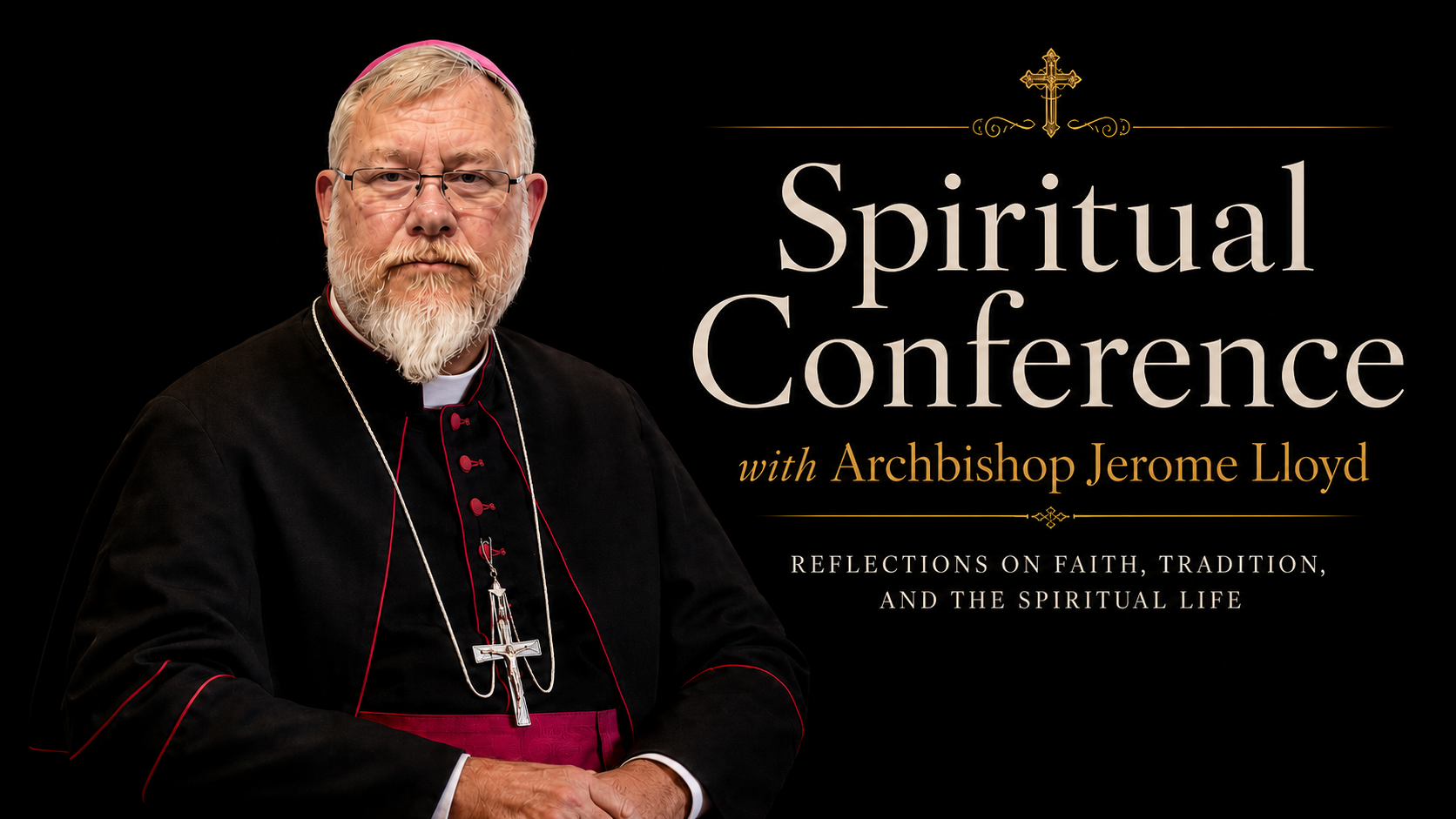
- Everything Has Changed—and Nothing Has ChangedIn a recent Q&A, HE ✠Jerome Lloyd addressed the Society of St Pius X’s situation, exploring the implications of episcopal consecrations and associated excommunications. His central conclusion was that while Rome’s stance has become stricter, not all members of the Society are automatically excommunicated, highlighting the importance of individual culpability over collective condemnation.
- The Chalice of the Bride: The Feast of the Most Precious Blood on the First Sunday of JulyThe Feast of the Most Precious Blood, celebrated on the first Sunday of July, reflects on the significance of Christ’s sacrifice and its eternal implications for the Church. Established in 1849, it connects the themes of redemption, the sacramental life, and the Church’s mission, highlighting the Precious Blood as both a source of mercy and unity among believers.
- Lest They Faint in the Way: The Sixth Sunday after Pentecost in the Tridentine RiteThe Sixth Sunday after Pentecost highlights the intertwined journey of the Christian life, commencing with Baptism and culminating in perseverance through divine grace. It emphasises reliance on God, as believers are sustained by Eucharistic nourishment while battling sin. The liturgy teaches the importance of humility, cooperation with grace, and the transformative power of Christ in their spiritual journey.
- If the Investigation Happened, Where Are the Acts? Ricardo Coronado, Pope Leo XIV and the Unresolved Chiclayo RecordRicardo Coronado’s interview questions the adequacy of the investigation into clerical abuse allegations against Bishop Robert Prevost in Chiclayo. Despite claims of a completed inquiry, complainants assert no formal investigation occurred. The need for independent verification of the diocesan account remains critical, amidst ongoing concerns about potential mishandling of abuse cases.
- When the Faithful Ask Rome to Listen: Sweden, Apostolic Visitation and the Test of SynodalityA lay appeal for an apostolic visitation in the Diocese of Stockholm raises critical questions about the Church’s commitment to listening to the faithful. Concerns over governance, transparency, and authority have sparked debate on synodality’s practicality. The outcome will reveal whether the Church prioritises truth and accountability over denial and avoidance in addressing serious allegations.
- A Shepherd, Not a Partisan: Pope Leo XIV Appoints Fr Stephen Wang as Bishop of Arundel & BrightonPope Leo XIV has appointed Fr Stephen Wang as the new Bishop of Arundel & Brighton. Known for his commitment to catechesis and pastoral care rather than activism, Wang’s appointment reflects a significant shift from political ecclesiastical appointments. His extensive background in faith formation positions him well to lead a diocese facing modern challenges.
- Leo XIV Praises Freedom of Conscience While Attempting to Excommunicate the SSPX for Expressing TheirsOn 3 July, Pope Leo XIV received the Liberty Medal for promoting religious liberty and conscience. However, the same day, Father Pagliarani’s plea to the Pope about the Society of Saint Pius X’s excommunication highlighted moral inconsistencies in the Church’s stance on conscience and coercion, raising concerns over treatment of traditional Catholics.
- Bread, Stones and the Rock of Peter: The SSPX Answers RomeFr Davide Pagliarani’s letter to Pope Leo XIV represents the SSPX’s formal response to its excommunication, expressing a desire for paternal guidance rather than condemnation. While reaffirming loyalty to the Church, Pagliarani highlights the need for Rome to address substantial doctrinal issues rather than imposing penalties, arguing that true reconciliation cannot occur without this clarity.
- Attendance Is Not Schism: Rome, the SSPX and the Canonical Rights of the LaityIn light of recent developments regarding the Society of Saint Pius X (SSPX), Rome’s decree and explanatory note assert that while six specific bishops are excommunicated, ordinary lay attendees are not automatically guilty of schism. Catholics attending SSPX chapels remain regarded as members of the Church, and their participation in Mass can fulfil Sunday obligations.
- No Burden Beyond Necessity—Except for Tradition? Rome’s Unequal Terms for SSPX ReconciliationThe article evaluates the disparate conditions imposed by the Dicastery for the Doctrine of the Faith on priests of the Society of Saint Pius X (SSPX) seeking reconciliation compared to Orthodox and Anglican ministers. It argues these additional requirements may reflect flawed assumptions about culpability and doctrinal acceptance, urging that any reconciliation process should focus on minimal necessary burdens rather than collective guilt.
- Rome Declares the SSPX in Schism: When Canonical Authority Becomes Collective CondemnationThe Holy See has declared the Society of St Pius X (SSPX) in schism, following the illicit consecration of bishops without papal mandate. This sweeping decree extends automatic excommunication to all SSPX ministers and adherents, rendering their sacraments invalid. The response has stirred significant debate regarding individual culpability and the broader implications for the Church.
- Ecône Episcopal Consecrations: Their Impact for the Church and for TraditionThe episcopal consecrations at Écône by the Society of St Pius X hold significant implications for the Catholic Church and traditionalism. This event will address questions on authority, jurisdiction, and the relationship with the Holy See, exploring the theological and canonical challenges posed by these actions and their potential consequences for the Church’s unity and tradition.
- “We Have Moved On”: Cardinal Radcliffe and the Mass That Betrayed Fiducia SupplicansCardinal Radcliffe’s participation in a Mass celebrating a same-sex partnership raises significant doctrinal and canonical concerns. The event, framed as a celebration of love, featured theological justifications linking the partnership to holy friendship and divine love. This has prompted demands for a high-level investigation within the Church regarding its implications for Church teachings on marriage and morality.
- After Ecône: Leo XIV Must Govern, Not Merely CondemnPope Leo XIV faces the challenge of addressing the recent episcopal consecrations conducted by the Society of Saint Pius X, which were executed without papal mandate. He must balance maintaining the authority of the Roman Primacy while seeking reconciliation with the Society, distinguishing between canonical offences and schism to preserve the faith of the clergy and laity.
- Tradition, Authority and the Wound of Irregularity: ORA PRimus issues Pastoral Letter in response to Ecône ConsecrationsThe Old Roman Apostolate’s Primus has issued a pastoral letter responding to the SSPX’s Écône consecrations, clarifying its irregular status and apostolic succession. The letter emphasises that canonical irregularity should not be an ecclesial ideal and advocates for reconciliation with Rome while maintaining doctrinal integrity and the traditional Roman Rite.
- Ecône Remembers: Why the SSPX Answered Leo XIV as It DidFather Pagliarani’s response to Pope Leo XIV reflects a complex history between the Society of Saint Pius X (SSPX) and the Vatican. Despite expressing respect and a desire for reconciliation, Pagliarani’s refusal to delay episcopal consecrations signals entrenched mistrust rooted in past ecclesiastical conflicts. The SSPX perceives ongoing threats to its mission, prompting cautious dialogue with Rome.
- SSPX: Leo XIV “Please Turn Back” — Then Open the RoadPope Leo XIV has urged the Society of Saint Pius X to cancel its planned episcopal consecrations in Écône, recognising their commitment but expressing concern over their actions. Despite his appeal, the Society responded resolutely, showing a lack of engagement with his request. The situation highlights the need for clear, actionable solutions from Rome.
- Leo XIV Can Stop the SSPX Schism — If He Chooses ToPope Leo XIV prioritises Christian unity, engaging in ecumenical efforts with various denominations while facing criticism for his handling of the Society of Saint Pius X (SSPX) schism. The Pope’s contrasting approach raises questions about his commitment to reconciliation with traditional Catholics who seek to remain loyal to the Church.



Leave a Reply