
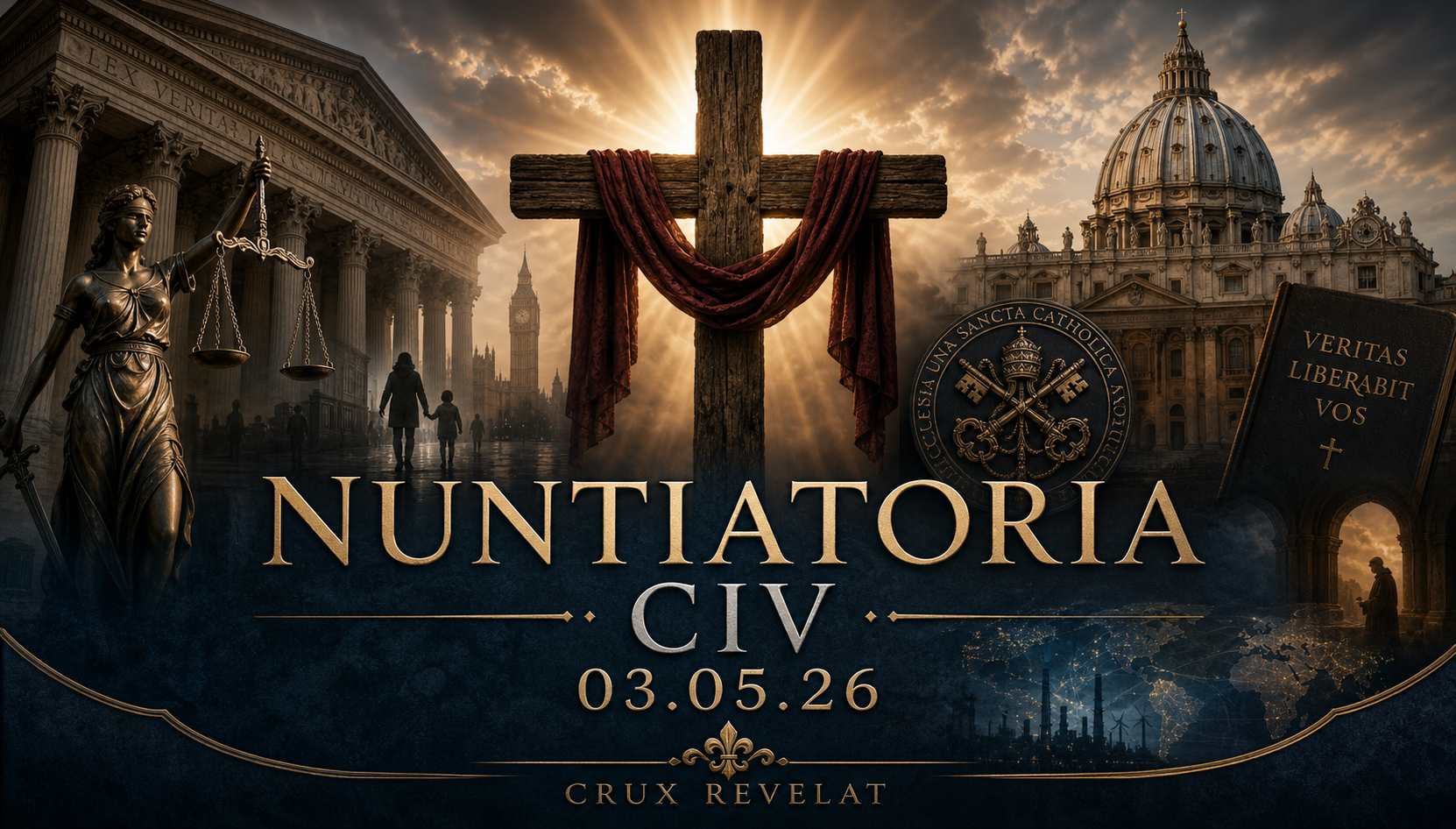
Editorial
This edition of Nuntiatoria acquires a deeper coherence when read against the liturgical horizon of the Feast of the Invention of the Holy Cross. What the individual articles diagnose at the level of law, culture, and ecclesial life, the feast itself interprets theologically: the recovery of truth through the instrument of contradiction. The Cross is not merely a devotional symbol; it is the axis upon which authority, justice, and meaning are rightly ordered. Where the Cross is obscured, confusion follows. Where it is rediscovered, clarity—even if costly—begins to return.
The legal and civic analysis that opens the edition can be understood precisely in these terms. The ruling at Glasgow Sheriff Court, dismissing charges against a woman offering consensual conversation within a buffer zone, is presented not simply as a technical judgment but as a moment of juridical re-alignment with reality. The law, briefly, recognises that presence is not coercion, and that moral witness—however unwelcome—is not inherently unlawful. Yet the necessity of such a ruling reveals how far the legal framework has drifted from its proper foundation. The Cross exposes this drift: it stands as the ultimate contradiction to a system that seeks order without truth, or peace without justice. A society that suppresses witness in the name of comfort inevitably finds itself incapable of distinguishing harm from dissent.
This same pattern is evident in the broader legal landscape examined throughout the edition. The reinterpretation of statutory categories—particularly under equality legislation—reflects an attempt to reconstruct reality through will rather than recognition. The projected conflicts in sport, prisons, and healthcare are not accidental; they are the inevitable collision between constructed identity and embodied truth. The Cross, in contrast, insists upon the inseparability of truth and suffering. It does not resolve contradiction by denial, but by revealing what is real, even when that reality is unwelcome.
The safeguarding failures explored through the events in Crewe, and their comparison with Rotherham and Telford, take on a sharper significance in this light. These are not merely administrative breakdowns; they are instances where the avoidance of discomfort—whether political, cultural, or reputational—was allowed to override the demands of truth. The Cross stands in direct opposition to such avoidance. It is the place where injustice is neither ignored nor rationalised, but confronted and borne. The editorial’s insistence on naming institutional reluctance is, in this sense, an attempt to recover a cruciform standard of accountability: one that prioritises truth over expediency, and protection over perception.
At the level of criminal justice, the analysis of individual cases reinforces this theme. Where deterrence weakens and trust erodes, the problem is not only procedural but moral. A system that cannot consistently distinguish right from wrong—or that appears unwilling to do so—ceases to command obedience. The Cross again provides the interpretative key: it reveals justice not as abstraction, but as the restoration of right order through sacrifice. Without such a framework, law risks becoming either arbitrary or instrumental, detached from any stable conception of the good.
The ecclesial dimension of the edition is perhaps where the connection to the feast becomes most explicit. The reported preparations within the Dicastery for the Doctrine of the Faith concerning potential actions against the Society of St. Pius X are examined as a crisis of authority. Yet the Cross reframes this crisis: true authority in the Church is inseparable from fidelity to the truth it is given to guard. Where governance appears inconsistent, or where doctrinal clarity is obscured by ambiguous gestures, the faithful are left navigating a dissonance between what is taught and what is done. The Cross resolves such dissonance not by accommodation but by witness. It is the definitive sign that truth is not negotiated but revealed, and that fidelity may entail conflict rather than consensus.
This is particularly evident in the discussion of sacramental coherence. Where the Church definitively teaches that certain realities—such as the ordination of women—are ontologically impossible, any external simulation of those realities introduces not dialogue but contradiction. The Cross, as the locus of definitive revelation, tolerates no such ambiguity. It is both scandal and clarity: a sign that cannot be reinterpreted without losing its meaning. The editorial’s critique of symbolic gestures that blur doctrinal boundaries is therefore grounded not in rigidity, but in the logic of the Cross itself.
The decline of contemplative religious life, examined through the closure of monasteries and the erosion of vocation, is likewise illuminated by the feast. The Cross is the heart of the consecrated life: a voluntary participation in sacrifice ordered toward union with God. Where this dimension is diminished—whether through theological dilution or cultural accommodation—the life itself becomes unintelligible. The invocation of Sponsa Christi serves to highlight the contrast between a vision of religious life centred on sacrifice and one oriented toward immanence. The disappearance of the former inevitably leads to the decline of vocations, not because the demands are too great, but because the purpose is no longer clear.
Even the edition’s engagement with mental health trends can be read through this lens. The projected rise in adolescent disorders is interpreted not only as a clinical issue but as a crisis of meaning. The Cross provides a framework within which suffering is neither denied nor pathologised, but integrated into a larger narrative of redemption. A culture that rejects this framework is left with suffering that appears arbitrary and therefore intolerable. The result is not merely increased distress, but a diminished capacity to endure it.
The analysis of global economic practices—particularly in relation to green energy supply chains—extends the same principle to the international sphere. The outsourcing of exploitation reflects a desire to achieve moral ends without moral cost. The Cross stands as the definitive repudiation of such logic: there is no redemption without sacrifice, no justice without truth. A system that seeks to evade cost inevitably transfers it elsewhere, often to those least able to bear it.
Finally, the comparative reference to the Supreme Court of the United States underscores that these tensions are not confined to a single jurisdiction. The struggle between conscience and coercion, between truth and expediency, is a shared feature of contemporary governance. Yet the Cross offers a universal criterion by which these struggles can be judged: not by outcomes alone, but by fidelity to what is true.
In this light, Nuntiatoria CIV can be read as an extended meditation on the necessity of rediscovery—an “invention” in the original sense of the term. Just as the historical feast commemorates the finding of the True Cross, so this edition calls for the recovery of the principles that once grounded law, authority, and culture. The crises it documents are not random; they are the consequence of a civilisation that has misplaced its centre.
The Cross, once found, does not simplify these crises. It intensifies them, bringing contradictions into sharper relief. But it also provides the only stable point from which they can be resolved. Without it, institutions drift between impotence and overreach. With it, there is at least the possibility of coherence—hard-won, costly, but real.
Thus the edition does not merely report a moment of disorder. It situates that disorder within a larger drama: the loss, and potential recovery, of the Cross as the organising principle of truth, justice, and human flourishing.

IN THIS EDITION
- Children as Experimental Subjects: The High Court Clears the PATHWAYS Puberty-Blocker Trial
- 24.05.26 Nuntiatoria CVII: Pentecost
- Prayer, Patriotism, and the Politics of Amnesia
- Sermon for St Gregory of Nazianzus
- 10.05.26 Nuntiatoria CV: Crux Manet
- Calm Without Clarity: The Illusion of Stability After One Year of Pope Leo XIV
- Rome’s Synodal Gamble: The Vatican’s New Theology of “Listening”
- Sermon for Apparition of St. Michael
- Sermon for St. John before the Latin Gate
- Fourteen Years of Apostolic Labour: The Ministry of ✠Jerome Lloyd and the Living Work of the Old Roman Apostolate
- Sermon for St. Pius V
- The Papacy in Question: A Response to the Transalpine Declaration
- Blessing Without Meaning: Rome, Germany, and the Limits of Doctrinal Control
- The Invention of the Holy Cross: The Hidden Wood and the Unhidden Mystery
- Cantate Domino: The Fourth Sunday after Easter and the Discipline of Resurrection
- Division and Its Discontents: German Defiance, Papal Correction, and the Crisis of Ecclesial Unity
- The “Missing” Trans Child? Development, Evidence, and the Reconfiguration of Gender Medicine
- 03.05.26 Nuntiatoria CIV: Crux Revelat
- 03.05.26 Nuntiatoria CIV: Editorial
- ORDO w/c 03.05.26
- The extinction of the cloister: Compiègne, La Trappe, and Mount Melleray as signs of an anthropological crisis in the Church
- Law, Reality, and the Limits of Reinvention — Britain Re-Anchors Sex in Law and Confronts the Consequences
- Bracknell: Rape, Obstruction, and the Moral Failure of Public Authority
- Refusal Without Words? Communion, Posture, and the Quiet Mechanics of Exclusion in Charlotte
- Punished for Conscience — Vindicated by the Constitution: Vermont’s $566,000 Lesson
- The End of Clinical Deference: Puberty Blockers, Consent, and the Reassertion of Law in Britain
- Surrogacy Reform or Safeguard Removal? The Parliamentary Fault Line Behind the 100,000-Signature Petition
- Christian Candidate Deselected — Lib Dems Admit Rights Breach
- The Broken Settlement: WATCH Demands Doctrinal Test for Bishops as London and Chichester Approach Succession
- Britain’s Lost Generation? — The Inflation of Youth Mental Illness and the Quiet Collapse of Resilience
- Louisiana deacon’s excommunication appeal tests canon law in the shadow of abuse crisis
- Federal Door, Constitutional Fault Line — Supreme Court Clears Path for Challenge to New Jersey Probe of Pregnancy Centres
- Audience Denied, Errors Embraced: Vatican II, the SSPX Crisis, and the Asymmetry of Rome’s Ecumenical Praxis
- Montagna Report: Vatican Preparing Schism Declaration Ahead of SSPX Consecrations — A Crisis of Ecclesial Authority and Legitimacy
- Crewe Raid Exposes a Known Safeguarding Pattern—And a System That Still Acts Too Late
- Abortion Images and Free Speech: R v Skinner Overturns Conviction in Landmark High Court Ruling
- Free Speech on Trial: The Crown’s Failure at Glasgow and the Fragility of Britain’s “Buffer Zone” Regime
- Rome Opens the File on Charlotte — A Test Case for Liturgical Authority
- Cardinal Ernest Simoni and Pope Leo XIV: The Witness of the Martyrs in an Age of Amnesia
- Pope Leo XIV and Sarah Mullally: When the Church Shows What She Does Not Teach
- Immanence and Transcendence: The Relocation of God and the Crisis of the Modern Church
- Catholic Bishops’ Empty Moralizing? Dignity, Order, and the Collapse of Proportion in Contemporary Catholic Discourse
- Independence Without Authority: CofE Safeguarding Reform and the Limits of Ecclesial Self-Regulation
- “Who Is Tearing the Tunic?”: The SSPX Consecrations and the Unravelling of Postconciliar Ecclesiology






Leave a Reply