
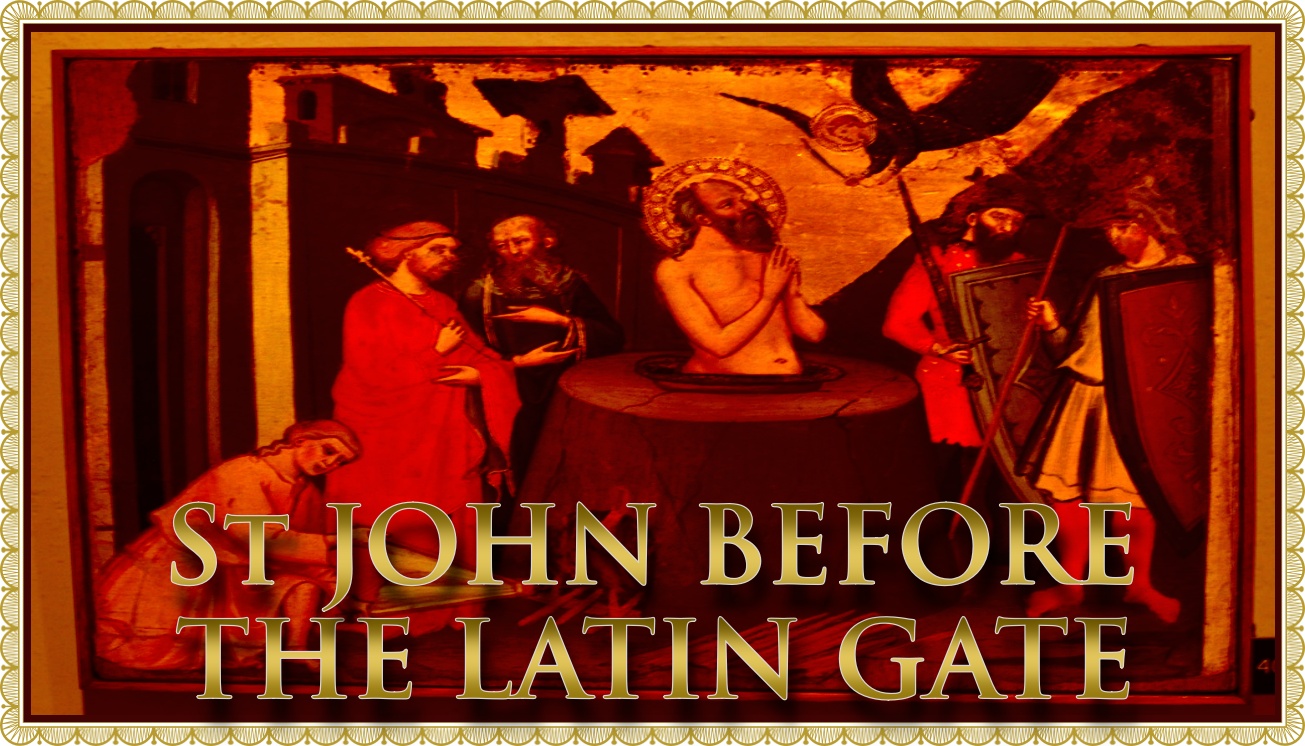
St. John before the Latin Gate
by the Revd Dr Robert Wilson PhD (Cantab), Old Roman Apostolate UK
Today we celebrate the feast of St. John before the Latin Gate. This commemorates an incident reported by Tertullian that Rome was “where Peter suffered death like his master (crucifixion), where Paul was crowned with the death of John (execution), where the apostle John, after being plunged in burning oil and suffering nothing, was banished to an island.”
It is not said when this took place. The implication would appear to be that it also occurred, like the deaths of St. Peter and St. Paul, in the persecution under Nero. St. Irenaeus stated that St. John saw his apocalypse at the end of the reign of Domitian, although he does not mention persecution. St. Jerome, who believed that the book of Revelation dated from the reign of Domitian (on the strength of St. Irenaeus’ testimony), interpreted Tertullian to mean that St. John’s suffering, like that of St. Peter and St. Paul, occurred under Nero.
There would seem to be good grounds for believing that the book of Revelation was based on St. John having been a “partaker of the sufferings” in Rome during and after the persecution under Nero, and that it was on this basis that he was banished to Patmos, where he had his visions of worse to come. On the other hand, the book may not have been published until the end of the reign of Domitian, as has traditionally been supposed on the basis of St. Irenaeus’ testimony.
It is clear that he was the last of the apostles to survive, living on until the reign of Trajan.
He had been (along with his brother St. James and St. Peter) part of the inner circle of Jesus’ disciples. St. James and St. John were the sons of Zebedee and shared in their father’s fishing business in Galilee. They were initially followers of St. John the Baptist, and then became followers of Jesus as the one to whom the Baptist pointed as the Coming One who would separate the wheat from the chaff and would baptise with the Holy Spirit and with fire (John 1).
Subsequently, following his earlier mission alongside St. John the Baptist in Judea, Jesus came into Galilee proclaiming that the Kingdom of God, future in its fullness, was now being manifested in his own words and mighty works. He called the sons of Zebedee to leave behind their fishing business and become his permanent disciples. In following him they would become fishers of men (Luke 5).
Presumably on the strength of this commitment they formed (along with St. Peter) the inner circle of Jesus’ disciples. They were known as the sons of thunder, perhaps on account of their fiery temperament, and this passionate commitment is reflected in the Gospel, Epistles and Revelation of St. John. They accompanied him (along with St. Peter) at many of the most crucial points in his ministry: on the Mount of the Transfiguration, at the preparation for the Last Supper in the Upper Room, and in the Garden of Gethsemane.
After his resurrection, ascension and the coming of the Holy Spirit at Pentecost, St. John appears alongside St. Peter preaching in Jerusalem in the early chapters of the Acts of the Apostles. His brother St. James was the first of the apostles to be martyred in the same persecution under King Herod in which St. Peter escaped from prison (Acts 12). St. John later settled in Ephesus (exactly when is not known), where he survived until the end of the century.
The passionate commitment of St. John (as with his brother St. James) is clear. However, his zeal was not always according to knowledge. He was initially drawn to follow one whom St. John the Baptist foretold would separate the wheat from the chaff. It was probably with this in mind that the two sons of Zebedee asked Jesus to call down fire from heaven, even as Elijah did, on a village that did not receive the Gospel.
Jesus replied that they did not know what spirit they were of, for the Son of Man had not come to destroy men’s lives but to save them (Luke 9). They followed one in whom the eyes of the blind were opened and the ears of the deaf unstopped, whom they believed to be the anointed liberator of Israel, through whom the promises of God for Israel and the world were finally being fulfilled.
When St. Peter acknowledged Jesus as the Christ at Caesarea Philippi, Jesus hailed him as the rock on which the Church, the faithful remnant of Israel, would be built. Yet when Jesus intimated that his messianic destiny, enthronement and rule would only come through reversal, repudiation, suffering and death, St. Peter sought to dissuade him from this course of action. He was still looking for a warrior and a conqueror, but God’s Messiah was to be a servant (Matthew 16).
Likewise, St. James and St. John also still saw the kingdom in triumphalist terms. They had given passionate commitment to the cause and desired first place in the kingdom, indeed to sit one on Jesus’ right hand and one on his left. Jesus asked if they were willing to share his cup and be baptised with his baptism (Matthew 20).
The baptism of fire which St. John the Baptist had foretold would be undergone by Jesus rather than simply dispensed by him. His baptism in the waters of the Jordan would finally be consummated at Golgotha, for the Son of Man came not to be served, but to serve, and to give his life as a ransom for many.
Though they did not fully understand the implications of what they were asking, St. James and St. John would themselves eventually undergo this baptism of blood: St. James in the persecution under Herod, while St. John would later escape from a cauldron of boiling oil in Rome (the incident we commemorate today) to survive until the end of the first century in Ephesus.
There is much to learn from the life of St. John today. There is still a tendency to see Christian ministry in triumphalist terms. People expect prosperity and material reward for their commitment to a cause. But Jesus did not promise ease and comfort for his followers in this world, but rather that they would themselves experience (as he himself had done) reversal, repudiation, suffering and even death.
This is much easier to state in theory than it is to witness to in practice. We are called to follow this apostolic witness in our own time. Even if we do not face actual martyrdom, we still face opposition and hostility from the world.
Let us pray that we will follow the passionate commitment of St. John in our own time and place, and that our zeal may be according to knowledge.





Leave a Reply