
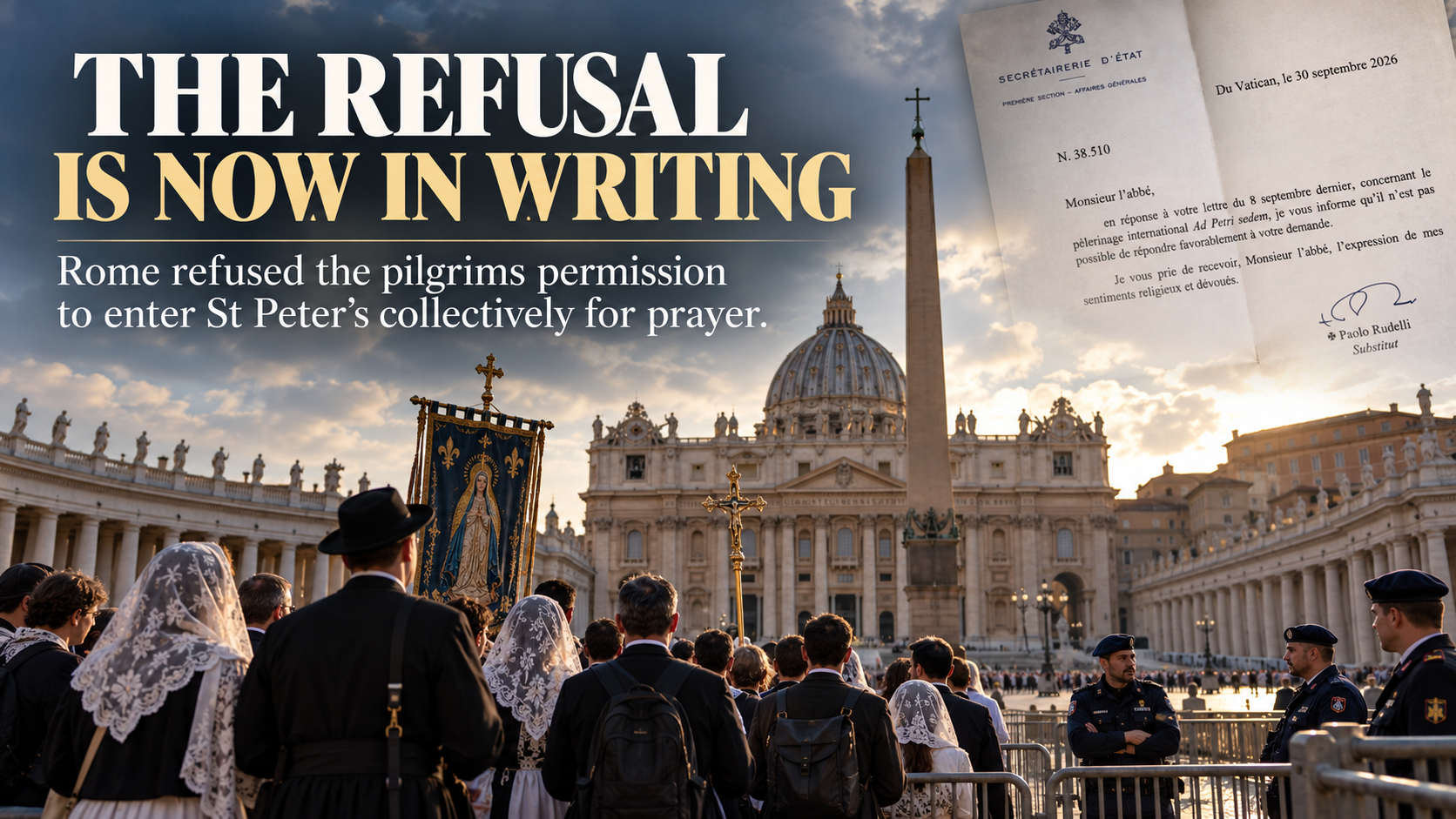
The Vatican’s correspondence confirms that the Summorum Pontificum pilgrims were refused permission to enter St Peter’s Basilica collectively to pray for the Pope. Further reporting has challenged the explanations offered for the restrictions, while pilgrimage organiser Mountain Butorac attributes much of the controversy to ordinary administrative procedures and possible organisational failings. Bishop Athanasius Schneider has condemned the contradiction between Rome’s appeals for inclusion and its treatment of traditional Catholics. The evidence now permits a clearer judgement of what happened, what remains disputed and why the affair matters beyond the events of one weekend.
The Vatican’s refusal to permit the fifteenth Ad Petri Sedem pilgrimage to enter St Peter’s Basilica in procession is no longer dependent upon second-hand accounts of confidential instructions. The letter has been published. Signed by Archbishop Paolo Rudelli, Substitute for General Affairs of the Secretariat of State, it confirms that the pilgrims’ request to pray collectively at the Apostle’s tomb was refused. No reason was supplied. What began as a dispute over the location of a Pontifical Mass has consequently become an examination of how ecclesiastical authority is exercised towards Catholics whose devotion to the traditional Roman liturgy is inseparable from their profession of communion with the Apostolic See.¹
The chronology deserves precision. In December 2025, Bishop Athanasius Schneider personally delivered to Pope Leo XIV a letter requesting both a papal audience and permission for the pilgrimage’s traditional Pontifical Mass in St Peter’s. According to Vatican journalist Michael Haynes, permission for the customary procession was subsequently granted in April 2026, although the original authorisation has not been published. Following further correspondence, the Secretariat of State refused permission for the Mass in a letter dated 7 August. The organisers accepted that decision, arranged for Bishop Schneider to celebrate at St Mary Major and published a revised programme retaining the procession into St Peter’s for prayer. Preparations had therefore begun many months beforehand, contrary to suggestions that the organisers approached the Vatican only six weeks before the pilgrimage.²
On 8 September, Abbé Claude Barthe, the pilgrimage’s chaplain, wrote again to the Secretariat of State. Acknowledging the earlier refusal, he requested permission for the pilgrims to enter St Peter’s in procession on 24 October, pray for Pope Leo XIV at the Confession of St Peter and adore the Blessed Sacrament at the Altar of the Chair. The basilica’s sacristy, he explained, had indicated that one o’clock would be possible, subject to the Secretariat’s approval. His request was precise, explicitly devotional and conditional upon the necessary authorisation.
Archbishop Rudelli’s reply, dated 30 September and bearing protocol number 58.510, was published on 25 October by Diane Montagna. Its substantive response consisted of one sentence: “It is not possible to respond favourably to your request.” No alternative was proposed and no circumstance identified which might have made the visit impracticable. Montagna reports that the letter took approximately ten to twelve days to arrive by post, suggesting receipt around the middle of October. The prohibition was announced publicly to pilgrims on 23 October, the day before the procession. Whether further correspondence intervened, and why the announcement followed the apparent receipt of the refusal by some days, remain unresolved. These are legitimate questions about the organisers’ communication, but they do not alter the origin or substance of the decision.³
Haynes maintains that permission had already been granted in April. His account merits consideration, particularly given his contact with the organisers, but the precise terms of that authorisation are essential. Permission for a procession through Rome, preliminary arrangements with the basilica and final approval for collective entry are not necessarily identical. Barthe’s September letter expressly sought the Secretariat’s consent, suggesting that at least one necessary authorisation remained outstanding. Until the April document is produced, the assertion that unconditional permission for entry was subsequently rescinded cannot be treated as established fact. What the published correspondence proves is narrower but significant: Catholics who had accepted the refusal of their Mass formally requested permission to enter the basilica together for prayer and Eucharistic adoration, and the Secretariat of State declined.
A different interpretation has been advanced by Mountain Butorac, the Rome-based pilgrimage organiser known as the Catholic Traveller. Writing on his X account on 24 October, Butorac challenged accusations of Vatican hostility, drawing upon two decades of experience organising pilgrimages and his familiarity with the procedures governing Rome’s principal churches. He pointed also to his attendance at traditional Masses celebrated by the Institute of Christ the King Sovereign Priest and the Priestly Fraternity of St Peter, rejecting any suggestion that his defence of the Vatican arose from opposition to the older liturgy. His conclusion was that poor planning and communication, perhaps on both sides, offered a more credible explanation than deliberate discrimination. His experience deserves respect. It does not, however, establish what was agreed in this particular case, and several of his arguments require closer examination.⁴
Butorac is right to reject the claim that the Franciscan celebration scheduled for St Peter’s on 24 October was hastily invented to obstruct the traditional pilgrimage. Preparations for the eighth centenary of the death of St Francis had begun years earlier, and no evidence supports such an allegation. The particular Lectio Francisci event at the Altar of the Chair was scheduled to begin at 3.30 p.m., with Mass following at six o’clock. A lengthy Pontifical Mass earlier that afternoon might reasonably have presented difficulties involving security, preparation or competing use of the altar. Such considerations are legitimate. They do not, however, explain why the pilgrims’ subsequent request for collective prayer at one o’clock could not be accommodated. The existence of the anniversary commemorations does not establish when this particular reservation was made or demonstrate that an earlier devotional visit was impossible.⁵
Butorac further maintains that the organisers were offered another date or location for their Mass. Edward Pentin, however, reported on 24 October that the organisers had told him directly that no alternative date or arrangement for a Pontifical Mass in St Peter’s had been offered. They maintained that the August refusal simply communicated the basilica’s unavailability, without identifying another engagement. An explanation attributed by Vatican Report to unnamed Vatican sources suggests otherwise. The competing accounts have not been reconciled, and the relevant correspondence should settle the question. Until it does, the allegation that the organisers rejected a reasonable alternative cannot be adopted as the explanation for the subsequent controversy.⁶
Butorac’s account of the procession itself encounters a more definite historical difficulty. He suggested that the pilgrims’ ability to enter St Peter’s in procession during the 2025 Jubilee was an exceptional privilege arising from special access arrangements. Yet on 28 October 2023, two years before the Jubilee, the National Catholic Register reported that the Summorum Pontificum procession entered St Peter’s and concluded with prayer and Eucharistic adoration at the Altar of the Chair. Remarkably, the report carried a procession photograph apparently credited to Mountain Butorac himself, although his surname was misspelt in the published attribution. On 26 October 2024, Cardinal Gerhard Müller addressed pilgrims inside St Peter’s following their annual procession, as documented by Pentin. Collective entry was therefore an established feature of the pilgrimage before the Jubilee. The particular entrance employed in 2025 may have been exceptional; the devotional practice was not.⁷
Nor does the existence of lengthy security queues settle the matter. In March 2023, the Fabbrica di San Pietro announced a dedicated prayer route intended to facilitate access for pilgrims and prayer groups without the delays experienced by ordinary visitors. Cardinal Mauro Gambetti presented the initiative as a means of making the basilica’s sacramental and devotional life more accessible. The route’s existence does not prove that the 2026 procession possessed permission to use it, but it demonstrates that organised religious access was neither unprecedented nor dependent upon Jubilee arrangements. The pilgrimage programme anticipated arrival in St Peter’s Square around noon, passage through security and prayer inside the basilica at one o’clock, before Mass at St Mary Major at three. Whether that timetable would ultimately have proved practicable is uncertain, but it had plainly been planned around the anticipated arrangements. Butorac’s additional criticism of photographs showing the pilgrims against temporary construction barriers is incidental. Camera angles may influence public perceptions, but the procession did indeed stop at the obelisk. The background does not alter the documented refusal.⁸
The restrictions at St Mary Major present a more substantial administrative question. According to Haynes and other contemporary reports, the organisers had prepared a solemn Pontifical Mass with Bishop Schneider but were subsequently informed that their use of the basilica would be restricted to one hour. The intended celebration was consequently replaced by a Missa praelatitia, the simpler episcopal form of Low Mass. Haynes also reported a prohibition upon official photography. Butorac maintains that one-hour allocations and advance permission for professional photography are normal conditions, even for groups accompanied by cardinals. The basilica’s published reservation form does expressly require written authorisation for filming, although it does not establish an invariable one-hour limit or determine every rule governing still photography. The decisive evidence would be the original booking confirmation. If the time limit was specified from the outset, the organisers’ preparation of a more elaborate celebration would require explanation. If sufficient time for a solemn Pontifical Mass had been expressly authorised and subsequently withdrawn, responsibility would lie elsewhere. Butorac himself acknowledges that he does not know whether the necessary photographic permission was requested. His account describes plausible administrative practice, not proof of what occurred in this instance.⁹
Friday’s Pontifical Vespers at the Pantheon were also brought forward from 6.30 to six o’clock following an urgent notice issued the preceding evening. The change could have inconvenienced pilgrims following the published programme, but neither the authority responsible nor the reason has been established. It would therefore be unjustified to attribute the alteration to an intention to reduce attendance. The same evidential discipline must govern the controversy as a whole. Ecclesiastical officials should not be accused of malice without proof, but administrative explanations cannot be accepted as conclusive merely because they describe familiar procedures.¹⁰
Butorac’s criticism is thus partly corrective and partly speculative. He rightly challenges allegations of a manufactured Franciscan event and identifies regulations which may account for difficulties at St Mary Major. He is mistaken in presenting collective entry into St Peter’s as essentially a Jubilee exception, and the evidence does not justify attributing the entire affair to organisational failings. The organisers began corresponding about their principal celebration in December 2025, accepted the August refusal and formally sought approval for their remaining devotional visit. They should still clarify the reported April authorisation and the conditions agreed at St Mary Major. Those questions are important, but they cannot make the Secretariat’s unexplained refusal disappear.
The distinction between possessing ecclesiastical authority and exercising it prudently is fundamental. An administrative decision may be valid without being wise. A restriction may fall within an official’s competence while nevertheless causing avoidable spiritual injury. The faithful are entitled to expect more from ecclesiastical government than the minimum required to establish jurisdiction, particularly when the matter concerns their access to the places of worship which embody the Church’s most sacred history.
Bishop Athanasius Schneider’s intervention consequently deserves particular attention. Speaking to Niwa Limbu for AdVaticanum following the prohibition, Schneider challenged the contradiction between Rome’s repeated appeals to synodality, tolerance and inclusion and its treatment of Catholics who recognise the Pope, pray for him and seek to worship according to the liturgy which sanctified generations of their forebears. He rejected the suggestion that attachment to the inherited Roman rite necessarily entails rejection of the Second Vatican Council, describing the selective application of contemporary ecclesiastical inclusiveness as “ideological and selective”. His remarks were informed by personal involvement in the pilgrimage’s preparations, including his delivery of the original petition to Leo XIV. He was not simply expressing sympathy for an aggrieved congregation.¹¹
Schneider’s homily at St Mary Major gave his criticism a deeper theological foundation. Recalling that St Pius V had preserved rather than invented the inherited Roman rite, he described the traditional Mass as part of the Church’s enduring liturgical patrimony, through which countless generations had worshipped and been sanctified. He acknowledged that Catholics attached to the older liturgy, particularly the young, increasingly feel themselves treated as second-class members of the Church. Nevertheless, he urged them to harbour no bitterness, remain devoted to their ecclesiastical mother and continue loving and praying for the Pope. Invoking Our Lady as Salus Populi Romani, he appealed for liturgical peace and the restoration of the full and unrestricted use of the traditional Roman rite. His response offered neither repudiation of the Apostolic See nor acquiescence in the treatment of the pilgrims. It was an appeal for justice within communion.¹²
Yet, as Nuntiatoria argued in Tradition Behind the Fence, the defence of the traditional Roman liturgy cannot rest principally upon appeals to inclusion. The question is not simply whether Catholics attached to the older rite deserve consideration alongside other ecclesiastical constituencies, although justice requires that consideration. It is whether the liturgical inheritance of the Roman Church may legitimately be treated as a minority preference dependent upon administrative indulgence. Schneider’s homily demonstrated that his defence extends beyond arguments about diversity or personal spiritual attachment. The Church’s ancient worship possesses doctrinal, sacramental and spiritual significance which cannot be exhausted by the preferences of those who presently cherish it. Its preservation concerns the transmission of the Catholic Faith itself.¹³
This matters because Traditionis custodes remains operative. Its accompanying letter disclosed the intention to direct Catholics attached to the older liturgical books towards the reformed Roman Rite. The continued existence of approved traditional priestly societies and designated chapels therefore presents a troubling ambiguity. They preserve an inheritance which the wider disciplinary settlement increasingly confines to exceptional circumstances. Their ministry is valuable, but the survival of Tradition within particular authorised institutions cannot be mistaken for the restoration of its rightful place within ordinary Catholic life. Nuntiatoria has previously described this phenomenon as traditionalist enclavism: inherited Catholic worship preserved within designated ecclesiastical enclosures while its transmission beyond them remains restricted. The dispute at St Peter’s illustrates the practical consequences of that settlement, although the prohibition of the procession does not itself derive directly from Traditionis custodes.
The implications for relations with the Society of Saint Pius X are equally serious. The Society has long maintained that the ordinary structures of ecclesiastical government have become unreliable guardians of Catholic Tradition. That claim does not settle the canonical difficulties surrounding its ministry or the episcopal consecrations at Écône earlier this year. Neither can every disputed administrative decision be invoked as sufficient proof of necessity. Nevertheless, restrictions imposed upon Catholics who expressly profess communion with the Pope lend rhetorical force to arguments about the treatment of Tradition within the Church. Rome should recognise that repeated experiences of unexplained exclusion risk persuading some of the faithful that their inherited worship is regarded with suspicion. Such consequences cannot be remedied merely by renewed insistence upon obedience. The authority which rightly demands obedience must also demonstrate the pastoral solicitude and fidelity to received doctrine and worship which make its exercise credible.¹⁴
The coincidence with the publication of Venite ad me on 22 October adds another dimension. The Dicastery for the Doctrine of the Faith has acknowledged the grave difficulties confronting the transmission of Catholic belief and recognised the formative importance of sacred worship, inherited devotions and the liturgical life through which generations receive the Faith. Nuntiatoria has already examined the inadequacy of diagnosing that crisis without investigating the consequences of the Church’s own liturgical and pastoral reforms. The pilgrims who assembled in Rome represented precisely the attachment to received worship, religious continuity and Catholic identity whose disappearance elsewhere has become a matter of ecclesiastical concern. That their collective approach to the Apostle’s tomb should have been refused, without any explanation in the correspondence now published, illustrates an uncomfortable tension between the Church’s stated pastoral priorities and the administration of her liturgical inheritance.¹⁵
None of this requires denying the Vatican’s responsibility for governing its basilicas. Access must be regulated, celebrations scheduled and legitimate conditions observed. The pilgrims possessed no unconditional right to determine the use of St Peter’s, and those responsible for its administration cannot be presumed to have acted maliciously merely because they refused a request. The question is whether the decisions were made with adequate consideration for the spiritual welfare of those affected and whether the reasons can withstand reasonable scrutiny. Authority which possesses sound reasons need not fear explaining them. Transparency belongs to the responsible administration of institutions whose purposes are sacred.
The remaining documentary questions are identifiable. The organisers should publish the reported April authorisation and clarify when they received the September refusal. The correspondence concerning alternative dates should be made available, particularly given the contradictory accounts attributed to the organisers and Vatican sources. The booking confirmation at St Mary Major should establish whether sufficient time for a solemn Pontifical Mass had been authorised or whether ordinary conditions were misunderstood. These matters deserve examination because the evidence supports neither the allegation of deliberate Vatican vindictiveness nor the competing explanation that the organisers’ shortcomings account for everything.
But the publication of Archbishop Rudelli’s letter has settled what may properly be said about the principal decision. After months of correspondence, the pilgrimage was refused permission to celebrate its traditional Mass in St Peter’s. Having accepted that refusal, its chaplain formally requested permission for the pilgrims to enter in procession, pray for Pope Leo XIV and adore the Blessed Sacrament. The Secretariat of State refused that further request without giving a reason in its reply. On Saturday 24 October, the procession stopped at the obelisk. The pilgrims did not enter the basilica collectively. Bishop Schneider subsequently offered the Holy Sacrifice at St Mary Major and appealed for peace within the Church.
Their conduct offers no justification for regarding them as enemies of the Apostolic See. They had travelled to Rome precisely to demonstrate their fidelity to it. Their profession of communion with Peter was not an incidental feature of the pilgrimage but one of its defining purposes. Preventing them from entering the Apostle’s basilica together therefore carries an ecclesiastical significance which remains even if every individual administrative restriction ultimately receives a satisfactory practical explanation.
Mountain Butorac is right that legitimate administrative considerations should not be converted into accusations of conspiracy. Bishop Schneider is right to insist that the Church’s repeated appeals for inclusion must have meaning for Catholics attached to the inherited Roman liturgy. Yet his wider theological defence also reminds us that the matter cannot be reduced to a request for the tolerant treatment of a minority preference. The traditional Roman rite belongs to the history, worship and doctrinal expression of the Church herself. Its preservation concerns considerably more than the privileges of those who presently celebrate it.
The Secretariat of State has now provided the evidence of its refusal. It has not provided the reason. The organisers have questions to answer about arrangements they understood to have been authorised, and responsible journalism must continue to distinguish those questions from decisions already established. But the greater pastoral responsibility remains with the ecclesiastical authorities who govern the basilica of the Apostle whose ministry embodies the visible unity of the Church.
St Peter’s is not merely an important building whose ceremonial calendar must be managed. It is the shrine of the Apostle to whom Christ entrusted the keys of the Kingdom and upon whose confession He promised to build His Church. The purpose of its administration cannot be separated from the pastoral responsibilities of the office which the basilica honours.
The pilgrims came to profess their communion with Peter. They sought to pray for his successor, not to challenge his office. Their exclusion may yet have an adequate practical explanation. If it exists, Rome should provide it.
For a Church which speaks so insistently of dialogue, listening and reconciliation, an unexplained refusal is a poor substitute for pastoral government. The authority to close a door is not in question. What remains unanswered is why this particular door needed to be closed to Catholics who had travelled so far to pray at it.
¹ Diane Montagna, Letter Confirms Vatican Barred Annual TLM Pilgrimage from Entering St Peter’s Basilica, 25 October 2026; Nuntiatoria, Tradition Behind the Fence, 24 October 2026.
² Edward Pentin, No Response to Traditional Pilgrimage’s Papal Audience Request, 19 September 2026; Niwa Limbu, Vatican Letter Leaves Door Open for Summorum Pontificum Mass to Return to St Peter’s, AdVaticanum, 10 September 2026; Coetus Internationalis Summorum Pontificum, Official Programme of the Fifteenth Ad Petri Sedem Pilgrimage, 23–25 October 2026.
³ Diane Montagna, Letter Confirms Vatican Barred Annual TLM Pilgrimage from Entering St Peter’s Basilica, 25 October 2026, reproducing the Secretariat of State’s letter of 30 September 2026, protocol no. 58.510, and reporting Abbé Claude Barthe’s request of 8 September.
⁴ Mountain Butorac, Commentary on the Summorum Pontificum Pilgrimage, X, 24 October 2026; Michael Haynes, Clarification of the Pilgrimage’s Correspondence and Restrictions, X, 24 October 2026.
⁵ Fabbrica di San Pietro, Lectio Francisci: An Event Dedicated to Saint Francis of Assisi in St Peter’s Basilica, 23 September 2026.
⁶ Edward Pentin, account of his enquiries with pilgrimage organisers, X, 24 October 2026; Vatican Report, Ad Petri Sedem: Traditional Mass Pilgrims Barred from Entering the Vatican, updated 25 October 2026; Edward Pentin, No Response to Traditional Pilgrimage’s Papal Audience Request, 19 September 2026.
⁷ Matthew Santucci, Summorum Pontificum Pilgrimage Draws Traditional Latin Mass Devotees to Rome, National Catholic Register, 1 November 2023; Edward Pentin, Cardinal Müller: Build Your Life on the Rock of Friendship With Christ, National Catholic Register, 26 October 2024.
⁸ Vatican News, Fabric of St Peter’s Facilitates Entry to St Peter’s Basilica for Pilgrims, 28 March 2023; Coetus Internationalis Summorum Pontificum, Pilgrimage Programme and Timetable, October 2026.
⁹ Michael Haynes, Latin Mass Pilgrims Flock to Rome Despite Vatican Ban on Mass and Procession, Catholic Herald, 24 October 2026; Basilica Papale di Santa Maria Maggiore, Reservation of Holy Mass: Official Booking Form and Conditions; Mountain Butorac, Commentary on Basilica Regulations, 24 October 2026.
¹⁰ Messainlatino, Avviso urgente: I Vespri di domani del Pellegrinaggio sono anticipati alle ore 18, 22 October 2026.
¹¹ AdVaticanum, Exclusive: Bishop Athanasius Schneider on Vatican’s Ban of Traditional Pilgrimage Procession, interview conducted by Niwa Limbu, October 2026; Nuntiatoria, Tradition Behind the Fence, 24 October 2026.
¹² Bishop Athanasius Schneider, Full Homily at St Mary Major during the Ad Petri Sedem Pilgrimage, AdVaticanum, 24 October 2026.
¹³ Nuntiatoria, Tradition Behind the Fence, 24 October 2026; Francis, Traditionis custodes, 16 July 2021; Francis, Letter to the Bishops Accompanying Traditionis custodes, 16 July 2021.
¹⁴ Nuntiatoria, Rome, the Society and the Limits of Obedience: Peace Cannot Be Bought at the Price of Truth, 23 October 2026.
¹⁵ Dicastery for the Doctrine of the Faith, Venite ad me: Considerations on the Transmission of the Faith in an Epochal Change, 22 October 2026, §§90–94; Nuntiatoria, Venite ad Me: Leo XIV, Cardinal Fernández and the Tradition Rome Has Failed to Transmit, 23 October 2026.





Leave a Reply