
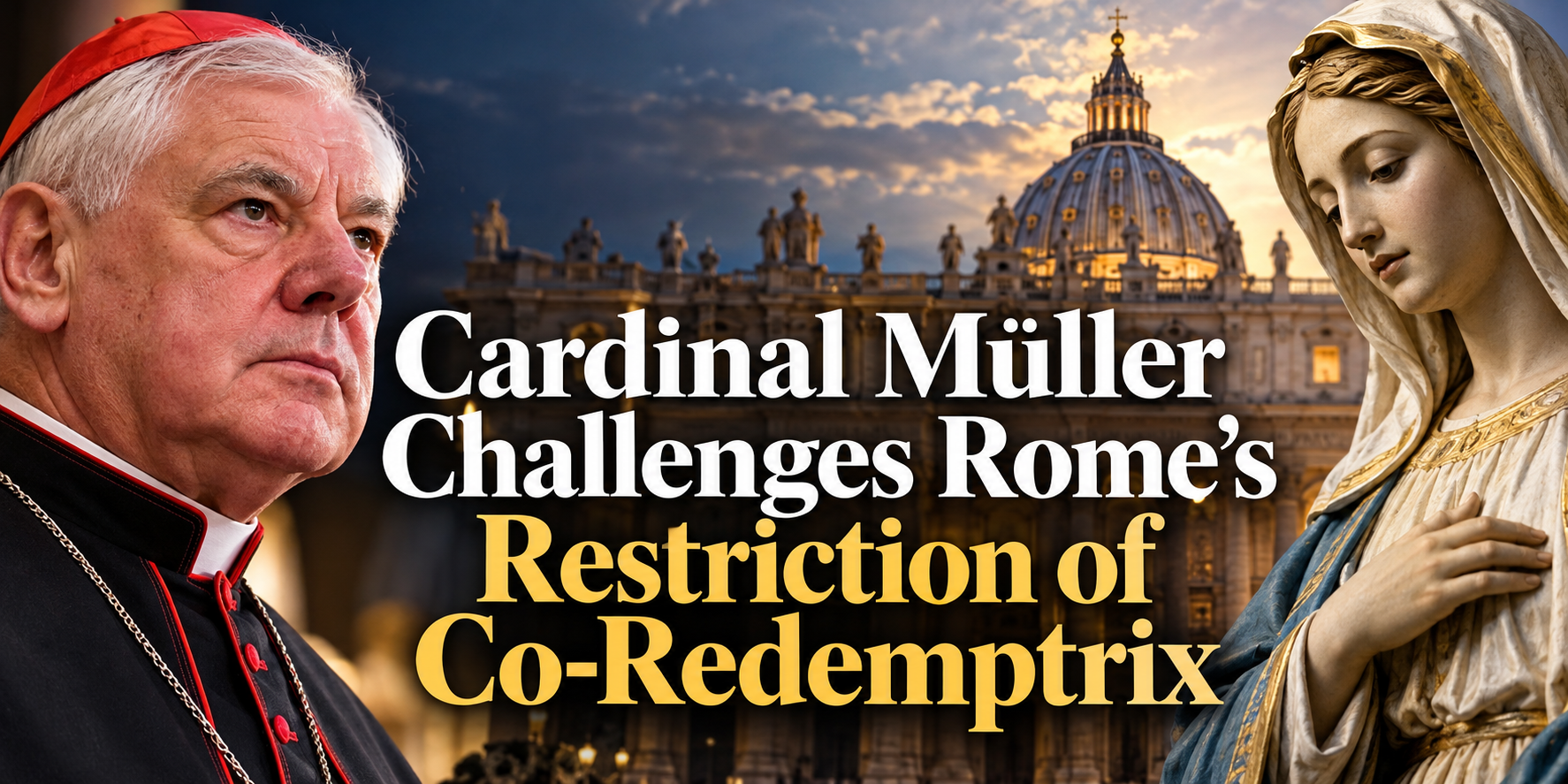
Cardinal Gerhard Ludwig Müller’s explanation of his changed assessment of Co-Redemptrix has given the Marian controversy a new significance. Building upon Nuntiatoria’s earlier examinations of doctrinal continuity, ecumenism and ecclesiastical authority, his intervention raises a question that cannot be settled by the mere repetition of an official judgement: has Rome adequately answered the theological argument?
Cardinal Gerhard Ludwig Müller has now explained why he reconsidered his earlier reservations concerning the Blessed Virgin Mary’s title Co-Redemptrix. The explanation, published alongside the authorised English translation of his address to the international Marian conference De Maria numquam satis, held in Rome on 7–8 October 2026, is more consequential than another declaration of support for a disputed expression. The former Prefect of the Congregation for the Doctrine of the Faith has identified what he considers a deficiency in the theological reasoning of the Dicastery for the Doctrine of the Faith’s document Mater Populi fidelis. Its discouragement of the title prompted him to examine the question afresh and to defend the expression as conveying a truth objectively contained in Revelation.¹
This development requires a different examination from the one Nuntiatoria published on 9 October. In Co-Redemptrix: When “Always Inappropriate” Meets “Objectively Contained in Revelation”, the fundamental doctrinal disagreement was already established. Christ alone accomplishes Redemption through His infinite merits, yet His unique causality does not exclude the wholly subordinate cooperation of creatures whom He freely associates with His saving work. The disagreement between the Dicastery and Cardinals Müller and Raymond Burke concerns whether the traditional Marian title legitimately expresses the singular cooperation which Catholic doctrine acknowledges, or whether its terminology compromises the clarity of Christ’s unique mediation.²
The new information concerns Müller’s own intellectual development. He previously questioned the prudence of defining Mary as Co-Redemptrix as a dogma. He has now explained that the Dicastery’s restrictive judgement, which he considers insufficiently attentive to the title’s authentic meaning, prompted further study. His former caution about a solemn definition must therefore be distinguished from his present defence of the expression’s theological legitimacy. The truth of a proposition, the suitability of the terminology employed to express it and the prudence of defining it as dogma are three distinct questions. Failure to distinguish them creates an appearance of contradiction where a legitimate development of theological judgement may have occurred.
This is not a minor distinction. A theologian may believe that a particular expression is orthodox while considering a dogmatic definition unnecessary or inopportune. He may also recognise that the expression requires careful explanation without regarding it as inherently misleading. The Church is not obliged to define every theological truth, and the legitimacy of a title does not establish an obligation to employ it in every official document. But neither does a decision to discourage its use automatically establish that the doctrine it has historically conveyed is erroneous.
The difficulty arises from the categorical language of Mater Populi fidelis. Paragraph 22 declares it “always inappropriate” to employ Co-Redemptrix to define Mary’s cooperation in Redemption. The Dicastery argues that the title risks obscuring Christ’s unique salvific mediation and that its repeated need for explanation makes it unsuitable. Yet the same document acknowledges the history of the expression, including its use in Roman documents and by Popes, while affirming Mary’s singular cooperation in the saving mission of her Son. Cardinal Víctor Manuel Fernández subsequently clarified that the restriction was intended to govern future official ecclesiastical usage, rather than to condemn every previous invocation or informed private discussion.³
That clarification is important, but it does not remove the theological difficulty. If a title can possess an orthodox meaning, has been employed by earlier ecclesiastical authorities and may still be used by those who understand its proper sense, what establishes its categorical unsuitability for official expression? A prudential judgement about contemporary pastoral circumstances might provide an answer. But such a judgement is not identical to a demonstration that the title itself contradicts Catholic doctrine. The distinction matters especially when the language employed appears to extend beyond a particular pastoral context.
The Dicastery is entitled to consider whether one formulation communicates the faith more effectively than another. It is not necessary to maintain that every historical theological expression must remain permanently in official use. Nevertheless, the need for explanation cannot by itself establish theological inadequacy. Catholic doctrine contains many technical expressions whose meanings are not immediately evident to an uninstructed audience. The Church has not ordinarily responded to that difficulty by abandoning precise terminology. She has explained what the terminology means and why it is necessary.
This comparison does not confer upon Co-Redemptrix the doctrinal standing of terms defined by ecumenical councils. It establishes only that difficulty of comprehension is not equivalent to doctrinal error. If the objection is that the title necessarily attributes an independent redemptive causality to Mary, that proposition must be demonstrated. If the objection is that its legitimate meaning is too easily misunderstood, the judgement belongs principally to the realm of pastoral prudence. The two arguments must not be confused.
Müller’s defence rests upon the Catholic understanding of grace and human freedom. Divine initiative does not exclude genuine creaturely cooperation; grace makes such cooperation possible. The Council of Trent rejected the proposition that man could initiate his justification through natural powers, but it also affirmed the reality of the free assent and cooperation made possible by prevenient grace. Saint Thomas Aquinas distinguished the primary causality of God from the subordinate activity of created causes, explaining that divine providence confers upon creatures the dignity of participating in its purposes.⁴
The Blessed Virgin’s cooperation belongs within this framework. Her consent at the Annunciation was a genuine human act made possible by divine grace. Her association with the Incarnation and Passion was entirely dependent upon Christ, whose merits preserved and sanctified her. Nothing in this account requires a second, independent source of Redemption. The Catholic understanding of subordinate cooperation presupposes the absolute primacy and sufficiency of Christ’s saving work.
These theological foundations were examined in Nuntiatoria’s previous editorial and need not be reconstructed at length. Their significance now lies in the question Müller has raised about the Dicastery’s reasoning. It is not enough to establish that Christ alone is the Redeemer. Both parties affirm that truth. The disputed proposition is whether the authentic meaning of Co-Redemptrix contradicts it, or whether the title can legitimately express the subordinate cooperation which the Church already teaches.
The patristic tradition supplies important evidence. Saint Justin Martyr contrasts Eve’s disobedience with Mary’s faithful response to the angelic message. Saint Irenaeus develops the relationship between the first Eve and the New Eve, presenting Mary’s obedience as associated with the restoration accomplished through Christ. These Fathers did not employ the later technical title Co-Redemptrix, but their teaching establishes that Mary’s participation in the divine economy was recognised long before the emergence of the disputed terminology.⁵
The distinction between a doctrine and its later conceptual formulation is indispensable. The relatively late appearance of an expression does not prove that the truth it intends to convey is absent from Revelation. Equally, the development of terminology does not automatically establish its legitimacy. The proper examination must determine whether the expression faithfully articulates what Scripture and Tradition contain. Müller’s argument must be judged by that standard, rather than by the antiquity or novelty of the word alone.
The Second Vatican Council itself affirmed Mary’s free cooperation in human salvation, her union with Christ’s sacrifice at Calvary and her maternal participation in the communication of grace. Lumen gentium carefully subordinated every aspect of her mediation to Christ’s unique mediation. Its decision not to employ Co-Redemptrix is a significant consideration, but declining to use a title is not equivalent to defining that the title is doctrinally false. The distinction must be preserved if the Council’s teaching is to be interpreted accurately.⁶
This question of interpretation connects directly with Nuntiatoria’s earlier examination of ecclesiastical authority. In Continuity or Contradiction? Cardinals Müller, Sarah, and the Crisis Beneath the Crisis, published on 29 May, the central argument concerned the relationship between authoritative declarations and the Church’s received teaching. That editorial insisted that appeals to authority cannot substitute for demonstrating continuity where a genuine doctrinal difficulty has arisen. Significantly, it applied this standard to Müller’s own arguments concerning ecclesiastical obedience and traditionalist apostolates. The principle was not invented to defend him against Rome; it was employed when his own reasoning required scrutiny.⁷
The same consistency is necessary here. Müller’s former office does not establish the truth of his present position. Nor does the Dicastery’s authority render every theological explanation in its document irreformable. Mater Populi fidelis was approved by Pope Leo XIV and issued by the competent Roman authority. It therefore deserves serious consideration and the religious respect appropriate to its character. Nevertheless, its non-definitive assessment of a theological title is distinguishable from a solemn definition of revealed dogma.
Catholic theology has always recognised distinctions between definitive teaching, non-definitive teaching, disciplinary regulation and prudential judgement. These distinctions do not weaken ecclesiastical authority. They protect its proper exercise by preventing different kinds of authoritative act from being treated as though they possessed identical doctrinal force. The faithful are not entitled to disregard the Magisterium whenever they encounter difficulty, but neither does fidelity require them to regard every theological explanation as incapable of further clarification.
The problem is especially acute where an authoritative document employs categorical language about an expression previously accepted in ecclesiastical usage. The history acknowledged by Mater Populi fidelis does not establish that the title must be retained indefinitely. It does, however, require an explanation of how earlier legitimate usage relates to the present restriction. A judgement concerning future official terminology may be perfectly compatible with historical acceptance. But that compatibility must be articulated rather than assumed.
Müller’s intervention therefore concerns more than Marian devotion. It raises the question of how doctrinal authority should respond when the theological reasoning supporting a restriction is challenged from within the Church’s own tradition. The appropriate answer cannot consist merely in repeating that the restriction has been issued. It must address the distinction between the legitimate meaning of the title and the misunderstandings which its use may occasion.
This is also where the ecumenical dimension becomes consequential. Nuntiatoria’s earlier commentary on synodality and ecumenism, particularly From Revelation to Conversation: The New Ecclesiology of Leo XIV, examined the danger of allowing dialogue to become the organising principle of ecclesiastical life rather than a means of communicating revealed truth. The concern was not that engagement with other Christians is illegitimate, but that the desire for agreement can begin to determine which elements of Catholic teaching are expressed clearly and which are quietly set aside.⁸
Müller’s argument concerning Protestant objections brings that concern directly into the present controversy. Certain classical Protestant accounts of justification understand genuine human cooperation as a threat to the primacy of divine grace. Catholic theology rejects that opposition. Grace precedes, enables and sustains the creature’s free cooperation; it does not necessarily abolish it. Mary’s singular participation in the economy of salvation must therefore be evaluated according to Catholic doctrinal principles, rather than by accepting objections arising from a theological system whose premises the Church does not share.
This does not justify treating Protestant theology as an undifferentiated whole. Lutheran, Reformed and other traditions have developed distinct accounts of justification, sanctification and cooperation. The Joint Declaration on the Doctrine of Justification identified substantial agreement concerning the primacy of grace while acknowledging continuing theological differences. It did not settle the separate question of Marian co-redemption. The relevant principle remains that ecumenical dialogue must seek accurate understanding rather than conceal genuine doctrinal disagreement.⁹
There is a legitimate distinction between avoiding unnecessary misunderstanding and surrendering theological precision. The Church may choose expressions which communicate her doctrine more effectively. She may explain why particular terminology requires qualification. But if the reason for abandoning an expression is principally that another confession rejects the doctrine it conveys, the difficulty is no longer merely linguistic. It concerns whether Catholic teaching is being judged according to its own principles or according to the requirements of ecumenical accommodation.
The same concern underlay Nuntiatoria’s criticism of a synodal culture in which conversation risks becoming an alternative to doctrinal determination. Dialogue is a means of discovering, explaining and communicating truth. It is not an independent source of Revelation. Agreement cannot make a proposition true, and disagreement cannot make a revealed truth dispensable. Where ecumenical considerations influence official terminology, the theological grounds for that influence must remain open to examination.
There is, however, an equal obligation upon defenders of Co-Redemptrix. Historical usage and devotional attachment cannot substitute for theological demonstration. The fact that Popes and respected theologians have employed an expression is relevant evidence of its acceptance, but it does not establish that a new dogmatic definition is required. Nor does the legitimacy of subordinate cooperation settle every question concerning the most suitable terminology for expressing it.
A responsible defence must preserve the distinction between the objective accomplishment of Redemption and the application of its fruits. Christ alone possesses the infinite merits by which mankind is redeemed. The faithful may cooperate in the communication of those fruits through prayer, sacrifice and apostolic labour. Mary’s cooperation is singular because her divine motherhood and association with the Incarnation and Passion place her within the historical economy of salvation in a manner belonging to no other creature. Cardinal Burke’s address to the Rome conference emphasised this distinction, while maintaining that Mary’s participation remains entirely subordinate to her Son.¹⁰
The theological argument must therefore avoid two opposite errors. It must neither attribute to Mary an independent redemptive power nor reduce her cooperation to an empty formality. Catholic doctrine affirms the unique sufficiency of Christ’s Redemption and the reality of the cooperation which His grace makes possible. The disputed title must be examined within that relationship.
The ecclesiastical significance of Müller’s intervention is heightened by his own record. He has repeatedly defended doctrinal continuity and criticised attempts to reinterpret Catholic teaching through contemporary pastoral or synodal processes. Yet Nuntiatoria has also challenged his conclusions where his treatment of ecclesiastical obedience appeared insufficiently attentive to unresolved questions of continuity. His present defence of Co-Redemptrix should therefore receive neither automatic endorsement nor dismissal. The argument, rather than the reputation of its author, must determine its theological weight.
The same standard applies to Cardinal Fernández and the Dicastery. The existence of Roman authority is not in dispute. The issue is the precise nature of the judgement exercised and the sufficiency of its supporting reasons. An authoritative document may legitimately discourage a title on prudential grounds. It may also identify genuine doctrinal dangers associated with particular interpretations. But where the title has an established orthodox meaning, those grounds must be distinguished with care.
This distinction was already reflected in Nuntiatoria’s overview of Edition CXXVII, State, et Tenete Traditiones, which situated the Marian controversy within the wider question of how the Church receives and transmits what has been handed down. The governing concern was not opposition to every development, but the necessity of distinguishing legitimate clarification from the reconstruction or abandonment of inherited doctrine. That principle applies with particular force when a Roman document appears to restrict terminology previously employed within the Church’s own theological tradition.¹¹
The authorised publication of Müller’s address has therefore changed the character of the dispute. His earlier reservations can no longer be cited without acknowledging his subsequent explanation. He did not previously regard a dogmatic definition as opportune; he now defends the title’s theological legitimacy against what he considers an inadequately reasoned restriction. Those positions are not inherently contradictory. Indeed, the distinction between doctrinal truth, legitimate terminology and the prudence of definition is precisely what the controversy requires.
Cardinal Fernández’s clarification concerning official and private usage may provide the basis for a more precise settlement. If the Dicastery accepts that the title can possess an orthodox meaning, the remaining disagreement may concern its pastoral suitability in official ecclesiastical language. That would be a narrower question than whether the title itself is doctrinally illegitimate. But the categorical wording of Mater Populi fidelis makes it important that this distinction be explicitly maintained.
The controversy is not resolved by portraying one Cardinal as Marian and another as Christocentric. Both affirm that Christ alone redeems mankind in the principal and absolute sense. Both acknowledge Mary’s dependence upon His grace. The disagreement concerns the legitimate expression of her singular cooperation and the weight to be given to possible misunderstanding. To present it otherwise is to substitute rhetoric for theology.
Nor is the controversy resolved by suggesting that obedience requires silence. The Church’s doctrinal authority exists to preserve and expound Revelation. Responsible theological examination is not inherently opposed to that purpose. On the contrary, where a genuine difficulty arises concerning the relationship between a new formulation and an inherited expression, clarification serves the integrity of the Church’s teaching office.
There is an institutional irony in the present circumstances. A former prefect of the Church’s principal doctrinal congregation has been prompted by a document issued by that same authority to reconsider his earlier judgement and articulate a defence of the very expression now discouraged. That fact does not establish that Müller is right. It establishes that the document has not brought the theological disagreement to a conclusion and that the arguments advanced in its support remain open to serious examination.
The question is consequently larger than whether Co-Redemptrix should appear in future Roman documents. It concerns the standards by which inherited theological language is evaluated, the distinction between doctrinal error and pastoral difficulty, and the responsibility of ecclesiastical authority to explain how its judgements relate to previous teaching.
Nuntiatoria has consistently maintained that fidelity to Tradition requires such distinctions. Authority must be respected according to its proper nature; theological propositions must be evaluated according to their meaning; and claims of continuity must be demonstrated rather than merely asserted. The Marian controversy provides another occasion upon which those principles must be applied without favour or exception.
The Church does not honour Christ by denying what His grace accomplishes in His Mother. Neither does she honour Mary by attributing to her anything belonging uniquely to her Son. Catholic theology must preserve both truths without confusion. If Co-Redemptrix legitimately expresses that relationship, its meaning deserves an adequate theological account. If Rome judges that the title should nevertheless be avoided, the reasons must be proportionate to the judgement and clearly distinguished from a condemnation of its orthodox meaning.
Cardinal Müller has made that demand more difficult to evade. His intervention does not compel a fifth Marian dogma, nor does it establish that every traditional expression must be retained regardless of circumstances. It insists that a theological question be answered theologically.
Authority has spoken. Müller has answered. What remains is not another assertion of authority, but an adequate resolution of the argument.
- Cardinal Gerhard Ludwig Müller, The Blessed Virgin Mary’s Cooperation in Redemption, address delivered 8 October 2026, authorised English translation published by Diane Montagna, 11 October 2026.
- Nuntiatoria, Co-Redemptrix: When “Always Inappropriate” Meets “Objectively Contained in Revelation”, 9 October 2026.
- Dicastery for the Doctrine of the Faith, Mater Populi fidelis, 4 November 2025, §§17–22; Diane Montagna, Cardinal Müller Defends Mary’s Title “Co-Redemptrix”, 11 October 2026.
- Council of Trent, Decretum de iustificatione, Session VI, chapters 5–8; Saint Thomas Aquinas, Summa Theologiae, I, q. 23, a. 8, ad 2.
- Saint Justin Martyr, Dialogue with Trypho, 100; Saint Irenaeus, Adversus Haereses, III, 22, 4.
- Second Vatican Council, Lumen gentium, 21 November 1964, §§56, 58, 60–62.
- Nuntiatoria, Continuity or Contradiction? Cardinals Müller, Sarah, and the Crisis Beneath the Crisis, 29 May 2026.
- Nuntiatoria, From Revelation to Conversation: The New Ecclesiology of Leo XIV, 28 October 2025.
- Catholic Church and Lutheran World Federation, Joint Declaration on the Doctrine of Justification, 31 October 1999; Cardinal Gerhard Ludwig Müller, The Blessed Virgin Mary’s Cooperation in Redemption, §5, 8 October 2026.
- Cardinal Raymond Leo Burke, Our Lady of Guadalupe and the Kingdom of Christ the King: The Mission of the Co-Redemptrix and the Co-Redeemers, address delivered 7 October 2026.
- Nuntiatoria, 11.10.26 Nuntiatoria CXXVII: State, et Tenete Traditiones, 9 October 2026.



Leave a Reply