
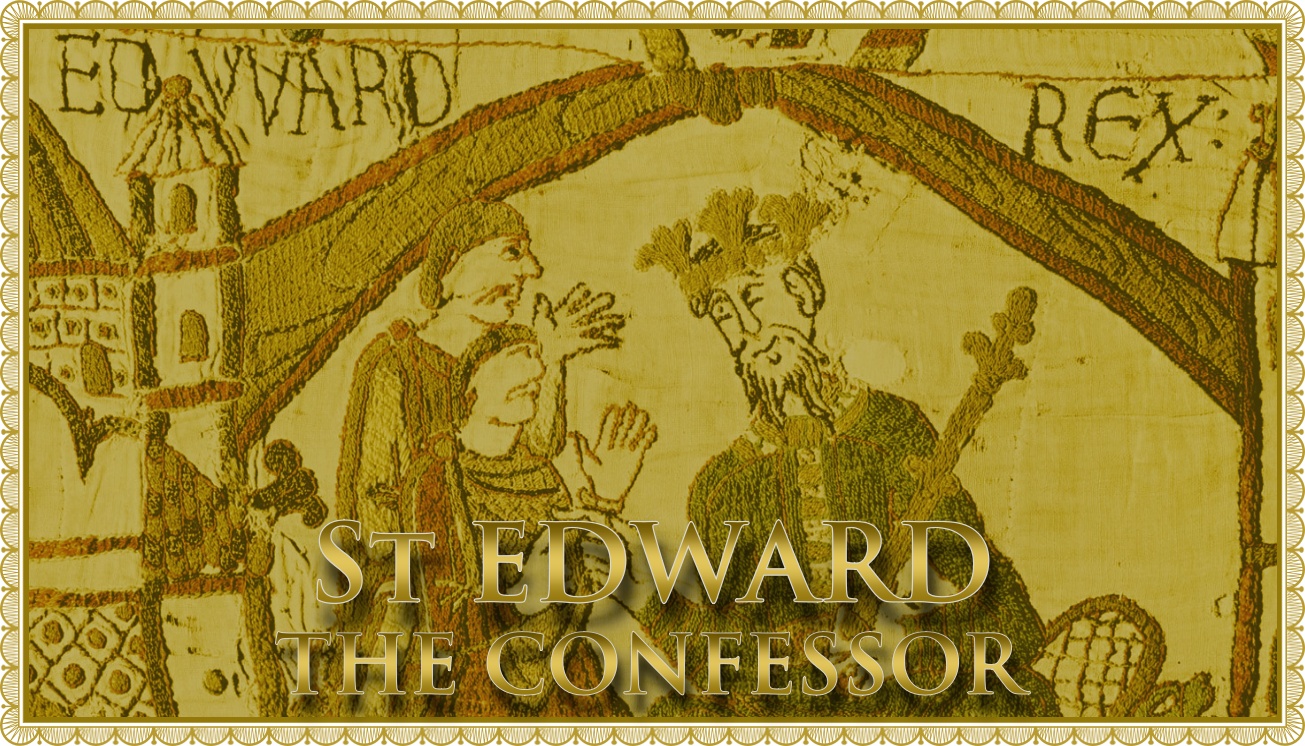
St. Edward the Confessor
Today we celebrate the feast of St. Edward the Confessor. He was the son of Ethelred the Unready and Emma of Normandy. Though an Anglo Saxon his sympathies were Norman, derived from his Norman mother and upbringing in Normandy. His Norman sympathies were shown by his ecclesiastical appointments, such as that of Robert of Jumieges as Archbishop of Canterbury. His most famous achievement was the founding of Westminster Abbey. He died leaving no obvious successor, but his connection with the Dukes of Normandy led William, Duke of Normandy to claim the throne, defeating Harold at the Battle of Hastings in 1066.
Edward was the last of the Kings of Wessex, who had in effect replaced the other Saxon kingdoms, and emerged as the first Kings of all England, as Wessex was the last area to hold out against Danish invaders. Edward’s reign marked a period of transition between an Anglo Saxon England whose strength lay in local government to the coming of the Normans and their stronger central government structure.
While there is no reason to dispute his personal piety opinion is very much divided about his success as a king. It depends very largely on the attitude taken to the subsequent Norman Conquest. For some, Edward’s pro-Norman policy fatally undermined the Saxon monarchy, and paved the way for the Norman conquest, which represented an alien yoke over the English people. For others, his Norman sympathies were an example of his enlightened outlook and paved the way for the replacement of the Anglo Saxons with more sophisticated continental Norman rulers, with their castles and massive cathedrals.
However, what both sides agree is that the period marked a dramatic change in the direction of English society. The Norman Conquest led to the replacement of virtually the entire English ecclesiastical hierarchy with Norman Frenchmen. The larger Saxon churches were pulled down and replaced by massive Norman cathedrals. Older Saxon sees were replaced by new ones centred on towns. For example, Sherborne was replaced by Salisbury and Selsey by Chichester.
The Saxon nobility were replaced with Normans, and castles were built to enforce the Norman hegemony. English was replaced as the language of the court by Norman French. It would not be until the later Middle Ages that the English language reasserted itself, as the Normans went native. The Normans showed little understanding of the people whom they governed (this included the English saints, with many of their relics being destroyed by the Normans).
This process was subsequently extended to Wales and Ireland, with the establishment in both countries of a Norman governing class over the native population. There is the same division of opinion over whether this process should be seen in a positive or negative light.
The people of these islands are now divided on not dissimilar lines over the issue of whether they should view the world through the lens of nationalism or cosmopolitanism. The nationalist sees the nation as a home which belongs to those who were born there. Outsiders are sometimes welcome as guests, but they remain outsiders. By contrast, the cosmopolitan sees our society as more like a hotel, in which people may book different rooms, but they all remain visitors and no one truly belongs, for to say some belong and not others will cause division and conflict.
Yet cosmopolitans can often be very contemptuous of non-cosmopolitans, the mass of humanity. Most people want to belong somewhere rather than nowhere. The Christian Church is sometimes co-opted by both nationalists and cosmopolitans in support of their contrasting political agendas.
However, if we are to take the Bible seriously as our starting point, a different picture emerges than either nationalism or cosmopolitanism. The Israelites were defined by their covenant with God. They were a mixed multitude of many tribes, yet Moses welded them into a unity because they all, high and low, rich and poor were bound to the covenant. They subsequently conquered a land and had a monarchy and temple like other nations, but what ultimately united them as a people was their covenant with God.
They were judged according to their faithfulness to the covenant. That is why they were able to survive the loss of land, monarchy and temple, because they were a people that “dwelleth alone, that shall not be numbered among nations”. Their identity was derived from their covenant with God.
The prophet Jeremiah looked forward to a time when a new covenant, in which sins would be forgiven, would be written on the hearts of men. The first Christians believed that this new covenant was sealed through the blood of Christ, his saving death and resurrection. The new covenant people of God, the Body of Christ, are those who have been baptised into Christ, and they are from every tribe, nation and tongue. Their life is sustained by the sacrament of the Eucharist.
In this life they will continue to render to Caesar the things that are Caesar’s, for they will belong to an earthly society, whether it is nationalist or cosmopolitan, but their ultimate commonwealth is in heaven, as they await the Saviour’s second coming and that new heaven and new earth, wherein dwelleth righteousness.
The peoples of these islands come from many different tribes, but what ultimately defined them was their adherence to this faith. The Venerable Bede could write the history of the English people before they obtained political unity because they were united as one people by their faith. The same could also be said of the nations of Scotland, Ireland and Wales, with their clan structure before they achieved political unity as nations. What ultimately gave them their distinct identity was the Christian faith.
If the peoples of these islands are to find a way forward out of the current crisis, it will not come from either nationalism or cosmopolitanism but from the Christian faith. What ultimately matters about Edward the Confessor is not whether he favoured Saxon or Norman, but the faith that is shown by the abbey that he founded. Let us pray that we may follow in his footsteps and build up the Church in this land in our own time.
by the Revd Dr Robert Wilson PhD (Cantab), Old Roman Apostolate UK




Leave a Reply