
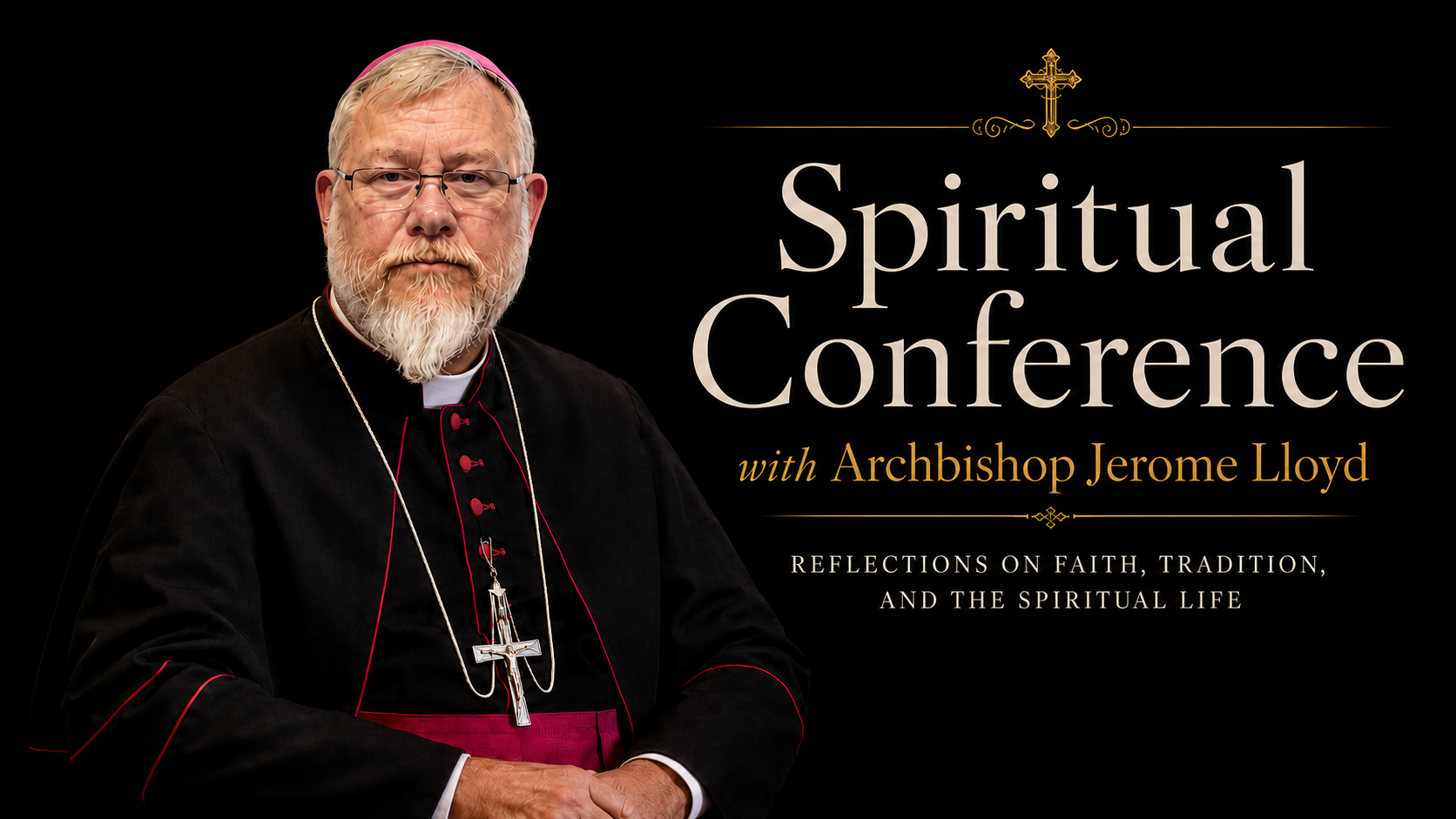
St Paul’s command to “prove all things” is as much about the way we judge ourselves as the way we judge the Church and the world. This conference considers synodality, ecumenism, sacred space, education and the fruits of Tradition in natural spoken language while preserving the theological distinctions behind them, before turning through the Rosary and the wedding garment towards the decisive question: whether the truths we defend are making us holy.
Beloved in Christ, there is something wonderfully practical about St Paul’s advice this week: Omnia autem probate: quod bonum est tenete — “Prove all things; hold fast that which is good.”¹ In ordinary language we might say: do not swallow everything whole, but do not become so suspicious that you end up incapable of recognising anything good either. Listen, think, test, and then keep what is worth keeping. What makes the verse particularly important is the context. St Paul has just said, “Extinguish not the spirit. Despise not prophecies.” He is not warning us against being open to God; quite the opposite. He wants Christians who are open enough to recognise grace, but sober enough not to confuse every strong feeling, every persuasive personality or every new ecclesiastical enthusiasm with the action of the Holy Ghost.
St John says much the same thing: “Believe not every spirit, but try the spirits if they be of God.”² That command belongs as much to everyday Christian life as it does to extraordinary claims of prophecy or mystical experience. Most of us are not nearly as objective about ourselves as we like to think. We can call pride principle, resentment justice, fear prudence and the desire to be liked charity. We can do the right thing for the wrong reason and then congratulate ourselves because the outward result looked respectable. Anyone who has made a serious examination of conscience over many years eventually discovers that the human heart is capable of giving very flattering names to things which are spiritually disordered.
St Ignatius Loyola was very alert to this problem. In his rules for discernment he warns that even after a genuine spiritual consolation we can go on to form opinions and resolutions which are not, simply because they followed the consolation, directly given by God.³ That is a very useful distinction in an age in which we hear a great deal about “what the Spirit is saying”. A man can pray sincerely and then reason badly. A meeting can begin with the Veni Creator and still reach a poor decision. A person can feel peaceful about a choice and still be mistaken about what that peace means. The Church’s tradition of discernment has always been more careful than the modern habit of moving quickly from “we prayed” to “therefore God has confirmed our conclusion”.
That warning matters particularly for those of us who spend much time thinking about the present crisis in the Church. It is possible to become very skilled at detecting ambiguity in a Vatican document and rather less skilled at recognising vanity in our own reactions. We can become experts in ecclesiastical confusion while barely noticing that outrage itself has become a kind of spiritual entertainment. We can defend Tradition accurately and yet live it superficially. None of that makes the public questions unimportant. It simply means that truth is not given to us merely so that we can be correct about other people. If we stand beneath the truth rather than merely using it as a weapon, it has to judge us as well.
St Thomas Aquinas gives us another useful rule. Taking up an ancient gloss, he says that “every truth, by whomsoever spoken is from the Holy Ghost.”⁴ He is not saying that everyone who says something true is inspired in a prophetic sense, still less that everything else such a person says must be accepted. He expressly distinguishes the natural light by which truth may be recognised from sanctifying grace and supernatural gifts. But his point remains valuable: truth is truth wherever it is found. If somebody with whom we profoundly disagree identifies a genuine weakness in our argument, the weakness does not disappear because we dislike the person who noticed it. One of the hardest parts of omnia probate is learning to love truth more than the satisfaction of being proved right.
That brings us to synodality, because so much contemporary ecclesiastical language is itself framed in terms of discernment. Synodality is usually described as “walking together”, listening to the baptised and trying to hear what the Holy Ghost is saying to the Church. Much of that, taken in itself, is unobjectionable. Bishops should listen. Priests should know their people. Lay Catholics often possess experience and expertise which clergy do not. The Church has suffered enough from institutional deafness to know the damage caused when authority refuses to hear facts which are inconvenient.
The difficulty comes when listening itself starts to carry a theological weight which properly belongs to the truth being sought. This week we examined proposals to give more permanent juridical force to synodal structures through canon law: stronger requirements for pastoral councils, more regular consultative bodies, enlarged participation in decision-making and wider possibilities for lay governing functions.⁵ Some of those proposals may be defensible as administrative arrangements. The more important question is what understanding of the Church gradually becomes normal if structures designed to assist Apostolic government begin, even unintentionally, to reshape the way authority itself is understood.
Catholic ecclesiology starts from something received. Christ did not establish a religious democracy which later evolved bishops. The bishop receives an office within the Apostolic constitution of the Church. That authority is not arbitrary or unlimited; it is bound by Revelation, divine law, the constitution of the Church, the rights of the faithful and the salvation of souls. But there remains a real distinction between authority which listens and authority which is constituted by listening. Once that distinction becomes blurred, one can continue using traditional Catholic vocabulary while a rather different conception of ecclesial authority begins to take root beneath it.
That is also why our article “Vatican III by Stealth?” asked what people now mean when they speak of the continuing “reception” of Vatican II.⁶ Every council must be received. Its teaching has to be assimilated, explained and applied. But receiving what a council actually taught is not the same thing as treating the council as the starting point of an indefinitely unfolding project whose presumed direction can become more important than its texts. “What did Vatican II teach?” and “Where was Vatican II leading us?” are not identical questions. The first remains tied to what the Council actually enacted; the second gives later interpreters much greater freedom to construct an intention which the Council Fathers themselves never formally expressed.
St Vincent of Lérins gives us a very old and very Catholic way of thinking about this. He did not deny development; quite the opposite. He insisted that Christian understanding should grow. But he also insisted that the growth be “real progress, not alteration of the faith”.⁷ That distinction matters enormously. A child grows into an adult and remains the same person. An acorn becomes an oak and not something of another species. Development deepens, clarifies and unfolds what is already there. It does not become a respectable word for contradiction.
The same distinction appears in the spiritual life, because we too are capable of preserving a word while gradually changing what it demands. We believe in forgiveness until forgiveness touches the grievance we prefer to keep. We believe in custody of the senses until curiosity becomes pleasurable. We believe in Sunday obligation until something more attractive appears. We believe in prayer until prayer competes with sleep, work, entertainment or the telephone. The principle remains intact in our vocabulary while its practical demands are quietly negotiated away. So omnia probate cannot be used only against ecclesiastical innovations; it has to test our own explanations of ourselves as well.
The protest at Fulda showed another difficulty in contemporary talk about listening. The German Synodal Way has spent years discussing sexual morality, women and ordained ministry, priestly celibacy and ecclesiastical power, often in the name of lay participation. Yet outside the meeting of the German Bishops’ Conference stood Pro Fide Ecclesiae, clergy and lay Catholics objecting to the direction of that process.⁸ They are laity too. Catholic women among them do not regard the male priesthood as an injustice. Catholic families among them do not believe the moral law requires reconstruction. Their presence raises a very simple but very important question: when we say “listen to the faithful”, which faithful are we talking about?
Every consultation is mediated. Somebody chooses who takes part, somebody frames the questions, somebody decides how to group the answers and somebody writes the final synthesis. That does not make consultation dishonest; it simply means it is human. The difficulty comes when the result of the process begins to be treated as though human mediation had somehow become transparent to the Holy Ghost. The sensus fidelium, the supernatural “sense of the faithful”, is not simply the sum of opinions held by baptised people. It belongs to believers who are actually living within the Faith, formed by Revelation, worship, sacramental life and fidelity. The faithful do not manufacture the Faith by consensus; they recognise and receive what has been handed down.
The Holy Ghost invoked in a synodal meeting is the same Spirit who inspired Scripture, strengthened the martyrs, illuminated the Fathers and preserved the Church through the great doctrinal crises of her history. He does not contradict Himself. If a modern process appears to reach a conclusion incompatible with Revelation or definitive teaching, the answer cannot simply be that the Spirit is “doing something new”. The claim has to be tested.
The same discipline is needed in ecumenism. Pope Leo XIV recently met representatives of the Lutheran World Federation and looked towards 2030, the five-hundredth anniversary of the Augsburg Confession, as an important ecumenical moment.⁹ Many Catholics will recognise Luther’s name without knowing much about the Augsburg Confession itself. It was presented in 1530 and became the foundational statement of Lutheran belief on questions such as justification, ministry, the Church, the sacraments, the Mass and ecclesiastical authority.
There is no problem with Catholics and Lutherans studying the document together. In fact, there are good reasons for doing so. Christian division is a wound. Misunderstandings should be corrected and genuine areas of agreement recognised. But if the aim shifts from resolving contradiction to celebrating the fact that contradictory confessions exist side by side, then the meaning of ecumenism has changed. Real reconciliation has to care about truth, otherwise one simply becomes more comfortable with separation.
You can see the same thing in ordinary relationships. Sometimes people say they have “made peace” when what they really mean is that they have agreed never to mention the underlying problem again. That may preserve civility for a while, but it is not the same as reconciliation. Charity certainly forbids us to weaponise truth or use it cruelly. It does not require us to pretend that contradiction disappears because everybody has agreed to be polite about it.
The adhān in a Christian church raises the same question in a more visible form. The adhān is the Islamic call to prayer. It contains explicit Islamic statements of belief, including that Muhammad is the messenger of Allah.¹⁰ It is not simply a neutral piece of Arabic chant. Islam does not confess the Most Holy Trinity, nor Jesus Christ as the eternal Son consubstantial with the Father, nor the Incarnation and Redemption in the Catholic sense.
None of that means Muslims should be treated badly. A Muslim is our neighbour and should be treated with justice, courtesy and charity. Christians and Muslims can cooperate in many areas of genuine common concern. But respecting Muslims also means taking Islam seriously enough to acknowledge what it actually teaches. If the adhān is used inside a Christian church, it is reasonable to ask what theological message is being communicated by allowing an explicitly non-Christian profession of faith to sound within a place dedicated to the worship of the Trinity.
And then the question turns back on us. We can become very animated about an Islamic profession being sounded in a church and then walk into the same church ourselves chatting, looking at our phones and barely acknowledging the Blessed Sacrament. If we believe the place is sacred, our own behaviour ought to show it. That is where these controversies become spiritually useful: when they stop being merely examples of what somebody else has done wrong and begin to expose what we ourselves actually believe.
The educational questions this week point in the same direction. At Gonville and Caius College in Cambridge, mandatory inclusivity training raised concerns because contested legal and ideological claims were being presented under the very attractive headings of kindness and inclusion. In Ireland, by contrast, Catholic educators introduced Living Love Senior, a relationships and sexuality programme which begins explicitly from Catholic teaching about the human person: body and soul, male and female, dignity, chastity and virtue.¹¹ The point is not simply that one programme is secular and the other Catholic. The deeper point is that nobody teaches from nowhere. Every educational programme assumes something about what a human being is.
The same is true of us. What we repeatedly put into our minds will eventually shape how we see things. We cannot spend hours feeding ourselves outrage, vanity, gossip, sensuality and distraction and then expect ten minutes of prayer to form the imagination more deeply than everything else we consume. St Augustine’s words are very useful here: Noli foras ire, in teipsum redi; in interiore homine habitat veritas — “Do not go outside yourself; return within yourself; in the inner man dwells truth.”¹² At some point you have to stop analysing everything out there and ask what is happening in here, before God.
That is one reason the Rosary matters so much. October is traditionally associated with it, and the Feast of the Holy Rosary is connected with the victory at Lepanto in 1571, when the Holy League fought the Ottoman fleet after St Pius V had called Christians to prayer.¹³ The battle was real and the danger was real, but the Rosary does something before it ever becomes a weapon against an external threat: it begins by putting the soul in order.
Think about what happens when you pray it. At the Annunciation you see freedom expressed as surrender to God. At Bethlehem you see majesty hidden in poverty. At Nazareth you see most of Christ’s earthly life spent quietly, without spectacle or public importance. In Gethsemane you see obedience when obedience hurts. At Calvary you see apparent defeat become Redemption. At Easter you discover that Good Friday did not have the last word.
If you pray those mysteries regularly, they begin to change what you admire and what you fear. The world says freedom means keeping every option open; Our Lady says freedom can mean fiat. The world tells us to avoid suffering whenever possible; the Sorrowful Mysteries tell us that suffering can be borne and offered. The world treats death as final failure; the Glorious Mysteries teach us to see life from the perspective of eternity.
That is why the family Rosary used to matter so much. It did more than teach people to say prayers. It created a Catholic imagination. Children learned, almost without noticing, that motherhood was holy, sacrifice mattered, purity was possible and Heaven was real. A great deal of the modern crisis goes deeper than bad catechism classes. People have lost the imaginative world in which Catholic doctrine once made sense.
That is also why the developments at Bellefontaine matter. An ageing Trappist community in France could no longer sustain the monastery, and twelve monks from the traditional Benedictine Abbey of Le Barroux moved in.¹⁴ That does not make the older monks failures. Many had given their lives faithfully to God. But it is still significant that one form of religious culture had run out of successors while another had enough vocations to send twelve monks somewhere else.
The broader figures are interesting too. In the survey we examined, many contemplative houses using only French had closed, fewer bilingual houses had closed, and none of the Latin-only houses in that particular study had done so. Latin is obviously not a magic device which produces vocations. Other factors matter enormously: leadership, discipline, community life, fidelity to the rule, liturgy and the clarity of the vocation being offered. But neither should we pretend those figures mean nothing simply because they complicate a fashionable assumption.
The more important point is what tends to come with that traditional religious culture: chant, silence, asceticism, stability, a serious liturgy and a clear sense that the whole purpose of religious life is God. St Benedict puts it with extraordinary economy: “prefer nothing whatever to Christ.”¹⁵ That is the heart of the matter. If a monastery no longer makes that priority obvious, it should not surprise us if young men wonder why they should give up everything to enter it.
The same question comes up with diocesan priests moving towards the SSPX.¹⁶ The Society has a complicated and irregular canonical situation, and there is no point pretending otherwise. But some priests who already possessed diocesan faculties and recognised ministries have accepted serious consequences in order to associate themselves with it or with traditional apostolates around it. That should at least make people curious.
Why would they do it? Why would a priest give up security for something canonically irregular? If diocesan celebrations of the traditional Mass are restricted while irregular traditional apostolates continue to attract priests and faithful, bishops should want to understand what is happening. Discipline may be canonically necessary in a particular case, but discipline alone does not answer the pastoral question.
Numbers do not prove truth. We know that. But fruit still matters. Vocations matter. Perseverance matters. Families handing on the Faith matter. Monasteries with novices matter. If omnia probate means anything, it means we cannot decide in advance which evidence we are prepared to notice.
And then we have to turn the same question on ourselves. If we have attended the traditional Mass for years, what has it actually done in us? Are we more recollected, more patient, more sacrificial, more honest in confession and less worldly? Has devotion to Our Lady purified the imagination? Has exposure to the lives of the saints made us more serious about becoming saints ourselves? Or have we mainly become better informed about liturgy and ecclesiastical politics?
Tradition cannot simply become a badge. The old Mass exists to worship God and sanctify souls. You can know every rubric and still be proud. You can be right about Modernism and still be uncharitable. You can understand the crisis in the Church and still completely misread the state of your own soul.
That is why the Gospel of the wedding garment matters so much. Our Lord tells of a king who prepares a wedding feast. The hall fills, but one man is found without the proper garment. He is already inside. That is the uncomfortable part. He has come to the feast, but something essential is still missing. Catholic tradition has usually understood the garment as sanctifying grace and charity.¹⁷
In other words, it is possible to be in the right place and still not be right with God. You can know where the right Mass is, understand synodality, ecumenism, Islam, Catholic anthropology and the crisis of religious vocations, and be correct in all of those arguments, and still lack charity.
St John of the Cross puts it with almost frightening simplicity: “When evening comes, you will be examined in love.”¹⁸ That does not mean doctrine is unimportant, nor that truth somehow dissolves into sentiment. It means doctrine has a purpose. Truth is supposed to make us holy. We shall not be examined on whether we won every controversy or whether our predictions about Church politics turned out to be correct. We shall answer for grace received, duties fulfilled, sins repented of, charity practised or refused, and the love of God and neighbour which either became the governing reality of our lives or did not.
If we defend reverence, then we should become reverent. If we defend marriage, our own family life should become more faithful. If we criticise ambiguity, we should be less evasive in confession. If we insist that the Faith must be handed on, we should actually be handing it on to someone. Before we speak too confidently about restoring Christendom, there ought to be some evidence that Christ is reigning in us.
The same applies to all the talk of Lepanto, Europe and even crusade. Europe does face real questions about Islam, demographics and the collapse of Christian identity. There is no point pretending otherwise. But Europe’s deepest problem is not that Muslims believe Islam too strongly. It is that millions of baptised Christians barely believe Christianity at all. A civilisation which has emptied its churches, abandoned Christian marriage and stopped teaching its children the Faith cannot repair itself merely by identifying an external opponent.
Before putting on the crusader’s cross, we need the wedding garment. Deus vult — God wills it — has to begin with us actually doing the will of God. If Europe is ever going to become Christian again, it will not happen because Catholics became angrier. It will happen because families pray, marriages endure, children are baptised and taught, priests believe in the priesthood, religious communities live as if God is enough, and ordinary Catholics become recognisably serious about the Faith. That begins at home.
And this brings us back to the second half of St Paul’s sentence: quod bonum est tenete — hold fast to what is good. That sounds easy until you think about it. We are trained to move on constantly: another article, another controversy, another video, another book, another devotion. We consume religion as quickly as everything else. But holiness is repetitive. The same Rosary, the same Mass, the same commandments, the same sins brought back to confession until grace finally wins more ground.
There is something very beautiful about that kind of perseverance. The monk stays under his rule. Husband and wife keep their promises. The elderly priest prays the same Office he prayed as a young man. The widow continues the Rosary after the person who used to answer has gone. None of that makes headlines, but that is how the Church survives.
Most of us are not going to decide the future of synodality or shape Rome’s ecumenical policy. But we can say the Rosary tonight. We can make a good confession. We can teach a child the Creed. We can keep Friday. We can turn up for Mass early enough to pray. We can forgive somebody. Those things are not avoiding the crisis; they are the beginning of restoration.
One of the dangers of living through constant ecclesiastical crisis is that you start to need it. You get used to the adrenaline of bad news. If nothing alarming is happening, you almost feel you have missed something. Eventually the Faith becomes mainly a way of watching everything that is wrong. At that point even true information can become spiritually damaging because of the way we are consuming it. We do not need to know everything. We do not need an opinion on every controversy. The fact that something is true does not mean it deserves permanent residence in the imagination.
The Rosary helps because for fifteen or twenty minutes the world stops deciding what you think about. You go back to Bethlehem, Nazareth, Gethsemane, Calvary and the empty tomb. That is not escapism; it is a deliberate return to the events which tell us what reality finally means.
So perhaps omnia probate needs to become part of our examination of conscience. Not only, “Is this story true?” but also, “What does this story do to me?” Why do I enjoy some scandals? Why am I disappointed when an accusation against someone I dislike turns out to be exaggerated? Why do I find it difficult to admit that someone from another camp has said something sensible? St Thomas’s principle comes back again: truth remains truth whoever speaks it. If I cannot admit that, I am no longer testing things by truth; I am testing truth by allegiance.
We should test our zeal as well. Has it made us pray more? Has it improved our confessions? Has it made us more patient? Do we actually want the people we disagree with to get to Heaven? If I want someone humiliated more than I want him converted, then whatever else I may call it, charity is not governing my reaction.
So by the end the motto becomes very simple. Test what comes to you, and test your own reaction too. Test fashionable ideas against Revelation and Tradition, but test your own favourite arguments just as severely. Test the spirit which makes you angry, anxious, vain or restless. Then hold on to what is good.
Keep the Faith because it is true. Keep the traditional Mass because it teaches sacrifice and adoration, and let sacrifice and adoration enter your own life. Keep the Rosary until it changes how you see things. Keep the commandments when they are inconvenient. Keep your promises. Keep Sunday. Keep confession. Keep some silence.
And above all, go back to St Benedict: “prefer nothing whatever to Christ.” That really is the whole thing. When the controversies of 2026 are old history, Christ will still be there. Synodal programmes will have changed, pontificates will have ended, movements will have come and gone, and most of what we are arguing about now will eventually be forgotten. But Jesus Christ is “yesterday, and today; and the same for ever.”¹⁹
So perhaps the final question is the simplest one of all: are we becoming His? Not merely Catholic in opinion, not merely traditional in taste, not merely orthodox in argument, but His. Omnia autem probate: quod bonum est tenete. Prove all things; hold fast that which is good. And after spending so much time testing the age in which we live, perhaps we should ask God for the grace to let Him test us.
¹ Douay-Rheims Bible — 1 Thessalonians 5, vv. 19–21.
² Douay-Rheims Bible — 1 John 4, v. 1.
³ St Ignatius Loyola, Spiritual Exercises — Rules for the Discernment of Spirits, Second Week, Rule 8.
⁴ St Thomas Aquinas, Summa Theologiae, I–II, q. 109, a. 1, reply to objection 1.
⁵ Nuntiatoria, Synodality’s Next Step: Writing the Revolution into Canon Law, 1 October 2026.
⁶ Nuntiatoria, Vatican III by Stealth? When “Reception” Becomes Revision, 30 September 2026.
⁷ St Vincent of Lérins, Commonitorium, chapter 23.
⁸ Nuntiatoria, The Laity Synodality Forgot: Fulda Exposes the Contradiction at the Heart of Germany’s Ecclesiastical Revolution, 2 October 2026.
⁹ Pope Leo XIV, Address to the Delegation of the Lutheran World Federation, 1 October 2026.
¹⁰ Nuntiatoria, The Adhān in the Church: Dialogue or the Erasure of Sacred Boundaries?, 2 October 2026.
¹¹ Nuntiatoria, Ireland Shows Catholic RSE Need Not Surrender, 5 October 2026.
¹² St Augustine, De Vera Religione, XXXIX, 72.
¹³ Nuntiatoria, October Beneath Our Lady’s Standard, 30 September 2026.
¹⁴ Nuntiatoria, Bellefontaine: Tradition, Transmission and the Future of France, 5 October 2026.
¹⁵ St Benedict, Rule of Saint Benedict, chapter 72.
¹⁶ Nuntiatoria, Yet Another Priest Turns to the SSPX, 5 October 2026.
¹⁷ Douay-Rheims Bible — Matthew 22, vv. 1–14; Nuntiatoria, The Wedding Garment: The Nineteenth Sunday after Pentecost, 2 October 2026.
¹⁸ St John of the Cross, Sayings of Light and Love, no. 60.
¹⁹ Douay-Rheims Bible — Hebrews 13, v. 8.
RELATED ARTICLES






Leave a Reply