

The Faith Entrusted to Us
MASS Dicit Dóminus
EPISTLE Philippians 3:17–21; 4:1–3
GOSPEL St Matthew 16:13–19
HOMILIST Mt Revd Jerome Lloyd OSJV

In the Name of the Father, and of the Son, and of the Holy Ghost. Amen.
Carissimi, beloved in Christ
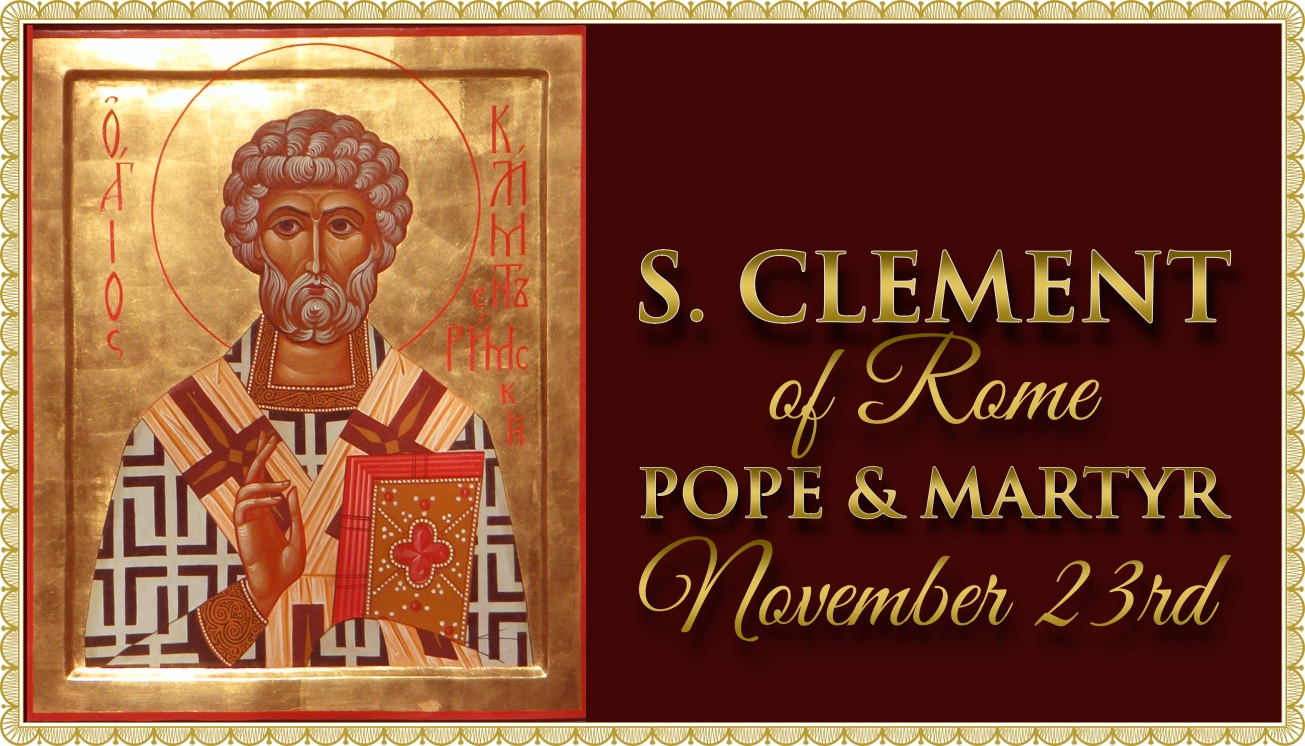
Today we celebrate St Clement of Rome, one of the earliest successors of St Peter, whose name we hear whenever the Roman Canon is offered. We know surprisingly little about his personal life, but possess something of greater importance: a letter which allows us to hear the voice of the Roman Church while the memory of the Apostles was still fresh.
Clement wrote to the Christians at Corinth towards the end of the first century. Certain presbyters had been removed from their ministry by a faction within the community, and the dispute had disturbed the peace of the Church. It is worth remembering that these difficulties arose within living memory of the Apostles. Those who imagine that ecclesiastical quarrels are a modern invention have evidently not read much early Christian history. Human nature was already quite recognisable.
What makes Clement’s response important is the principle upon which he proceeds. He does not treat the dispute as a contest between groups, each entitled to arrange the Church according to its preferences. He recalls the authority received from Christ through the Apostles, the order they established, and the obligation to preserve what had been entrusted to their successors.
He writes that Christ was sent from God and the Apostles from Christ, each according to the divine will. The Apostles preached the Gospel and appointed bishops and deacons in the communities they established. Clement continues that they made provision for other approved men to succeed those ministers when they died. His conclusion is that men who have faithfully exercised their ministry ought not to be removed without just cause.
Here we find an early witness to apostolic succession. The ministry of the Church was received from the Apostles and was intended to continue beyond their lifetimes. Its authority did not originate in the preferences of the congregation or the personal qualities of the minister. It belonged to an order established for the service of Christ’s people.
We must be careful when interpreting documents from this period. The precise relationship between bishops and presbyters was not yet expressed everywhere in the terminology which subsequently became universal. By the time of St Ignatius of Antioch, early in the second century, the threefold distinction between bishop, presbyters and deacons is unmistakable. Clement nevertheless provides testimony to the continuity of the apostolic ministry and the seriousness with which Christians regarded its transmission.
Today’s Gospel takes us to Caesarea Philippi, where Our Lord asks His disciples whom men say that He is. Peter answers, ‘Thou art Christ, the Son of the living God.’ Our Lord declares him blessed and promises, ‘Upon this rock I will build my church, and the gates of hell shall not prevail against it.’
The promise is given by Christ Himself. He establishes His Church upon Peter, entrusts him with the keys of the kingdom, and confers the authority of binding and loosing. The Church’s authority is received from her divine Founder and must remain subject to His purposes. Those entrusted with it are servants of the revelation they have received.
Clement’s intervention at Corinth is interesting in this respect. The dispute occurred outside Rome, yet the Roman Church addressed it with evident seriousness. Clement expected his appeal to be heard and proper order restored. We should avoid reading every detail of later canonical administration into this correspondence, but neither should we overlook what it reveals about Rome’s early concern for the wider Church.
There is another passage in Clement’s letter which deserves attention, especially when we consider the worship of God. He recalls the ordered sacrifices of the Old Covenant, in which the high priest, priests, Levites and people each possessed their appointed responsibilities. He then exhorts Christians to give thanks to God according to their proper order, with reverence and a good conscience.
Clement is drawing an analogy with the worship of Israel, and we should respect its limits. Nevertheless, his teaching reveals that liturgical order was regarded seriously. The worship of God was not an opportunity for individuals to invent whatever arrangements pleased them. It was to be conducted reverently, according to the responsibilities entrusted to those who served.
That principle remains relevant. The sacred liturgy belongs to the Church, and those who celebrate or assist at it are bound to respect its received order. The priest does not approach the altar as the proprietor of a ceremony which he may alter according to his tastes. He exercises a sacred ministry for the worship of Almighty God and the sanctification of the faithful.
But Clement’s teaching also reminds us that the laity have their proper place and responsibilities. Their participation in the worship of God is neither insignificant nor dependent upon performing the functions of the clergy. They unite themselves to the sacrifice, offer their prayers, receive the sacraments and carry the grace of the liturgy into their daily lives. Each serves God according to his vocation.
We should remember why Clement wrote in the first place. His concern was the restoration of peace among Christians whose divisions had become scandalous. He appealed repeatedly for humility, repentance and charity. He knew that the Church’s visible order could be damaged by pride, jealousy and the determination of individuals to have their own way.
We may recognise something of ourselves here. It is possible to defend a sound principle with an unsound disposition. We can become so occupied with proving ourselves correct that we forget the obligations of patience and charity. There are occasions when truth must be defended firmly, but even then we must examine whether we are serving Christ or merely gratifying our own importance.
Clement points his readers towards St Peter and St Paul, whose endurance under persecution provides an example of fidelity. Their greatness was proved through suffering for Christ. They had received the Gospel and given their lives to its proclamation. The same Faith which sustained them was entrusted to the Christians of Corinth, and has been handed down to us.
Today’s Epistle reminds us where that Faith must lead. St Paul tells the Philippians that our conversation, our citizenship, is in heaven. He warns against becoming absorbed in earthly things and directs our attention towards the Saviour who will transform our mortal bodies. The Church exists to bring men to that heavenly inheritance.
This gives us the proper measure of ecclesiastical activity. Buildings, institutions, administration and organisation have their necessary place, but their value depends upon their service to the salvation of souls. A bishop must teach the Faith and sanctify his flock. A priest must offer the Holy Sacrifice and administer the sacraments faithfully. The faithful must respond to grace through prayer, repentance, charity and perseverance.
The commemoration of St Felicitas brings the same lesson into the Christian household. Roman tradition remembers her courage as a mother and martyr. Whatever uncertainties surround the details of her Passion, the Church honours a woman who placed fidelity to Christ above even the deepest earthly attachments. Parents today may face different trials, but they too must teach their children that love of God gives every other love its proper place.
As Advent approaches, Clement’s witness invites us to consider how faithfully we have received what has been handed down. We cannot preserve the apostolic Faith merely by admiring its antiquity. We must believe it, practise it and allow it to govern our lives.
Let us therefore approach the sacraments with renewed seriousness, confess our sins sincerely, receive Holy Communion worthily, and fulfil the duties of our state with charity. May St Clement obtain for the shepherds of the Church fidelity to their sacred trust, and for all the faithful the grace to persevere in the truth received from the Apostles.
In the Name of the Father, and of the Son, and of the Holy Ghost. Amen.





Leave a Reply