

This Day Is Salvation Come to This House
MASS Terribilis est locus iste
EPISTLE Apocalypse 21:2–5
GOSPEL St Luke 19:1–10
HOMILIST Mt Revd Jerome Lloyd OSJV

In the Name of the Father, and of the Son, and of the Holy Ghost. Amen.
Carissimi, beloved in Christ
There is a rather striking detail in today’s Gospel which we might easily overlook. Zacchaeus wanted to see Our Lord, but the crowd was in his way. Being a short man, he climbed a sycamore tree. We know the story so well that we may miss the indignity of it. Here was a wealthy chief publican, a man accustomed to giving orders, scrambling up a tree like a schoolboy because he could not bear to miss the chance of seeing Jesus pass. He was prepared to look ridiculous. That may have been the first genuinely sensible thing he had done for some time.
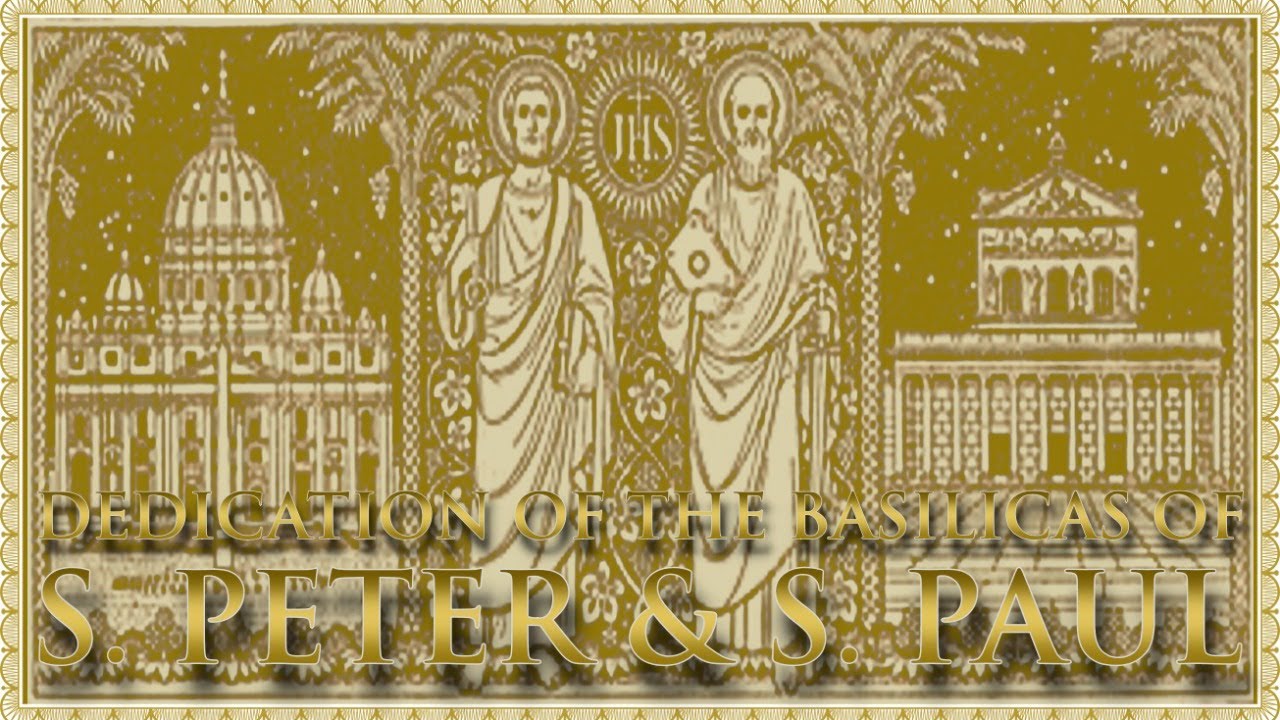
The Church gives us this Gospel on the feast of the Dedication of the Basilicas of Saints Peter and Paul in Rome. At first the choice might seem curious. We are celebrating two magnificent churches, built above places long venerated as the burial sites of the Apostles; and the Gospel speaks of a tax collector perched among the branches in Jericho. Yet the connection is wonderfully exact. A church is consecrated so that men may encounter Christ, and Zacchaeus shows us what happens when a man truly allows that encounter to change his life.
The basilica of St Peter which we see today was dedicated by Urban VIII on 18 November 1626. The present basilica of St Paul Outside-the-Walls was consecrated by Pius IX in 1854, following the terrible fire which destroyed much of its predecessor in 1823. Both stand in continuity with ancient Christian sanctuaries associated with the Apostles’ tombs. Centuries of architecture, sacrifice and devotion are gathered into these places. But we would misunderstand them if we imagined that their principal purpose was to preserve the achievements of Christian civilisation for the admiration of visitors.
The Introit gives us Jacob’s words at Bethel: Terribilis est locus iste, ‘How terrible is this place.’ Terrible here means awe-inspiring, a place before which a man ought to stand with reverence because God is present. Jacob had awakened from his vision to discover that the place where he had slept was the house of God and the gate of heaven. The Christian church possesses something greater still. Upon its altar the sacrifice of Calvary is made sacramentally present, and in its tabernacle Our Lord remains truly present beneath the appearances of bread.
We should therefore understand why Catholics have taken such care over their churches. The altar, the sanctuary lamp, the sacred vessels and the vestments all have their purpose. They teach us, often without a word being spoken, whom we have come to worship. Even the silence before Mass is a confession of faith. It says that we are in the presence of Someone to whom our ordinary conversations may reasonably give way. We ought to take care that our familiarity with a chapel does not make us careless in it.
Yet there is another danger, particularly for those who love the beauty and dignity of the traditional liturgy. We can become so attentive to the condition of the building and the correctness of the ceremonies that we fail to consider the condition of the soul which has come to worship. A church may be beautifully adorned while the people within it remain unreconciled to God. We may know precisely when to kneel and still be reluctant to kneel in the confessional. The outward reverence is good; it must lead us towards the inward conversion for which it exists.
That is where Zacchaeus becomes an uncomfortable companion. When Our Lord looked up into the tree, He did not merely reward the man’s curiosity. He called him by name and announced that He would stay in his house. Zacchaeus came down quickly and received Him with joy. The crowd complained, because they knew the man’s reputation. Publicans had opportunities for extortion, and this one had grown rich. Yet Christ had come to seek and to save what was lost. He saw a sinner who could still become a penitent.
Notice that Zacchaeus did more than express warm feelings about Jesus. He promised half his goods to the poor and fourfold restitution wherever he had defrauded another. His repentance entered the practical arrangements of his life. Money had to be surrendered; wrongs had to be repaired. There is a difference between regretting that our sins have made us unhappy and being willing to abandon the sins themselves. Zacchaeus did not ask Our Lord to admire his good intentions while he continued to profit from dishonesty.
This has a direct bearing upon confession. We approach the sacrament with sorrow for our sins and a firm purpose of amendment. Where justice requires restitution, we must make it as far as we reasonably can. A dishonest gain does not become honest merely because we have ceased to think about the person who suffered the loss. Nor can we treat absolution as permission to return cheerfully to the same deliberate occasions of sin. Grace enables us to begin again, but it calls for our cooperation.
The Epistle opens before us a different scene: St John sees the new Jerusalem descending from heaven, prepared as a bride adorned for her husband. He hears the promise that God will dwell with His people, and that death and mourning shall pass away. Here is the final destination towards which every consecrated church points. The basilicas of Rome, like the humblest mission chapel, are earthly places in which we receive the means of reaching that heavenly dwelling. Their stones will not endure for ever. The communion with God to which they direct us will.
There is particular consolation in remembering the Apostles whose names these basilicas bear. Peter denied his Master three times; Paul persecuted the Church before his conversion. Their authority and their sanctity were gifts of divine grace, received through repentance and fidelity. They did not found a religion of admirable men who had never needed forgiveness. They bore witness to the Saviour who had forgiven them. And they sealed that witness with their blood in Rome.
The Church built upon their apostolic testimony must therefore remain faithful to what they received and preached. Peter was charged to strengthen his brethren; Paul warned against another gospel, even were it announced by an angel from heaven. The splendour of their basilicas cannot supply for the loss of apostolic truth. We honour the Roman See most faithfully when we remember the purpose for which Christ established its ministry: to preserve His flock in the faith and lead souls to salvation.
That responsibility belongs in different ways to all of us. Parents must make their homes places where the Faith is taught and practised. Priests must offer the sacraments and speak the truth with charity. Every Catholic must examine whether his conduct at home and at work agrees with the reverence he shows at Mass. The person who lights a candle before an image of St Peter should also remember Peter’s tears of repentance. The person who venerates St Paul should remember how completely grace altered the direction of his life.
Perhaps today we might take Zacchaeus as our guide. He made an effort to see Christ; he accepted the Lord’s invitation; and he changed what needed changing. We have been given something he could scarcely have imagined: the Holy Sacrifice, the Blessed Sacrament, and the forgiveness of sins entrusted to the Church. Let us approach these gifts with gratitude and seriousness. Then the words spoken of the house of Zacchaeus may, by God’s mercy, be spoken also of our own souls: ‘This day is salvation come to this house.’
In the Name of the Father, and of the Son, and of the Holy Ghost. Amen.




Leave a Reply