
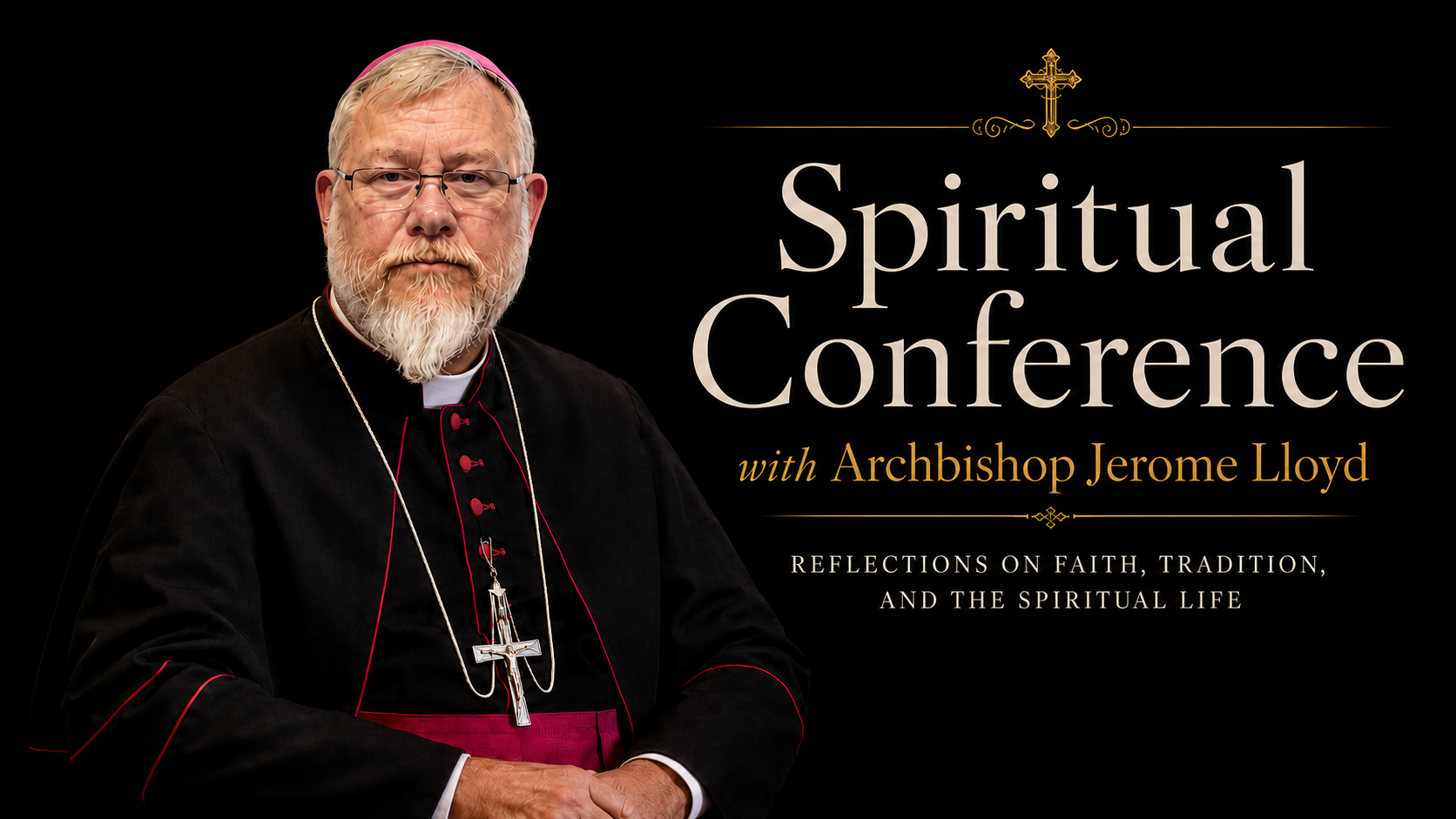
Learning to Think with the Church
HE ✠Jerome Lloyd, Titular Archbishop of Selsey and Primus of the Old Roman Apostolate
Beloved in Christ,
There are few things more irritating than discovering that somebody you disagree with is right. You’ve listened patiently, or at least made a reasonable show of it, and you’ve already got your reply prepared. Then an awkward little fact appears which rather spoils the argument. For a moment you have the opportunity to learn something. You also have the opportunity to change the subject, which can seem much more attractive.
I suspect we all know that moment. Our minds are remarkably resourceful when there’s something we’d rather not admit. We can find reasons for nursing a resentment, postponing an apology, or dismissing advice because we don’t much like the person who offered it. And what troubles me is that a Catholic can understand his religion very well on paper while being just as inventive as anybody else at evading its demands in practice. I include myself in that observation, naturally; priests have no special exemption from the temptation to be right.
In this week’s Nuntiatoria we’ve been considering education, the decline of serious reading, and the responsibility of handing on what we’ve received. Those subjects matter. But they raise a question which comes rather closer to home: what sort of minds are we allowing ourselves to acquire? We may be anxious about what children are being taught in school, and rightly so, without giving much attention to the habits of thought we’re practising ourselves.
We have resources which previous generations could scarcely have imagined. I can look up a passage from St Augustine, consult a missal, or find a historical document without leaving my chair. That is a considerable blessing. Yet it’s also possible to pick up the telephone to check a reference and emerge twenty minutes later having read three arguments, replied to a message and forgotten the reference altogether. The mind has been busy. Whether it has been well employed is another matter.
And that has a bearing upon prayer. If we spend the day leaping from one opinion or irritation to the next, it’s hardly surprising that we find it difficult to sit quietly before Almighty God. The saints knew all about wandering thoughts; they simply didn’t have quite so many people and devices competing to supply them. We need to recover the patience to attend to the truth, and the honesty to let it correct us when necessary.
St Paul says to the Romans, ‘And be not conformed to this world; but be reformed in the newness of your mind.’ He is speaking about conversion. We tend to think of conversion in terms of the sins a person gives up, the prayers he begins to say, or the sacraments he comes to receive. All these matter enormously. But St Paul reaches further. Even the way we see things must be changed by grace.
Now, that’s quite a demand. Most of us have spent years acquiring our view of the world. We inherited some of it from our parents, some from teachers, some from the company we kept when we were young. Experience added a great deal, including things we would rather not have learnt the hard way. Somewhere along the road we developed very firm opinions about people, politics, money, education and the conduct of almost everybody except ourselves. Those opinions can become so familiar that we no longer recognise them as opinions.
Then the Gospel asks us to examine them. Perhaps I have always admired success, but what do I mean by success if I believe my last end is Heaven? Perhaps I take satisfaction in being proved right, but how does that sit with charity? Perhaps I believe myself a patient person, provided nobody actually tests my patience. It’s in these ordinary places that our minds begin to be formed as Catholics.
There’s a mistake we should avoid at the outset. To have a Catholic mind does not mean having an ecclesiastical answer ready for every question. Nor does it mean leaving reason at the church door. Our Faith makes real claims about God and man, and therefore invites the serious use of the intelligence God has given us. The Church has spent centuries teaching, arguing, studying languages, preserving texts and establishing schools. She has no reason to be frightened of a sensible question honestly asked.
St Augustine was a man who asked a great many questions, often with an inconvenient persistence. He was intelligent, educated and quite capable of finding arguments to defend whatever he wished to believe. His Confessions show us that a brilliant mind can spend years travelling in the wrong direction. He had misconceptions about Christianity which were gradually corrected, not least through his encounter with St Ambrose. Yet even when he began to see the truth, he discovered another obstacle: he wasn’t ready to surrender the habits which contradicted it.
That’s very recognisable, isn’t it? A man may understand the Church’s teaching on forgiveness and still nurse a resentment he rather enjoys. He knows that charity requires him to stop rehearsing the offence, but every time he recalls it he finds some new detail proving that he was in the right. Eventually he has constructed a case so complete that he could present it to a jury, though the jury has never been asked to sit. The difficulty is no longer that he doesn’t know what Christ commands. He knows. He simply doesn’t want to do it.
A certain amount of religious education can leave that problem untouched. We may memorise the commandments, explain mortal and venial sin, understand the doctrine of the Real Presence and defend the indissolubility of marriage. We ought to know these things. But they have to enter our decisions. The point of knowing that our neighbour is made in God’s image is that we must treat him accordingly, including when he’s tiresome. The point of knowing that earthly life is brief is that we mustn’t live as though every inconvenience were a catastrophe.
This is why I’d be rather cautious of measuring Christian formation by the quantity of information a person can repeat. I’ve known people with little formal education whose judgement was deeply sound. They had paid attention to life, listened to the teaching of the Church, prayed faithfully and learnt how to put their own troubles in proportion. Conversely, an impressive command of theology does not always make someone a pleasant guest at supper. Knowledge is a good thing; we ought to acquire as much of it as we can use well. But it cannot do the work of virtue for us.
That brings us to children, because the way we begin matters. We spend a great deal of time discussing schools and very little asking what a child actually sees at home. A small child is learning long before he can read a sentence. He watches how adults speak to one another, what happens when somebody makes a mistake, whether a promise is kept and what becomes of a disagreement when the visitor has gone home. He learns which things matter by noticing what the family makes time for.
You can explain the importance of Sunday Mass very beautifully, but if Mass is always the first thing sacrificed when the weekend becomes inconvenient, the explanation won’t carry much weight. Children have an uncomfortable talent for noticing that sort of discrepancy. If, on the other hand, they see their parents praying when no one is looking, saying sorry when they’ve been unreasonable, and doing something kind for a person who can’t repay them, they’ve received an education which no examination could measure.
Pius XI spoke of the rights and duties of parents in Divini Illius Magistri. He was concerned that education should be understood in relation to the whole of man’s life and, above all, his supernatural end. Parents have a responsibility which cannot simply be transferred to the State; the Church too has her own teaching mission. These are not merely arrangements about who controls a classroom. They follow from what a human being is and what he’s for.
It is a strange thing that we can discuss a child’s future for hours without once asking what sort of adult we hope he’ll become. We worry about qualifications, employment, prospects, the cost of housing. I understand all of that. Families must live, and there’s nothing especially edifying about an unpaid electricity bill. But a child might grow up rich and accomplished and still be unable to apologise, tell the truth at personal cost, or keep faith with someone who has become inconvenient. I wouldn’t call that a complete education.
Nor should we treat questions from children as a threat. A young person who asks why the Church teaches something may be showing that he takes it seriously. Give him the reason, as far as he’s ready to understand it. If he asks about the Real Presence, explain what the Church means by Christ’s presence in the Eucharist. If he asks why marriage matters, don’t merely tell him that it’s a rule. Help him understand the promise, the good of husband and wife, and the children to whom that promise opens a home. And if he asks something you can’t answer, tell him you’ll find out. Parents aren’t diminished by learning alongside their children.
There is a difficulty here for many adults. Their religious education stopped when they were quite young, whereas everything else went on developing. They came to understand their work, relationships, public affairs and the complicated business of earning a living. Yet when a serious question about God arises, they may still have only the explanation they received at ten years old. It may have been a perfectly good explanation for a ten-year-old. They now need to grow beyond it without despising the simplicity in which they first learnt the Faith.
Newman is helpful here. In The Idea of a University he describes the cultivation of the intellect: the ability to see relations between subjects, weigh arguments and recognise where a question belongs. He also insists upon a distinction we mustn’t lose. Intellectual cultivation is not the same thing as moral goodness. A highly educated man can be selfish or vicious. Newman knew that a university may pursue a genuine intellectual good without thereby making its students saints. The Catholic has a further task, which is to bring his knowledge and his whole life into the service of God.
I should like us to recover the habit of reading for that reason. Not merely looking up a fact to settle an argument, but staying with a book long enough to be taught something. There is a certain humility in reading carefully. We allow someone who may have lived hundreds of years before us to finish his thought before we announce our opinion. We discover that an argument can be more subtle than its first sentence, and that our objection has perhaps been answered two pages later. It requires patience, which is already a useful exercise in virtue.
And perhaps we might begin to regard the education of the mind as something continuing throughout life. We don’t stop needing instruction when we receive Confirmation, take a degree, or reach an age at which people begin asking us for advice. Indeed, experience ought to make us more willing to learn. By then we have discovered how confidently one can hold a mistaken opinion, especially if one has held it for many years.
There is another quality I want us to consider, because it’s where all this becomes practical: prudence. We use the word rather loosely. A prudent person is someone who checks whether it might rain, keeps a spare set of keys and never quite trusts the train timetable. Those may be sensible habits. I can’t pretend to have mastered all of them. But St Thomas Aquinas means something more demanding when he speaks of prudence as right reason about things to be done.
Prudence helps us judge what we ought to do here, now, with these people and these circumstances. It requires knowledge of the moral law, but it also demands attention to reality. One must know when to speak and when to keep silence, when to wait and when delay would be cowardice. A person can be extremely cautious because he’s frightened of doing anything. That isn’t necessarily prudence. Sometimes the prudent thing is the difficult thing which cannot safely be postponed.
Suppose someone tells you an unpleasant story about a person you know. It’s an interesting story, and perhaps you never much liked the person concerned. Before you’ve finished listening, you find yourself remembering other incidents which seem to fit. You feel you’ve discovered what the fellow is really like. But have you? Who told the story? What does he know firsthand? What has been left out? Even if the account is true, who needs to hear it, and why?
The moral theologians distinguish calumny from detraction. To damage someone’s good name by a false accusation is calumny; to reveal genuine faults without a proportionate reason is detraction. Naturally, wrongdoing may sometimes need to be disclosed, especially where others require protection. Charity doesn’t demand that we hide a serious offence. But neither does the possession of a true story give us an unrestricted right to circulate it. The question often comes down to a rather awkward examination of our own motives.
I think this is one of the places where our present habits of communication do us very little good. We can hear an allegation in the morning and have it repeated across the world by lunchtime, accompanied by thousands of confident verdicts from people who know nothing beyond the first account. When a correction appears, it rarely travels quite as far. As Catholics, we shouldn’t have to be reminded that reputation belongs among the goods protected by justice. Yet we can be as careless with another person’s name as anybody else.
Prudence also teaches us to recognise when we lack sufficient information to judge. We don’t have to pronounce upon everything. Someone may ask what we think of a dispute, a public controversy or an ecclesiastical decision. If we don’t know the circumstances, there’s no shame in saying so. That isn’t the same as avoiding difficult questions. It is refusing to pretend to knowledge we do not possess. A person who can say ‘I don’t know enough yet’ has gained a freedom from the pressure to appear certain.
And there’s something else. The habits by which we reach a judgement are closely connected with the habits by which we pray. If we spend the day darting from one annoyance to another, responding immediately to every message and feeding our curiosity with whatever appears before us, should we be surprised that half an hour’s prayer feels difficult? We ask the mind to become recollected after giving it almost no practice in recollection.
Anyone who has tried mental prayer knows what happens. You begin with a passage of the Gospel, perhaps Our Lord in Gethsemane, and presently you’re thinking about a bill, an appointment, or whether the bins went out. Then you grow cross with yourself for being distracted, which becomes another distraction. It’s a familiar business. The saints were acquainted with wandering thoughts long before the invention of the smartphone. We needn’t be alarmed by an involuntary distraction, but we should return patiently to prayer and resist the habits which make attention unnecessarily difficult.
St Francis de Sales is a very good companion here. His Introduction to the Devout Life was written for people living amidst ordinary duties. He knew that devotion had to find its place in households, occupations and relationships. He doesn’t tell every Christian to seek the silence of a monastery. He teaches regular prayer, examination of conscience, the practice of virtue and fidelity to one’s state in life. There is a steadiness about his teaching which I find particularly useful. He expects us to persevere, and when we fail, to begin again without making an enormous drama out of our failure.
Sometimes we think we haven’t prayed well unless we have enjoyed it. We sit down expecting a feeling of peace and are disappointed when the mind won’t settle. But love is often shown most plainly when an action costs something. A man who says his prayers on a day when he’s tired and distracted has still turned towards God. A mother who makes room for a few minutes of prayer among a dozen interruptions may be offering something very precious. We mustn’t despise a small act of fidelity because it doesn’t feel impressive.
The same principle helps with spiritual reading. I wouldn’t ask someone with a demanding job and young children to spend two hours every evening in theological study. That would be a fine way of ensuring the books were never opened. Fifteen minutes with the Gospel, attentively read, could become a very fruitful habit. Read a passage, consider what Our Lord is doing and saying, and ask what it has to do with the way you live. If a sentence stays with you, let it stay. There’s no obligation to finish a chapter merely because you began one.
I would also suggest that we take care about what forms our religious imagination. If our only contact with Catholic affairs is through reports of scandal and argument, we may know a great deal about disputes and very little about prayer. It is possible to spend an entire evening reading about the Mass and still neglect to prepare properly for the Mass we shall attend tomorrow. We need to understand the difficulties facing the Church; some of them are serious, and pretending otherwise serves no one. But a Catholic ought to be nourished by something more enduring than the latest controversy.
That brings us to conscience, a word much used and not always well understood. People sometimes speak as though conscience were an inner vote whose result must be correct simply because it is sincerely cast. But conscience is a judgement about the moral quality of what we are doing or proposing to do. It is subject to truth. We are obliged to follow a certain judgement of conscience, yet equally obliged to form that conscience and correct it where necessary. Sincerity doesn’t turn an error into a virtue.
Consider somebody who has begun to suspect that a habit of his is wrong. He could seek advice, read the Church’s teaching, perhaps discuss the matter in confession. But he rather likes the habit, and fears what he might discover. So he avoids asking. After a while the discomfort lessens and he tells himself that his conscience is perfectly clear. It may feel clear; whether it has been properly formed is another matter. We are responsible for the ways in which we avoid unwelcome truths.
And sometimes the unwelcome truth is about ourselves. We can explain the duty of charity magnificently while being rather sharp with someone at home. We can speak of humility and resent being corrected. We can urge other people to examine their motives and remain astonishingly incurious about our own. I don’t say this in order to make everyone miserable with self-suspicion. The point of an examination of conscience is to see ourselves honestly in God’s presence, repent of what is wrong and receive His grace to begin again.
There is a danger for people who enjoy theology, which I think deserves an affectionate warning. We may become very accomplished at identifying somebody else’s mistake. We know the relevant distinction, the passage from a council, perhaps a paragraph from a respected theologian. We can produce it at the first sign of disagreement. That’s useful when the question genuinely calls for it. But there’s a kind of satisfaction in winning an argument which has very little to do with love of truth. We should occasionally ask whether we want our neighbour to understand, or simply to concede defeat.
St Thomas is a good corrective. His theological writings are immense in their intellectual achievement, yet his life was ordered by prayer and religious obedience. The Eucharistic hymns he composed for Corpus Christi show us doctrine becoming adoration. His understanding of the Blessed Sacrament did not make the mystery ordinary to him. It deepened his reverence. If our knowledge of theology makes us less attentive at Mass, less patient with the weak, or less inclined to pray, we ought to reconsider what use we’re making of it.
There is also a distinction between the wisdom which comes through experience and the supernatural gift of wisdom. St Thomas teaches that this gift of the Holy Ghost is connected with charity. By it the soul, under divine influence, is disposed to judge things in relation to God. It’s a gift of grace, not a reward for reading enough books. We should never imagine that theological qualifications automatically confer it.
Think of someone who has cared for a sick relative over many years. His understanding of self-sacrifice may be deeper than that of a man who can quote every recognised authority on charity but has never permitted his own comfort to be disturbed. Or think of a woman who has endured bereavement and, without pretending to explain suffering, has learnt to trust God’s Providence. She may have found a language of hope which is difficult to acquire in a classroom. Experience alone doesn’t make us holy, of course, but when suffering is united to faith and charity, God can teach us through it.
St Thérèse of Lisieux understood this beautifully. Her Little Way did not require extraordinary deeds or an impressive intellectual reputation. She understood the enormous importance of little acts offered to God with love, of confidence in His mercy, of accepting one’s weakness without allowing it to become an excuse. Her spiritual teaching is profound, and the Church’s recognition of her as a Doctor is a reminder that the knowledge of God cannot be measured simply in academic degrees.
I hope that will encourage those who find study difficult. Some people read slowly; others never had much opportunity for formal education. None of that places holiness beyond their reach. The Church asks us to receive and believe the truths God has revealed, to learn what we need for our Christian life, and to grow in charity. We should make use of our faculties according to our circumstances. The elderly person who patiently prays the Rosary and forgives an old injury may be making very good use indeed of the understanding God has given him.
It would be a mistake, however, to turn that consolation into an excuse for laziness. We all have something we can learn. A person who cannot read a theological volume may be able to listen to a chapter of the Gospel. A parent who has forgotten the catechism can recover it alongside the children. A man who thinks he knows his neighbour very well may discover, by listening for once without interruption, that he’s understood very little about him. Our education continues in places which never appear on a timetable.
And perhaps this is where age can do us some good. When we’re young we sometimes suppose that experience will eventually provide answers to everything. Later we discover how complicated people are, how much our judgements depend upon circumstances we don’t see, and how often we’ve mistaken a first impression for the whole truth. If that knowledge makes us more patient, age has taught us something worthwhile. If it merely makes us more certain that everyone else is foolish, perhaps we’ve missed a lesson or two.
I’ve been thinking, too, of Our Lady. St Luke twice tells us that she kept the events surrounding Our Lord’s childhood in her heart. She had heard the shepherds, witnessed the marvels of Bethlehem, and later endured the anxiety of searching for the Child Jesus in Jerusalem. She did not treat these things as news to be received and then displaced by the next remarkable event. She pondered them. She remained attentive to what God was revealing, even when she did not yet understand all that was involved.
There is a great deal to learn from that quiet attention. Our lives contain moments we scarcely notice at the time: an act of kindness, a rebuke we needed, a prayer answered in an unexpected way, a difficulty which exposes something of our pride. We hurry onwards, anxious to settle the next matter. Our Lady teaches us to keep these things before God, to allow memory and prayer to deepen our understanding. The Rosary itself trains us in that way of looking, returning us again and again to the mysteries of Christ’s life.
I would like us to attempt something simple this week. Choose a passage of Scripture or a chapter from a good spiritual book, and give it a short, undisturbed period each day. Don’t measure success by the number of pages. Take one thought seriously enough to carry it into your work, your family life or your prayers. If you’re reading about forgiveness, think of the person with whom you need to make peace. If you’re reading about Providence, remember what has been making you anxious. Give the truth somewhere to live.
And while you’re at it, try a small discipline in conversation. When someone says something you dislike, let him finish. Ask what he means before correcting him. If he turns out to be wrong, you can still explain why. If he turns out to have seen something you missed, you’ve gained more than you would have gained by winning the argument. There’s no humiliation in learning. Most of us could do with practising that a little more often, beginning with me.
I don’t want to send you away with a new burden of intellectual self-improvement. Most people have enough obligations already. I want us to remember what our minds are for. We have been given the capacity to know truth, and faith has opened to us truths which reason alone could never discover. We are to receive them gratefully, think about them honestly and allow them, with the help of grace, to change our lives. A Catholic who knows the right answer but remains unwilling to act upon it has more growing to do; so have we all.
There will be days when the growth is hardly perceptible. You may read a page and forget most of it. You may make an effort to be patient and fail before lunchtime. You may return to confession with a fault you thought you had conquered years ago. Begin again. God has not ceased to teach you. Indeed, one of the blessings of the Christian life is that we remain disciples for as long as we live. We never graduate from the need for grace.
So when you next sit down with that book, or open the Gospel, or find yourself listening to somebody whose opinion differs from yours, remember that these ordinary moments can become part of your formation. Be attentive. Be teachable. Ask Our Lady, Seat of Wisdom, to help you keep the words of her Son in your heart. And ask the Holy Ghost to bring what you know into closer agreement with the way you live. That would be a good beginning for the week, and a very good use of the mind Almighty God has given us.





Leave a Reply