

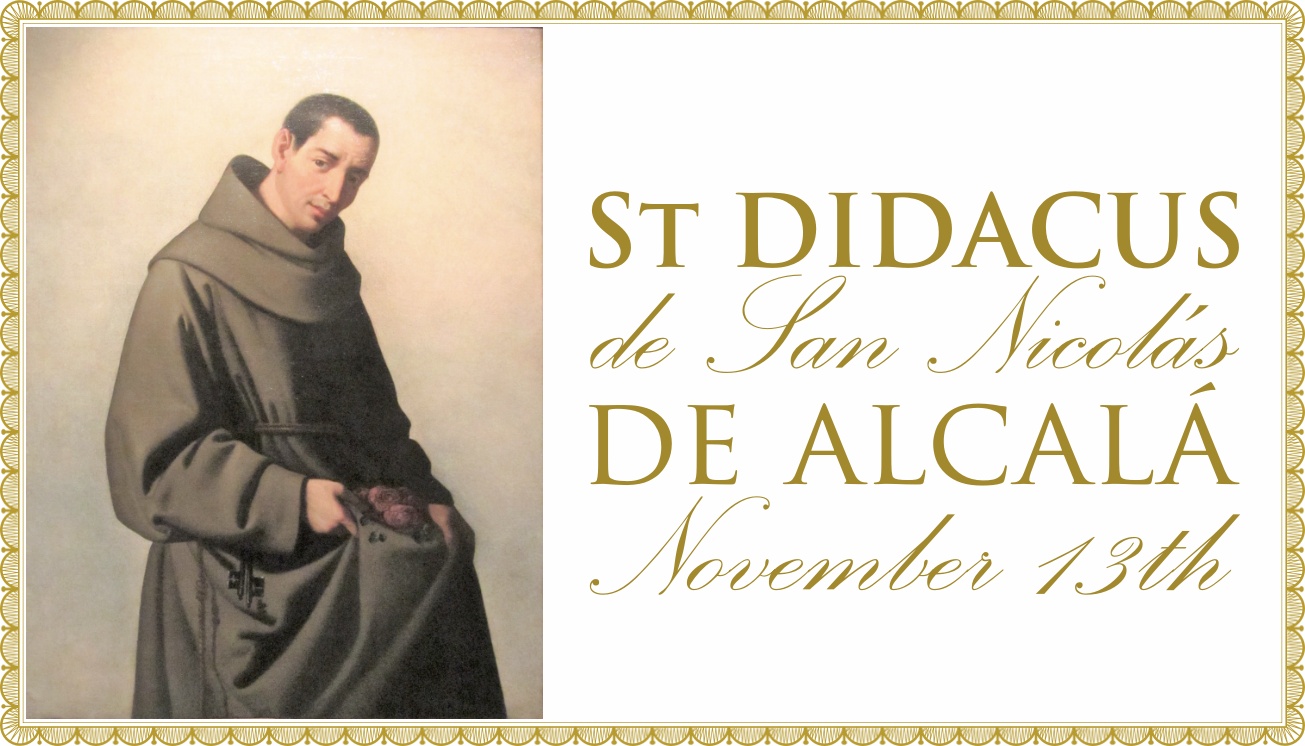
St Didacus of Alcalá: The Wisdom of Those Who Possess Nothing
MASS Justus ut palma
EPISTLE 1 Corinthians 4:9–14
GOSPEL St Luke 12:32–34
HOMILIST Mt Revd Jerome Lloyd OSJV

In the Name of the Father, and of the Son, and of the Holy Ghost. Amen.
My dear brethren,
In the year 1450, Rome was celebrating the canonisation of St Bernardine of Siena, the great Franciscan preacher whose voice had stirred the consciences of princes and common people throughout Italy. Among the friars who travelled to Rome for the occasion was a Spanish lay brother named Diego, whom we honour today as St Didacus of Alcalá. Bernardine had preached before multitudes; Diego had spent much of his religious life performing the ordinary duties of a Franciscan community. Yet the same Church which raised Bernardine to the honours of the altar would eventually place Diego beside him. There is something rather wonderful in that, because it reminds us how differently God measures the worth of a man’s life.
The Collect of today’s Mass gives us the explanation. Almighty God, we are told, chooses the weak things of the world to confound the strong. It is a familiar enough passage from St Paul, but we ought to consider what the Church means by placing it upon our lips in honour of this particular saint. God does not despise learning, ability or distinction. Indeed, some of His greatest saints possessed all three in abundance. Yet these qualities, which men are naturally inclined to admire, become spiritually fruitful only when they are surrendered to His service. A man may possess considerable knowledge of divine things without having acquired much knowledge of God Himself.
Diego was born of poor parents near San Nicolás del Puerto in Spain, sometime around the beginning of the fifteenth century. As a young man he received spiritual direction from a hermit before entering the Franciscan Order as a lay brother. He had little formal education, but he possessed something which his religious brethren soon recognised: a profound understanding of the spiritual life, acquired through prayer, obedience and the patient discipline of his own will.
In 1445 he was appointed guardian of the Franciscan community on Fuerteventura in the Canary Islands. It was an unusual appointment, since the office was ordinarily entrusted to a priest. Yet his brethren evidently discerned in him the prudence and spiritual judgement necessary for its exercise. One suspects that they understood something which is occasionally forgotten whenever offices and qualifications become the principal measure of a man’s worth: the ability to govern others begins with the ability to govern oneself.
There is a lesson here for us, although perhaps not quite the one we might first imagine. We often admire the humility of the saints because it appears so attractive at a distance. We are rather less enthusiastic when Providence gives us an opportunity to practise it. Humility is agreeable enough when someone else is being humble. It becomes considerably more demanding when our own opinion is disregarded, when another receives the recognition we hoped for, or when obedience requires us to accept a decision which we would not ourselves have made.
Yet this is precisely where the spiritual life begins to acquire substance. We cannot become holy merely by admiring holiness. Grace must be permitted to change the manner in which we think, judge, speak and act. The man who cannot bear to be contradicted will find it difficult to follow a crucified Saviour, however admirably he may be able to explain the doctrine of the Cross.
Today’s Epistle brings this home with considerable force. St Paul describes the Apostles as fools for Christ’s sake, despised, persecuted, hungry and without a fixed dwelling. Yet he speaks of these sufferings without resentment, because he knows whom he serves. He is not pursuing the world’s approval, and consequently the world’s disapproval cannot determine his fidelity. His freedom comes from belonging entirely to Christ.
We see something of that same freedom in Didacus when, having travelled to Rome, he undertook the care of the sick at the Franciscan convent of Ara Coeli. His biographers record remarkable cures through his prayers, but I think we ought to dwell for a moment upon the circumstances in which those miracles occurred. He was tending the sick. There were wounds to dress, bodies to wash, discomforts to endure and the daily demands of men who could offer him little in return. Such work rarely attracts public admiration, and the person who performs it faithfully may pass through life almost unnoticed.
Our Lord, however, has told us that even a cup of cold water given in His name shall not lose its reward. The infirmary at Ara Coeli was therefore a place in which Diego encountered Christ Himself, present in the suffering members of His Mystical Body. What he did for them he did for his Saviour. His charity was something which could be seen and touched, and which cost him his own comfort.
That consideration brings us naturally to the Gospel. Our Lord tells His disciples to make for themselves a treasure in heaven which neither thief can steal nor moth destroy, adding those searching words: Ubi enim thesaurus vester est, ibi et cor vestrum erit. “For where your treasure is, there will your heart be also.”
We should notice that He does not ask where we would like our treasure to be, or even where we believe it ought to be. He tells us that our hearts will inevitably follow what we treasure. We may profess that God is first in our lives, and sincerely intend that He should be, whilst discovering that our peace of mind depends upon a hundred lesser things. We worry about what others think of us, become anxious about possessions, resent the success of another, or allow some passing disappointment to occupy our thoughts long after we have ceased to remember our prayers.
None of this means that ordinary responsibilities are unimportant. The husband and father who works to provide for his family is fulfilling a serious obligation before God. The widow who carefully manages her savings is exercising prudence. The Church has never taught that poverty, considered simply as the absence of possessions, makes a man holy. What matters is whether these things remain subject to God, and whether our hearts are sufficiently free to surrender them when fidelity to Him requires it.
For Didacus, that surrender took the particular form of Franciscan poverty. For most of us, it will be expressed in the faithful discharge of obligations which we have already undertaken, in generosity towards those who have less than ourselves, and in the readiness to accept the sacrifices which charity demands. There is no need to seek extraordinary mortifications whilst neglecting the opportunities for self-denial which appear at our own door.
And perhaps here we should consider the opening words of today’s Gospel, which are so easily overshadowed by the command to renounce earthly treasure. Nolite timere, pusillus grex. “Fear not, little flock.”
Our Lord speaks these words to disciples who have very little worldly security. He does not promise them an easy passage through life, or assure them that fidelity will always be rewarded with visible success. He promises them the kingdom of His Father.
That promise ought to sustain us amid the present difficulties of Catholic life. There is much which rightly concerns the faithful, and no Catholic should suppose that indifference to error or the abandonment of sacred tradition can be excused as spiritual detachment. Yet the Church’s supernatural life continues through the grace of Christ, communicated in the sacraments and bearing fruit in souls. Our responsibility is to remain faithful to what we have received, and to ensure that our concern for the preservation of the Faith is accompanied by its active transmission to others.
We cannot restore what has been lost merely by lamenting its disappearance. A child must still be taught to pray. Someone must instruct the convert, encourage the doubtful, visit the sick and help the sinner find his way back to confession. The Church has always depended upon such hidden acts of fidelity, and much of her history has been written by people whose names never appeared in any chronicle.
When Didacus died at Alcalá on 12 November 1463, tradition records that he held the crucifix and repeated the words of the ancient hymn: Dulce lignum, dulces clavos, dulce pondus sustinet — “Sweet the wood, sweet the nails, sweet the burden they sustain.”
Here, surely, was the secret of his life. He had learned to recognise in the Cross of Christ the measure of everything else. The poverty he embraced, the obedience he practised, the sick whom he served, and the sacrifices which accompanied his religious vocation had prepared him for that final surrender which every Christian must one day make. His treasure had long since been placed beyond the reach of death.
In a few moments we shall approach the altar upon which the Sacrifice of Calvary is made sacramentally present. The Lord Who possessed nothing upon the Cross gives Himself to us beneath the appearances of bread and wine. We have little enough to offer Him in return, save the hearts which He has already redeemed. Let us ask St Didacus to obtain for us the wisdom to give Him those hearts without reserve, so that when our own final hour comes, we too may embrace the Cross with confidence, and discover that everything surrendered for the love of Christ has been preserved for eternity.
In the Name of the Father, and of the Son, and of the Holy Ghost. Amen.
Homilies Archive

Mass Propers


DAILY MASS ONLINE
One of the earliest online apostolates dedicated to the Traditional Latin Mass, Old Roman TV began broadcasting the Holy Sacrifice on the Feast of the Assumption, 15 August 2008. During the COVID-19 pandemic, additional programming — devotions, catechesis, and conferences — was added to support the faithful in prayer and formation.
Support the daily Holy Mass on Old Roman TV by offering a Mass intention — for loved ones, thanksgiving, or the repose of souls. Your intention helps sustain the sacred liturgy and brings grace to those you remember before God’s altar.
SUPPORT THE DAILY MASS ONLINE
Likely the world’s longest-running daily online broadcast of the
Traditional Latin Mass, streaming faithfully since the
Feast of the Assumption 2008.

This apostolate cannot continue without immediate help
Please support us with a contribution toward
chapel rent, sacristy supplies, operating costs, and web-hosting.
Our essential monthly costs reach £1,000.




Leave a Reply