

The Virgin of the Temple: Mary’s Hidden Consecration and the Dawn of Redemption
MASS Salve sancta parens
LESSON Proverbs 8:22-35
GOSPEL St Matthew 1:1-16
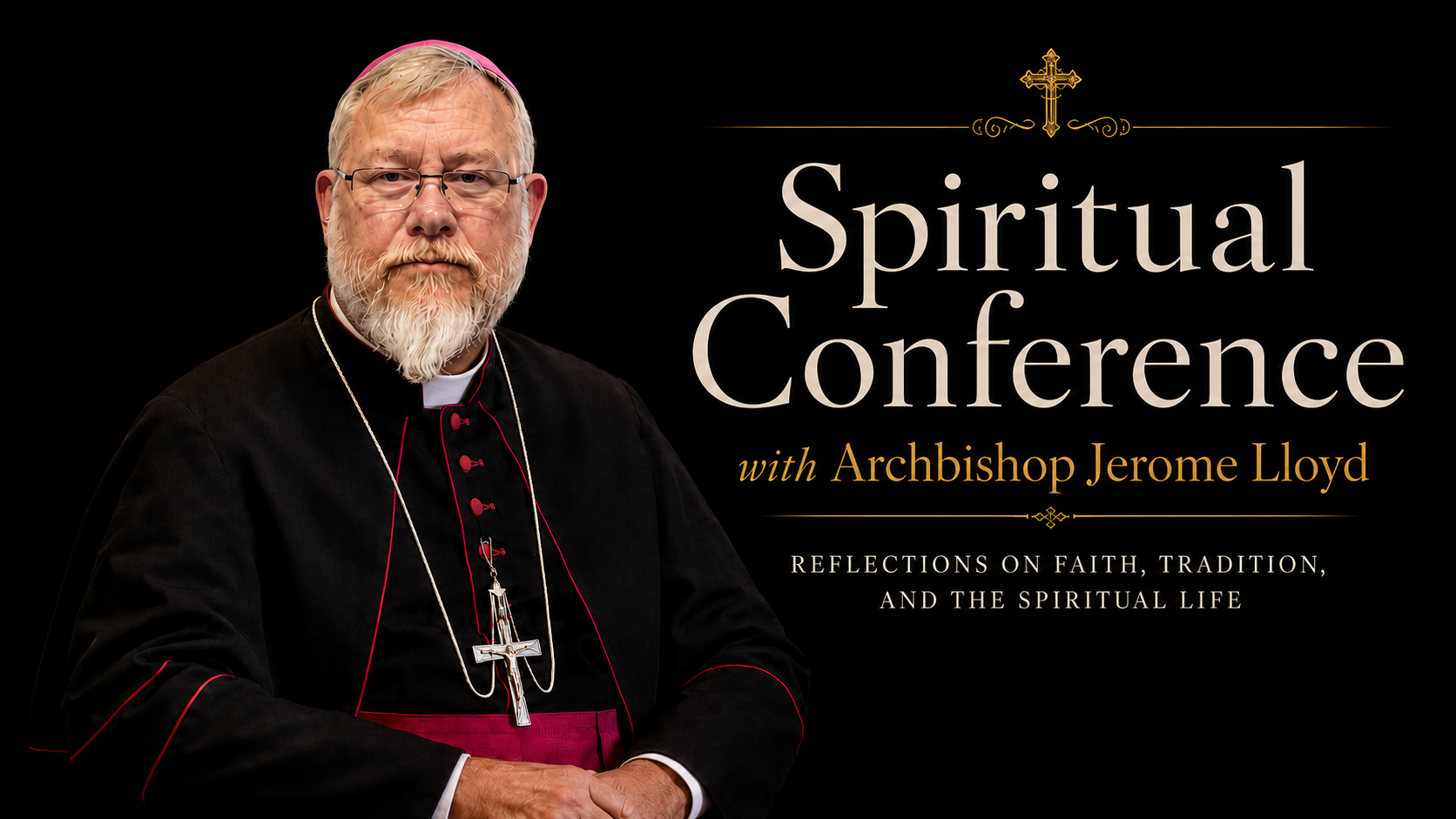
HOMILIST Mt Revd Jerome Lloyd OSJV

In the Name of the Father, and of the Son, and of the Holy Ghost. Amen.
The Church lingers in joy during this Octave of the Nativity of the Blessed Virgin, for her birth is no private or accidental event, but the dawn of salvation. From her the Savior will be born; in her the new creation begins. St. Paschasius Radbertus, writing in the ninth century, marveled that the Church celebrates only three earthly birthdays in her liturgical calendar: Our Lord, St. John the Baptist, and the Blessed Virgin Mary, since each of these is bound up directly with the Incarnation itself.^1
Tradition recalls that St. Joachim, the father of Mary, was himself a priest of the Temple, as Zachariah would later be, the father of John the Baptist (Luke 1:5). Thus, Mary grew up within a household steeped in priestly service. Just as the Old Testament priests were custodians of the covenant, so the one born to them would herself become the Ark of the New Covenant, the living tabernacle of the Word made flesh.
Joachim and Anna, long barren but blessed in their old age with a child, offered her to the Lord in thanksgiving, fulfilling their vow. This act places them in the company of Israel’s great intercessors. Hannah, for example, vowed to dedicate Samuel to the Lord, saying: “I will offer him to the Lord all the days of his life” (1 Sam. 1:11, 28). The pattern is clear: the first fruits are given to God, raised in His house, consecrated for His glory.
The Protoevangelium of St. James (c. A.D. 150), though apocryphal, preserves the earliest Christian meditation on Mary’s childhood. At the age of three, she was led in solemn procession to the Temple, and the text recounts that the child “ran up the steps” without looking back, as if drawn already by divine love.^2 There she joined the company of virgins who served in the Temple precincts, sometimes called oblates.
Josephus notes that “a multitude of women were attached to the service of the Temple” (Antiquities 8.5.3), assisting in works proper to their station. Their duties, according to Jewish sources and later patristic reflection, included weaving the veils and vestments, preparing incense and vessels, maintaining the sacred precincts, and—significantly—assisting in the preparation of the flour used for the Bread of the Presence.
The Bread of the Presence (or Showbread, Hebrew lehem ha-panim) was to be placed before the Lord each Sabbath (Exod. 25:30; Lev. 24:5–9). The Mishnah (Menahoth XI.2–7) prescribes that the flour was to be sifted eleven times, then baked into twelve loaves representing the tribes of Israel. Only priests could eat this bread, but lay and female assistants could prepare its materials. Thus, while Mary could not have baked the loaves themselves, it is historically plausible that she helped to grind, sift, or prepare the flour, just as the women of Exodus 35:25–26 spun and wove the materials for the tabernacle.
Here the typology shines: the Virgin who once prepared the flour for the bread of the Old Covenant would one day give to the world the true Bread of Life, her Son Jesus Christ (John 6:35). The veil she may have woven foreshadowed the veil of His flesh (Heb. 10:20). In her childhood service the realities of the New Covenant are already being prepared.
It was within this Temple life that Mary consecrated herself wholly to God in virginity. Most Temple virgins, after a period of service, left to marry. Mary, however, made an extraordinary vow to remain a virgin forever. St. Ambrose calls her “the pattern of virginity,” noting that her purity was of both body and soul.^3 St. Augustine affirms that “Mary’s holiness was already total when she conceived the Holy One.”^4
Her later betrothal to St. Joseph, far from contradicting this vow, was its providential safeguard. In Jewish society, a woman without a husband or protector was exposed to suspicion and dishonour. God therefore entrusted her to Joseph, “a just man” (Matt. 1:19), who became the faithful guardian of her purity. St. Augustine explains: “She was espoused to Joseph, lest her condition bring reproach, but she was filled with Christ, lest her virginity be corrupted.”^5 St. John Chrysostom calls Joseph “the faithful servant set over the Virgin’s purity.”^6 Their marriage was virginal, a true union of fidelity and guardianship, designed by God so that the world might witness both her maternity and her inviolate consecration.
Thus, when Gabriel greeted her, Mary’s words—“How shall this be, since I know not man?” (Luke 1:34)—were not hesitation, but fidelity to her vow. And God crowned her gift not by taking it away, but by exalting it beyond nature: virginity joined to motherhood, purity ennobled by fruitfulness. St. John Damascene exclaims: “O Temple in which God was contained, O Ark in which the Word sanctified His dwelling, O Virgin, raised in the Temple to become the Mother of God!”^7
Today’s Epistle (Prov. 8:23–35) seems to speak prophetically of her: “Blessed is the man that heareth me, and watcheth daily at my gates, and waiteth at the posts of my doors.” Who more than Mary watched daily at the gates of the Temple, hearkening to Wisdom, until Wisdom Himself took flesh within her?
With her feast today is joined the memory of the martyrs Protus and Hyacinth, Roman brothers who shed their blood for Christ under Valerian. Their witness reminds us that the fruit of Mary’s consecration is not for herself alone. From her virginal womb came forth the Lamb, and from the Lamb comes the host of martyrs. Her nativity leads not only to Bethlehem’s joy but to Calvary’s victory, and to the courage of those who love not their lives unto death (Rev. 12:11).
Dear brethren, the lesson is plain. God begins His greatest works in silence, in hiddenness, in consecration. The salvation of the world began with a child in the Temple, a virgin whose heart was wholly His. Our Lady’s hidden childhood, her weaving of the veil, her preparation of the bread, her vow of virginity, and her betrothal to Joseph—all these were preparation for the Incarnation.
We, too, are invited to imitate her temple-life: lives of prayer, purity, fidelity, and self-offering. Let us become living temples, dwelling places of Christ, witnesses before the world. Then the peace promised in today’s Collect will be ours: the peace of belonging wholly to Christ, the fruit of Mary’s nativity, the crown of her consecration, and the witness of the martyrs who follow the Lamb wherever He goes.
In the Name of the Father, and of the Son, and of the Holy Ghost. Amen.
- Paschasius Radbertus, De Nativitate Sanctae Mariae, PL 120:1369.
- Protoevangelium of St. James, ch. 7–8.
- St. Ambrose, De Virginibus, I.
- St. Augustine, Sermon 25: On the Annunciation of the Lord.
- St. Augustine, Sermon 51, PL 38:342.
- St. John Chrysostom, Homily on Matthew V.3.
- St. John Damascene, Homily on the Presentation of the Blessed Virgin Mary.
- Josephus, Antiquities of the Jews, VIII.5.3.
- Mishnah, Menahoth XI.2–7.
Homilies Archive

Mass Propers


DAILY MASS ONLINE
One of the earliest online apostolates dedicated to the Traditional Latin Mass, Old Roman TV began broadcasting the Holy Sacrifice on the Feast of the Assumption, 15 August 2008. During the COVID-19 pandemic, additional programming — devotions, catechesis, and conferences — was added to support the faithful in prayer and formation.
Support the daily Holy Mass on Old Roman TV by offering a Mass intention — for loved ones, thanksgiving, or the repose of souls. Your intention helps sustain the sacred liturgy and brings grace to those you remember before God’s altar.
SUPPORT THE DAILY MASS ONLINE
Likely the world’s longest-running daily online broadcast of the
Traditional Latin Mass, streaming faithfully since the
Feast of the Assumption 2008.

This apostolate cannot continue without immediate help
Please support us with a contribution toward
chapel rent, sacristy supplies, operating costs, and web-hosting.
Our essential monthly costs reach £1,000.


Leave a Reply