

The Harvest God Seeks
MASS Exsultáte Deo
LESSON Amos 9:13-15 & 2 Esdra 8:1-10
GOSPEL St Mark 9:16-28
HOMILIST Mt Revd Jerome Lloyd OSJV

In the Name of the Father, and of the Son, and of the Holy Ghost. Amen.
“This kind can go out by nothing, but by prayer and fasting.” (Mark 9:28)
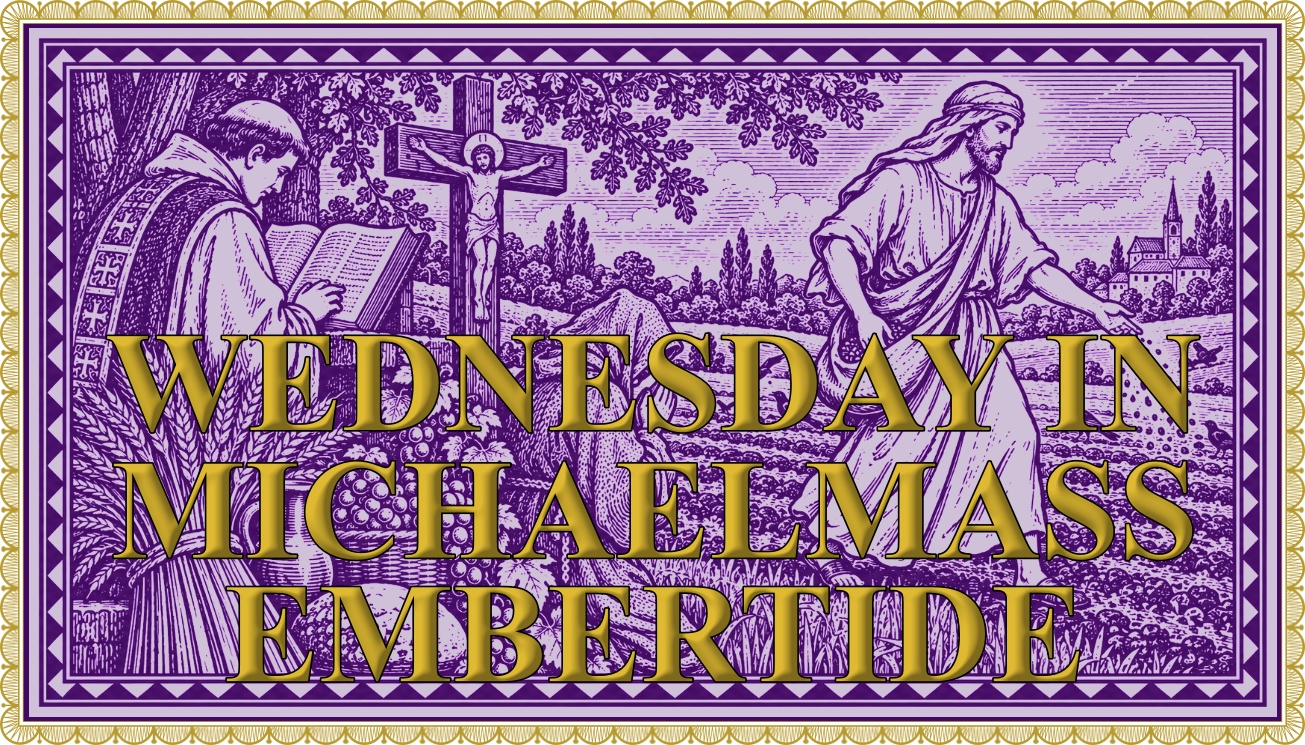
The Church begins this autumn fast with abundance. That is the first surprise of today’s Mass. Before she speaks to us of demons, weakness and fasting, she places before us the prophecy of Amos: “The ploughman shall overtake the reaper, and the treader of grapes him that soweth seed: and the mountains shall drop sweetness.” (Amos 9:13) The fields are full, the vineyards heavy, the harvest secure. And precisely then the Church tells us to fast. She does not wait until there is nothing upon the table. She asks us to abstain when there is plenty. That is because Christian fasting is not contempt for the goodness of creation. It is the refusal to mistake creation for the Creator. The September Ember Days arrive when the earth has borne its fruit so that man may ask whether he has borne his.
Today’s Roman station is at St Mary Major. That is no accidental decoration in the Missal. We begin Michaelmas Embertide beneath the patronage of the Mother of God, and no creature shows more perfectly what fruitfulness before God means. The Fathers loved to see Our Lady as the good earth which receives the divine seed without resistance and brings forth the Blessed Fruit, Jesus Christ. In her there is no conflict between hearing and obeying. The word of God is received, and immediately becomes life. She hears, “Behold thou shalt conceive”; she answers, “Behold the handmaid of the Lord”; and the Word is made flesh. The station at St Mary Major therefore places before us, at the very beginning of the Ember fast, the pattern of every Christian soul. God speaks; grace is given; fruit must follow.
The first Lesson from Amos shows us the generosity of God. Israel will rebuild, plant vineyards, make gardens and enjoy their fruit. The picture is deliberately rich. Catholicism has never taught us to despise bread, wine, harvest, home or human rejoicing. They are gifts. The danger lies elsewhere. Fallen man has an astonishing ability to receive gifts until he forgets that they are gifts. A full barn can produce gratitude, but it can also produce the illusion of independence. A comfortable life can move us to praise God, or it can gradually persuade us that we no longer need Him.
That is why the old Roman Church placed fasting beside harvest. At the very moment when nature says, “Take”, the Church says, “Give thanks.” When abundance says, “Have more”, the Church says, “Go without something.” When possession whispers, “This is yours”, the Church answers, “Everything is received.” St Leo the Great, preaching these very seasonal fasts to the Christians of Rome, returned repeatedly to the threefold work of prayer, fasting and almsgiving. Fasting which merely leaves more food in the cupboard has missed its purpose. What appetite surrenders, charity should learn to give. The Ember fast is meant to loosen not only the hold of food upon the body, but the hold of possessions upon the heart.
Then the second Lesson takes us somewhere apparently different. Esdras stands before the people and reads the book of the Law. (2 Esdras 8) They listen from morning until midday. The text is explained so that they understand it, and when they understand it, they begin to weep. There is a lesson here which our age badly needs. Israel does not discover sin by consulting its feelings. It hears God’s Law. Repentance begins when man allows himself to be judged by something higher than himself.
We live in an age which very readily asks, “How do I feel about this?” and much less readily asks, “What has God commanded?” Yet conscience is not the invention of a private morality. It must be formed by truth. Esdras reads; the people listen; understanding comes; tears follow. And still the story does not end in misery, because they are told, “The joy of the Lord is our strength.” True repentance does not leave the sinner staring endlessly at himself. It restores him to God.
So the first Lesson gives us the fruit of the earth, the second the word of God. Then the Gospel reveals why neither abundance nor knowledge is enough. A father comes to Christ with a son horribly afflicted by an unclean spirit. The disciples have attempted to deliver him and failed. The father utters one of the most perfect prayers in Scripture: “I do believe, Lord: help my unbelief.” Christ commands the spirit to depart, takes the child by the hand, and raises him up. Afterwards the disciples ask Him privately why they could not cast it out. Our Lord replies: “This kind can go out by nothing, but by prayer and fasting.”
The Fathers saw in that answer something far larger than a rule for exorcism. St John Chrysostom, commenting upon the parallel Gospel, speaks of fasting as a companion of prayer which makes the Christian formidable to the demons because it weakens the tyranny of the passions. The point is not that food is evil, nor that holiness consists in making oneself miserable. The enemy exploits disorder. If every appetite must immediately be obeyed, if every irritation must be expressed, if every curiosity must be satisfied, if every comfort is treated as indispensable, the will gradually loses the habit of command. Then when a grave temptation comes, we discover that we have spent years teaching ourselves the opposite of self-mastery.
St Thomas Aquinas therefore says that fasting serves three ends: it restrains the concupiscence of the flesh, disposes the mind towards contemplation, and makes satisfaction for sin. Notice the order. Fasting is not war against the body. It is the restoration of government. The body is good, but appetite must obey reason; reason must be enlightened by faith; and the whole man must be ordered towards God. If a horse throws its rider, the solution is not to kill the horse. It is to restore the reins.
This is where today’s Gospel becomes uncomfortable. The disciples are not unbelievers. They are Christ’s own followers. They have received authority from Him. They have already seen His power. Yet they encounter an enemy before whom their confidence proves insufficient. There are spiritual battles which cannot be won on yesterday’s grace, yesterday’s fervour or yesterday’s reputation. No amount of having once prayed well makes prayer unnecessary today. No previous act of self-denial exempts us from present discipline.
And this is why Embertide is so useful. It interrupts our spiritual complacency. It asks us to begin again. Perhaps our prayer has become mechanical. Perhaps resentment has been carefully preserved while we have continued to receive Holy Communion. Perhaps our temper is excused because “that is simply how I am”. Perhaps we have become unable to sit quietly without entertainment, unable to pass a shop without buying, unable to leave an opinion unspoken, unable to accept inconvenience without complaint. None of these things seems dramatic. That is precisely why they matter. Character is formed largely through small acts of obedience or small acts of surrender.
Prayer and fasting attack the illusion that we are sufficient to ourselves. Fasting says, “I do not have to obey every appetite.” Prayer says, “But I cannot conquer myself without God.” The two belong together. Fasting without prayer can become pride. Prayer without self-denial can become pious sentiment. Joined together, they place the whole person before God: body, mind, appetite, will and soul.
And once again the station at St Mary Major shows us the opposite of spiritual sterility. Our Lady does not merely hear the Word; she keeps it. She does not merely receive grace; grace becomes fruitful in her. The Church brings us to Mary’s basilica on this Ember Wednesday because the Christian life is not measured finally by what we have received but by what grace has produced.
The earth has produced its autumn harvest. The vine has done what it was created to do. The field has answered sun and rain with grain. We have received far more than the earth: Baptism, absolution, Holy Communion, Scripture, the teaching of the Church, repeated mercies, repeated warnings, repeated opportunities to begin again. And so the real examination of Embertide is not complicated. Has all this grace made us more charitable, more patient, more truthful, more recollected, more forgiving, more willing to sacrifice? Or have we accumulated religious things without becoming fruitful?
The father’s prayer gives us hope: “I do believe, Lord: help my unbelief.” He does not bring Christ perfect faith. He brings weakness honestly confessed. That is enough to begin. Ember Wednesday is not for those who have already mastered themselves. It is for Christians willing to admit that there remain things in us which will not go out without prayer and fasting.
The earth bears fruit because it cannot refuse the law God has written into it. Man alone can receive grace and resist.
May Our Lady of St Mary Major teach us to receive the word as she received it, to obey it as she obeyed it, and to bear fruit from it as she bore the Fruit of salvation.
The Lord of the harvest has given us another season.
When He comes seeking fruit, may He find it.
In the Name of the Father, and of the Son, and of the Holy Ghost. Amen.
Homilies Archive

Mass Propers


DAILY MASS ONLINE
One of the earliest online apostolates dedicated to the Traditional Latin Mass, Old Roman TV began broadcasting the Holy Sacrifice on the Feast of the Assumption, 15 August 2008. During the COVID-19 pandemic, additional programming — devotions, catechesis, and conferences — was added to support the faithful in prayer and formation.
Support the daily Holy Mass on Old Roman TV by offering a Mass intention — for loved ones, thanksgiving, or the repose of souls. Your intention helps sustain the sacred liturgy and brings grace to those you remember before God’s altar.
SUPPORT THE DAILY MASS ONLINE
Likely the world’s longest-running daily online broadcast of the
Traditional Latin Mass, streaming faithfully since the
Feast of the Assumption 2008.

This apostolate cannot continue without immediate help
Please support us with a contribution toward
chapel rent, sacristy supplies, operating costs, and web-hosting.
Our essential monthly costs reach £1,000.



Leave a Reply