
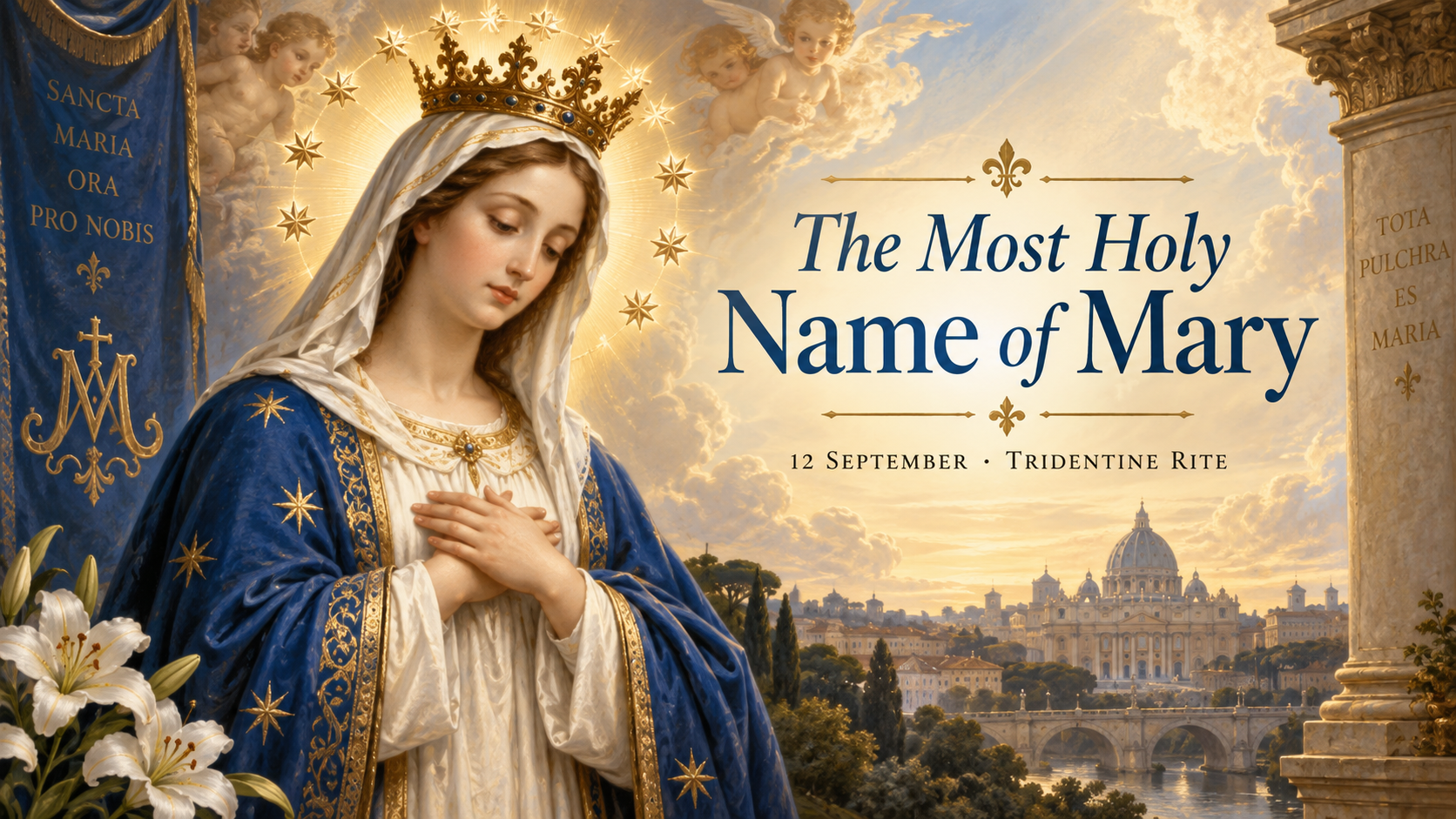
Et nomen Virginis Maria — “And the Virgin’s name was Mary”
The traditional Roman calendar possesses a remarkable instinct for allowing one mystery to unfold into another. On 8 September the Church celebrates the Nativity of the Blessed Virgin Mary. Four days later, on 12 September, she venerates the Most Holy Name of Mary. The distinction is important. The Holy Name is not the feast of 8 September: in the pre-1955 Roman calendar it is observed on 12 September as a Greater Double, in white vestments, with the Mass Vultum tuum. Yet the proximity of the two feasts is itself part of their meaning. The Church first rejoices that Mary has been born; then she pauses over the name by which that child will be known throughout the history of salvation: Maria.
Before the reforms of 1955 the Nativity of Our Lady still possessed a simple octave. After the reforms of St Pius X a simple octave no longer produced the full succession of liturgical days formerly associated with the older octave discipline, but 12 September nevertheless remained enclosed within the chronological span between the Nativity and its octave day. The old calendar thus gives September a distinctively Marian progression: the Nativity on the 8th, the Holy Name on the 12th, the Exaltation of the Holy Cross on the 14th, and the Seven Sorrows on the 15th. Birth, name, Cross and sorrow follow one another with striking theological harmony. Mary is born for Christ; she bears the name under which Christians will invoke her; and the calendar then turns almost immediately towards the mystery of the Cross beneath which she will stand as the faithful Mother of the Redeemer.¹
The feast concerns the person signified by the name. To pronounce the name of Mary with devotion is to turn the mind and heart towards the Immaculate Virgin of Nazareth, Mother of God, Mother of the Redeemer, Queen of Heaven, refuge of sinners and spiritual Mother of the faithful. The Church therefore rejoices, as the Collect says, beneath Mary’s “name and protection”, because the name brings before her the person, and the person of Mary is inseparable from the mystery of Jesus Christ.
From Cuenca to the universal Church
The feast long predates the Battle of Vienna with which it later became inseparably associated. Its documented liturgical history begins at Cuenca in Spain in 1513, where it was assigned with a proper Office to 15 September, then regarded as the octave day of the Nativity of the Blessed Virgin. Following the reform of the Breviary under St Pius V, Sixtus V transferred it in 1587 to 17 September. It then spread gradually through the Church: Gregory XV extended it to Toledo in 1622; the Spanish Trinitarians were celebrating it by 1640; the French Oratory received it in 1658; the Discalced Carmelites obtained permission in 1666 to celebrate an Office of the Name of Mary several times during the year; and in 1671 the feast was granted to Spain and the Kingdom of Naples.²
Its passage from a regional and religious observance into the universal Roman calendar came after the deliverance of Vienna in 1683. The city had been under Ottoman siege since July, and its fall would have carried grave consequences for Central Europe. A relief army composed of Polish, imperial and German forces advanced under the overall command of King John III Sobieski of Poland, and on 12 September the allied forces decisively broke the siege. Contemporary accounts explicitly date the raising of the siege and the victory to that day.³
The deliverance was received throughout Catholic Europe as an occasion of public thanksgiving. Sobieski’s Marian devotion was well known; Pope Innocent XI had supported the alliance against the Ottoman advance; and the raising of the siege was remembered within the Church as a providential mercy for which God was to be thanked through the intercession of the Blessed Virgin. The liturgical consequence was not the creation of an entirely new devotion, but the elevation of an existing one.
Innocent XI extended the already established Feast of the Holy Name of Mary to the universal Church, assigning it as a Greater Double to the Sunday after the Nativity of Our Lady. The history is therefore more exact than the common summary that the Pope simply instituted the feast on 12 September. He universalised a feast already more than a century and a half old and bound its wider observance to the thanksgiving which followed Vienna. A decree of 1908 provided that when the feast could not be kept on its Sunday because of a higher celebration it should be observed on 12 September; under the calendar reform associated with St Pius X it became fixed upon that date.²
Vienna thus explains the universalisation of the feast, but not its spiritual origin. The name of Mary had already been loved, invoked and honoured because the faithful recognised in it the name of the Mother whom God had chosen for His Son. The events of 1683 gave public and historical expression to a confidence already deeply rooted in Catholic life: that the Church may seek the intercession of the Blessed Virgin both in the hidden conflicts of the soul and in the dangers which confront Christian peoples.
The theology of a name
Sacred Scripture often treats a name as something more than an accidental label. A name can disclose vocation, covenant and mission. Abram becomes Abraham; Jacob becomes Israel; Simon becomes Peter. Above every created name stands the Holy Name of Jesus, imposed by divine command because it signifies the saving mission of the Incarnate Word: “Thou shalt call his name Jesus. For he shall save his people from their sins.”
The Holy Name of Jesus belongs to an order altogether unique, for He who bears it is Himself God made man. Mary’s name possesses no such divine dignity, nor does it need one. Its holiness is the holiness of the creature whom God filled with grace, preserved from sin, chose as Mother of His Son and exalted above every other purely created person. The honour paid to her name therefore rises from the singular dignity of the one whom it signifies, and that dignity in turn rests entirely upon the mystery of Christ.
St Thomas Aquinas supplies the scholastic order by which Marian devotion is rightly understood. Latria, the worship of adoration, belongs to God alone. The saints receive dulia, while the Blessed Virgin, because of her incomparable dignity as Mother of God, receives that special and highest form of creaturely veneration traditionally called hyperdulia. Aquinas observes that honour shown to the Mother redounds to the Son because she is honoured on account of Him.⁴
This hierarchy belongs to the very beauty of Catholic worship. Mary is not diminished because she remains a creature; rather, the greatness of grace is shown precisely in what God has accomplished in a creature. Her holiness proclaims His holiness, her privileges His generosity, her maternity the truth of the Incarnation, and her glory the triumph of the Redemption wrought by her Son.
The Collect of the feast expresses the same doctrine with the economy and precision proper to the Roman liturgy. The prayer is addressed to Almighty God and asks that the faithful who rejoice beneath the name and protection of the Most Holy Virgin Mary may, through her loving intercession, be delivered from earthly evils and attain eternal joy. Mary intercedes because God has given her that place within the communion of saints; the faithful ask because they are members of that communion; God grants because every grace has its source in Him.
The Mass Vultum tuum
The theology of the feast is contained most authoritatively in its Mass. The texts are largely drawn from the traditional Common of the Blessed Virgin, yet their arrangement gives the celebration a distinctive contour and allows the Church to show what she means when she honours Mary’s name.
The Introit begins Vultum tuum deprecabuntur omnes divites plebis, from Psalm 44: the rich among the people shall entreat her countenance, while virgins are brought after her to the King.⁵ Psalm 44 is a royal and nuptial psalm. In the Christian tradition its bridal imagery belongs pre-eminently to Christ and His Church, but the Roman liturgy also applies its language by accommodation to the Blessed Virgin, in whom the bridal holiness of the Church is perfectly realised. The movement of the Introit is significant: those who follow her are brought to the King. Marian devotion is therefore not a movement which ends in Mary, but one which passes through her to Christ.
The Epistle is Ecclesiasticus 24:23–31, beginning Ego quasi vitis fructificavi suavitatem odoris. Wisdom speaks under the image of a vine bringing forth sweetness and declares herself the mother of fair love, fear, knowledge and holy hope.⁶ In its literal scriptural sense the passage concerns Wisdom, yet the ancient liturgy applies these sapiential words to Our Lady because she received divine Wisdom with a perfection unmatched among creatures and, more profoundly still, bore the Incarnate Wisdom Himself in her womb.
The older liturgical tradition does not require that every Marian use of a sapiential text should be treated as a literal identification of Mary with Divine Wisdom. Its mode of reading is typological, analogical and contemplative. Mary is Sedes Sapientiae, the Seat of Wisdom. What belongs absolutely and essentially to God may be reflected in her by participation because she is full of grace and because the Word, through whom all things were made, took flesh from her.
The Gradual then turns explicitly towards the divine maternity. Mary is blessed because, without loss of her virginity, she became Mother of the Saviour; He whom the heavens cannot contain was enclosed within her womb when He became man. The Alleluia continues in the same Marian key and implores the intercession of the perpetual Virgin and Mother of God. The Church thus moves from royal imagery to Wisdom, from Wisdom to maternity, and from maternity to intercession.
The Gospel is the Annunciation, Luke 1:26–38. At its centre stands a phrase so simple that it might easily pass unnoticed: **“and the Virgin’s name was Mary” — et nomen Virginis Maria.**⁷ It is the scriptural heart of the feast.
St Luke names the city: Nazareth. He names Joseph. He names David. And he names Mary. She enters the Gospel not as an abstraction but as a real woman personally addressed by God. Gabriel is sent to her; grace is bestowed upon her; the divine proposal is placed before her; and her free consent is given in the fiat upon which the mystery of the Incarnation immediately follows. The name therefore belongs to the concreteness of salvation history. God acts through persons whom He calls, sanctifies and draws into His providential design.
The Offertory is the Angelic Salutation itself, Ave Maria. Having heard the Evangelist tell us that “the Virgin’s name was Mary”, the Church takes that name upon her own lips and joins herself to Gabriel’s greeting.
The Communion provides the final Christological key: Beata viscera Mariae Virginis, quae portaverunt aeterni Patris Filium — blessed is the womb of the Virgin Mary which bore the Son of the Eternal Father.⁵ The entire Mass returns therefore to the source of Mary’s greatness. Her name is holy because the person who bears it has been singularly sanctified by God; the person is exalted because she is Mother of God; and the divine maternity receives all its dignity from the eternal Son whom she bore. The liturgy begins with the Queen and leads unfailingly to the King.
Maria: the meaning of the name
The exact philological origin of the Hebrew Miryam remains uncertain. Various explanations have been proposed across the centuries, including associations with bitterness, belovedness, exaltation and an Egyptian derivation. No single modern etymology has the status of a doctrine of faith.⁸
The Christian tradition, however, received and cherished above all the interpretation Stella Maris — Star of the Sea. Its textual history is complex. A tradition associated with St Jerome appears in some witnesses as stilla maris, “drop of the sea”, and the reading stella maris, “star of the sea”, seems to have arisen through manuscript transmission. Yet by the early Middle Ages Stella Maris had already acquired a profound theological and devotional life of its own. Isidore, Bede and later writers employed the image; the ancient hymn Ave maris stella embedded it in the worship of the Western Church; and St Bernard of Clairvaux gave it one of its most enduring spiritual interpretations.⁸
The spiritual value of the title does not depend upon proving that it represents the original philological meaning of Miryam. Patristic and medieval writers often received traditional etymologies as material for contemplation, drawing from them truths about the persons and mysteries signified. In this way Stella Maris became not merely an etymological proposal but a theological image consecrated by centuries of prayer.
St Thomas Aquinas receives it in precisely this manner in his exposition of the Angelic Salutation. Mary is called Star of the Sea because, as sailors are guided through the waters by a star, Christians are directed through the dangers of this life towards heavenly glory by her maternal help.⁹ The comparison preserves the entire order of Catholic devotion. The star is not the harbour; it directs the voyager towards it. Mary does not replace the end for which man was created. She guides him towards the God whom she herself loves perfectly.
St Bernard: look to the Star
No spiritual commentary upon Mary’s name has exercised a greater influence than that of St Bernard of Clairvaux. Beginning from St Luke’s words Et nomen Virginis Maria, Bernard unfolds the image of the Star of the Sea until it becomes a complete lesson in the interior life.
For Bernard, human life is a voyage upon uncertain waters. Temptations rise like winds; tribulations strike like rocks; pride, ambition, envy, anger, avarice and sensual temptation batter the soul like waves. There are also darker storms: the memory of one’s sins, the weight of conscience, the fear that follows repeated failure, and that temptation to despair in which sorrow ceases to be contrition and becomes a refusal to trust in mercy.
Into these circumstances Bernard places his celebrated counsel: **Respice stellam, voca Mariam — look to the star; call upon Mary.**¹⁰
The spiritual wisdom of the passage lies in its doctrine of recollection. The soul in temptation becomes absorbed by the object which troubles it. Anger circles around the injury; lust around the image; ambition around the honour desired; discouragement around the memory of sin. Bernard teaches the Christian to break that captivity of attention by deliberately recalling the Mother of God. To think of Mary is to remember another order: purity instead of lust, humility instead of pride, obedience instead of self-will, confidence instead of despair.
Yet Bernard never separates invocation from imitation. To seek the help of Mary’s prayer while refusing the example of her life would be to divide what the Church joins together. He who invokes the Immaculate Virgin against impurity must desire chastity; he who invokes the handmaid of the Lord against pride must consent to humility; he who turns to her in fear must learn from the faith with which she received the word of Gabriel; he who seeks her companionship in suffering must look upon her steadfastness beneath the Cross.¹⁰
Pius XII returned to this passage in Doctor Mellifluus, praising Bernard precisely because his Marian doctrine combines tender confidence with the demands of Christian discipleship.¹⁰ The name of Mary is therefore not merely cried out in danger; it is kept in the heart as a summons to live according to the virtues of the Mother whose help is sought.
St Thomas: order in devotion
Where St Bernard gives the mystical and ascetical movement of the devotion, St Thomas provides its theological order.
Mary is honoured above all saints because the dignity bestowed upon her is unique: she is Mother of God. The title does not imply that she is the source of the divine nature or that she precedes the eternal Son. It confesses the unity of the Person born from her. The one whom she conceived and bore according to His human nature is the eternal Word Himself; therefore she is truly Theotokos, Mother of God.
From this relationship to Christ flows the singular honour accorded to her. Yet the distinction between latria and hyperdulia remains absolute. No creature can receive the adoration due to the Creator. Mary’s glory belongs entirely within the created order, but within that order she stands in a place altogether singular because God chose her for a maternal relationship with the Incarnate Son which no other creature can possess.⁴
This doctrine gives Marian devotion both its boldness and its sobriety. The Church need not exaggerate Mary’s dignity in order to exalt her. The privileges God has actually bestowed are already beyond ordinary measure. She need not become divine in order to be Mother of God; she need not become the source of grace in order to be gratia plena; she need not displace Christ in order to exercise a maternal intercession within His Mystical Body.
The Collect expresses this entire order in prayer. The Church asks Almighty God to deliver His faithful through Mary’s intercession. God remains the first source of every grace; yet His providence does not render created intercession meaningless. He wills that the members of His Church should pray for one another, and within that communion the prayer of the Mother of God possesses a maternal dignity unlike any other.
The sweetness of the name
St Alphonsus Maria de Liguori treats another dimension of the devotion in The Glories of Mary, where he writes of the sweetness of Mary’s name “in life and in death”.¹¹ By this sweetness he means above all the spiritual consolation, confidence and hope awakened in the faithful soul by the devout invocation of the Mother of God.
Such consolation need not be sensible. The Christian life often proceeds in dryness, distraction and suffering. A man may pray the Rosary faithfully while feeling nothing; the dying may be able to form only a few words; a soul under trial may receive no emotional relief at all. The worth of the invocation does not depend upon a passing feeling. The name is spoken because it expresses confidence in the intercession of the person who bears it.
For this reason Catholic devotion has long joined the names Jesus and Mary, especially in prayers for perseverance and a holy death. The order is always clear: Jesus is the Saviour and Mary the Mother who intercedes. Yet the Christian naturally desires to pass from this life with the Name of Jesus upon his lips and with the prayer of the Mother who stood faithfully beside His Cross. Traditional prayer books therefore encouraged brief aspirations such as “Jesus, Mary”, gathering into two names the mystery of the Redeemer and the maternal intercession of His Mother.¹²
The Holy Name in temptation and spiritual combat
Traditional spiritual writers frequently speak of the name of Mary as terrible to the enemies of the soul. The meaning belongs to the person signified. Mary is the woman placed in enmity with the serpent, the Immaculate Virgin, the Mother through whom the Word assumed the human nature in which He conquered sin and death, and the faithful handmaid whose fiat is the complete contrary of rebellion against God.
Her very holiness is therefore an accusation against the spirit of disobedience.
The invocation of her name has a corresponding place in spiritual combat because it helps restore the soul to recollection. Against impurity it recalls virginity; against pride, humility; against bitterness, charity; against rebellion, obedience; against discouragement, hope. The faithful soul turns deliberately from the disorder which tempts it towards the Mother in whom grace found such perfect correspondence.
Thus St Bernard’s counsel Mariam cogita, Mariam invoca — think of Mary, invoke Mary — belongs to the traditional discipline of custody of the heart. The imagination and memory, which may become instruments of temptation, are brought back under the rule of faith by being directed towards what is holy. The will is strengthened by remembrance; the heart is recollected; grace is sought; and the soul resumes the struggle.
Invocation, however, must always accompany conversion. The man who asks Mary’s help against grave sin must also flee its occasions. He who has fallen must repent and return to the Sacrament of Penance. The Mother who said Fiat mihi secundum verbum tuum cannot be invoked sincerely while the will remains deliberately attached to what contradicts the will of God.
Vienna and public thanksgiving
The historical association with Vienna gives the feast a public dimension which is easily overlooked when Marian devotion is considered only in personal terms.
The traditional liturgy assumes that Providence concerns peoples as well as individuals. Catholic nations prayed for deliverance from plague, famine and war; they asked for peace, rain, protection and victory; and when great dangers passed they offered public thanksgiving. This did not require men to claim knowledge of every secret judgment of Providence. It rested upon the simpler conviction that history remains under God and that gratitude is owed for benefits received.
The deliverance of Vienna belongs to that world.
The victory of 12 September 1683 was not the achievement of one people alone. Sobieski’s Polish army fought beside imperial and German forces, while the defenders of Vienna had already endured a prolonged siege. Contemporary accounts speak of the lifting of the siege as a decisive deliverance after weeks of extreme danger.³ The Church answered that deliverance with thanksgiving, and Innocent XI’s extension of the feast perpetuated the thanksgiving within the Roman calendar.
The conflict itself was understood by contemporaries as more than a contest over territory. It was dynastic and military, certainly, but it was also religious and civilisational. The Roman feast preserves the Catholic memory of the event in its own proper manner: men fought, commanders planned, soldiers suffered and died, but human action remained under Providence and victory called forth gratitude to God.
The devotion left a permanent mark in Rome. The Confraternity of the Most Holy Name of Mary received formal approval from Innocent XI in 1688; the Pope himself and Emperor Leopold I were associated with it, and its later home became the church of Santissimo Nome di Maria al Foro Traiano, beside Trajan’s Column.¹³ The very stones of Rome thus preserve the connection between Mary’s Name and the thanksgiving which followed the deliverance of 1683.
Here the Roman calendar reveals one of its deepest instincts: history may become liturgical memory. A generation which believes itself to have received a mercy does not merely record it; it places that gratitude before God in worship so that descendants may continue to remember.
Devotional traditions and customs
The Feast of the Holy Name possesses no single universal popular ceremony comparable to the blessing of candles at Candlemas or palms on Palm Sunday. Its customs are more interior and devotional, which is fitting for a feast centred upon the reverent invocation of a name.
The simplest observance is therefore also one of the most characteristic: to pronounce Mary’s name with devotion. Traditional Catholic life has always made generous use of brief aspirations because they allow prayer to accompany ordinary labour, travel, sickness, temptation and sleeplessness. “Jesus, Mary and Joseph”, “Jesus, Mary”, or St Bernard’s Respice stellam, voca Mariam may become acts of recollection offered repeatedly through the day.
The Ave Maria is particularly suited to the feast because the Gospel is the Annunciation and the Offertory itself takes up Gabriel’s salutation. To pray the Hail Mary attentively on 12 September is therefore to enter directly into the liturgical text appointed by the Church. The Rosary, the Litany of Loreto and the ancient hymn Ave maris stella belong naturally to the same observance.
The feast also sheds light upon the older Catholic understanding of Christian names. The name received at Baptism traditionally placed a child not only within a family but within the communion of saints. To bear the name of Mary, or to adopt it in religious life, expressed patronage, imitation and belonging. The extraordinary diffusion of Maria, Mary, Marie, María and their compounds across Christian civilisation bears witness to the affection with which the name of the Mother of God was received among the faithful.
The devotion also entered the life of religious communities. The feast became a patronal observance of the Piarists and of the Society of Mary, while several religious families received proper Offices or privileges connected with it.² Such patronage is especially fitting because a name gathers up the whole person. To place a community under the Holy Name of Mary is therefore to place before it not one isolated privilege of the Blessed Virgin but the whole pattern of her life: faith, purity, humility, obedience, contemplation, suffering and maternal charity.
“Let her name not depart from thy heart”
The deepest meaning of the feast belongs to the interior life, for Christian sanctity depends greatly upon holy remembrance. Sin thrives upon forgetfulness: forgetfulness of judgment, of mercy, of Providence, of eternity, of the presence of God. The Church gives the faithful sacred names, images, feasts and prayers so that memory itself may be sanctified and continually brought back to divine things.
The name Mary performs this office with particular tenderness. It recalls Nazareth and the fiat; Bethlehem and the Mother who held the Creator in her arms; Egypt and the hidden life; Cana and maternal intercession; Calvary and fidelity beneath the Cross; the Upper Room and the praying Church. It recalls purity without harshness, humility without weakness, contemplation without withdrawal from duty, sorrow without despair, and obedience without hesitation. Above all, it recalls a creature in whom grace was received with perfect correspondence.
This is why St Bernard does not ask only that Mary’s name should be upon the lips. He would have it remain also in the heart.¹⁰ The lips invoke what the heart remembers, and the heart learns to desire the virtues of the Mother whose intercession it seeks.
The relationship between 8 and 12 September therefore possesses a quiet beauty of its own. On the Nativity of Mary the Church rejoices in the coming into the world of the woman chosen from eternity to be Mother of the Redeemer. On the Feast of her Holy Name the Church receives that same person into the intimate vocabulary of Christian prayer. The child whose birth has been celebrated is now called by the name under which generations of Christians will seek her maternal help.
Yet every movement of the feast remains ordered towards Christ. The Introit leads the virgins to the King; the Epistle speaks in the language of Wisdom; the Gospel announces the Incarnation; the Offertory gives us the Ave Maria; and the Communion blesses the womb which bore the Son of the Eternal Father. To know Mary rightly is to be drawn towards her Son, for the whole mystery of her life is defined by Him.
Thus the ancient title Stella Maris remains one of the most perfect images for the feast. The sea is the present life, unstable and often dark; the harbour is eternal beatitude; Christ is the Saviour who brings His people home. Mary shines over the waters because the light of grace has filled her and because God has appointed her maternal intercession as a help to those who voyage towards Him. The storms of temptation change their outward form from age to age, but the counsel of St Bernard remains unchanged: Respice stellam, voca Mariam — look to the Star, call upon Mary. To invoke her name with faith is to remember the Mother; to remember the Mother is to be recalled to her virtues; and to follow those virtues is to be led more faithfully to the King.
¹ General Roman Calendar of 1954, calendar entries for 8, 12, 14 and 15 September.
² Frederick G. Holweck, “Feast of the Holy Name of Mary”, The Catholic Encyclopedia, vol. X (New York: Robert Appleton Company, 1911).
³ A True and Exact Relation of the Raising of the Siege of Vienna and the Victory obtained over the Ottoman Army, the 12th of September 1683, contemporary account reproduced by German History in Documents and Images.
⁴ St Thomas Aquinas, Summa Theologiae, III, q. 25, a. 5, on the special veneration of the Blessed Virgin and its distinction from the latria due to God alone.
⁵ Liber Usualis, Proper of Saints: 12 September, Most Holy Name of Mary, Mass Vultum tuum.
⁶ Ecclesiasticus 24:23–31, Douay-Rheims Bible.
⁷ Luke 1:26–38, Douay-Rheims Bible.
⁸ Herbert Thurston, “The Blessed Virgin Mary”, The Catholic Encyclopedia, vol. XV (New York: Robert Appleton Company, 1912), especially the discussion of the name Mary and the Stilla/Stella Maris tradition.
⁹ St Thomas Aquinas, Expositio Salutationis Angelicae, commentary on the Angelic Salutation and the traditional interpretation of Mary as Stella Maris.
¹⁰ St Bernard of Clairvaux, Super Missus est, Homily II; see also Pope Pius XII, Doctor Mellifluus, 24 May 1953, §§30–31.
¹¹ St Alphonsus Maria de Liguori, The Glories of Mary, Part I, chapter X, “How Sweet is the Name of Mary in Life and in Death.”
¹² With God: A Book of Prayers and Reflections, section on devotion to the Holy Name of Jesus and the indulgenced invocation “Jesus! Mary!”
¹³ Diocese of Rome, “Alla scoperta della chiesa del Santissimo Nome di Maria al Foro Traiano”, on the Confraternity of the Most Holy Name of Mary and the Roman church dedicated to the feast.



Leave a Reply