
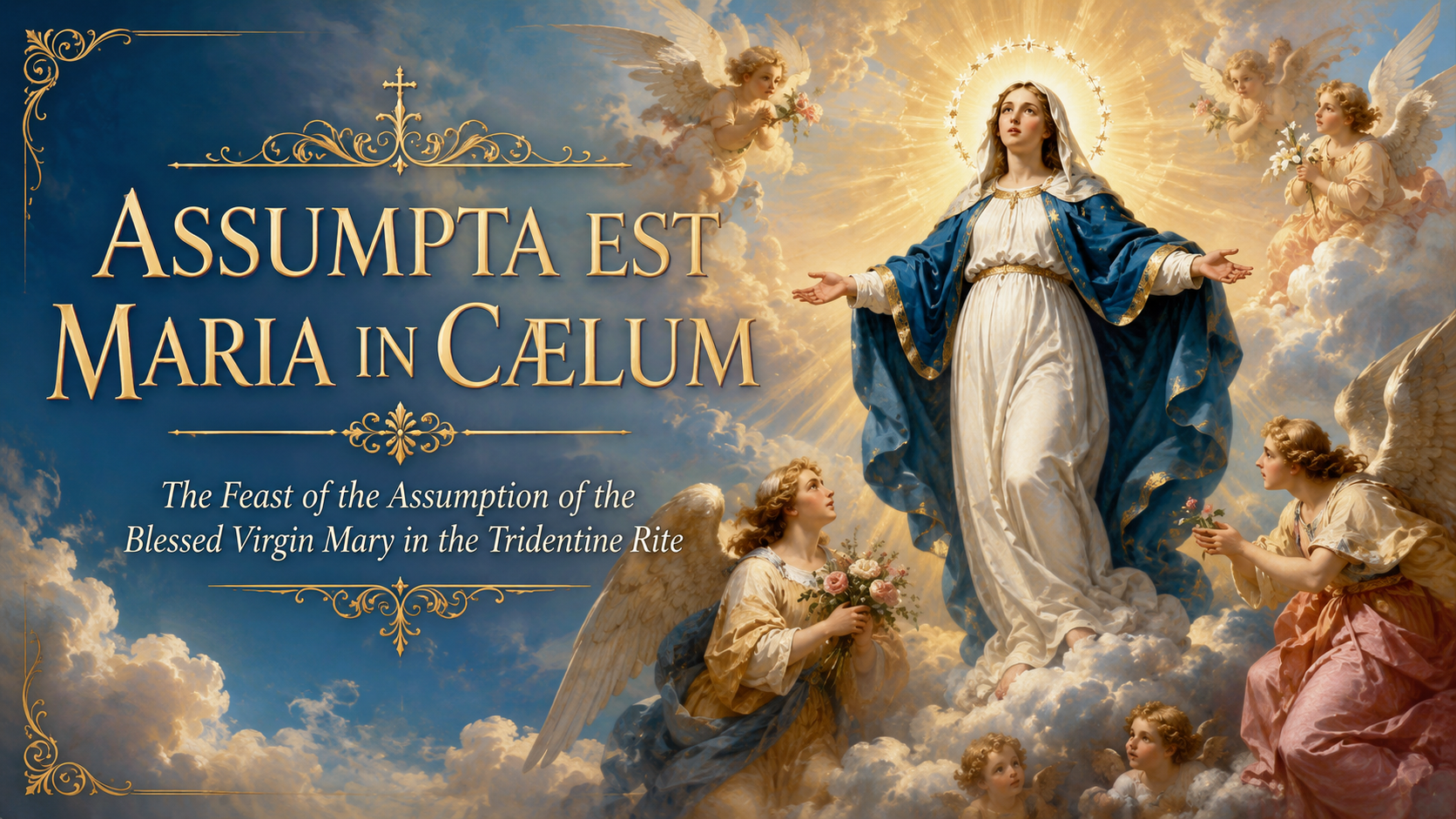
ASSUMPTA EST MARIA IN CÆLUM: The Feast of the Assumption of the Blessed Virgin Mary, August 15
The dogma which the Roman Church sang for centuries before she solemnly defined it

There is something particularly instructive about the Feast of the Assumption in the old Roman Rite. The Church did not wait until 1950 to discover what had happened to the Mother of God at the completion of her earthly life. She had prayed it, sung it, preached it, painted it, processed through the streets of Rome in its honour and taught it to generations of the faithful long before Pius XII gathered the testimony of Scripture, Tradition, Fathers, Doctors, theologians and liturgy into the solemn definition of Munificentissimus Deus. The definition did not manufacture a new Marian privilege. It placed the seal of the extraordinary Magisterium upon a truth already deeply embedded in the Church’s ordinary teaching and worship. Pius XII himself made precisely this point: ancient Eastern and Western liturgies were among the witnesses by which the Church’s perennial belief could be recognised.¹
To understand the feast specifically in the Tridentine Rite, however, one distinction is necessary. The Mass found in the Roman Missals inherited from the age of St Pius V down to the middle of the twentieth century was the ancient Gaudeamus omnes formulary. After the dogmatic definition of 1950, Pius XII ordered a new Office and Mass, Signum magnum, which came into use in 1951 and is consequently the form encountered in the later preconciliar books, including the 1962 Missal. The older Gaudeamus Mass is therefore especially precious when we wish to know how the Roman Church celebrated the mystery before the definition: not because its doctrine was less certain, but because it displays how the dogma had grown organically inside the Roman liturgical tradition.²
And the difference is revealing. The newer formulary announces the mystery through the apocalyptic “great sign” and the Visitation. The ancient Mass approaches it through Wisdom, the royal Psalm, Martha and Mary, the language of heavenly assumption, and a prayer which calmly presupposes Our Lady’s passage from earthly life. It does not argue. It remembers. It sings as one sings something already possessed.
A Feast Older Than the Definition
By the early Middle Ages, the Roman observance of 15 August was already one of the great Marian celebrations. Pope Sergius I prescribed the solemn procession associated with the feasts of the Nativity, Annunciation, Purification and Dormition of the Blessed Virgin; Pope Leo IV subsequently increased the solemnity of the Assumption with its Vigil and observance through the Octave. In the developed Roman calendar the feast stood surrounded by precisely that liturgical amplitude which modern calendars find difficult to reproduce: preparation on the Vigil, the feast itself, and prolonged contemplation through the Octave.³
The old Roman station was St Mary Major, the great basilica of the Mother of God. Blessed Ildefonso Schuster reconstructs something of the splendour of medieval Rome on the night before the feast. After Vespers and the vigiliary Office at St Mary Major, clergy and people took part in the nocturnal procession associated with the Lateran and the ancient icon of the Saviour. By morning the long procession had reached St Mary Major, where the Pope celebrated the stational Mass and blessed the exhausted faithful before they dispersed to break their fast.⁴ This was theology enacted with feet, lamps, fasting, psalmody and procession. Rome did not merely hold an opinion that Mary had been received bodily into heaven: the city kept vigil as though awaiting the arrival of a Queen.
The Vigil itself already points towards the meaning of the following day. Its Gospel is St Luke 11:27–28. A woman in the crowd, hearing Christ, cries: “Blessed is the womb that bore thee, and the paps that gave thee suck.” Our Lord answers: “Yea rather, blessed are they who hear the word of God, and keep it.” The reply does not diminish His Mother. It tells us why she is blessed. Before Mary conceived the Word according to the flesh, she had received Him by faith; she who bore the Incarnate Word kept the word of God more perfectly than any other creature. The Vigil therefore refuses a merely biological understanding of Mary’s greatness. Her divine maternity and her perfect obedience belong together.⁵
That is important for the Assumption. The body taken into heaven is not honoured merely because it once performed a physical function. It is the body of the woman whose whole person answered fiat to God.
“Let Us All Rejoice in the Lord”
The ancient Mass begins with one of the most beautiful entrances in the Roman repertoire:
Gaudeamus omnes in Domino, diem festum celebrantes sub honore beatæ Mariæ Virginis: de cujus Assumptione gaudent Angeli, et collaudant Filium Dei.
Let us all rejoice in the Lord, celebrating a feast-day in honour of the Blessed Virgin Mary, at whose Assumption the Angels rejoice and together praise the Son of God.
Already the proportions are perfect. The feast honours Mary; the Angels rejoice over Mary; but they praise the Son of God. True Marian worship is inherently Christological. Every privilege of the Mother declares something about the munificence of the Son. Her Assumption does not place a rival beside Christ’s Ascension. Christ ascends by His own divine power; Mary is assumed. The grammar itself teaches the doctrine. He is Victor by nature and right. She shares His victory by grace.
The old Collect is almost startling in its restraint. Instead of attempting to describe heavenly splendour, the Church asks forgiveness for her sinful children through the intercession of the Mother of God’s Son.⁶ The glorified Virgin is therefore presented immediately not as an object of aesthetic admiration but as a living intercessor. Assumption has not removed Mary from the Church below. Her entrance into glory perfects rather than abolishes her maternal solicitude.
Then comes Ecclesiasticus 24. The lesson speaks in the voice of Wisdom and of the dwelling of Wisdom among God’s chosen people. The Church applies these sapiential words to Mary, not by pretending that the Blessed Virgin is herself the uncreated Divine Wisdom, but by the traditional principle of accommodated and typological interpretation: in her the Eternal Wisdom truly made His dwelling. Schuster notes that the text originally celebrates the place where divine Wisdom dwells; applied to the Mother of God, the correspondence is astonishingly apt.⁷ The Ark, Temple, dwelling-place and sanctuary converge in the woman of Nazareth because the Word truly became flesh in her.
This is why bodily Assumption is not extraneous to the Incarnation. Christianity does not teach that the Son of God merely passed through Mary. He received from her a true human nature. The flesh born at Bethlehem is genuinely human flesh received from His Mother. The body which bore Him, nursed Him, carried Him into Egypt and stood beneath His Cross belongs irrevocably to the history of salvation. The question of Mary’s body therefore cannot be dismissed as pious curiosity about the remains of a saint. The mystery presses directly upon the doctrine of the Incarnation.
The Gradual takes up Psalm 44: “Hearken, O daughter, and see, and incline thy ear: for the king hath greatly desired thy beauty.” The Alleluia then removes any possible ambiguity about what the Church is celebrating:
Assumpta est Maria in cælum: gaudet exercitus Angelorum.
Mary is taken up into heaven: the host of Angels rejoiceth.
The Offertory returns to the same proclamation: Mary has been taken into heaven; the Angels rejoice and bless the Lord. Schuster saw the significance. The Roman liturgy does not merely speak of Mary’s soul attaining the blessedness common to the saints. If Assumptio meant only that, nothing would distinguish her feast from the heavenly birthday of any other saint. The liturgical insistence is upon a singular privilege, and therefore upon the glorification of her body.⁸
The dogma of 1950 is already being sung.
Martha, Mary, and the Gospel Rome Chose
The most remarkable feature of the ancient Mass is perhaps its Gospel. For centuries, Rome celebrated the Assumption not with the Visitation but with St Luke 10:38–42, the visit of Christ to Martha and Mary. Martha is “busy about much serving”; Mary sits at the Lord’s feet and hears His word. Christ does not condemn Martha’s service, but declares:
“Mary hath chosen the best part, which shall not be taken away from her.”
At first sight it seems an odd Gospel for the bodily Assumption. Medieval Christians did not think so.
St Ambrose had already discerned in the sisters the complementary perfections of attentive contemplation and charitable action. St Augustine went further. Martha and Mary signify, he says, the two lives of the Christian: the present and the future; labour and rest; time and eternity. Martha performs works which are good precisely because the misery of this world requires them. Hunger demands feeding, sickness visiting, strangers hospitality, the dead burial. But in the world to come these works cease because the evils which made them necessary have ceased. Mary meanwhile sits before the Word. Her portion abides. “The labour of manifoldness passes away,” Augustine observes, while the one thing necessary remains.⁹
Placed on the Assumption, Augustine’s exegesis becomes luminous. Our Lady had known Martha’s work. She went cum festinatione into the hill country to serve Elizabeth. She wrapped the Infant in swaddling clothes. She fled with Joseph and the Child into Egypt. She kept the household at Nazareth. She noticed the embarrassment of the wedding hosts at Cana. She stood beneath the Cross. She prayed with the infant Church. Hers was no spirituality detached from duty.
But she was also Mary at the Lord’s feet. St Luke twice tells us that she kept the mysteries of Christ and pondered them in her heart. Action flowed from contemplation; contemplation did not excuse her from action. Now, at the end of her earthly pilgrimage, the labour proper to this world is finished. The “best part” remains, and it shall not be taken from her.
Medieval liturgists developed this interpretation with remarkable richness. John Beleth explains that some Gospel pericopes are appointed because they narrate the feast historically, while others are chosen allegorically. The Martha-and-Mary Gospel belongs to the latter kind: in the Blessed Virgin, he says, both the active and contemplative lives reached perfection. Sicard of Cremona notices that the Vulgate says Christ entered a castellum, a little fortified town. Mary herself becomes the castellum: a fortress secured against the devil, Martha in perfect action and Mary in perfect contemplation. William Durandus develops the same image. The Virgin is the humble fortress into whom Christ entered; she serves Him in the Visitation, the care of His childhood and the flight into Egypt, while contemplatively she keeps His words in her heart.¹⁰
This is not medieval ingenuity imposed arbitrarily upon Scripture. It is the liturgy teaching through the spiritual senses of Scripture. The Mother of God had received Christ utterly, in body and soul, in work and contemplation. On the feast of her Assumption the Church proclaims that nothing of this consecrated wholeness is lost.
Here the old Gospel reaches a depth which a merely descriptive reading of the feast might miss. The Assumption is not principally about travelling from one geographical place to another. It is about possession. Mary possesses God, and God possesses Mary. The “best part” cannot be taken from her because death itself has been prevented from retaining even her body.
The Fathers: The Mother of Life Cannot Be Held by Death
The patristic tradition does not arrive at this conviction by sentimental enthusiasm. Its central argument is Christological.
The Roman tradition itself preserved the magnificent ancient prayer cited by Pius XII from the sacramentary sent by Pope Adrian I to Charlemagne: the Mother of God “suffered temporal death,” yet could not be held by the bonds of death because from herself she had brought forth the incarnate Son of God.¹¹ In a single austere Roman sentence lie Dormition, death, divine maternity and victory over the grave.
In the East, St John Damascene gave classical expression to the doctrine of fittingness. The body which preserved virginity in childbirth ought fittingly to be preserved from corruption; she who carried the Creator ought to dwell in the heavenly tabernacles; she who saw her Son upon the Cross ought to behold Him beside the Father.¹² None of these propositions means that God was constrained by some law superior to Himself. Convenientia in the Fathers and scholastics means the harmony of God’s works. Once God freely chose Mary for the divine maternity, certain privileges are perceived as magnificently consonant with that choice.
St Germanus of Constantinople speaks still more directly of Mary’s virginal body as wholly holy and as the dwelling-place of God, transformed into the heavenly life of incorruptibility. The ancient homily attributed to St Modestus of Jerusalem speaks of the Mother of the giver of life receiving bodily incorruptibility from Him who raised her from the tomb and took her to Himself.¹³
The logic is consistent. The Fathers do not worship Mary’s body. They take the body seriously because God took the body seriously. Christianity is not Platonism with sacramentals added. Creation is good; flesh is real; the Incarnation is real; the Resurrection is bodily; the sacraments sanctify through material signs; and the Christian hope is not the everlasting escape of a soul from matter but “the resurrection of the body and life everlasting.”
Mary’s Assumption is one of the most radical affirmations of that faith.
It is equally important not to confuse the dogma with every ancient narrative that gathered around Mary’s final days. The Transitus traditions, the stories of the Apostles assembled around her bed, the traditions concerning Jerusalem or Ephesus, and the varying accounts of her tomb belong to the historical and devotional reception of the mystery in differing degrees. The Church has never required belief in every detail of them. Pius XII’s definition is deliberately more restrained. What is revealed is not a particular picturesque reconstruction of Mary’s last hours but that “having completed the course of her earthly life” she was assumed body and soul into heavenly glory.¹⁴
The traditional Roman liturgy nevertheless speaks quite naturally of Mary’s death. Its ancient Secret says that although the Mother of God passed from this life according to the condition of mortal flesh, she now intercedes before God in heavenly glory; the Gregorian tradition likewise says that she underwent temporal death but could not be held by its bonds.¹⁵ The dogmatic formula leaves the precise question outside the definition; the inherited Roman liturgical tradition is much less hesitant in speaking of her Dormition and death.
This is worth retaining. Mary does not triumph by avoiding everything that resembles her Son’s path. She triumphs because death cannot keep her.
The Scholastics: What the Fathers Sang, the Schools Examined
Scholastic theology did not invent the Assumption any more than Pius XII did. What the schools did was ask with increasing precision why the traditional belief cohered with the rest of Catholic doctrine.
St Albert the Great, after gathering arguments from Scripture, earlier authorities, liturgy and theological reason, concluded that the Mother of God had indeed been assumed above the choirs of Angels. St Anthony of Padua, commenting upon the Psalmist’s “Arise, O Lord, into thy resting place: thou and the ark which thou hast sanctified,” applied the Ark to the body of the Virgin from whom Christ had received His flesh.¹⁶
Most strikingly, St Thomas Aquinas is quite explicit when he touches upon the question. In his exposition of the Angelic Salutation, after considering the curse that man should return to dust, he says that the Blessed Virgin was exempt from this consequence because “with her body she was assumed into heaven” — cum corpore assumpta est in cælum. He immediately invokes Psalm 131:8 and its image of the sanctified Ark.¹⁷ This is not an isolated sentimental remark in St Thomas. It belongs to his larger understanding of grace: what God wrought in Mary’s soul overflowed into the sanctification of the body which served the mystery of the Incarnation.
St Bonaventure supplies another decisive insight. If Mary’s soul alone were in heaven while her body remained awaiting the general resurrection, her beatitude would not possess the completeness proper to the human person. Man is neither merely body nor merely soul. The soul separated from the body survives death, but the perfection of human nature requires their reunion. Bonaventure therefore argues that Mary’s complete glorification fittingly entails body and soul together.¹⁸
This is one reason the Assumption matters far beyond Mariology. It protects Christian anthropology. Salvation does not discard one half of the human person.
Later writers make the same argument with increasing warmth. St Bernardine of Siena insists upon the likeness and union of Mother and Son: Mary should be where Christ is. St Robert Bellarmine recoils from the thought that the virginal flesh which had been the dwelling of the Word should become the spoil of corruption. St Francis de Sales puts the matter with almost disarming simplicity: what loving son, if it were in his power, would not restore his mother to life and bring her with him into paradise? St Alphonsus Liguori similarly grounds Mary’s preservation from corruption in the honour of the Son who took flesh from her.¹⁹
These are arguments from fittingness, not attempts to make revelation unnecessary. The dogma is believed because it belongs to the revealed deposit as received and taught by the Church. The theological arguments show its inner harmony. They allow the intellect to see why a truth received in faith makes profoundly coherent sense.
Scripture: Ark, Queen, Woman, New Eve
Catholic exegesis of the Assumption has never depended upon finding a verse which reads like the solemn definition of 1950. That is not how the Church ordinarily reads mysteries whose full implications become clearer within Tradition. Instead, the whole scriptural economy supplies a pattern.
There is the Ark: “Arise, O Lord, into thy resting place: thou and the ark, which thou hast sanctified.” There is the royal daughter of Psalm 44, drawn into the presence of the King. There is the spouse of the Canticle ascending from the wilderness. There is Gabriel’s greeting, “Hail, full of grace.” There is the woman of the Apocalypse, clothed with the sun, the moon beneath her feet and a crown of twelve stars upon her head. Pius XII deliberately collected these traditional lines of interpretation when explaining the biblical foundations upon which the Fathers and Doctors had meditated.²⁰
A careful Catholic exegete does not have to flatten these passages into single-level predictions. Cornelius à Lapide, commenting upon Apocalypse 12, is an excellent example. He takes the primary prophetic sense of the Woman as the Church, the Bride of Christ struggling against the dragon; but he also insists that the passage is legitimately and profoundly appropriated to the Blessed Virgin, the noblest member and type of the Church, the Mother of the Head from whom the Mystical Body receives its life. He can therefore read the same inspired symbol ecclesially and Marianly without making the senses compete.²¹
That distinction becomes especially valuable on the Assumption. Mary is not an alternative to the Church. She is the Church’s most perfect created member and the personal anticipation of what the whole Mystical Body hopes to become. What Apocalypse displays corporately in the Woman triumphant over the dragon is already realised in a singular way in the Mother of the Messiah.
Behind this stands an even older patristic parallel: Mary as the New Eve. From the second century the Fathers set the obedience of the Virgin against the disobedience of the first woman. Eve listens to the serpent; Mary listens to Gabriel. Eve’s disobedience is bound up with sin and death; Mary’s obedience serves the entrance into the world of Him who defeats both. Pius XII therefore connects Mary’s bodily glorification with the New Adam’s victory until the Apostle’s promise is fulfilled: **“Death is swallowed up in victory.”**²²
This does not make Mary a second redeemer standing parallel to Christ. Everything she possesses is from Him. The parallel is radically unequal: Christ conquers; Mary participates in His conquest. Christ redeems; Mary is the most perfectly redeemed. Christ rises by His own power; Mary is raised by His. Yet the very completeness of her dependence displays the completeness of His victory.
The Mystics: The Liturgy Entering the Soul
What scholastic theology analyses, the mystical tradition often contemplates from within the prayer of the Church. St Gertrude the Great is particularly instructive because her Assumption visions are inseparable from the liturgy itself. Her contemplation moves through Mass, Vespers, Matins, antiphons and responsories. At the Eucharistic elevation she understands the grace of Christ flowing to those who honour His Mother; at Vespers she sees the praises sung to Mary gathered first into the Heart of Christ and poured from Him upon her.²³
The image is theologically exact even though the vision belongs to private revelation. Praise offered to Mary does not terminate independently in Mary. It passes through Christ and returns to the glory of God. In another Assumption contemplation, St Gertrude sees Our Lady’s entrance into heaven unfolding through the chants of Matins, while the needs of the Church militant remain before her maternal solicitude.²⁴
Private revelations neither establish nor enlarge dogma, and Catholic theology must never reverse that order. We do not believe in the Assumption because St Gertrude saw it, any more than we believe in the Eucharist because a mystic experienced an apparition at Mass. The value of the mystic lies elsewhere. St Gertrude shows what happens when the objective liturgy is received into a profoundly contemplative soul. The chant ceases to be background. Every antiphon becomes a window into the mystery being celebrated.
This is very close to Dom Prosper Guéranger’s conception of the liturgical year. For Guéranger, 15 August is heaven’s festival of the Queen’s arrival, but the glory of the day remains inseparable from the victory of her Son. He lingers over the ancient antiphon which distils the feast into one sentence: **“Today the Virgin Mary ascended to heaven: rejoice, for she reigns with Christ for ever.”**²⁵ It is characteristic of the old liturgy that so much theology can be carried by a single antiphon. Mary reigns with Christ. Her queenship is participatory; her glory is received; her exaltation magnifies His triumph.
The Definition of 1950 and the Older Roman Mass
On 1 November 1950 Pius XII finally pronounced the definition:
**“The Immaculate Mother of God, the ever Virgin Mary, having completed the course of her earthly life, was assumed body and soul into heavenly glory.”**²⁶
Every word is measured. Mary is the Mother of God, so the mystery begins with Christ. She is ever Virgin, linking her bodily glorification with the virginal body consecrated to divine maternity. She has completed the course of her earthly life, a formula which defines neither the circumstances nor chronology of her departure. She is assumed, because this is God’s act. And she is assumed body and soul, because anything less would fail to express the dogma.
The following year brought the new Signum magnum Mass. Apocalypse 12 moved to the foreground; the Gospel became St Luke’s account of the Visitation and the beginning of the Magnificat. Nothing in this new formulary contradicts the older one. It makes explicit in a different manner what had long been confessed. Yet the ancient Gaudeamus Mass deserves to be remembered precisely because it demonstrates the falsity of any suggestion that the Roman Church lacked liturgical certainty about the bodily Assumption until the twentieth century. Centuries before the definition, she was already singing Assumpta est Maria in cælum and interpreting “the best part” as Mary’s imperishable heavenly possession.²⁷
Indeed, the old Mass may teach us something about the difference between developing doctrine and inventing doctrine. Authentic development does not produce a new faith unrelated to what preceded it. It clarifies, distinguishes and formally defines what was already present in the Church’s life. In the case of the Assumption we can watch the process almost visibly: ancient feast, patristic preaching, Roman procession, medieval exegesis, scholastic reasoning, mystical contemplation, centuries of universal worship, theological investigation, episcopal consensus, and finally dogmatic definition.
The fruit existed before the label was printed upon it.
The Immaculate Conception and the Assumption: One Arc of Victory
Pius XII draws particular attention to the relationship between the Immaculate Conception and the Assumption. The connection should not be reduced to a mechanical syllogism, as though one privilege automatically necessitated the other. It is instead the “perfect harmony” of God’s work in Mary.²⁸
At the beginning of her earthly existence, the grace of Christ preserves Mary from original sin. At its completion, the victory of Christ preserves her body from remaining in the corruption of the grave. The two mysteries stand at opposite ends of one life wholly claimed by grace. The first tells us what God prevented sin from doing to her; the second reveals what He would not permit death finally to do.
And between them stands the Cross.
Mary’s privileges never exempt her from Calvary. The Immaculate Mother is the woman whose soul Simeon’s sword pierces; the Mother of Life stands where her Son dies. Her Assumption is therefore not the celestial reward of someone protected from the realities of human sorrow. It is the Easter conclusion to a life that passed through them in union with Christ.
Here the Assumption becomes inseparable from the mystery of Christian hope. The Virgin does not rise above Christianity into some separate Marian religion. She shows what Christianity is capable of doing to a human creature when grace has completed its work.
Why the Assumption Matters Now
Pius XII himself drew an anthropological consequence from the dogma. Contemplation of Mary’s bodily glory, he hoped, would strengthen faith in our own resurrection and remind mankind of the “lofty goal” to which both body and soul are destined.²⁹ That point has lost none of its urgency.
Every age has its characteristic contempt for the body. Some despise it by treating matter as evil and salvation as escape. Others appear to worship it while in fact treating it as merchandise: something to be displayed, altered, exploited, commodified, sterilised, discarded or reconstructed according to appetite and will. The Christian answer is more demanding than either materialism or disembodied spiritualism.
The body is created.
The body is meaningful.
The body can be sanctified.
The Word Himself became flesh.
Christ’s Body truly rose from the tomb.
Our bodies are destined to rise.
And on 15 August the Church points to a human creature in whom that promised consummation has already been extraordinarily realised.
Mary’s Assumption therefore tells us something indispensable about ourselves. A Christian funeral is not the disposal of an obsolete container after its “real” inhabitant has escaped. The corpse laid in consecrated ground is the body of someone created for resurrection. We honour relics because sanctity touches the body. We receive sacraments through matter because grace does not despise creation. We kneel, fast, genuflect, sign ourselves, receive ashes, anoint with oil and consume the sacramental Body and Blood of Christ because Catholicism is incarnational down to its foundations.
Mary’s empty tomb — whatever historical questions may surround its location and circumstances — signifies the same final defiance heard at Easter: death does not own the Christian body forever.
“The Best Part Shall Not Be Taken Away”
We can now return to the ancient Gospel and understand why the Roman Church chose it.
Martha’s work is finished.
Bethlehem is finished. Egypt is finished. Nazareth is finished. Cana is finished. Calvary is finished. The long hidden years of service are finished. The sword has pierced. The Son has risen. The infant Church has prayed. Mary’s earthly pilgrimage has reached its term.
But Mary’s part has not been taken from her.
She who listened to the Word now beholds the Word. She who carried Him in her womb dwells with Him in glory. She who gave Him human flesh possesses her own flesh transfigured by His victory. She who stood beside the new Adam beneath the tree of the Cross shares, as the New Eve and entirely by His grace, in the triumph which flowed from that tree.
The old Communion could therefore place upon the lips of the faithful the sentence which unlocks the whole feast:
Maria optimam partem elegit, quæ non auferetur ab ea in æternum.
Mary hath chosen the best part, which shall not be taken away from her for ever.
There is the Assumption in one line.
Not escape from creation, but its fulfilment.
Not the deification of Mary, but the triumph of grace in Mary.
Not a rival ascension beside Christ’s, but the most perfect created fruit of Christ’s Resurrection.
Not a body discarded, but a body glorified.
Not a Mother removed from her children, but a Queen established beside her Son to intercede for them.
And above all, not a Marian feast which ends in Mary. The ancient Introit gave the proper order at the very threshold of the Mass. The Angels rejoice at her Assumption, and in their joy they praise the Son of God.
That is why 15 August is one of the great feasts of Christian hope. We look towards the Queen already in glory and discover, beyond her, the purpose for which every Christian was created. What God has done uniquely in the Mother is a pledge of what the Resurrection of the Son has made possible for His Mystical Body. The grave is real, death is real, corruption is real — but none of them is ultimate.
Assumpta est Maria in cælum: gaudent Angeli, laudantes benedicunt Dominum.
Mary is assumed into heaven: the Angels rejoice, praising and blessing the Lord.
And the Church on earth rejoices with them, because in the glorified Mother of God she sees not only her Queen, but the radiant promise of her own last end: resurrection, incorruption, the vision of God, and that “best part” which, when at last it is perfectly possessed, shall never be taken away.
¹ Pius XII, Apostolic Constitution Munificentissimus Deus, 1 November 1950, §§12–20, especially the Pope’s appeal to the ancient liturgical witness of East and West and to the liturgy as a profession of heavenly truths.
² Gregory DiPippo, “The Gospel of the Assumption: A Medieval Allegory,” documenting the replacement of the ancient Gospel and Mass by the Signum magnum formulary following the definition of 1950.
³ Pius XII, Munificentissimus Deus, §§16–19, on the ancient Roman celebration, the procession prescribed by St Sergius I and the Vigil and Octave associated with St Leo IV.
⁴ Bl. Ildefonso Schuster, OSB, Liber Sacramentorum (The Sacramentary): Historical and Liturgical Notes on the Roman Missal, vol. V, 14–15 August, on the Vigil, nocturnal procession and station at St Mary Major.
⁵ Missale Romanum, Vigil of the Assumption, Gospel: Luke 11:27–28; see also DiPippo, “The Gospel of the Assumption,” on the relation between the Vigil Gospel and the traditional Gospel of the feast.
⁶ Schuster, Liber Sacramentorum, vol. V, 15 August, on the ancient Introit, Collect and stational Mass of the Assumption.
⁷ Ibid., on the Lesson from Ecclesiasticus 24:11–13, 15–20 and its liturgical application to the Blessed Virgin as the dwelling of the Incarnate Word.
⁸ Ibid., on the Alleluia and Offertory Assumpta est Maria in cælum and the specifically bodily meaning of the liturgical title Assumptio.
⁹ St Ambrose, Expositio Evangelii secundum Lucam, VII; St Augustine, sermon on Martha and Mary, especially his contrast between temporal service and the abiding contemplation of the world to come.
¹⁰ John Beleth, Summa de ecclesiasticis officiis, §§29, 146; Sicard of Cremona, Mitrale, IX.40; William Durandus, Rationale Divinorum Officiorum, VII.24. The texts and references are collected in DiPippo, “The Gospel of the Assumption.”
¹¹ Pius XII, Munificentissimus Deus, §§16–18, citing the sacramentary sent by Pope Adrian I to Charlemagne and its ancient Roman prayer concerning the temporal death of the Mother of God and her freedom from the bonds of death.
¹² St John Damascene, Homilia II in Dormitionem Beatæ Mariæ Virginis, 14; cited by Pius XII, Munificentissimus Deus, §21.
¹³ St Germanus of Constantinople, In Sanctæ Dei Genetricis Dormitionem, I; ancient homily attributed to St Modestus of Jerusalem, both cited in Munificentissimus Deus, §22.
¹⁴ Pius XII, Munificentissimus Deus, §44.
¹⁵ Missale Romanum, ancient Secret of the Assumption; Gregorian Sacramentary, Sancta Dei Genitrix mortem subiit temporalem, nec tamen mortis nexibus deprimi potuit; discussed by Schuster, Liber Sacramentorum, vol. V.
¹⁶ St Anthony of Padua, sermon for the Assumption; St Albert the Great, Mariale, q. 132; both cited and summarised in Pius XII, Munificentissimus Deus, §§29–30.
¹⁷ St Thomas Aquinas, Expositio Salutationis Angelicæ, on the third consequence of the curse and the Blessed Virgin’s bodily Assumption: cum corpore assumpta est in cælum; cf. Psalm 131:8.
¹⁸ St Bonaventure, De Assumptione Beatæ Mariæ Virginis, Sermo I; cited in Pius XII, Munificentissimus Deus, §32.
¹⁹ St Bernardine of Siena, St Robert Bellarmine, St Francis de Sales and St Alphonsus Liguori, testimonies collected in Munificentissimus Deus, §§33–35.
²⁰ Pius XII, Munificentissimus Deus, §§24–27, on Psalm 131, Psalm 44, the Canticle of Canticles, Luke 1:28 and Apocalypse 12 in the theological tradition concerning the Assumption.
²¹ Cornelius à Lapide, SJ, Commentaria in Scripturam Sacram, commentary on Apocalypse 12:1, distinguishing the primary ecclesial interpretation of the Woman from its legitimate and traditional Marian appropriation.
²² Pius XII, Munificentissimus Deus, §§39–40, on the patristic New Eve tradition and Mary’s participation, subordinate to Christ, in His victory over sin and death.
²³ The Life and Revelations of Saint Gertrude, “Revelations Concerning the Assumption,” on her contemplation of the Mass of the Assumption and the Eucharistic mystery.
²⁴ Ibid., on the Assumption Office, Vespers and Matins and St Gertrude’s mystical contemplation of the Blessed Virgin’s entry into heavenly glory.
²⁵ Dom Prosper Guéranger, OSB, The Liturgical Year, Time after Pentecost, “The Assumption of the Blessed Virgin Mary,” 15 August.
²⁶ Pius XII, Munificentissimus Deus, §44.
²⁷ Schuster, Liber Sacramentorum, vol. V, 15 August; DiPippo, “The Gospel of the Assumption,” on the older Gaudeamus Mass and the later Signum magnum formulary.
²⁸ Pius XII, Munificentissimus Deus, §§3–5, on the harmony between the Immaculate Conception, Christ’s victory over sin and death, and Mary’s exemption from remaining in the corruption of the grave.
²⁹ Pius XII, Munificentissimus Deus, §42, on the value of human life and the destiny of body and soul in the light of the Assumption.
related articles


Latest articles
- Today’s Mass: September 30 St Jerome of BethlehemSaint Jerome, born in Dalmatia in 329, was a prominent Doctor of the Church, known for his scripture translations and contributions to Catholic teachings. He emphasised monastic life and the Divine Office. Jerome died in Bethlehem on 30 September 420. Today also marks the name day of His Grace, Jerome OSJV of Selsey.
- Sermon for St. JeromeSt. Jerome, born around 342, was a pivotal biblical scholar and translator whose work established the Vulgate as the standard Latin Bible. His life reflected the tensions of early Christianity, as he struggled with controversies while advocating for orthodoxy. Jerome’s rich education and transformation from a pagan scholar to a Christian hermit marked his enduring legacy in the Church. He died in 420.
- Veritas non mutatur consensu ~ Truth is not altered by agreement: Spiritual Conference for Nuntiatoria CXXVThe text explores the theme of enduring truth amidst changing societal values, particularly within the Catholic faith. It emphasises that truth remains unchanged irrespective of popular opinion or individual feelings, urging believers to receive and embody divine teachings faithfully. The article concludes with a call to act upon this truth in daily life and relationships.
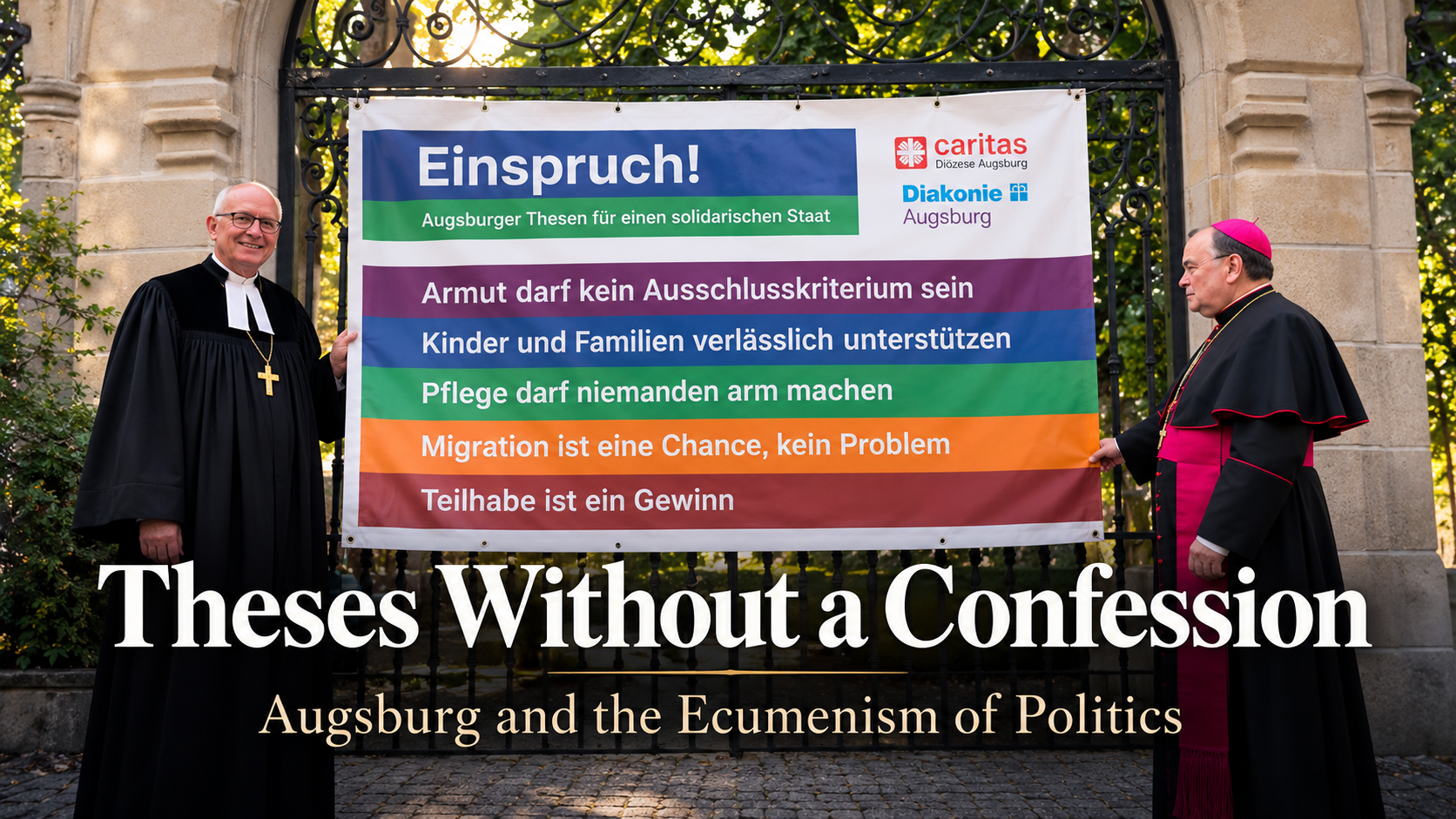
- Theses Without a Confession: Augsburg and the Ecumenism of PoliticsIn Augsburg, Catholic and Lutheran leaders have symbolically reposted theses on social issues like poverty and migration, reflecting Christian social teaching. This event highlights a growing divide where churches confidently address social policies while unresolved doctrinal differences remain. Cooperation on such issues is valuable but should not replace the pursuit of true Christian unity.
- Quis ut Deus? Michaelmas and the Order of HeavenThe Dedication of Saint Michael, celebrated on 29 September, highlights the Archangel’s role within divine order, illustrating humility and obedience before God. Rooted in ancient Roman traditions, the feast contrasts human pride with the recognition of God’s sovereignty. It underlines the importance of worship that connects earthly life to heavenly realities, centering around God’s presence.


Leave a Reply