
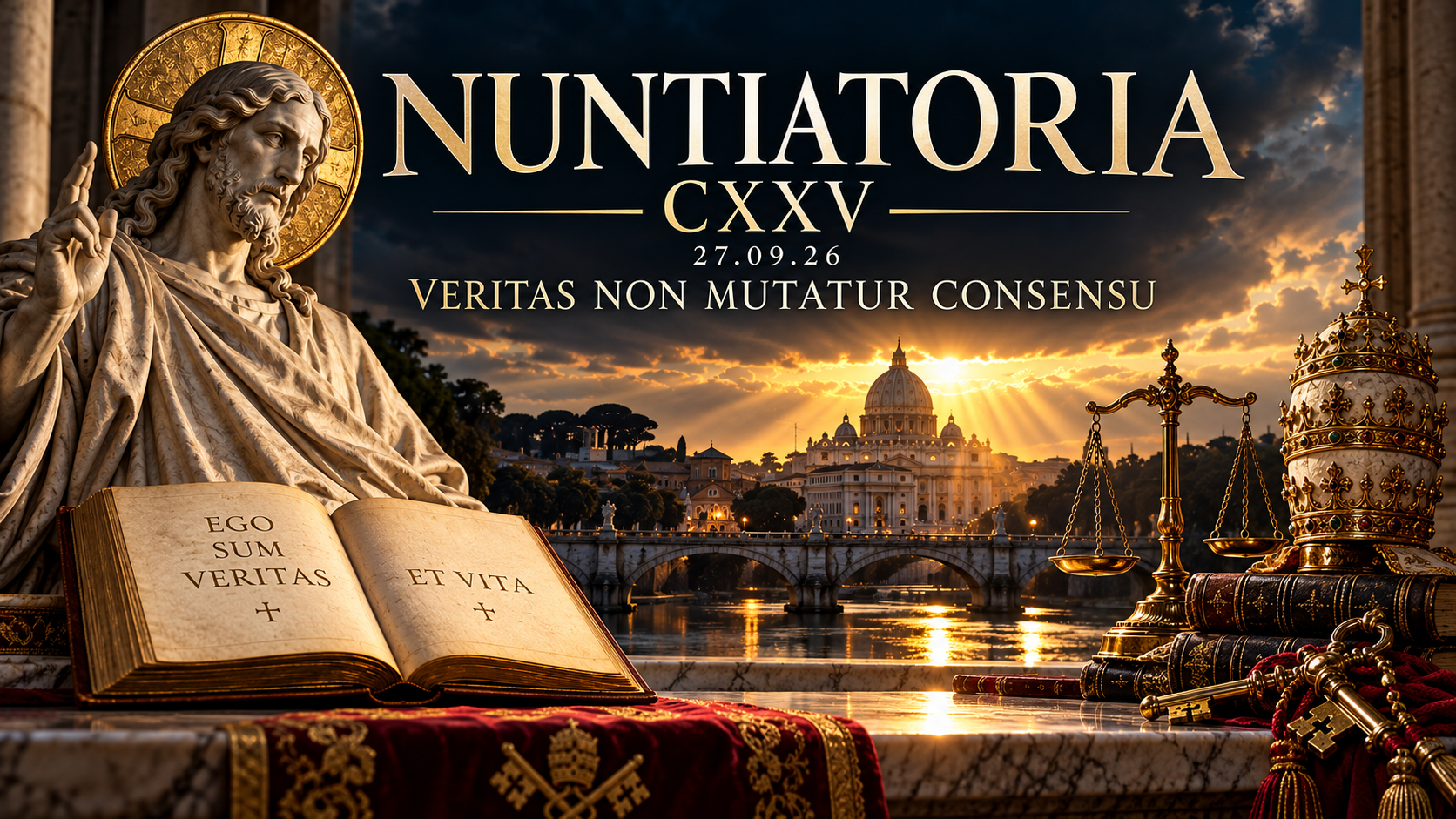
EDITORIAL Truth is not altered by agreement
Truth does not become false because authority contradicts it, nor falsehood true because institutions agree upon it. This edition asks what happens when procedure, consensus and administrative power cease to serve realities they did not create — in the Church, in law, in medicine and in public life.
Last week we considered inheritance. Quod accepimus, custodimus et tradimus: what we have received, we guard and hand on. The Faith reached us because others understood themselves as custodians rather than proprietors, bound to preserve something which existed before them and which would remain true after them. But that immediately raises another question. By what standard do we know whether what has been received is actually being guarded, rather than merely administered under familiar names while its substance changes?
The answer is the theme of this edition: Veritas non mutatur consensu. Truth is not altered by agreement.
It is a necessary principle because ours is an age peculiarly tempted to confuse authority over things with authority to determine what things are. Governments legislate, courts adjudicate, doctors exercise clinical judgement, professional bodies promulgate policies, bishops govern dioceses, dicasteries issue decrees and synods deliberate. All these exercises of authority may be legitimate. None creates the reality upon which its legitimate authority depends.
That distinction lies beneath apparently very different controversies considered in this edition. The subjects range from the traditional Roman liturgy, German synodality, Archbishop ✠Carlo Maria Viganò, Fr Marko Rupnik, martyrdom and interreligious practice to single-sex spaces, end-of-life treatment and criminal sentencing. These are not interchangeable disputes, and it would be intellectually dishonest to force them into one. What unites them is a prior question: when an institution describes, regulates or judges reality, is its judgement answerable to something antecedent to itself?
Catholicism necessarily answers yes. Revelation is received, not manufactured. The natural law is discovered, not enacted. Human dignity belongs to the person before the State recognises it. Justice binds the judge who administers it. The sacred does not become sacred because an ecclesiastical committee designates it so. And ecclesiastical authority exists because Christ constituted His Church and entrusted something to her which those exercising authority are bound faithfully to preserve.
This is why the continuing controversy surrounding Traditionis Custodes concerns considerably more than permissions to celebrate a particular form of Mass. The documentary record matters. The distinction between dioceses, churches, first permissions and renewals matters. So does the distinction between decisions made under Francis and those made since the election of Leo XIV. Facts must precede argument. But once the administrative record has been established, the theological question remains. What precisely is being administered?
The traditional Roman liturgy was not devised by those Catholics who now ask permission to celebrate it. It was not created by the priests who offer it or the bishops who regulate it. Neither was it invented by Benedict XVI when he recognised that what earlier generations regarded as sacred could not suddenly be considered harmful. It is an inherited liturgical patrimony. The Pope possesses genuine authority over the discipline of the Church and her worship; yet the existence of authority does not answer every question concerning the purposes and limits of its exercise. The administrator is not thereby transformed into the author of the inheritance entrusted to him.
The same distinction explains why the German debate over synodality cannot finally be settled by discussing whether Germans want “too much, too quickly”. The observation of the Apostolic Nuncio, ✠Hubertus van Megen, is revealing, but speed is secondary. An authentic development does not become false because it proceeds rapidly, nor an erroneous proposition true because it advances cautiously. Consultation can be prudent; participation can be useful; listening can reveal difficulties which authority has overlooked. But consultation is not Revelation, participation is not Magisterium, and consensus is not truth. A synodal process can discover what people think. It cannot determine whether what God has revealed is true.
This is not an argument against authority. It is an argument for authority properly understood.
The opposite error appears whenever resistance itself becomes self-authenticating. Our examination of Archbishop ✠Carlo Maria Viganò’s thesis of a “schism of the head” therefore matters. There are real limits to papal authority. A Pope is not an absolute monarch whose will manufactures Catholic truth. He can govern badly, exercise prudential judgement badly and cause grave damage. But it does not follow that an individual Catholic may convert the recognition of those limits into a private jurisdiction for determining when the visible head of the Church has ceased to belong to the body. Papal maximalism cannot be corrected by ecclesiological individualism. Both mistakes ultimately make authority something other than what Catholic Tradition says it is.
Here the principle cuts in both directions. Veritas non mutatur consensu does not mean “whatever I believe remains true however many authorities disagree with me”. That would merely replace institutional subjectivism with personal subjectivism. It means that both ruler and ruled are answerable to truth. The Pope is bound by the deposit he is commissioned to guard; the Catholic who resists a particular exercise of authority remains bound by the divine constitution of the Church. Tradition judges neither by opinion polls nor by force of personality.
The Rupnik affair demonstrates why the same discipline is required when justice rather than doctrine is at stake. The allegations are grave. So too is the Church’s obligation to distinguish allegation, standing, evidence, procedure and judgement. The women who have made accusations cannot simply be described as parties possessing whatever procedural status public sympathy assumes them to possess; neither can their position be treated as morally insignificant because canon law assigns particular juridical roles within a penal process. Rupnik, meanwhile, retains rights precisely because Catholic justice does not decide guilt by acclamation.
Yet due process must not become a rhetorical hiding place. Procedure exists for justice; justice does not exist for procedure. If an institution repeatedly invokes process without adequately explaining what the process is doing, whom it protects, what stage has been reached and why delay has occurred, public confidence will inevitably deteriorate. The answer to institutional failure is not mob justice. Neither is the answer to demands for justice an indefinite appeal to machinery whose movement outsiders cannot see.
The new Vatican catalogue concerned with Christian witnesses and martyrs brings us to the importance of words themselves. Martyrdom is not merely an ecclesiastical compliment for an admirable death. Catholic theology has traditionally meant something by martyrium. Ecumenical generosity cannot dispense with theological definition. Christians outside visible Catholic unity may display heroic fidelity to Christ, even unto death, and their suffering may rightly move Catholics profoundly. But if established theological categories are broadened, the change must be explained rather than concealed beneath vocabulary whose historical meaning is simply assumed. Charity does not require ambiguity. Indeed, authentic charity requires us to care enough about truth to make necessary distinctions.
The same obligation becomes still more acute when the question concerns sacred places and non-Christian religion. The scenes examined in this edition — including the Shinto presence before the altar in Osaka and the precedent established at Assisi — cannot adequately be assessed by repeating the word “dialogue”. Dialogue describes an intention; it does not settle the theological meaning of an act.
Nostra aetate did not teach that religions are interchangeable. It did not abolish the First Commandment. It did not convert consecrated Catholic churches into religiously neutral spaces. Nor, if the Second Vatican Council is interpreted according to the hermeneutic of continuity insisted upon by Benedict XVI, can subsequent practices simply be projected backwards and treated as though their permissibility were proved by their occurrence. The proper test runs in the other direction. Later practice must be judged in the light of the received Faith.
Assisi remains unavoidable precisely because the controversy was never simply about whether Catholics may speak respectfully with adherents of other religions. Of course they may. It concerned what religious acts signify when representatives of contradictory religions are assembled under ecclesiastical auspices, and particularly what happens when non-Christian rites enter spaces consecrated to Catholic worship. Good intention does not abolish objective signification. Nor does repetition retrospectively settle a theological controversy. A practice may become familiar without thereby becoming traditional.
Beyond explicitly ecclesiastical affairs, the same conflict between reality and institutional description becomes unmistakable.
The Sandie Peggie controversy involves NHS employment, professional-union conduct and the legal protection of single-sex spaces, but beneath those questions lies a fact which neither an employer nor a union created: human beings are sexually differentiated. Law must determine how competing rights and workplace interests are accommodated; employers must protect staff and patients; professional organisations must represent their members within the law. But an institution cannot fairly adjudicate a dispute about sex if its operative vocabulary has already made one side’s understanding of sex impossible to express. Otherwise the conclusion has been embedded in the language before the dispute begins.
End-of-life cases expose the stakes still more starkly because the decision may be irreversible. Clinical expertise matters. So does the law. Families do not possess unlimited authority over patients, and clinicians are not merely technicians required to obey relatives. But neither does medical expertise convert a contested moral and legal judgement into a purely clinical fact. Where life-sustaining treatment is disputed, procedure matters precisely because the patient cannot be restored to life if the decision proves mistaken after treatment has been withdrawn. Safeguards are not bureaucratic obstacles placed in the way of compassionate medicine. Where the consequence is death, they are among the means by which a civilised society acknowledges the gravity of what is being decided.
Our consideration of criminal sentencing following political disorder raises the same principle in the language of justice. An offence does not cease to be an offence because its perpetrator has a political grievance. Violence, intimidation and public disorder are not made lawful by anger. But the reverse is equally important: political sensitivity cannot transform proportionality into an optional virtue. A sentence may be legally available and still provoke legitimate questions about consistency, comparable offending and the proper relationship between culpability and punishment.
The aftermath of Southport makes that question particularly important. The disorder was real; crimes committed during it required prosecution. Yet justice must remain individual. Collective political disgust cannot substitute for assessment of the act actually committed by the defendant before the court. The State’s legitimate interest in deterring disorder cannot be allowed to create the appearance that exemplary sentences are being used to communicate political condemnation rather than proportionate punishment. Justice must not only possess authority. It must remain recognisably just.
This is the thread running through CXXV. It is not that every institution examined here is corrupt, nor that every exercise of authority with which we disagree is illegitimate. Such a conclusion would be simplistic and, more importantly, un-Catholic. Authority is necessary. Law is necessary. Ecclesiastical government is necessary. Courts, medical expertise, professional regulation and institutional procedures are necessary. The alternative to rightly ordered authority is not freedom but arbitrary power exercised by somebody else.
The real danger is subtler. It begins when institutions cease to regard themselves as servants of realities antecedent to them and gradually become arbiters of those realities. Administration then becomes definition. Procedure becomes vindication. Consensus becomes orthodoxy. Policy becomes anthropology. Legality becomes justice. Dialogue becomes theological justification. Eventually the existence of the institutional decision is offered as proof of the correctness of the institutional decision.
That is precisely where Catholic thought must refuse to follow.
St Thomas Aquinas did not understand law as whatever a legislator happened successfully to enact. Law is an ordinance of reason for the common good, promulgated by one who has care of the community. Authority therefore has an intelligible end outside its own will. The same principle reaches higher in the Church. The Magisterium is authoritative because it serves Revelation, not because Revelation is whatever ecclesiastical authority presently says it wishes to be true. As the Second Vatican Council itself teaches in Dei Verbum, the Magisterium “is not above the word of God, but serves it, teaching only what has been handed on”.
That sentence is devastating to both progressive reinvention and traditionalist voluntarism. Neither Pope, synod, theologian, journalist nor traditionalist polemicist owns the Faith. We receive it.
And because we receive it, truth can correct us.
That is the necessary development from last week’s edition. Quod accepimus, custodimus et tradimus established the duty: what we have received, we guard and hand on. But custody without an objective standard could mean merely preserving whatever the present custodian happens to prefer. CXXV therefore asks what makes genuine custody possible. The answer is that the thing received possesses an identity independent of the receiver.
Res sunt quod sunt. Things are what they are.
Accipere, non fingere. Receive, do not invent.
Qui bene distinguit, bene docet. He who distinguishes well teaches well.
Quod accepimus, custodimus et tradimus. What we have received, we guard and hand on.
And now: Veritas non mutatur consensu. Truth is not altered by agreement.
These are not disconnected slogans. They are stages in one argument. Reality precedes us. Therefore we must receive rather than invent. To receive faithfully we must distinguish accurately. What has been received must then be guarded and transmitted. And all of this is possible only because truth remains true independently of our consent.
That is why the Catholic can resist both despair and fashion. If truth depended upon consensus, the Faith would have disappeared many times in history. If justice depended upon power, there could be no standard by which unjust power could be condemned. If human dignity depended upon recognition, the unwanted would possess it only by permission. If the sacred depended upon contemporary ecclesiastical preference, yesterday’s sacrilege could become tomorrow’s pastoral initiative merely by committee decision.
But truth is not ours to manufacture.
The world may vote, legislate, regulate, litigate, consult, diagnose, sentence and administer. The Church must govern, teach and discipline. All these things have their legitimate place. What neither Churchman nor State possesses is sovereignty over reality itself.
For the Catholic, the final reason is not philosophical but personal.
“I am the way, and the truth, and the life.”
Truth ultimately is not an institutional settlement awaiting our ratification. Truth has a Face. He preceded us, He judges us, and He will remain when every committee has adjourned, every government has fallen and every fashionable consensus has become a footnote in history.
Our task is not to make Him true.
It is to remain faithful to Him.
Veritas non mutatur consensu.
Truth is not altered by agreement.
¹ 20.09.26 Nuntiatoria CXXIV: Quod accepimus, custodimus et tradimus
² Quod accepimus, custodimus et tradimus — Spiritual Conference for Nuntiatoria CXXIV
³ Archbishop Viganò’s “Schism of the Head”: A True Diagnosis That Risks a False Ecclesiology
⁴ Second Vatican Council, Dei Verbum, §10.
⁵ Benedict XVI, Letter to the Bishops accompanying Summorum Pontificum, 7 July 2007.
⁶ Second Vatican Council, Nostra aetate, 28 October 1965.
⁷ Pius XI, Mortalium Animos, 6 January 1928.
⁸ John Paul II, Address to the Representatives of the Christian Churches and Ecclesial Communities and of the World Religions, Assisi, 27 October 1986.
⁹ St Thomas Aquinas, Summa Theologiae, I–II, q.90.
¹⁰ Douay-Rheims Bible, St John 14:6.
IN THIS EDITION
- 27.09.26 Nuntiatoria CXXV: VERITAS NON MUTATUR CONSENSU
 This edition emphasises that truth remains constant, regardless of institutional consensus. It explores how authority should serve existing realities rather than define them, stressing the importance of preserving the Church’s traditions and teachings. The Church’s role is to guard and transmit truth, not to create it through agreement or procedure.
 - ORDO w/c 27.09.26
 The week begins with the Eighteenth Sunday after Pentecost, honouring various saints, culminating in the feast of St Francis of Assisi. Key celebrations include St Wenceslaus, St Michael the Archangel, St Jerome, and St Thérèse of the Child Jesus. The period highlights the call to surrender worldly attachments in devotion to God.
 - Rupnik’s accusers appeal to Leo XIV: the women are still outside the door
 The text explores the concept of “spiritual denial” within the Catholic Church regarding serious allegations against church leaders. It argues that this denial, often perceived as loyalty, leads to evasion of uncomfortable truths. The piece emphasises that acknowledging these failures does not undermine the Church’s integrity, urging faithful confrontation of wrongdoing while maintaining justice for all involved.
 - The Church that sustained Derry did not misunderstand Baptism
 Bishop ✠Michael Router starts his ministry in Derry, inheriting a strong Catholic heritage but facing a significant crisis of faith transmission. With baptisms down 26 per cent and declining clergy numbers, the diocese lacks effective evangelisation. The urgency lies in revitalising faith and sacramental life, not merely redefining Baptism’s role.
 - NOSTRA AETATE AT SIXTY: From Assisi to Osaka ~ when dialogue becomes worship
 The prayer practices involving Shinto and Buddhist rituals at Osaka’s Catholic cathedral highlight a significant tension between contemporary interreligious dialogue and traditional Catholic doctrine. Critics argue that such practices contradict earlier Church teachings on maintaining the sanctity of Catholic worship spaces and challenge the foundational principles established by Vatican II. The ongoing debate raises questions about the theological implications of these developments.
 - Resistance or rupture? Pompei, Viganò and the meaning of “capital schism”
 Fr Leonardo Pompei’s defence of his excommunication rests substantially upon ✠Carlo Maria Viganò’s theory of a “schism of the head”, examined by Nuntiatoria as Pompei’s own defence entered the public sphere. His case exposes the theory’s central difficulty: Catholic authority can be abused and particular acts may have to be resisted, but judging an unlawful act is not the same thing as possessing authority to determine where the Church’s visible communion itself now resides.
 - SANDIE PEGGIE & THE RCN: representation cannot depend on ideological conformity
 Sandie Peggie’s ongoing tribunal challenges the Royal College of Nursing’s impartiality in representing her gender-critical beliefs amidst alleged discrimination. The case raises essential questions about the balance between campaigning and providing unbiased representation. It examines whether professional standards were upheld or compromised due to institutional biases regarding contested beliefs.
 - Where is Jesus Christ? Germany’s Synodal Way reaches its Roman reckoning
 Germany’s proposed permanent Synodal Conference is stalled as Rome evaluates its statutes, prompting debates about synodality’s purpose. Key figures raise concerns regarding the balance between consultation and episcopal authority, urging collaboration and spiritual discernment. Amidst this, Archbishop Hubertus van Megen’s critical question remains: “Where do we see Jesus Christ?”
 - TRADITIONIS CUSTODES BY THE NUMBERS: WHAT ROME’S 2025 DECREE REGISTER ACTUALLY SHOWS
 The Vatican’s 2025 decree register clarifies the status of the Traditional Roman Mass, detailing 34 decrees concerning 33 jurisdictions and 55 parish churches. While 41 locations have renewed permissions, this system requires repeated authorisation from Rome, indicating administrative dependency on continuous approval for traditional practices rather than expanding opportunities.
 - THE POWER GIVEN TO MEN: XVIII Sunday Post Pentecost
 The healing of the paralytic reveals the Catholic form of divine mercy. Christ proves His invisible authority to forgive sins by the visible miracle of making the paralytic walk, and after the Resurrection explicitly entrusts the ministry of forgiveness to His Apostles. Yet absolution demands amendment: the man once carried by his bed must rise, carry it himself and return home. Grace does not merely pardon captivity; it restores the sinner to freedom.
 - THE PATRIARCH, THE PREFECT AND THE FIRST TEST OF MUTUA CONCORDIA
 Less than a month after Nuntiatoria welcomed Mutua concordia as a restoration of genuine Eastern Synodal authority under the supreme primacy of Peter, its first application has produced an extraordinary accusation. Patriarch ✠Ignatius Youssef III Younan alleges that Cardinal ✠Claudio Gugerotti helped shape the new removal mechanism and intervened in the campaign now seeking to use it against him. The allegations remain unproved, but they go directly to the safeguard written into Leo XIV’s own law: that Synodal judgment must be free from improper internal or external pressure. A Patriarch is not above Peter — but neither is a Roman Prefect Peter.
 - NOSTRA AETATE AT SIXTY: WHEN DIALOGUE BECOMES A THEOLOGICAL PRINCIPLE
 The Vatican’s new sixtieth-anniversary Note on Nostra aetate explicitly retains crucial Catholic safeguards: Christ alone is Redeemer and religious relativism is rejected. Yet its presentation of dialogue as a theological locus and its language concerning religions, divine will and the activity of the Holy Ghost confirm a development Nuntiatoria has been documenting across interreligious and ecumenical practice. The question is not whether Catholics may engage other religions, but whether dialogue remains subordinate to the Church’s received missionary faith or has increasingly become a theological principle in its own right.
 - WHEN IS A MARTYR A MARTYR?
 Pope Leo XIV has explicitly distinguished the Vatican’s wider historical category of “Witnesses to the Faith” from canonically established martyrdom. Traditional Catholic theology supplies two further safeguards: the cause, not merely the suffering, makes the martyr; and Christian witness outside full Catholic communion must be considered without either denying subjective inculpability or treating ecclesial unity as irrelevant.
 - FROM SOUTHPORT TO PORTSMOUTH: WHEN DETERRENCE BECOMES EXEMPLARY JUSTICE
 The two-year imprisonment of Del Somerville after violent disorder at an anti-migration protest in Portsmouth cannot responsibly be reduced either to “two years for throwing a plastic bottle” or dismissed merely because violent disorder carries a five-year maximum. Against the precedent of Southport and the established law of deterrent sentencing during widespread disorder, Nuntiatoria examines the harder constitutional question: when does legitimate deterrence risk becoming exemplary punishment, and how is individual proportionality preserved when criminal justice operates in an intensely political context?
 - WHEN THE SAFEGUARD BECOMES THE PATHWAY
 Robert Barnor died before the Court of Protection could determine the disputed withdrawal of his dialysis, after the Court of Appeal rejected the proposition that such a decision could escape best-interests scrutiny merely by being called “clinical”. Now the specialist unit directed by Professor Lynne Turner-Stokes, whose advice formed part of that litigation, is proposed to manage the withdrawal of nutrition and hydration from FHR. The issue is larger than personal culpability: when decisions are irreversible, incapacitated patients require demonstrable independence, scrutiny and a moral presumption that profound dependency never diminishes human dignity.





Leave a Reply