
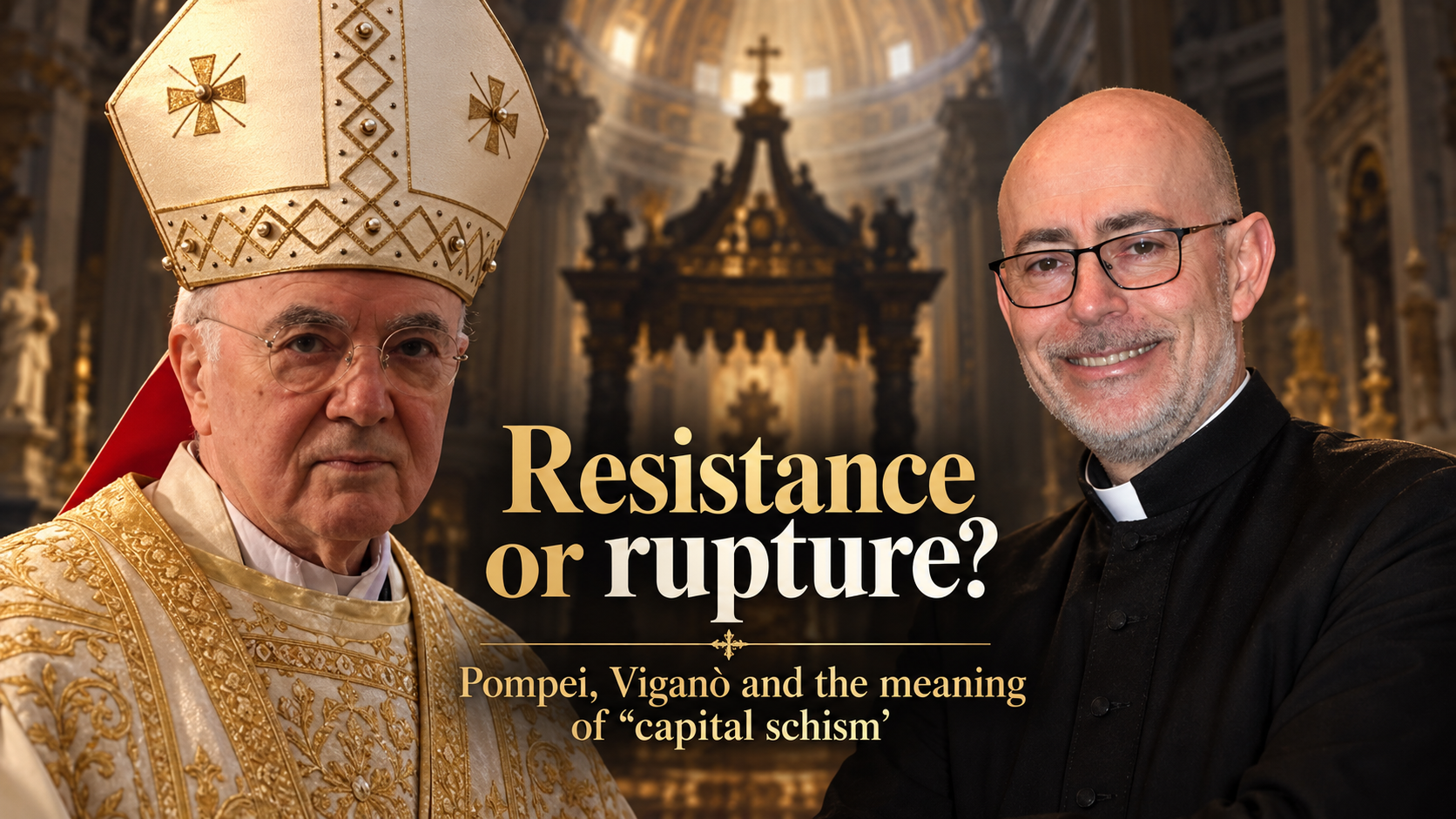
Fr Leonardo Maria Pompei says that he has been declared a schismatic because he refused to abandon what the Church has always taught. Yet his defence now rests substantially upon ✠Carlo Maria Viganò’s theory of a “schism of the head” — the very theory Nuntiatoria examined as Pompei’s own defence entered the public sphere. His case provides an unusually immediate test of where legitimate Catholic resistance ends and rupture from visible ecclesial communion begins.
On the same day that Fr Leonardo Maria Pompei’s extensive defence of his position appeared, Nuntiatoria published its analysis of ✠Carlo Maria Viganò’s proposed category of scisma capitale, the “schism of the head”. The coincidence could scarcely have been more pertinent. We concluded that Viganò had identified a real and grave problem: papal authority can be abused, exercised against Tradition and employed contrary to the supernatural purpose for which Christ instituted the Papacy. But we also identified the danger within his proposed solution. If “capital schism” means more than a description of an office-holder acting against the proper end of his office, it risks allowing the individual resister to decide whether the visible head remains united to the Church and, consequently, where authentic ecclesial communion now resides.¹
Pompei’s case is not merely related to that argument. It is its almost immediate practical test. He expressly tells LifeSiteNews that he regards Viganò’s recent position as “more correct, measured, and less divisive” than alternative explanations of the crisis and adds: “I share this position to a large extent.”² In the second part of the interview he is still more explicit, saying that he shares Viganò’s interpretation, “particularly his distinction between the See and its occupant and his concept of capital schism”.³ We are therefore no longer examining scisma capitale merely as an abstract ecclesiological hypothesis. We can ask what happens when a priest actually employs it to explain why declaring himself no longer in communion with the Pope and bishops need not, in his judgement, constitute separation from the Catholic Church.
The chronology should first be stated without caricature. Pompei says that his “fault” consisted in “preaching the doctrine of all time”, “defending the traditional faith, morality, and liturgy” and publicly opposing what he believed were errors devastating the Church.² He concluded that exercising his priesthood within ordinary diocesan structures had become impossible and on 29 August 2025 informed ✠Mariano Crociata, Bishop of Latina-Terracina-Sezze-Priverno, that he was resigning as parish priest and intended to continue his ministry within what he described as “the broad and varied world of Catholic tradition”.²
The Diocese’s own account confirms that the subsequent disciplinary conflict initially concerned obedience. A penal precept ordered Pompei “di non convocare alcun incontro o assemblea parrocchiale” and to suspend his activity on social media.⁴ He nevertheless conducted a public YouTube meeting on 3 September 2025. The Diocese subsequently said that he had “venuto meno in forma positiva e pubblica all’obbligo di obbedienza al suo Ordinario” — publicly and positively failed in his obligation of obedience to his Ordinary.⁴ The following day Bishop Crociata signed a decree suspending him from all acts of the power of orders and governance and from the rights or functions attached to office.⁵
Pompei does not deny that he disobeyed the precept. His contention is that the precept itself could not morally bind. “Catholic obedience is never blind,” he says, “and can never be separated from truth and the law of God.”² He believed obedience would have required him to suppress a public apostolate through which he considered himself obliged to defend the Faith and warn souls. In principle, the proposition that ecclesiastical obedience has limits is entirely Catholic. A bishop cannot make sin obligatory, error true or conduct contrary to divine law morally binding merely by commanding it.
That, however, was not yet the eventual charge of schism. The Diocese’s communiqué of 11 September 2026 identifies a deeper rupture. It states that Pompei communicated that he no longer considered himself “in comunione con il Vescovo Diocesano e nemmeno con il Papa”, adding that the same applied to the bishops of the Catholic Church.⁴ The communiqué further records his refusal to continue celebrating according to the post-conciliar liturgy and says that these positions were subsequently expressed publicly. An extrajudicial penal process was then conducted by the Diocese under mandate from the Dicastery for the Doctrine of the Faith and concluded in May 2026 with a decree finding him guilty of schism.⁴
Pompei largely confirms that chronology. He says the judgment was dated 22 May 2026 and served upon him on 27 May. According to the text he quotes, its dispositive section declared: “the Reverend Don Leonardo Pompei is guilty of the reserved delict of schism.”² He also correctly distinguishes between the imposition of a new ferendae sententiae penalty and a declaration that a latae sententiae excommunication had already been incurred through the conduct judged schismatic.
One evidential limitation remains important. The complete decree of 22 May has not been published, nor has Pompei published his complete ten-page defence. He expressly says that it contains facts and arguments which he does not presently consider appropriate to disclose.² We therefore possess the diocesan summary, Pompei’s own extensive account and his quotation of the dispositive portion, but not the complete reasoning by which the canonical decision dealt with every question of intent, imputability, necessity and mitigation. Any commentary claiming to know more must go beyond the public record.
The law defining the offence is nevertheless straightforward. Canon 751 says that schism is “the refusal of submission to the Supreme Pontiff or of communion with the members of the Church subject to him”.⁶ Canon 1364 §1 provides that a schismatic incurs latae sententiae excommunication.⁷ Heresy and schism are consequently distinct offences, and that distinction matters because Pompei repeatedly makes the absence of a heresy allegation central to his defence.
“All this occurred,” he says, “without my being accused of having taught any heresy or doctrinal error.”² He later sharpens the argument: “I am declared a schismatic not because I abandoned Catholic doctrine or embraced a new religion, but because I refused to abandon what the Church has always believed, taught, and celebrated.”² The paradox deserves serious attention, particularly when no public evidence has been produced that Pompei was preaching denial of the Trinity, the Incarnation, the Real Presence or another defined dogma.
But absence of heresy cannot by itself answer a charge of schism because the Church has never treated the two as synonymous. A man may profess the Creed and nevertheless rupture ecclesiastical communion. Catholic unity involves profession of the same Faith, participation in the same sacramental life and visible hierarchical communion. Doctrinal orthodoxy cannot prove the third simply by proving the first.
Pompei understands that difficulty, and his actual defence is considerably more sophisticated than the headline suggestion that he was simply punished for believing old-fashioned Catholic doctrine. He does not deny making statements about communion; he qualifies their meaning. “When I stated that I no longer considered myself in communion with the present Pope and the bishops,” he says, “I did not mean that I had separated myself from apostolic communion, from the papacy, from the episcopate, or from the Catholic Church.”² He means instead that he cannot be in communion with those authorities insofar as they adhere to principles, doctrines and practices which he believes belong to a new conciliar and synodal religion incompatible with Tradition.
Here the connection with Viganò becomes decisive. Pompei distinguishes, as Viganò does, between the divine institution and the man occupying its office. The papacy cannot defect because Christ instituted it; its occupant nevertheless remains a free human being capable of abusing the authority entrusted to him. In Part II he puts the proposition plainly: “The papacy can be betrayed by the person who occupies its chair when he uses the authority he has received” contrary to its purpose.³
There is much in that distinction which is simply traditional Catholic theology. The Roman Pontiff is not the proprietor of Revelation. Vatican I itself teaches that the Holy Ghost was not promised to Peter’s successors so that they might “reveal some new doctrine”, but so that the Revelation handed down from the Apostles might be faithfully guarded and expounded.⁸ Papal authority is supreme, but it remains ministerial. Its supernatural purpose precedes the individual man who receives it.
Our recent editorial on Viganò therefore did not object to saying that a Pope could misuse his office, injure Tradition, tolerate error or act contrary to the proper purpose of the Papacy. The problem arose when that diagnosis became the theory of scisma capitale. Viganò proposed that instead of members separating from the visible head, the head himself may separate from the Mystical Body and the Tradition which precedes him. As a description of grave papal misconduct, the expression possesses considerable force. As an ecclesiological principle by which the location of Catholic communion is determined, it becomes much more difficult.¹
Pompei now gives that difficulty concrete form. He says that he is no longer in communion with the Pope and bishops in the relevant respects, but simultaneously maintains that he remains in apostolic and Catholic communion because the hierarchy itself has departed from the proper principles of Catholic Tradition. “Consequently,” he argues, “I am not the one rejecting Catholic communion.”² The hierarchy, on his account, has attempted to impose under the name of communion adherence to things incompatible with the Faith; refusal of that communion is therefore not separation from the Church but fidelity to it.
This is the exact point at which careful distinctions are required. Every act of legitimate resistance necessarily involves personal judgement. A priest ordered to commit sacrilege cannot avoid judging that the command is unlawful. A Catholic confronted by an apparent contradiction with defined doctrine must employ reason, Tradition and the prior Magisterium to understand what he is being asked to believe. To denounce “private judgement” as though no Catholic may ever judge an act of authority would merely recreate papal positivism under another name.
But there is a fundamental difference between judging an act of authority and claiming competence to judge the objective location of ecclesial communion itself. The first says: this teaching, command or action contradicts a higher law and therefore must be resisted. The second says: because the Pope and bishops have departed from Tradition, their communion no longer determines my communion with the visible Church. The former may become a moral duty; the latter begins to assume an ecclesiological competence which the individual does not obviously possess.
Pompei himself supplies the principle by which that distinction should be measured. In Part II he says that “the initial presumption should certainly favor authority”, that resistance cannot be the first reaction, and that it becomes necessary only when conflict with faith, divine law or the good of souls is “objective, grave, and sufficiently certain”.³ Most importantly, after citing Saint Thomas Aquinas and Saint Robert Bellarmine, he writes: “To resist, however, is neither to depose nor to arrogate an authority one does not possess.”³
Precisely so. Resistance has a determinate object. One resists an erroneous proposition, an unlawful command or a harmful act. The person being resisted remains the superior precisely because the resistance concerns the misuse of an authority still acknowledged to exist. Bellarmine’s classic argument depends upon that distinction. Resistance is neither blind submission nor self-promotion into a superior jurisdiction.
The difficulty for Pompei is therefore not that he exercises judgement. It is whether the consequences he derives from that judgement go beyond resistance. His formulation risks reasoning from “this Pope is acting contrary to the purpose of his office” to “communion with this Pope may therefore be withheld without loss of ecclesial communion”. That second conclusion does not automatically follow from the first.
His appeal to the Roman Canon illustrates the problem particularly clearly. Pompei points to the Te igitur: una cum famulo tuo Papa nostro N. et Antistite nostro N. et omnibus orthodoxis atque catholicae et apostolicae fidei cultoribus. He argues that communion with Pope and bishop cannot be detached from profession of the orthodox, Catholic and apostolic Faith.² He is right. Catholic communion is not personal loyalty to a man irrespective of truth, and the Pope and bishop are themselves bound to the Revelation which they exist to guard.
Yet the same una cum also witnesses to visible ecclesial communion. The celebrant does not commemorate an abstract papacy or an ideal episcopate but an identifiable Pope and bishop. To say that the words concerning orthodox professors of the Faith permit the individual celebrant to decide that he remains in authentic communion while the named holders of those offices have placed themselves outside it would ask the Canon to establish substantially more than its text supplies.
This was the central warning of our Viganò editorial. If a Pope remains Pope, his abuse of authority does not make another Catholic the judge of the Petrine office. If he has somehow ceased to hold that office, the conclusion is more momentous still and cannot safely depend upon the private theological deduction of each bishop, priest or layman. Otherwise the visible principle of unity becomes an invisible reality claimed by competing parties, each insisting that its own fidelity to Tradition identifies the true locus of communion.¹
The parallel with ✠Viganò’s own canonical history makes Pompei’s adoption of scisma capitale particularly significant. In July 2024 the Dicastery for the Doctrine of the Faith declared Viganò guilty of the reserved delict of schism. It identified among the relevant public positions his “refusal to recognize and submit to the Supreme Pontiff” and his “rejection of communion with the members of the Church subject to him”.⁹ The DDF consequently declared the latae sententiae excommunication under canon 1364 §1.
That judgment does not refute Viganò’s theory merely because the same ecclesiastical authority whose conduct he contests pronounced it. To argue that way would be circular. Its relevance is different and more substantial: scisma capitale was developed precisely within a controversy about whether visible submission and communion with the contemporary hierarchy continue to function according to the ordinary canonical understanding of those terms. Pompei has now adopted that explanatory framework while himself facing a penal determination based upon substantially the same canonical categories. The recurrence exposes the theory’s unresolved ecclesiological problem rather than disposing of it by authority alone.
Pompei himself seems conscious of the danger. In Part II he warns against the multiplication of “little private magisteria” among traditional Catholics and refuses to make disputed hypotheses concerning a heretical Pope, an invalid election or loss of office into private dogmas.³ That is a wise principle. But it must apply equally to scisma capitale. If Cassiciacum, sedevacantism and theories surrounding the 2013 resignation cannot become private criteria of Catholic communion, neither can the proposition that the hierarchy has become the schismatic party.
None of this means that the canonical penalty itself should escape scrutiny. Pompei says that his ten-page defence invoked an “extremely grave state of ecclesial necessity”.² That assertion is canonically relevant. Canons 1323 and 1324 deal expressly with necessity, grave inconvenience, imperfect imputability and erroneous belief concerning exculpatory circumstances; canon 1324 §3 provides that where the mitigating circumstances described in §1 apply, the offender is not bound by a latae sententiae penalty, although lesser penalties or penances may still be imposed.¹⁰
The Holy See’s own 1996 explanatory note concerning adherents of Archbishop ✠Marcel Lefebvre likewise insisted that the moral question of schism must be distinguished from the juridical-penal question and that canons 1323–1324 are relevant to the latter. It also stated that for other faithful occasional participation in Lefebvrian liturgical acts is not by itself sufficient to establish formal adherence; intention and its external manifestation must be considered.¹¹
That qualification is strikingly reflected in the Diocese of Latina’s own communiqué. The Diocese does not say that everyone attending a Mass celebrated by Pompei thereby becomes excommunicated. It warns specifically of those who participate intending to manifest their refusal of submission to the Roman Pontiff or communion with those subject to him.⁴ This is an important distinction and should be preserved against sensational reporting in either direction.
The absence of the complete May decree consequently matters. We cannot presently know from public documents exactly how the tribunal treated Pompei’s plea of necessity, how it established the subjective requirements for the automatic censure, or which particular external acts it considered sufficient to complete the offence. The public evidence establishes the allegation and result; it does not disclose the entire juridical reasoning.
Pompei’s decision not to pursue canonical recourse makes that limitation more regrettable. He says that an appeal would have involved asking authorities belonging to the same doctrinal and disciplinary system to restore him to a communion whose contemporary meaning he disputes. He insists that he did not want “a personal privilege” or merely a tolerable canonical arrangement while the wider crisis remained untouched.² The coherence of that position within his own thesis should be acknowledged.
Yet the Church’s published norms specifically preserve recourse to the Dicastery for the Doctrine of the Faith in first-instance cases of heresy, apostasy and schism, and the Code states that recourse against a decree imposing or declaring a penalty has suspensive effect.¹² A recourse could therefore have tested whether canon 751 was satisfied, whether the requirements of imputability were established and whether canons 1323–1324 affected the supposed automatic penalty. Refusing that remedy does not invalidate Pompei’s substantive objections, but it means that the higher canonical forum was never required to answer them.
This returns us to the theological heart of the interview. Pompei asks: “Who is truly in schism – the one who preserves what the Church has always taught, or the one who seeks to change it?”² It is a powerful question because the present ecclesial crisis has repeatedly confronted Catholics with teaching, discipline and pastoral practice which appear difficult to reconcile with what preceded them.
But the question is not sufficient as a criterion of communion. Catholicity cannot finally be established by asking which competing party can assemble the larger dossier of historical quotations. The Church possesses a received Faith which authority cannot alter, but she also possesses a visible and hierarchical constitution which individual judgement cannot recreate. Both realities belong to Tradition.
The alternative would place faithful Catholics in an impossible ecclesiology. One Catholic judges the Pope to have entered a capital schism; another concludes that the See is formally vacant; another maintains material occupancy without formal authority; another identifies a defect in the 2013 resignation; another recognises the Pope but suspends practical communion whenever his own criterion of Tradition requires it. Each may sincerely insist that he has not departed from the Church because the Church is wherever the true Faith is preserved. Yet without an objective visible principle of communion, “the Church” threatens to become precisely the abstraction which every faction claims for itself.
This is why the distinction between recognition and resistance remains indispensable. It avoids the papal maximalism according to which everything emanating from Rome must be defended because it emanates from Rome. It also avoids the contrary assumption that abuse of authority transfers authority to the person resisting it. We may distinguish the office from its occupant precisely because the office has an objective constitution independent of his virtues or failures; we cannot then make the reality of that office depend upon whether each Catholic considers its occupant sufficiently faithful to its purpose.
Pompei is right that authority is limited by truth. He is right that Catholic obedience is not blind. He is right that Vatican I did not transform the Roman Pontiff into the creator of doctrine. He is right that no superior may require sin or command a Catholic to embrace what contradicts divine Revelation. He is also right to warn traditional Catholics against turning provisional explanations of the present catastrophe into competing private magisteria.
Those admissions make the unresolved problem sharper, not weaker. If resistance is “neither to depose nor to arrogate an authority one does not possess”, then capital schism must not quietly become a mechanism for doing ecclesiologically what Pompei disclaims doing juridically: deciding that the visible hierarchy has forfeited its place as the objective reference of communion while the resister remains, by his own judgment, in the true ecclesial body.³
That was the thesis of our earlier Viganò editorial. Pompei’s interview has now supplied its concrete test. The problem with scisma capitale is not its recognition that an occupant of the Papacy may gravely betray the purpose of his office. Catholic history supplies more than enough evidence that Popes may sin, govern badly and inflict grave damage. The problem is whether that diagnosis can be turned into an ecclesiology capable of explaining how visible communion survives without making the individual theologian, bishop, priest or layman the effective judge of where that communion resides.
Pompei’s case therefore deserves neither easy condemnation nor romantic simplification. “Priest excommunicated for defending Tradition” captures his understanding of events but not the whole canonical question. “Disobedient priest becomes schismatic” reproduces the juridical conclusion without addressing the theological crisis from which his resistance arose. The truth requiring examination lies precisely between those slogans.
Catholics may sometimes have to resist ecclesiastical authority in order to remain faithful to what that authority itself was instituted to guard. But authentic resistance must remain what Pompei himself says it is: resistance to an identifiable error, command or abuse without arrogating an authority which has not been given to the resister. The Faith cannot be altered by authority; communion cannot be recreated by private judgement.
That is the narrow road which the present crisis makes increasingly difficult and increasingly necessary. It rejects both the absolutisation of the office-holder and the absolutisation of the resister. It neither baptises novelty because Rome proposes it nor relocates Rome because the individual rejects it. It guards what has been received while refusing to claim powers which have not been received.
In that sense, the Pompei affair is not merely another disciplinary controversy. It is the practical sequel to the Viganò debate and a test of the ecclesiology by which traditional Catholics intend to survive the crisis. The Faith is something authority cannot alter; ecclesial communion is something private judgement cannot recreate. To preserve both, without sacrificing either, is the real work of Catholic resistance.
¹ Nuntiatoria, Archbishop Viganò’s “Schism of the Head”: A True Diagnosis That Risks a False Ecclesiology, 22 September 2026.
² Gaetano Masciullo, LifeSiteNews, EXCLUSIVE: Priest excommunicated after defending Tradition speaks out, 22 September 2026.
³ Gaetano Masciullo, LifeSiteNews, EXCLUSIVE: Excommunicated priest: “Resistance” can be necessary to remain Catholic, 23 September 2026.
⁴ Diocese of Latina-Terracina-Sezze-Priverno, Dichiarata la scomunica per scisma a carico di don Leonardo Pompei, 11 September 2026.
⁵ Diocese of Latina-Terracina-Sezze-Priverno, Sospensione per Don Leonardo Pompei, il decreto firmato oggi dal vescovo Mariano Crociata, 4 September 2025.
⁶ Code of Canon Law, Canon 751: heresy, apostasy and schism.
⁷ Code of Canon Law, Canon 1364: offences against the Faith and unity of the Church.
⁸ First Vatican Council, Pastor aeternus, 18 July 1870.
⁹ Dicastery for the Doctrine of the Faith, Press Release About the Conclusion of the Extrajudicial Penal Process Against Archbishop Carlo Maria Viganò, 5 July 2024.
¹⁰ Code of Canon Law, Canons 1323–1324, concerning necessity, imputability and mitigating circumstances.
¹¹ Pontifical Council for Legislative Texts, Explanatory Note on excommunication for schism among adherents of Archbishop Marcel Lefebvre, 24 August 1996, especially nos. 7–9.
¹² Congregation for the Doctrine of the Faith, Norms regarding delicts reserved to the Congregation for the Doctrine of the Faith, 11 October 2021, arts. 2 and 23; Code of Canon Law, canon 1353.




Leave a Reply