
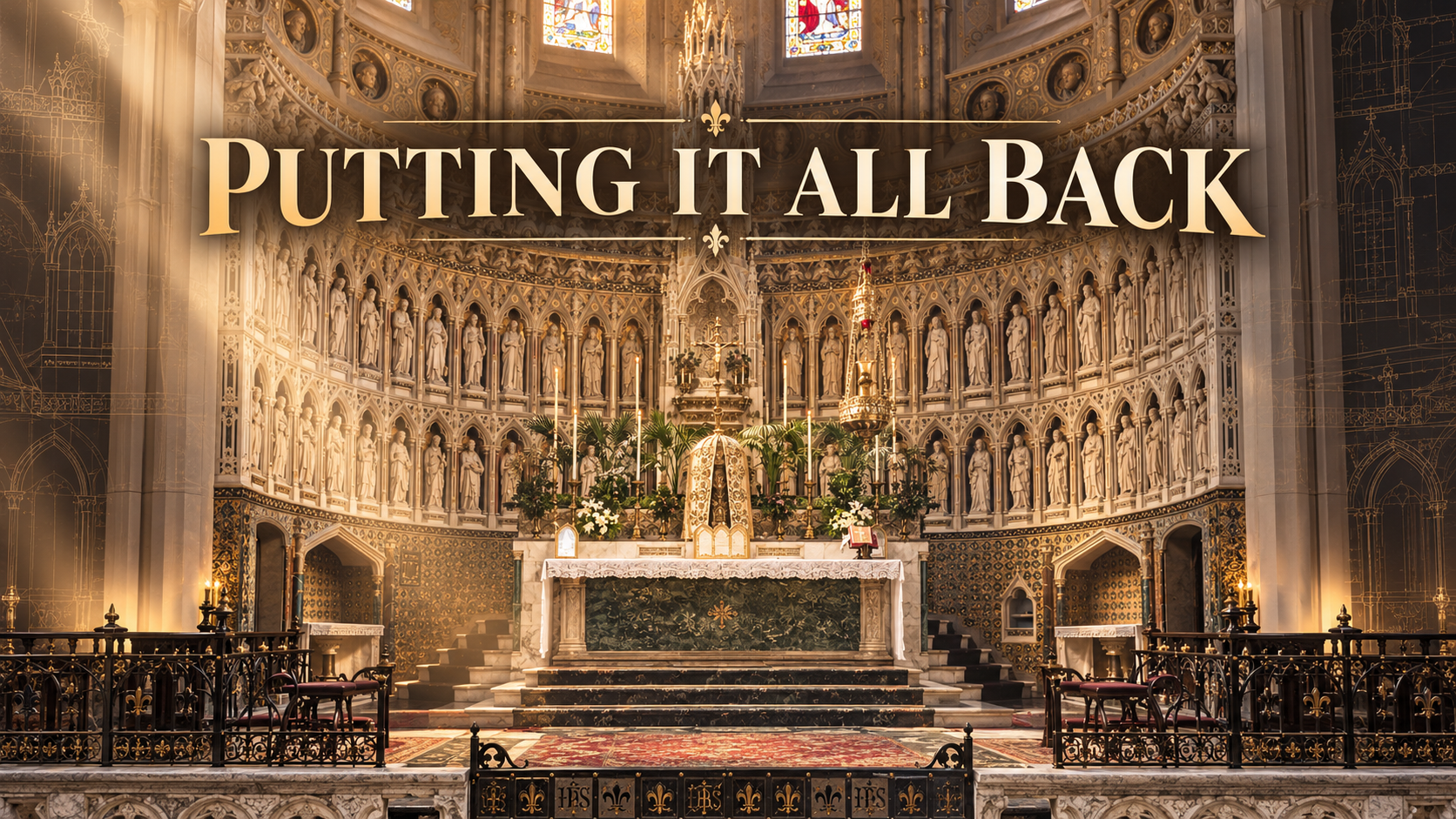
In 1966 the High Altar of St Aloysius, Oxford, was chopped up and moved forward. Sixty years later, the Oratory is building a new High Altar in its original position. In one sanctuary, the distinction between Vatican II, its official implementation and the later culture of liturgical change has become visible in stone.
“Our church is not as it should be.” The Oxford Oratory could scarcely have found a more arresting sentence with which to announce the next stage of the restoration of St Aloysius. Repairs to the apse are under way and the sacristy is to be restored. Inside the church, however, something still more significant is about to happen. A High Altar is going back into the position for which the sanctuary was designed. The Fathers’ fundraising slogan is admirably uncomplicated: “We’re putting it all back.”¹
Nor does the Oratory disguise what happened before. Its announcement says that the original High Altar was “chopped up and moved forward in 1966”. So little remains that the surviving stone of the present altar cannot simply be returned to its former position. A new High Altar must therefore be constructed. Work in the sanctuary begins in the week commencing 21 September and is expected to continue for approximately six months. Together with repairs to the apse and restoration of the sacristy, the present appeal seeks £3.3 million; at the announcement of the works, 37 per cent had already been raised. During construction the sanctuary will be screened off immediately in front of the altar rails and a temporary sanctuary established so that the principal programme of Masses and confessions can continue.¹
The date is crucial: 1966. The old altar was dismantled three years before Paul VI promulgated the Apostolic Constitution Missale Romanum on 3 April 1969.⁷ The physical reordering of the sanctuary therefore preceded the promulgation of the reformed Roman Missal by three years. Oxford had already taken a hammer to its architectural inheritance while the reform with which such sanctuary alterations would subsequently become identified was still developing.
Something had certainly changed by then. The instruction Inter Oecumenici, issued on 26 September 1964 and effective from 7 March 1965, said that the principal altar should preferably be constructed apart from the wall so that it could readily be walked around and celebration versus populum could take place.⁵ The wording matters. The Latin is praestat: it is preferable. The purpose is expressed by possit: so that celebration facing the people may be possible. Neither proposition amounted to a command that every priest must face the congregation, still less an instruction that inherited High Altars should be broken apart. The same instruction, indeed, continued to envisage reservation of the Blessed Sacrament in the middle of the principal altar and expressly contemplated Mass facing the people where a tabernacle remained upon it.⁵
This distinction is one Nuntiatoria has repeatedly had cause to make. Vatican II authorised liturgical reform. Authorities charged with implementing the Council subsequently made particular choices. Those choices encouraged further practices. Practices became expectations; expectations became embedded in ecclesiastical culture; and within remarkably little time the whole accumulation was remembered simply as “what Vatican II did”. Permission became preference, preference became expectation, expectation became near-universal practice, and near-universal practice became historical memory.⁸ At Oxford the significance of that process can be seen without opening a liturgical textbook, because the historic photograph shows that the altar did not merely occupy the back of a large room. The sanctuary was composed around it.
The steps ascend towards the altar. The rails mark the approach to it. The tabernacle occupies its axis. Behind it rises the great reredos and above it the Crucifix. The Oratory’s own account describes fifty-two full-length saints and another twenty represented in roundels, angels bearing the Sanctus, and Our Lady and St Joseph in the places of honour beside the Cross. Decorative vines continue from the sanctuary railings through the murals and reredos, bearing fruit directly behind the tabernacle. The Oratory describes the reredos itself as the heavenly court looking down upon the worship of the sanctuary and sharing in that worship from heaven. Architecture here is not scenery but theology arranged in stone, paint and space.³
Moving the altar therefore did something more consequential than moving a piece of ecclesiastical furniture. Once detached from the architectural composition made to interpret it, the altar acquired a different visual relationship with everything around it. The reredos became a background rather than the culmination of an ascending whole. The tabernacle no longer occupied the same uninterrupted liturgical axis. A second focal point appeared before the structure towards which the sanctuary had originally been directed. Something conceived as one theological composition became several objects sharing the same space. No advanced degree in liturgical history is required to perceive the difference; the photograph is sufficient.
Reducing the question to personal taste is consequently inadequate. Some prefer Gothic richness; others modern simplicity. Some like marble, painted ceilings and sanctuary rails; others prefer an uncluttered interior. Catholic sacred architecture cannot finally be judged as wallpaper. A sanctuary makes theological claims whether those who alter it acknowledge them or not. It establishes relationships between altar, priest, people, tabernacle, Cross and sacred space. It directs attention, establishes hierarchy and teaches the worshipper how to inhabit the church before a word of catechesis has been spoken.
The old arrangement at St Aloysius says unmistakably that Catholic worship has a direction. Priest and people are not arranged principally to contemplate one another. They are incorporated into an action which carries them beyond themselves. The altar of Sacrifice stands at the point towards which the building advances; the tabernacle occupies the sacred axis; the Cross rises above; the saints surround the earthly liturgy as witnesses to the heavenly one. The whole structure says that neither celebrant nor congregation is the protagonist. God is.
That is why the claim that Vatican II required such sanctuaries to disappear cannot survive contact with the Council’s own text. Sacrosanctum Concilium contains no requirement that Mass be celebrated facing the congregation and no direction that old High Altars be demolished. Its chapter on sacred art says that the artistic treasury accumulated through the centuries “must be very carefully preserved”, while requiring the laws concerning churches, altars, tabernacles and sacred furnishings to be revised in accordance with the reformed liturgy. More fundamentally, the Council’s general norm for reform was that there should be “no innovations unless the good of the Church genuinely and certainly requires them”, and that new forms should grow organically from those already existing.⁴ The Council authorised reform. It did not promulgate an ecclesiastical year zero.
There is no need to caricature the history in the opposite direction. Inter Oecumenici was an authoritative instruction implementing the Constitution on the Sacred Liturgy, formally approved and confirmed by Paul VI.⁵ New principles concerning the arrangement of sanctuaries were indeed being introduced. The point is not that nothing changed or that every alteration was unlawful. The point is historical precision. The Council, the measures adopted to implement it, and the much wider ecclesiastical culture which arose around those measures were not one and the same thing. To describe the entire process simply as “Vatican II” obscures who decided what, when, and under which authority.⁸
Oxford makes that distinction especially difficult to evade because the chisel arrived so early. In 1966 there was no Missal of Paul VI. Paul VI would not promulgate Missale Romanum until April 1969, when he described major changes including additions to the Eucharistic Prayer and extensive revision of the Order of Mass and biblical readings.⁷ Whatever reasoning justified the Oxford reordering at the time, the destruction of its High Altar cannot retrospectively be described as obedience to the rubrics of a Missal which did not yet exist.
The subsequent legislation adds another irony. The present General Instruction of the Roman Missal favours a freestanding altar where this is possible, but explicitly considers the case of an existing church in which an old altar cannot be moved without damage to its artistic value. In that circumstance another fixed altar is to be erected and the old altar left in place.⁶ That provision did not govern Oxford in 1966 and should not be projected backwards as though it did. Its significance is nevertheless revealing: even the mature legislation of the reformed liturgy recognises that an inherited altar may possess an artistic integrity which ought not to be destroyed. What could not be left alone at Oxford in 1966 must now be reconstructed in 2026.
The Oratory is not merely attempting to reproduce the altar as it immediately existed before the reordering. Joseph Hansom’s surviving drawings record several stages of his design, progressively simplified as money became scarce. The new High Altar takes those drawings as its starting point, allowing the restoration to recover something of Hansom’s original intention rather than merely reproducing the compromised form which financial constraints permitted in the nineteenth century. The new altar will combine black and gold marble with white Carrara and coloured inlays; the existing gilt-bronze cross will be incorporated, the tabernacle restored and Hansom’s Versailles parquet design reinstated in the sanctuary floor.² There is a pleasing reversal here: an intervention which once simplified by destruction is being answered by a restoration which seeks to complete.
The High Altar is not an isolated recovery. Gabriel Pippet’s sanctuary murals disappeared beneath modern paint for some sixty years before being uncovered and restored in 2024. The paintings survived in remarkably good condition beneath those later layers and supplied vital evidence for the colours, patterns and decorative relationships of the original sanctuary. The recovered work revealed how vines, gilding, architectural mouldings, reredos, tabernacle and paintings belonged together; elsewhere, where the original decoration had not survived so well, the restored murals provided the evidence necessary for reconstruction.¹¹ What had come to appear as a collection of surviving Victorian and Edwardian details once belonged to a coherent whole.
There is no reason to conscript the Oxford Oratory Fathers into a polemic they have not themselves issued. Their project is a restoration campaign, not an indictment of the Second Vatican Council, and their intentions should be represented accurately. But accuracy does not require us to pretend that restoration is historically mute. The Fathers need not write the editorial. The building supplies the evidence.
One generation inherited the sanctuary and concluded that its High Altar should be broken up and brought forward. Another has inherited the result and concluded that a High Altar ought to stand there again. Earlier interventions concealed substantial parts of the decorative scheme; the present generation is painstakingly recovering them. The Oratory’s own restoration material says that the 1966 reconfiguration left the sanctuary without the focus Hansom had intended, while the present programme says that returning the High Altar will give the sanctuary back its focus.¹ ² These are not identical judgements about inheritance, beauty, continuity or what constitutes progress.
That is why “We’re putting it all back” has a resonance far beyond a fundraising campaign. Nuntiatoria has repeatedly examined the peculiar historical confidence with which inherited Catholic practices were treated in the decades surrounding and following the Council. The reforming generation did not invariably destroy, and those responsible for particular alterations were not necessarily animated by hostility to tradition. Yet the burden of proof changed. The inherited arrangement increasingly had to explain why it should survive; novelty could often appeal to the language of renewal. Altars, rails, tabernacles, Latin, Gregorian chant, traditional orientation, inherited ceremonial and popular devotions could all find themselves judged by a narrative in which the future had already won the argument.⁹
Sixty years later, the confidence of that judgement is no longer self-evident. One need not possess personal memories of the pre-conciliar Church to look at the old St Aloysius sanctuary and recognise its coherence. One need not remember High Mass before the Council to discover that Gregorian chant can still serve Catholic worship, nor remember an eastward celebration from childhood to understand the theological symbolism of priest and people turned together in a common liturgical direction. Where appreciation is acquired rather than remembered, “nostalgia” becomes an increasingly inadequate explanation.
Restoration differs from nostalgia precisely here. Nostalgia attempts to recover a feeling because the past is gone; restoration judges that something inherited still possesses value and can again serve the living. Oxford’s project matters because it is constructive. No sanctuary is restored by lamenting sanctuary destruction, and no altar reappears because another history of the Consilium is written. At St Aloysius, stone will actually be cut and set. The historic liturgical focus of the sanctuary will be recovered. A living congregation will worship in a church whose architecture once again makes sense on its own terms. This is not the creation of a museum but the recovery of a functioning Catholic inheritance for Catholics who have not yet been born.
The Oratory itself places the appeal in precisely that intergenerational context. Previous generations built St Aloysius, enriched it and handed it on. The present generation has received both their achievement and the subsequent losses. Its responsibility, the Fathers say, is to restore what has been lost, repair what has deteriorated and leave St Aloysius ready to serve generations still to come.¹ That principle reaches beyond architecture. It is the logic of tradition itself: reception before transmission, stewardship before reinvention.
Accipere, non fingere: to receive, not to invent.¹⁰ That does not mean that nothing can develop, or that every nineteenth-century architectural decision enjoys the status of Apostolic Tradition. It means that a Catholic begins as an heir. He receives a Faith he did not compose, a liturgy he did not originate, churches he did not build, devotions he did not invent and a sacred vocabulary formed by generations of believers whose names he will never know. His first responsibility is to understand the inheritance before assuming that his age has outgrown it.
The old photograph of St Aloysius therefore raises a more serious question than whether Victorian churches look better with their original fittings. Sixty years after its High Altar was dismantled amid an age of liturgical reconstruction, another Catholic generation judges the recovery of that sanctuary’s architectural focus worth considerable expenditure and craftsmanship. Altar, tabernacle, orientation, hierarchy, beauty and inherited sacred space evidently continue to possess theological intelligibility after the cultural moment which treated so much of their traditional expression as expendable has passed. “Tastes change” is not a sufficient explanation, because this is not wallpaper.
In 1966, the High Altar of St Aloysius was chopped up. In 2026, Oxford is putting it back. Placed beside one another, those two facts say an extraordinary amount about the last sixty years of Catholic liturgical history.
¹ Oxford Oratory, “We’re putting it all back”, 13 September 2026; Putting it all back; Restoration appeal.
² Oxford Oratory, It’s time to put the altar back.
³ Oxford Oratory, 150 Years of St Aloysius’ Church: (7) The Sanctuary, 19 March 2025.
⁴ Second Vatican Council, Sacrosanctum Concilium, especially §§23, 122–129.
⁵ Sacred Congregation of Rites and Consilium, Inter Oecumenici, Acta Apostolicae Sedis 56 (1964), especially §§91, 95.
⁶ Congregation for Divine Worship and the Discipline of the Sacraments, General Instruction of the Roman Missal, §§299, 303.
⁷ Paul VI, Missale Romanum, 3 April 1969.
⁸ Nuntiatoria, The Council, the Reform, and the Missing “Thus”, 28 August 2026.
⁹ Nuntiatoria, The Most Clerical Revolution in Modern Catholic History, 21 August 2026.
¹⁰ Nuntiatoria, ACCIPERE, NON FINGERE ~ To Receive, Not to Invent: A Spiritual Conference for Nuntiatoria CXIX, 18 August 2026.
¹¹ Oxford Oratory, St Aloysius Revealed: Restoring the Lost Murals of Gabriel Pippet, 18 March 2024.



Leave a Reply