
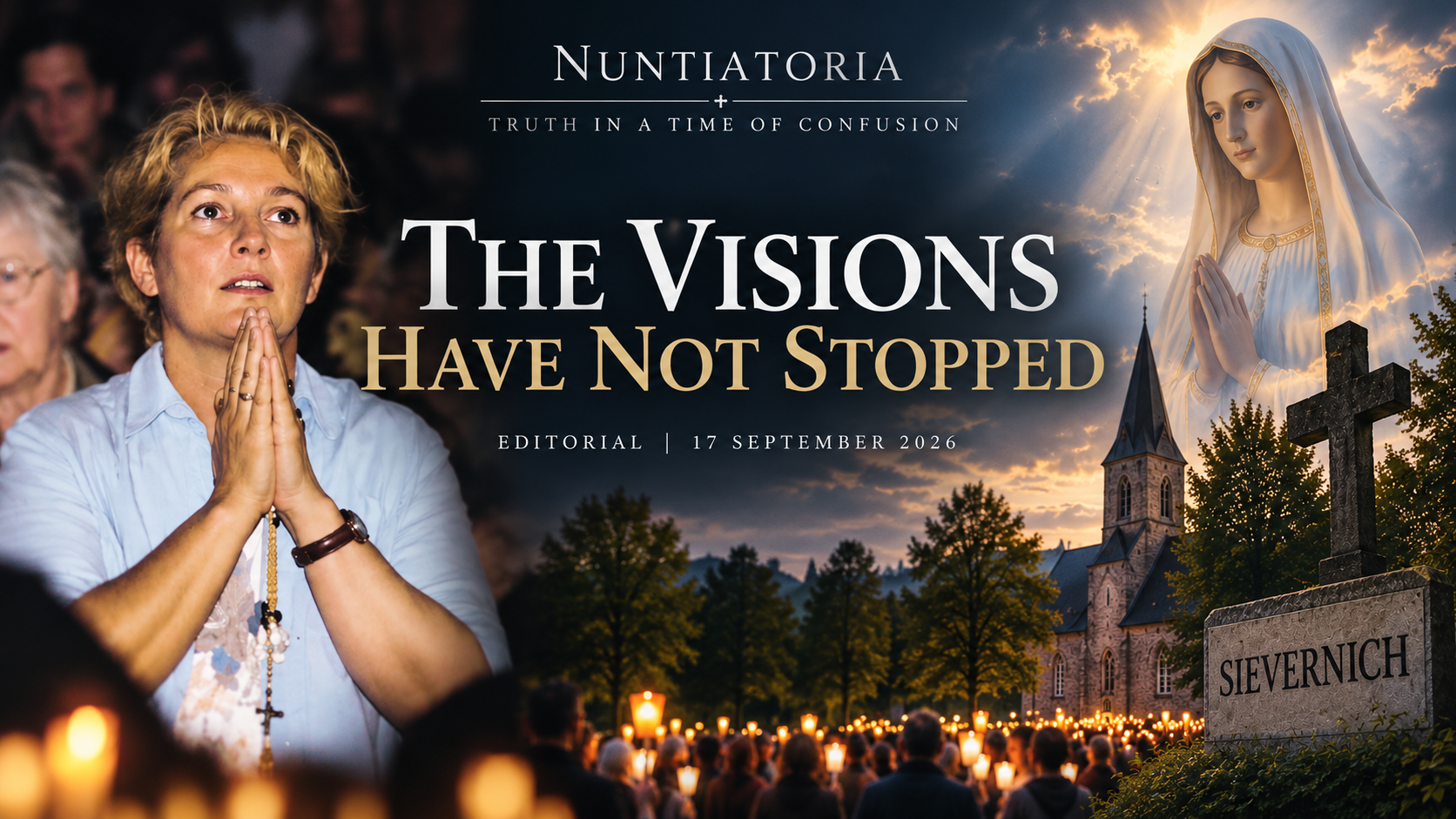
The Diocese of Aachen is formally investigating the long-running alleged apparitions at Sievernich under Rome’s new rules for supernatural phenomena. The difficulty is unusually sharp: the Church is not examining a finished episode, because new purported messages from Christ and the saints are still being published while the inquiry is under way.
The Diocese of Aachen has opened a formal investigation into one of Germany’s longest-running alleged apparition phenomena. At Sievernich, a village west of Cologne, claims which began with reported appearances of the Blessed Virgin in 2000 have developed over more than a quarter of a century into an extensive body of purported messages attributed to Christ, Our Lady, St Michael the Archangel and numerous saints. ✠Helmut Dieser, Bishop of Aachen, has now appointed a four-member commission under the Dicastery for the Doctrine of the Faith’s 2024 Norms for Proceeding in the Discernment of Alleged Supernatural Phenomena. The case is particularly significant because the commission is not studying a closed chapter of devotional history: alleged revelations were still being published in August 2026, after the investigation had begun.¹
That circumstance changes the nature of the inquiry. The commission, chaired by Professor Fr Stefan Mückl of the Pontifical University of the Holy Cross in Rome, must examine not only what was claimed twenty or twenty-five years ago but a corpus which continues to grow. Professor Sabine Konrad, Professor Bertram Stubenrauch and Matthias Neff complete the four-member body. The diocesan investigation will consider the alleged appearances and messages, the persons involved, the history of the phenomenon, its ecclesial character and its spiritual fruits; any eventual judgment from Aachen must then pass through the Dicastery for the Doctrine of the Faith.²
The material itself deserves close attention because some of the claims are unusually specific. On 5 March 2001 the visionary reported seeing Italy, then Rome and the Vatican, followed by a room containing numerous cardinals. According to the published account, they were discussing what the German text calls a Vereinheitlichung der Messfeier ohne Eucharistie — a standardisation of the celebration of Mass “without Eucharist”. Bread would simply be broken with the congregation because many no longer believed in the Eucharist. The figure identified as Our Lady then declared that they would not succeed in destroying the Church, the Body of Christ.³
That account is more than a general exhortation to Eucharistic devotion. It purports to disclose something being discussed among cardinals in Rome and links that supposed discussion directly to a crisis of Eucharistic faith. The theology of the warning is recognisably Catholic, but that establishes only the content, not the source. A serious inquiry can ask whether anything corresponding to the alleged discussion can be historically documented, whether the message reflects concerns already circulating among Catholics at the time, and whether the claimed supernatural knowledge contained anything genuinely unavailable by ordinary means. Orthodoxy and supernatural origin are distinct questions, and the first cannot be allowed to answer the second.
A further episode from 7 October 2002 is even more susceptible to documentary examination. The visionary reported that she had been entrusted with the “keys” of Christ, that she was to remain silent about them, and that they were intended only for the Holy Father in Rome. The Sievernich movement later stated that the material was delivered for Pope John Paul II and also records a meeting with Cardinal Joseph Ratzinger in Rome in February 2004.⁴ These are claims which ought to be capable, at least in part, of verification through contemporary records: when the texts were written, what they contained before later events occurred, who received them, and whether any independent record survives.
That distinction is important because prophecy is most evidentially significant when its meaning is clear before the alleged fulfilment. A sealed prediction written in advance and later fulfilled with specificity is quite different from an obscure text whose significance is discovered after events have occurred. The Church has centuries of experience distinguishing the prophetic from the merely retrospective, and Sievernich provides material which should be examined on precisely those terms. If documentary evidence exists, it should be weighed; if it does not, the absence should be acknowledged rather than supplied by devotional assumption.
The Sievernich corpus also includes claims of a specifically Eucharistic character. During adoration on 19 May 2003, the visionary reported that the Sacred Host appeared to develop blood-like marks and that the face of Christ, resembling the image of the Holy Shroud, became visible within it. She then said that Christ spoke to her from the Host and requested the establishment at Sievernich of a spiritual centre in service of the Church.⁵ Such a claim requires careful separation between an interior vision perceived by one person, an externally observable change in the Host, and testimony from independent witnesses. Those categories are not interchangeable, and reverence for the Blessed Sacrament is no reason to blur them.
The most recent material shows how far the phenomenon has developed beyond the original Marian claims. On 18 August 2026 the visionary reported three golden spheres of light, from the largest of which appeared St Michael the Archangel, dressed as a Roman soldier in white and gold and standing over the globe. His sword was then directed successively towards the United States, Latin America, Ukraine, the Middle East and Africa. Two further spheres opened and St Joan of Arc and St Irenaeus of Lyons appeared, producing an elaborate account involving apostolic teaching, Scripture, contemporary error and approaching tribulation.⁶
Seven days later another message was published under the title “King of Mercy”. Christ was described with crown, sceptre and Vulgate, accompanied by angels, while the message addressed confession, sin, mercy, the Church and current international affairs, including Germany, America, France, Ukraine and the Middle East.⁷ The theological and geopolitical range of these recent texts is significant, but their date is more significant still. They were being published after the diocesan inquiry had begun, which means the body of material awaiting ecclesiastical discernment was still expanding while the investigators were already at work.
That presents precisely the kind of difficulty Rome sought to address when it revised its rules in 2024. The DDF recognised that alleged supernatural phenomena can acquire enormous devotional, pastoral and even economic momentum while ecclesiastical investigations remain unfinished for decades. Sievernich illustrates that danger unusually well. What began with Marian claims at the turn of the millennium has grown into a sustained devotional phenomenon with pilgrimages, publications, prayer gatherings, livestreams, an extensive message archive and a widening company of purported heavenly visitors.⁸
None of this requires Catholics to begin with scepticism. Christianity is a supernatural religion, and a Church which professes the Incarnation, the Resurrection, angels, miracles, sacramental grace and divine Providence cannot sensibly adopt practical rationalism whenever somebody reports an extraordinary religious experience. Lourdes and Fatima themselves would have been impossible to investigate honestly had disbelief been the predetermined conclusion. The supernatural does not cease to be possible because modern Europe finds it embarrassing.
The Catholic position is nevertheless disciplined. Public Revelation is complete in Christ and cannot be supplemented by any subsequent apparition, locution or prophecy. Authentic private revelation may recall the faithful to neglected truths, urge conversion or illuminate the demands of the Gospel in a particular historical circumstance, but it can never furnish another rule of faith. Cardinal Joseph Ratzinger expressed the point clearly in his theological commentary on Fatima: private revelation has value insofar as it leads the faithful more deeply into the one Revelation already given in Christ.⁹
That principle is especially necessary at Sievernich because much of the material is likely to appeal immediately to Catholics concerned about the condition of the Church. The messages speak of confession, Eucharistic adoration, penance, reparation, apostasy, the failures of clergy, devotion to St Michael, chastisement and fidelity to Catholic doctrine. Such themes are not suspicious merely because secular modernity dislikes them, but neither are they evidence of supernatural origin merely because traditional Catholics recognise them. Any well-instructed Catholic could compose an orthodox exhortation to confession and Eucharistic reverence without an apparition.
The 2024 Roman norms properly acknowledge that religious experience may be more complicated than a crude choice between miracle and fraud. They instruct investigators to examine doctrinal soundness, credibility, humility, ecclesial communion, psychological factors, possible manipulation, pursuit of money or reputation, sectarian tendencies and the use of purported mystical authority to control others. They also require attention to conversions, prayer, sacramental life, charity and other positive spiritual fruits. Rome expressly allows for the possibility that genuine spiritual good may arise amid material which also contains subjective perception, memory, interpretation or other human elements.⁸
The most consequential feature of the new system is the meaning now attached to a favourable judgment. The Church no longer ordinarily seeks to conclude that an apparition is constat de supernaturalitate — established as supernatural. The highest normal category is Nihil obstat. That judgment means that no serious doctrinal or pastoral obstacle has been found and that the associated spiritual phenomenon may be appreciated or promoted prudently. It does not amount to ecclesiastical certification that Our Lady appeared, that Christ spoke or that any particular message originated in heaven.⁸
Medjugorje demonstrated how Rome intends that distinction to work. In September 2024 the DDF recognised abundant spiritual fruits associated with the place while deliberately declining to authenticate the alleged apparitions themselves. The Dicastery was particularly careful over continuing revelations: future messages, and older messages which had not yet been published, were to undergo ecclesiastical discernment before public dissemination.¹⁰ That provision is highly relevant to Sievernich because a qualified judgment about yesterday’s material cannot logically become an endorsement of tomorrow’s message.
This is where the present inquiry becomes pastorally difficult. A person may travel to Sievernich because of an alleged apparition, make a sincere confession, return to the Mass and begin praying the Rosary regularly. Those are genuine spiritual goods whether or not the apparition is eventually authenticated. Sacramental grace does not depend upon the historical accuracy of the pilgrim’s assumptions. The Church can recognise those fruits without deciding that the original supernatural claim is true.
An active stream of new messages creates a different problem. If the Church eventually permits devotion associated with Sievernich, popular language will quickly compress that carefully limited judgment into “Sievernich is approved”. Once that shorthand takes hold, fresh messages may acquire an ecclesiastical authority which they have never been examined to deserve. A Nihil obstat concerning material considered up to one date must not become a standing guarantee for whatever may be attributed to Christ or the saints afterwards.
Any favourable judgment would therefore need to address future messages explicitly. Rome has already created a precedent at Medjugorje for continuing ecclesiastical scrutiny, and Sievernich may require something similar. The commission cannot know in advance what may next be attributed to Christ concerning a war, a nation, a Pope, a bishop or a doctrinal dispute. If the phenomenon remains active, regulation of future publication is not an optional administrative detail but part of the substance of discernment.
The question of obedience will be equally important. On this point the present Sievernich material deserves fair treatment. After the investigation was announced, the visionary encouraged witnesses to contact the commission and has written that whatever the eventual decision may be, Deo gratias.¹¹ That does not authenticate any apparition, but it places the claimed experiences within the correct ecclesiological order: private revelation is judged by the Church and cannot create an alternative jurisdiction over her.
Nuntiatoria examined the opposite tendency in The Locution Above Peter, where purported private revelation came to function as a tribunal above papal and episcopal authority. The revelation was no longer being judged by the Church; it was being invoked to judge the Church.¹² There is no present basis for placing Sievernich in that category, and fairness requires saying so. The more demanding test would come only if ecclesiastical authority eventually imposed restrictions, rejected particular claims or required silence concerning future messages.
The content itself must also be judged by Catholic doctrine rather than by the theological fashions of the moment. Sievernich contains repeated references to tribulation, judgment and the consequences of sin. Nuntiatoria has already argued in If Cecchin Is Right, Fatima Is Wrong that warnings of divine chastisement cannot themselves disqualify an apparition; Scripture and Fatima make such a criterion impossible.¹³ The same discipline applies in the other direction: severity does not prove authenticity, and traditional language cannot be treated as a supernatural hallmark.
The Church therefore needs evidence rather than emotional identification with the messages. Historical claims should be tested against records, prophecies should be examined as they stood before their alleged fulfilment, external phenomena should be distinguished from private perceptions, and testimony should be separated from interpretation. We made the same point when examining the alleged Eucharistic phenomenon at Cuilapa: rigorous investigation is not hostility towards the supernatural but respect for truth.¹⁴ A genuine supernatural event has nothing to gain from weak evidence being protected from examination.
Sievernich now provides an unusually rich case for precisely that kind of discernment. Twenty-six years of material include alleged apparitions, purported prophecies, Eucharistic phenomena, private secrets, sensory manifestations, organised devotional structures and commentary upon both ecclesiastical and international events. The heavenly dramatis personae have expanded considerably since the original Marian claims, and the alleged messages continue to appear while the Church is trying to establish how the entire phenomenon should be understood.
St Paul’s instruction remains the appropriate Catholic rule: “Extinguish not the spirit. Despise not prophecies. But prove all things; hold fast that which is good.”¹⁵ The Apostle neither licenses credulity nor rewards contempt. Prophecy is taken seriously enough to be tested, and whatever survives that testing is to be retained. That balance is more demanding than either instant belief or instant dismissal, but it is the balance ecclesiastical discernment exists to preserve.
Nothing necessary for salvation depends upon Sievernich being authentic. Catholics already possess the Gospel, the Sacraments, the Holy Sacrifice of the Mass and the Deposit of Faith entrusted to the Church. If anything genuinely supernatural has occurred at Sievernich, its purpose can only be to direct the faithful back towards those realities. If the phenomenon proves partly or wholly human, the Church loses nothing necessary by saying so clearly.
Aachen’s task is therefore not to satisfy either devotees or sceptics. It is to determine what can be established, what remains uncertain, what spiritual fruits deserve recognition, what claims require correction and what continuing safeguards are necessary while new purported revelations are still being published. Rome revised its norms because such distinctions were too often postponed until an apparition movement had already developed a life of its own. At Sievernich that life is still developing, and that makes careful discernment more necessary, not less.
¹ Bistum Aachen, Kirchliches Amtsblatt, Ausgabe 2026/6 — Nr. 197: Bekanntmachung über die Einsetzung einer Untersuchungskommission; KNA, Was tun, wenn die Muttergottes in der Eifel erscheint?.
² Bistum Aachen, Kirchliches Amtsblatt, Ausgabe 2026/6 — Nr. 197: Bekanntmachung über die Einsetzung einer Untersuchungskommission; Dicastery for the Doctrine of the Faith, Norms for Proceeding in the Discernment of Alleged Supernatural Phenomena.
³ Sievernich, Botschaften Sievernich 2001, 5 March 2001.
⁴ Sievernich, Botschaften Sievernich 2002, 7 October 2002; Sievernich, Hauptseite: König der Barmherzigkeit — Maria die Makellose.
⁵ Sievernich, Botschaften nach Themen — Die Kernbotschaft von Sievernich, 19. Mai 2003.
⁶ Sievernich, Erscheinung des Heiligen Erzengels Michael am 18.08.2026.
⁷ Sievernich, Erscheinung des Königs der Barmherzigkeit am 25.08.2026.
⁸ Dicastery for the Doctrine of the Faith, Norms for Proceeding in the Discernment of Alleged Supernatural Phenomena, 17 May 2024.
⁹ Catechism of the Catholic Church, Private Revelation, §67; Congregation for the Doctrine of the Faith, The Message of Fatima, 26 June 2000.
¹⁰ Dicastery for the Doctrine of the Faith, The Queen of Peace: Note About the Spiritual Experience Connected with Medjugorje, 19 September 2024.
¹¹ Sievernich, Worte von Manuela — 2026.
¹² Nuntiatoria, The Locution Above Peter: John Mary Foster, the Mission of Divine Mercy, and the moment private revelation becomes a parallel magisterium, 14 August 2026.
¹³ Nuntiatoria, If Cecchin Is Right, Fatima Is Wrong, 4 September 2026.
¹⁴ Nuntiatoria, Before the Blood, the Body: Cuilapa, the Alleged Eucharistic Miracle — and the Greater Scandal We Already Know Is Real, 28 August 2026.
¹⁵ 1 Thessalonians 5:19–21 — Douay-Rheims Bible.




Leave a Reply