
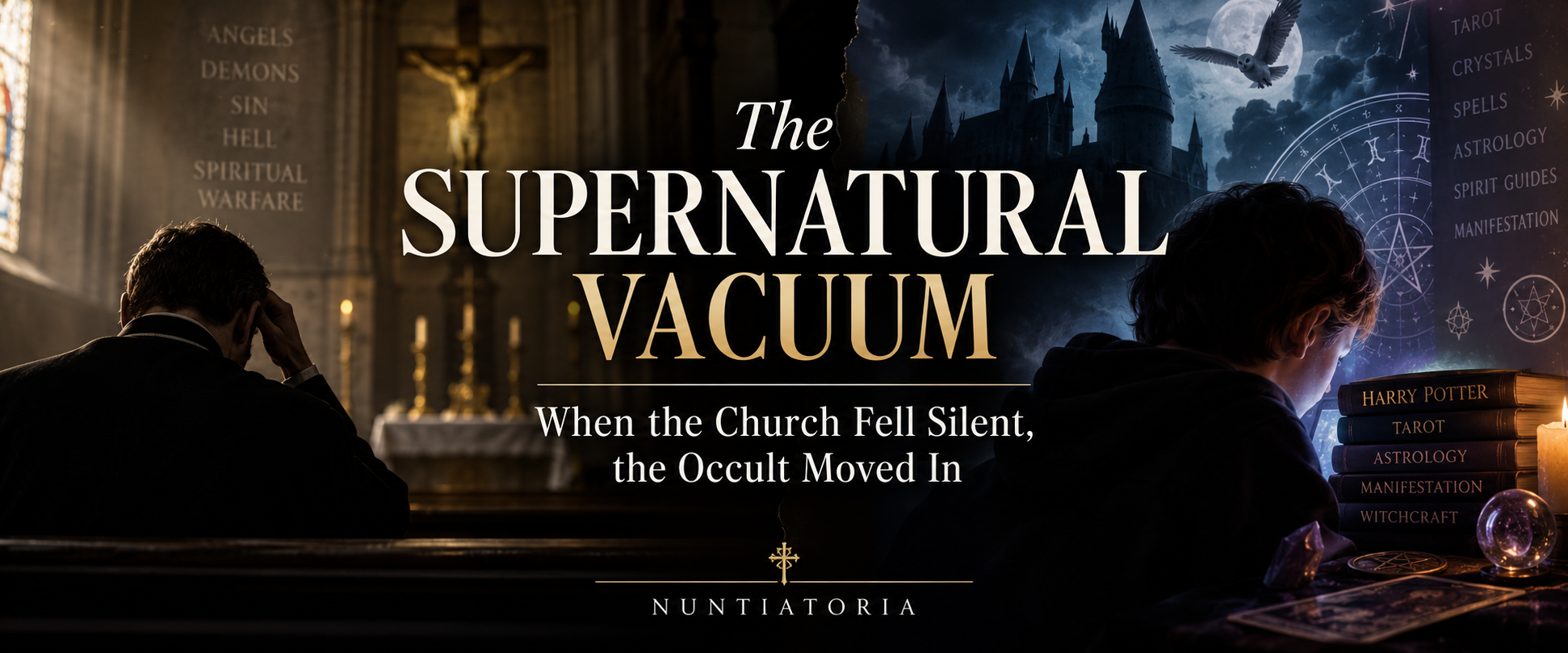
The modern world did not cease believing in the supernatural when it abandoned Christianity. It merely found different supernatural things in which to believe. Tarot, manifestation, astrology, spells and witchcraft now flourish in a culture from which much of the Church spent decades retreating from serious talk of angels, demons, Providence and spiritual warfare. A recent interview with exorcist Fr Carlos Martins therefore raises a question considerably larger than witchcraft itself: what happens when the Church stops teaching modern man how to understand the supernatural world?
For generations Western Christians have been encouraged, implicitly and sometimes explicitly, to suppose that modern man has become too sophisticated for serious talk of demons, spiritual combat and preternatural evil. The supposedly mature presentation of Christianity would concentrate upon the immediately visible and psychologically explicable. Homiletics became increasingly therapeutic; pastoral discourse adopted the languages of sociology, management, dialogue and accompaniment; judgment, Hell and Satan became markedly less prominent in ordinary Catholic preaching; exorcism remained in the Church’s books but, for many Catholics, seemed to belong to another religious age. Even when the doctrines were not formally denied, a culture of practical embarrassment frequently surrounded them.
Yet modern man did not become disenchanted. He began buying tarot cards. Astrology returned to ordinary conversation. Crystals promised healing. “Manifestation” promised that desire and intention might somehow bend reality towards the self. Mediums offered contact with the dead. “Spirit guides”, energy work, séances, spell-casting and witchcraft acquired vast audiences online. The secularised West did not cease believing in invisible realities. It merely became increasingly willing to consider almost every supernatural explanation except the Christian one.
That is what makes a recent conversation between Catholic priest and exorcist Fr Carlos Martins and Justin Kurian of Reclaiming Christendom worth taking seriously. Martins does not define witchcraft primarily through folklore, costume or membership of a coven. He describes it as an attempt to obtain “knowledge, power, protection, influence” or some desired effect through spiritual means apart from God. He also stresses that people frequently enter occult practices not because they awake one morning intending consciously to serve evil, but because they seek healing, protection, answers, purpose, control, meaning, contact with somebody who has died, or simply “spirituality without religion”.¹
That definition cuts to the theological heart of the matter. Witchcraft is not made harmless because the practitioner dislikes the word “witchcraft”. Tarot does not become spiritually neutral when described as a tool of introspection. Astrology does not escape the First Commandment by being repackaged as personality analysis. Mediumship is not rendered acceptable because grief provides the motive. A practice does not cease to be divination because somebody calls it intuition, nor does the attempt to manipulate hidden powers become Christian because the desired result is healing, romance, prosperity or protection rather than injury.
The temptation involved is extraordinarily ancient. “God doth know that in what day soever you shall eat thereof, your eyes shall be opened: and you shall be as Gods.” The serpent’s temptation in Genesis is not simply atheism. It is the promise that the creature may possess on his own terms what properly belongs under the sovereignty of the Creator. The occult continually repeats that promise. It offers knowledge where God has not revealed, control where Providence asks trust, power where Christianity requires dependence, and a technique for obtaining what religion teaches man to request humbly—or to surrender.
Sacred Scripture consequently leaves remarkably little room for accommodation. Deuteronomy prohibits divination, enchantments, sorcery, consultation with spirits and attempts to obtain knowledge from the dead. At Ephesus, converts do not preserve their books of magical arts as interesting remnants of their former spirituality; they destroy them publicly. St Paul numbers sorceries among the works of the flesh opposed to inheritance of the Kingdom of God. Christianity did not acquire its hostility to magic through a late medieval enthusiasm for witch trials. The prohibition belongs to Revelation itself.²
St Thomas Aquinas supplies the intellectual precision badly needed in a culture oscillating between materialist scepticism and indiscriminate supernaturalism. For Aquinas, divination is an illicit usurpation of knowledge which belongs to God or which man seeks by means incapable naturally of providing it. He places divination within superstition because it seeks something divine in an improper manner. He further distinguishes explicit recourse to demons from forms in which there is, in his terminology, a tacit compact because the practitioner seeks effects or knowledge through means that possess no natural causal power and have no divine institution.³
The distinction is important because Catholic theology does not require the occultist consciously to kneel before Satan before his actions become objectively disordered. Nor does it require us to imagine that every superstitious person understands what he is doing. The moral responsibility of individuals will depend upon knowledge, intention and other circumstances; the objective character of the practice is a separate question. A bereaved person may be sincerely seeking consolation when consulting a medium. His sorrow explains the act. It does not transform necromancy into prayer.
The Church’s contemporary Catechism states the same perennial principle with unusual directness. All forms of divination are to be rejected, including horoscopes, astrology, clairvoyance and recourse to mediums, because they manifest a desire for power over time, history and human beings and a wish to conciliate hidden powers. Magic and sorcery are gravely contrary to religion when they attempt to tame occult powers and place them at man’s service.⁴ The decisive phrase is precisely that: place them at man’s service. The occult is ultimately ordered towards the acquisition of power, whether the sought-after power is knowledge, protection, attraction, revenge, health, foresight or control.
The Dominican theologian and exorcist Fr François-Marie Dermine has made the same point pastorally. Discussing superstition and magic, Dermine argued that recourse to magic reveals a failure of confidence in Divine Providence: man decides that God may not provide what he wants and therefore seeks another spiritual route to obtaining it. His formulation reaches beneath the theatrical trappings of the occult to the spiritual vice beneath them. Magic is not merely the use of unusual objects or words. At its heart is the attempt to bypass Providence.⁵
This explains the radical difference between magic and Catholic sacramental life. Holy water is not a Christian potion. A blessed medal is not an amulet. A relic is not a talisman. A blessing is not a spell. The Rosary is not an incantation whose syllables mechanically compel an invisible force. Sacramentals derive from the prayer of the Church and remain entirely subordinate to the sovereignty of God. The Catholic petitions; God gives. The Church blesses through the authority entrusted to her; she does not discover a technique by which the Creator can be manipulated.
Magic reverses the order. Christianity says Fiat voluntas tua—Thy will be done. Magic, beneath its innumerable forms, tends towards fiat voluntas mea—let my will be done.
That is why the apparently gentle forms of occultism may be more pastorally significant than its grotesque extremes. A person does not generally begin with ritual Satanism. He begins with curiosity, grief, anxiety or desire. The woman consulting tarot about a relationship may have no hatred of God whatsoever. The teenager searching for a love spell may not imagine himself to be entering another religion. The grieving father seeking a medium wants one more conversation with his child. The frightened person wants protection. The ambitious person wants certainty. Martins is right to emphasise this gradualism because the seduction of occultism consists precisely in appearing to answer recognisable human needs.¹
The serpent rarely begins by introducing himself as the serpent.
The digital revolution has transformed the scale of the problem. Previous generations normally had to make some deliberate effort to encounter occult instruction: an esoteric shop, an occult book, a spiritualist meeting, a practitioner or a circle of acquaintances had to be sought. Now the material finds the user. Tarot, witchcraft, astrology, manifestation and spell-casting enter through the same screen used for music, comedy, news and messages from friends. Martins observes that online searches about spells and curses can return a flood of occult explanations and counter-spells. His broader point is difficult to dispute: the internet has removed almost every practical barrier between curiosity and instruction.¹
This is where the argument about Harry Potter deserves considerably more care than it normally receives from either side. Martins regards the series as culturally important but explicitly refuses to describe it as a “demonic enterprise”. He says that he has read the books and does not join those exorcists who condemn them outright. His concern is that they contributed to a changed imaginative grammar in which the central heroic characters themselves cast spells and manipulate magical powers.⁶
Martins goes too far when he presents this as though sympathetic magical protagonists were unprecedented in storytelling. They plainly were not. European folklore, mythology, fairy tales and fantasy literature contained magic, magicians, enchantments and sympathetic supernatural figures long before J. K. Rowling. That historical overstatement should simply be corrected rather than defended.
But correcting it does not dispose of the more serious cultural question. Harry Potter achieved a degree of global penetration far beyond the ordinary fairy tale. Through novels, films, games, merchandise and a vast commercial culture, generations of children inhabited an imaginative universe in which magic was principally distinguished by the moral intentions of those wielding it. The question is not whether reading fantasy constitutes witchcraft. It does not. The question is whether prolonged imaginative familiarity with benevolent spell-casting can weaken the instinctive distinction between fantasy and the real-world practices which Christianity has always prohibited.
Martins is, in fact, comparatively moderate among Catholic exorcists on this question. Fr Gabriele Amorth, the renowned Roman exorcist and co-founder of the International Association of Exorcists, took a markedly harder view. Speaking in 2011, Amorth described Harry Potter as apparently innocent literature which nevertheless “leads to magic” and therefore to evil. Contemporary Italian reporting records him objecting particularly to its positive presentation of magical powers, spells and curses.⁷ Whatever one makes of Amorth’s prudential literary judgment, his position establishes an important fact: strong Catholic objections to the franchise were not confined to eccentric internet commentators unfamiliar with the theology or practice of exorcism.
Fr Francesco Bamonte provides still more substantial evidence. Bamonte, an exorcist from 2000 and president of the International Association of Exorcists from 2012 until the end of his permitted consecutive terms, devoted an entire chapter of his substantial 2020 study Il cristianesimo contemporaneo a confronto con esoterismo, occultismo e satanismo to “Esoterismo e il ‘fenomeno’ Harry Potter”. The book was published by Edizioni Messaggero Padova in the Association’s own studies series. His treatment of Potter was therefore not a passing comment extracted from an interview but part of an extended analysis of contemporary esotericism, occultism, magic and witchcraft.⁸
Nor did the subject disappear after the publication of Bamonte’s book. At the Portuguese-language National Congress of the International Association of Exorcists in 2024, Bamonte—by then vice-president of the Association—delivered a dedicated conference entitled “Harry Potter e o Ocultismo”. The significance is not that such a lecture amounts to a decree of the Magisterium. It plainly does not. The significance is that an organisation canonically recognised by the Church specifically for the formation of exorcists continued to consider the relationship between the Potter phenomenon and occultism sufficiently serious to warrant specialist instruction. The Association itself records its foundation by Amorth and Fr René Chenesseau in 1994, its canonical recognition in 2014, and its purpose of promoting both the formation of exorcists and sound knowledge of the ministry.⁸
Yet it would be inaccurate to suggest that Catholic exorcists speak with one voice. Fr Vincent Lampert, the long-serving exorcist associated with the Archdiocese of Indianapolis, offers a noticeably more discriminating judgment. When asked directly about Harry Potter in a 2023 interview with Matt Fradd, Lampert rejected the claim commonly made that the books themselves contain “real spells”. His test for parents was instead catechetical: which does the child know better, Harry Potter or the Bible? If the child is genuinely grounded in Scripture and Catholic faith, Lampert argued, fantasy can be filtered through that Christian framework. If not, the danger is that the child begins to regard magic as something good. In a later 2024 discussion he again warned Christians against imagining the demonic everywhere while insisting that poor formation can leave people vulnerable to being drawn towards darkness.⁹
The former Spanish exorcist and demonologist Fr José Antonio Fortea goes further in the permissive direction. In his own Exorcística, a work which ACI Prensa published electronically with Fortea’s cooperation, he directly considers Harry Potter alongside other stories and games involving magicians and witches. Fortea refuses the proposition that such fantasy should simply be prohibited. Christian Europe, he observes, has always contained stories of witches, magicians, spells and enchantments; taken consistently, a prohibition on Potter for containing magic would threaten The Lord of the Rings, traditional European fairy tales and even classical mythology. Yet Fortea immediately adds an important qualification: children imitate what they consume, and excessive immersion in stories where magic is habitual may require parents to intervene.¹⁰
That disagreement is more illuminating than an artificial consensus would be. Amorth strongly condemns. Bamonte subjects the Potter phenomenon to sustained analysis within the context of esotericism and occultism. Lampert emphasises the necessity of prior Christian formation. Fortea rejects prohibition but nevertheless warns against excessive saturation and imitation. Martins occupies a position closer to Lampert and Fortea while still arguing that the Potter phenomenon helped alter the cultural imagination surrounding magic. Their prudential conclusions differ. None of that alters the Church’s doctrinal prohibition of actual divination, sorcery, spiritism and occult attempts to obtain supernatural power.
Cardinal Joseph Ratzinger’s much-discussed intervention should be placed within exactly those limits. In private correspondence in 2003 with German author Gabriele Kuby, who had sent him her anti-Potter study, Ratzinger praised her effort to shed light on what he described as “subtle seductions” capable of working deeply upon Christianity in the soul. He subsequently authorised her to refer publicly to his judgment.¹¹ These were private letters, not a judgment of the Congregation for the Doctrine of the Faith, still less a papal act; attempts to turn them into a formal Vatican condemnation are therefore unsustainable. There is also legitimate debate about precisely what Ratzinger intended by the wording. But the opposite claim—that concern about the books was alien to Ratzinger—is equally impossible to maintain.
Nor was serious Catholic commentary universally hostile. Writing in La Civiltà Cattolica in 2002, Fr Antonio Spadaro concluded that the Potter stories themselves should substantially be acquitted of the strongest accusations made against them. Yet even Spadaro argued that prudent reading was necessary because children were already immersed in a wider culture characterised by an unhealthy fascination with the occult, which the Potter phenomenon could intensify.¹² Again the more useful point emerges not from pretending that Catholics agree about a particular series of novels, but from recognising the wider cultural environment in which the dispute arose.
Nuntiatoria therefore has no need to make claims which Catholic theology cannot support. Martins’s strongest formulation in the interview—that saying a spell, even as a gag, means that “a demon gains rights”—should be treated cautiously.⁶ The Church certainly teaches that deliberate occult practices are gravely dangerous and contrary to religion. Aquinas certainly teaches that illicit divination can involve explicit or tacit commerce with demons. But Catholic theology does not require us to posit an automatic juridical mechanism whereby accidentally pronouncing invented words immediately transfers some species of legal jurisdiction to a demon. Intention, knowledge, the objective nature of the act and the reality of the supposed invocation all matter. Fictional play is not identical with deliberate necromancy.
That precision makes the warning stronger, not weaker. If Catholics exaggerate demonstrably weak claims, sceptics can dismiss the sound doctrine together with the embellishment. There is no need for embellishment. Deliberate attempts at divination, spirit communication, sorcery or magical control are already condemned in Scripture, classical Catholic theology and the Church’s authoritative catechesis. The case does not require folklore.
The conversion of Alexandra Ashcroft illustrates why the phenomenon deserves attention without sensationalism. Known online as “Alex Reads Tarot”, Ashcroft built a TikTok audience approaching one million followers and accumulated more than fifty million likes before announcing in June 2026 that she would cease tarot readings and delete her occult material because she had embraced Christianity. She described the process as gradual, involving months of questioning, prayer and discernment, and said publicly that Jesus Christ had saved her life and that she could no longer ignore that reality.¹³ Martins discusses her conversion in the interview and repeats a claim that her occult business had generated more than a million dollars annually, but that income figure is not sufficiently established by the available primary evidence and need not be repeated as fact. What is securely documented is already striking: an exceptionally successful tarot influencer publicly abandoned the spiritual identity upon which her large platform had been built.
That is conversion in the properly Christian sense. It is not adding Christ to a collection of spiritual techniques. It is recognising that some things cannot coexist with allegiance to Him. The converts at Ephesus did not place their magical books beside the Gospel as alternative spiritual resources. They burned them.
Yet the deepest indictment arising from Martins’s interview does not fall upon witches. It falls upon the Church. Near the conclusion he says that people frequently tell him they have approached their pastors about questions concerning evil only to hear the priest admit: “I’m just not equipped to talk about the subject. I don’t know much about the subject.” Martins consequently recommends greater awareness among priests and seminarians because the Church’s ministers need to understand the spiritual realities with which people are confronting them.¹⁴
If that testimony describes even a substantial minority of experiences, the pastoral failure is extraordinary. A teenager can learn the vocabulary of tarot, manifestation, witchcraft, crystals, spirit guides, curses and spell-casting through a telephone, while a Catholic priest may emerge from years of formation unable confidently to explain superstition, divination, sacramentals, ordinary temptation, extraordinary demonic activity and the Church’s criteria of discernment. A grieving Catholic can find a medium more easily than a priest prepared to explain why attempting communication with the dead is forbidden. A generation may know its zodiac signs while never having heard a sermon on Providence.
What, then, was pastoral formation preparing pastors to pastor?
The irony is sharpened by the fact that the Magisterium itself explicitly warned against precisely this retreat. On 15 November 1972 Paul VI told a General Audience that one of the Church’s greatest contemporary needs was defence against the evil called the Devil. He rejected the reduction of Satan to a fictitious personification of misfortune, recalled the scriptural reality of spiritual conflict and declared that the chapter of Catholic doctrine concerning the Devil and his influence needed to be studied again because it was receiving too little attention. At the same time, he warned against credulity and specifically denied that every sin should be attributed directly to demonic action.¹⁵
The Sacred Congregation for the Doctrine of the Faith followed in 1975 with Christian Faith and Demonology, a study which the Congregation explicitly recommended as a secure basis for reaffirming the Church’s teaching. The document makes the balance unmistakable. Christianity must not make Satan the privileged subject of its preaching or turn the Gospel into a message of terror; obsessive preoccupation with demons and superstition are themselves condemned. But it is equally erroneous to behave as though the Redemption has already produced all its final effects and the spiritual combat described throughout the New Testament no longer needs to be fought. The existence of the demonic world, the document insists, belongs not to dispensable folklore but to the constant faith through which the Church understands sin and redemption.¹⁵
Traditional Catholic discipline exhibits exactly the same sobriety. The Rituale Romanum does not instruct the exorcist to discover demons everywhere. Its preliminary directions tell him first of all ne facile credat aliquem a daemonio esse obsessum—he is not readily to believe somebody possessed—and require him to distinguish possession from illness, explicitly including psychological illness in the 1952 form of the instruction.¹⁶ That is not scepticism about demons. It is Catholic prudence about diagnosing them.
The contrast with contemporary caricatures could scarcely be greater. Catholic supernatural realism is neither materialism nor paranoia. Not every psychological illness is possession. Not every misfortune is a curse. Not every temptation is extraordinary demonic activity. Not every frightening coincidence is supernatural. Not every work of fantasy constitutes occult practice. A Christian who becomes obsessed with demonic contamination, hidden curses and supposed spiritual portals can himself drift into a superstitious worldview in which Satan receives more attention than Christ.
The Devil is not the centre of Christianity. Jesus Christ is.
But confidence in Christ is not disbelief in the enemy Christ conquered. The fact that Satan is a creature does not mean he is imaginary. The fact that his powers are limited does not mean they are nonexistent. The fact that grace is infinitely superior to occult power does not make occult experimentation sensible. And recognising the legitimate competence of medicine and psychology does not require the Catholic to explain away the exorcisms of the Gospel as primitive misunderstanding.
This is where the supernatural vacuum becomes visible. Much of Western Christianity became hesitant about demons just as popular culture became fascinated with them. Explicit instruction on divination weakened while horoscopes became ordinary. Confidence in traditional sacramentals declined while crystals prospered. Providence was preached less clearly while “manifestation” entered everyday vocabulary. Angels became sentimental Christmas decorations while “spirit guides” became fashionable. Exorcism looked embarrassing to sophisticated Christians while cinema, streaming platforms and social media discovered that demons were commercially irresistible.
The religious instinct did not disappear. It changed teachers.
The answer is not panic, witch-hunting or an ecclesial obsession with darkness. It is the restoration of Catholic supernatural realism. Parents should teach their children plainly why tarot, mediumship, séances, deliberate spell-casting and attempts to invoke spirits are incompatible with Christianity. Priests should know how to explain the reason. Catholic schools should teach the First Commandment as something more substantial than a prohibition against bowing before pagan statues. Seminaries should form priests capable of distinguishing superstition from sacramentals, ordinary temptation from extraordinary phenomena, mental illness from possible preternatural disturbance, and genuine spiritual danger from fevered imagination.
Catholics should also recover confidence in their own supernatural inheritance without corrupting it into magic. Bless homes. Use holy water reverently. Wear blessed medals as sacramentals rather than talismans. Teach children the Guardian Angel. Pray for the dead rather than attempting to summon them. Preach Providence rather than manifestation. Teach the Communion of Saints rather than spirit guides. Explain why the sacramental world depends entirely upon Christ and the authority entrusted to His Church, not upon esoteric technique.
The answer to man’s desire to know the hidden future is confidence in Providence. The answer to manifestation is prayer. The answer to occult power is grace. The answer to mediumship is prayer for the faithful departed and belief in the Communion of Saints. The answer to magical protection is the Cross and the sacramental life. The answer to man’s desire to control reality is the difficult Christian petition, Fiat voluntas tua. And the answer to demons is not fascination with demons but Jesus Christ.
That is the final absurdity of the contemporary situation. Catholics sometimes fear that supernatural Christianity will sound incredible to modern people while modern people consult tarot readers, arrange crystals, analyse horoscopes, manifest relationships, seek messages from the dead and receive lessons in witchcraft through social media. The Church does not need to make herself more exotic in response. She needs to preach again, without embarrassment, the supernatural religion of which those things are counterfeits.
Martins is therefore right to sound the alarm, but the wider exorcist record makes the argument more interesting than any single interview. Amorth issued uncompromising warnings. Bamonte treated the Potter phenomenon within a sustained study of esotericism and continued addressing Potter and occultism in the formal educational work surrounding the International Association of Exorcists. Lampert counsels against indiscriminate fear but insists upon strong Christian formation. Fortea refuses an indiscriminate prohibition of fantasy yet warns that children’s habits of imitation and excessive immersion matter. Dermine identifies the deeper vice of magic as distrust of Providence. They disagree considerably in prudential assessment. They do not disagree that real occult practice and Catholic religion are incompatible.
And that brings us to the real scandal. The modern occult revival did not occur simply because witches became persuasive. It flourished in a civilisation from which Christian supernatural categories had been progressively withdrawn. The Church possessed an account of angels and demons, Providence and temptation, grace and sacramentals, death and judgment, Heaven and Hell, and the victory of Christ over the powers of darkness. Where that account ceased to be confidently taught, the appetite for the supernatural did not vanish. Other people fed it.
The tragedy of the modern occult revival is not that modern man still believes in the supernatural. It is that, having heard so little about it from the Church, he is increasingly learning about it from witches.
¹ Fr Carlos Martins, interview with Justin Kurian for Reclaiming Christendom, supplied transcript: Martins’s definition of witchcraft as the pursuit of knowledge, power, protection and influence through spiritual means apart from God, and his discussion of healing, protection, meaning, control, contact with the dead and “spirituality without religion” as pathways into occult practice.
² Douay-Rheims Bible, Deuteronomy 18:10–12; Acts 19:18–20; Galatians 5:19–21.
³ St Thomas Aquinas, Summa Theologiae, II-II, qq. 92 and 95, especially q.95, aa.1–2, on superstition, illicit divination and tacit or explicit compact with demons. Corpus Thomisticum: Summa Theologiae II-II, qq. 92–100
⁴ Catechism of the Catholic Church, §§2115–2117, “Divination and magic”. Vatican: Catechism §§2115–2117
⁵ Fr François-Marie Dermine OP, exorcist and theologian, interview on superstition and magic, 2012, identifying recourse to magic with a failure of trust in Divine Providence.
⁶ Fr Carlos Martins, supplied interview, on children, spells, his assertion concerning demonic “rights”, and his qualified assessment of Harry Potter.
⁷ Giacomo Galeazzi, interview/report on Fr Gabriele Amorth’s comments at the Popoli e Religioni festival, La Stampa, 27 November 2011; see also contemporary report in Quotidiano Nazionale, 24 November 2011.
⁸ Francesco Bamonte, Il cristianesimo contemporaneo a confronto con esoterismo, occultismo e satanismo, Edizioni Messaggero Padova, 2020, Chapter 16, “Esoterismo e il ‘fenomeno’ Harry Potter”; publisher’s bibliographical record and contents. International Association of Exorcists, official history and statutes; AIE Portuguese-language National Congress programme, 1 August 2024, listing Bamonte’s conference “Harry Potter e o Ocultismo”.
⁹ Fr Vincent Lampert, interview with Matt Fradd, Pints with Aquinas, 31 January 2023, discussion beginning at approximately 1:43:30; subsequent interview, August 2024.
¹⁰ José Antonio Fortea, Exorcística, section “Cuentos, novelas y películas sobre magos y brujos”, pp. 81–82; ACI Prensa publication record, 8 January 2013, confirming publication of the work with Fortea and its treatment of New Age practices.
¹¹ Joseph Cardinal Ratzinger, private letters to Gabriele Kuby, 7 March and 27 May 2003; contemporary reproduction and discussion in Kath.net and National Catholic Register.
¹² Antonio Spadaro SJ, “Il fenomeno ‘Harry Potter’”, La Civiltà Cattolica, 2 March 2002, Quaderno 3641, pp. 474–483. La Civiltà Cattolica: Il fenomeno Harry Potter
¹³ Alexandra Ashcroft’s June 2026 announcement abandoning “Alex Reads Tarot” and professing Christian faith; contemporary reporting documents approximately 933,000 followers and more than 52 million TikTok likes and reproduces substantial portions of her announcement. ChurchLeaders report Martins also discusses Ashcroft’s conversion in the supplied interview.
¹⁴ Fr Carlos Martins, supplied interview, on people reporting that pastors were unequipped to discuss questions concerning evil and on the need for priestly and seminarian formation.
¹⁵ Paul VI, General Audience, 15 November 1972, “Liberaci dal male”; Sacred Congregation for the Doctrine of the Faith, Christian Faith and Demonology, 26 June 1975, explicitly recommended by the Congregation as a secure basis for reaffirming the Church’s teaching on the subject. Vatican: Paul VI, General Audience, 15 November 1972 Vatican: Christian Faith and Demonology
¹⁶ Rituale Romanum, editio typica 1952, Titulus XII, Caput I, De exorcizandis obsessis a daemonio, n.3: ne facile credat aliquem a daemonio esse obsessum; bibliographical record of the 1952 typical edition and text of the preliminary instruction.



Leave a Reply