
The beloved physician, the Gospel of the Incarnation, and the duty to preserve what the Apostles received
The feast of St Luke the Evangelist, celebrated on 18 October as a Double of the Second Class in the traditional Roman Rite, honours a man whose inspired writings preserve some of Christianity’s most intimate and consequential revelations. Physician, historian and faithful companion of St Paul, Luke recounts the mystery of the Incarnation, the mercy extended to repentant sinners, and the beginnings of the Church’s mission among the nations. Yet the Evangelist of mercy is also the witness of sacrifice, conversion and apostolic continuity. His feast presents a truth of enduring importance: Christian compassion cannot be separated from the truth which makes redemption necessary, and the Church cannot fulfil her mission by altering the Gospel she exists to proclaim.
“Only Luke is with me.” Few sentences in the New Testament reveal so much through so few words. They occur towards the end of St Paul’s Second Epistle to Timothy, amid references to absent companions, unfinished business and the hardships of imprisonment. Demas has forsaken him, others have departed upon their respective journeys, and the Apostle records the presence of the one companion who remains: Lucas est mecum solus (2 Timothy 4:11). There is no elaborate commendation, no formal enumeration of virtues, no attempt to construct a memorial. Only the acknowledgement of a faithful friend. Yet in those five Latin words lies something essential to the character of the Evangelist whose feast the Church celebrates on 18 October. Before considering his extraordinary literary achievement, his place among the inspired authors of Scripture or his influence upon Christian devotion, there stands the example of a man who remained when fidelity had become costly.
The traditional Roman Church honours St Luke with a feast of considerable liturgical dignity. Under the calendar and rubrics preceding the reforms of 1955, it is a Double of the Second Class, Duplex II classis, celebrated in red vestments with the Mass Mihi autem. The Gloria and Creed are appointed, together with the Preface of the Apostles. In 2026, 18 October falls upon the Twenty-first Sunday after Pentecost. According to the older Roman arrangement, St Luke’s feast takes precedence, the Sunday is commemorated, and its Gospel supplies the ninth lesson at Matins and the proper Last Gospel at Mass. The order differs from the 1962 calendar, under which the Sunday takes precedence and the Evangelist is commemorated. As established in the current Nuntiatoria Ordo, the universal observance must also be distinguished from approved local propers: in Southwark, for example, the cathedral dedication takes precedence and St Luke is transferred to 19 October. Such distinctions are not incidental niceties. The calendar possesses its own theological hierarchy, expressing through the ordering of worship the importance which the Church attaches to the mysteries and witnesses of salvation.¹
St Luke was not numbered among the Twelve Apostles, nor does the New Testament expressly identify him as one of the seventy-two disciples whom Our Lord sent forth during His earthly ministry. His place in the apostolic inheritance rests upon a different but highly significant association. According to the ancient ecclesiastical tradition, he belonged to the circle of St Paul and was responsible for the Third Gospel and the Acts of the Apostles. The witness of St Irenaeus of Lyons is especially important. Writing in the second century, Irenaeus identifies Luke as the companion of Paul who committed to writing the Gospel associated with the Apostle’s preaching. He places that testimony within his account of the fourfold Gospel received by the Church, insisting that the Evangelists proclaim one God and one Jesus Christ. The differences between their writings do not imply competing Christianities. They are complementary witnesses to the same divine revelation.²
Eusebius of Caesarea preserves the tradition that Luke came from Antioch in Syria and was a physician by profession. He describes him as closely associated with Paul and acquainted with the other Apostles, and regards his two inspired books as evidence of the spiritual healing he had learnt through their preaching. St Jerome likewise identifies him as an Antiochene physician, commends his knowledge of Greek and records his companionship with Paul. Jerome also attributes to him the Gospel and Acts, distinguishing the testimony Luke received concerning Christ’s earthly ministry from his personal participation in some of the events narrated in the latter book. These ancient sources deserve serious consideration, although their testimony must not be confused with certainty about every detail subsequently added to the Evangelist’s biography. The circumstances of Luke’s death, including whether he suffered martyrdom, cannot be established with the same confidence as his association with Paul.³
The description Lucas medicus carissimus, Luke the beloved physician, comes from St Paul himself (Colossians 4:14). It is a designation which Christian tradition has never forgotten. Medicine requires attention to reality. The physician must observe, distinguish symptoms from causes, recognise suffering and seek its remedy. He cannot heal by sentiment alone, nor can he make disease disappear by redefining it. Yet neither is the patient reducible to the illness from which he suffers. The purpose of diagnosis is treatment; the purpose of treatment is healing. The analogy is especially appropriate to Luke, whose natural profession concerned the care of the body and whose evangelical vocation became an instrument of the divine remedy for the soul. It would be excessive to infer from his profession a complete psychological portrait of his literary character. Nevertheless, the convergence of physician and Evangelist illuminates a truth central to Christianity: grace does not deny the reality of the human condition, but restores what sin has wounded and elevates what nature alone cannot perfect.
Luke’s Gospel begins with an unusually explicit account of its own purpose. Addressing Theophilus, the author explains that others have undertaken to narrate the events accomplished among the Christians according to what was delivered by those who had been eyewitnesses and ministers of the word. Having diligently followed matters from the beginning, he intends to provide an orderly account so that his reader may know the certainty of the instruction received (Luke 1:1–4). Luke does not pretend to have witnessed personally everything he records. He distinguishes his work from the original testimony upon which it depends, acknowledges the transmission of that testimony and states plainly the purpose of his narrative. Divine inspiration does not render historical enquiry unnecessary. Rather, the Holy Ghost employs the human author’s faculties and methods within the supernatural act by which Sacred Scripture is given to the Church.
This is a particularly important consideration in an age accustomed to treating religious truth as something indefinitely negotiable. Christianity does not rest upon the subjective attractiveness of its ethical sentiments. It rests upon events which the Church professes to have occurred: the Incarnation of the Son of God, His real human life, His Passion under Pontius Pilate, His death, Resurrection and Ascension. The historical claims of the Gospel are not detachable ornaments surrounding an otherwise independent moral philosophy. They are integral to the revelation being proclaimed. At the same time, Luke’s writing is more than a chronicle. He narrates historical events in order to disclose their significance within the saving purpose of God. The theological interpretation does not abolish the history; it reveals why the history matters.
The relationship between his Gospel and the Acts of the Apostles gives this purpose its fullest expression. The first book begins with the expectation of Israel and the events surrounding the conception and birth of Christ. It concludes with the Resurrection, Ascension and the disciples returning to Jerusalem in worship. The second resumes the narrative with the Ascension and proceeds through Pentecost, the apostolic preaching, the conversion of St Paul and the extension of the Church’s mission throughout the Mediterranean world. The same Jesus who entered history through the Incarnation continues His saving work through the Church established upon His Apostles. The two books are not accounts of different religions, nor does the second describe the gradual liberation of Christianity from the teaching of its divine Founder. Together they reveal the continuity between the salvation accomplished by Christ and the proclamation of that salvation by His Church.
For the Church’s devotion to the Blessed Virgin Mary, the importance of St Luke’s Gospel is almost impossible to exaggerate. The Annunciation, the Visitation, the Magnificat, the Presentation of the Child Jesus in the Temple and the finding of Our Lord at Jerusalem are preserved through his inspired narrative. It is Luke who records Gabriel’s greeting, from which the Church derives the opening words of the Ave Maria. It is Luke who preserves Elizabeth’s acknowledgement of Mary as the Mother of her Lord, and Luke who twice draws attention to the Virgin’s contemplation of the mysteries entrusted to her. His Gospel provides not simply a collection of affecting incidents from the childhood of Jesus, but much of the scriptural foundation upon which the Church’s Marian doctrine and devotion rest.
There is a particular appropriateness in the proximity of St Luke’s feast to that of the Divine Maternity, celebrated on 11 October in the older Roman calendar. As considered in Nuntiatoria’s recent treatment of that solemnity, the title Theotokos safeguards a truth principally concerning Christ rather than merely conferring an additional distinction upon His Mother. Mary is truly Mother of God because the Person whom she conceived and bore according to His human nature is the eternal Son of God. Luke supplies the revelatory narrative within which this truth is unmistakably present. Gabriel announces the conception of the Son of the Most High. Elizabeth recognises the Mother of her Lord. The child born in Bethlehem is not a merely human individual subsequently united by favour or association to the divine Word. From the first instant of His conception, the humanity derived from Mary belongs personally to the eternal Son. The doctrine solemnly defended at Ephesus was not invented by the fifth-century Fathers. It was a necessary expression of the apostolic faith already witnessed in Scripture.⁴
St Ambrose, reflecting upon the Virgin’s life in his treatise De Virginibus, finds in Luke’s narrative a model of Christian holiness. Mary’s humility, modesty, charity, recollection and readiness to learn reveal a soul wholly disposed towards God. Ambrose is especially attentive to the Evangelist’s observation that Mary preserved and pondered the events surrounding her Son. Even as Mother of the Lord, she remained attentive to the unfolding revelation of His mysteries. Her holiness did not consist in treating what she could not yet comprehend as an occasion for doubt or reinterpretation. It consisted in receiving God’s word faithfully and submitting herself to His will. Here is an essential distinction in the spiritual life: faith does not require the believer to understand immediately everything which God has revealed, but it does require him to receive that revelation as true because God has spoken.⁵
The canticle of the Magnificat introduces another dimension which is sometimes overlooked. Mary’s praise proclaims the greatness of the Lord, His mercy towards those who fear Him, His resistance to the proud and His care for the lowly. The same themes will reappear throughout Luke’s Gospel in the Lord’s concern for the poor, His warnings to the rich, His condemnation of religious self-satisfaction and His welcome of repentant sinners. Yet the Magnificat is not a manifesto for the overthrow of one merely temporal arrangement by another. It is a proclamation of the divine order in which human pride is humbled, dependence upon God is vindicated and the promises made to Israel reach their fulfilment in Christ. The poor are not blessed merely because poverty constitutes an independent moral achievement, nor are the prosperous condemned simply because they possess material goods. The decisive question concerns the disposition of the soul towards God and neighbour. Luke’s Gospel repeatedly exposes the spiritual dangers of wealth, but it also records the generous use of possessions as a fruit of conversion.
The Evangelist’s association with the Blessed Virgin subsequently entered the tradition of Christian art. He became honoured as the patron of painters and was credited in later tradition with producing images of Our Lady, particularly in connection with the celebrated Hodegetria icon. The historical attribution of any surviving Marian image to Luke’s own hand cannot be demonstrated, and the development of the tradition belongs to a later period than the earliest testimony concerning his writings. This distinction deserves to be maintained without diminishing the devotional significance of the association. Christian iconography has long recognised that the representation of Christ and His Mother bears witness to the reality of the Incarnation. The Word truly became flesh; the invisible God has revealed Himself through the visible humanity of His Son. Sacred art consequently possesses a theological responsibility. Its purpose is not merely to express the artist’s religious feelings, but to serve the truth which the Church confesses.⁶
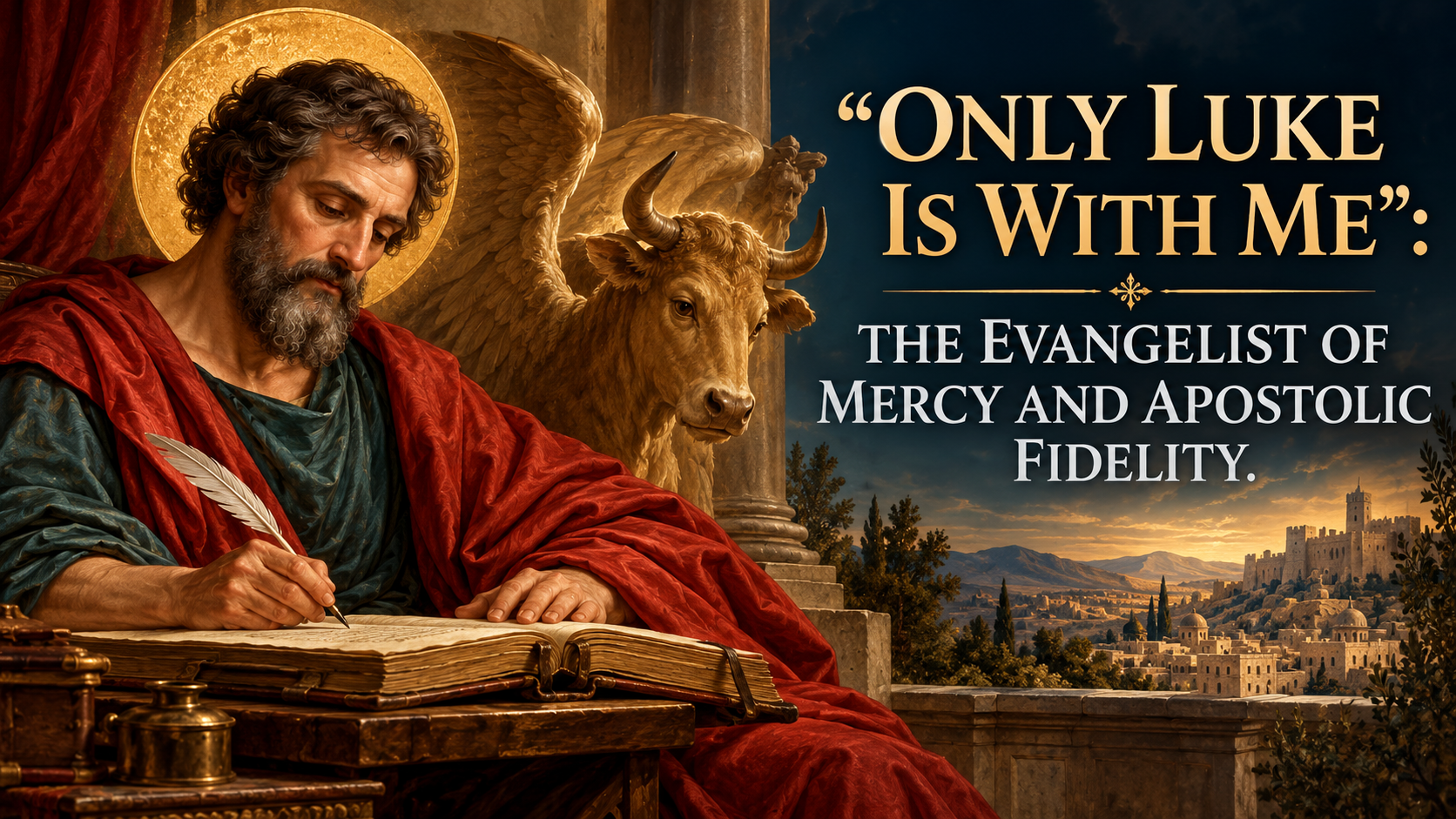
The traditional emblem of St Luke, the winged ox, reveals another aspect of his Gospel which is frequently obscured by its reputation for tenderness. Christian tradition associated the four Evangelists with the living creatures described by Ezechiel and St John, although the precise assignment of the symbols was not uniform among early commentators. St Augustine explains the association of Luke with the calf or ox through the priestly character of his Gospel. Luke begins with Zachary, the priest serving in the Temple, and records the observances surrounding the birth and presentation of Christ. For Augustine, the sacrificial animal directs attention towards the priesthood fulfilled in the Redeemer. The emblem therefore signifies something more profound than strength, service or perseverance. It points towards the sacrificial character of the salvation which Luke proclaims.⁷
This is an indispensable corrective to the suggestion that St Luke presents a Christianity concerned principally with emotional reassurance, social benevolence or the relaxation of moral demands. He is indeed the Evangelist through whom some of Our Lord’s most moving revelations of divine mercy have been preserved. His Gospel alone contains the parables of the Good Samaritan and the Prodigal Son, the accounts of the Pharisee and the Publican, the conversion of Zacheus and the promise of Paradise to the repentant thief. But the same Evangelist records the institution of the Holy Eucharist, the Agony in the Garden, the Passion and the death of Christ upon Calvary. Mercy is not presented as an alternative to sacrifice. It is made available to fallen humanity through the Redemption accomplished by the sacrifice of Christ.
St Thomas Aquinas supplies the theological principle underlying this relationship. Christ is the perfect Priest because He is the supreme Mediator between God and man. His priesthood consists in offering to the Father the sacrifice through which humanity is reconciled, while communicating to men the saving fruits of that oblation. He is both Priest and Victim. The mercy extended to sinners is therefore not a benevolent disregard of the disorder introduced by sin. It belongs to the divine economy by which that disorder is overcome. The Cross is not an unfortunate interruption of an otherwise reassuring religious message. It is the supreme manifestation of the love through which reconciliation becomes possible.⁸
The parable of the Prodigal Son provides perhaps the most familiar illustration of this truth. The father’s generosity is extraordinary, but he does not travel into the distant country to assure his son that nothing in his conduct requires alteration. The son comes to himself, recognises his degradation, acknowledges his sin and returns. The father’s welcome is immediate and unstinting, yet the narrative is one of repentance and restoration. Similarly, Zacheus responds to Christ’s gracious approach by undertaking restitution and generosity towards the poor. The Publican in the Temple is justified because he acknowledges his sin rather than congratulating himself upon his righteousness. The repentant thief recognises the justice of his own punishment and the innocence of Christ before receiving the promise of Paradise. In each instance mercy is transformative because it brings the sinner into a new relationship with the truth.
This develops a principle already considered in Nuntiatoria’s treatment of St Matthew. In the account of the calling of Levi, Christ declares that those who are healthy have no need of a physician, but those who are sick. St Luke records the same teaching: “They that are whole, need not the physician: but they that are sick” (Luke 5:31). The purpose of Christ’s association with sinners is not to pronounce their spiritual condition satisfactory, but to call them to repentance. The physician who refuses to diagnose an illness cannot claim to have acted mercifully merely because he has spared his patient an unwelcome truth. Equally, a physician who identifies disease only to condemn the sufferer has failed in the purpose of medicine. Christian charity requires accurate moral judgement and a sincere desire for the sinner’s healing. Neither truth without compassion nor compassion without truth represents the medicine of the Gospel.⁹
The distinction has immediate pastoral consequences. The Church must welcome sinners because Christ came to save sinners. She must preach repentance because Christ Himself preached repentance. She must offer the sacraments as instruments of sanctification rather than mere symbols of acceptance, while remembering that the purpose of ecclesiastical discipline is ultimately the salvation of souls. It is possible to defend authentic doctrine while behaving with an unchristian harshness of heart. It is equally possible to employ the language of tenderness while withholding the very truth upon which genuine conversion depends. St Luke’s Gospel permits neither distortion. The divine Physician does not humiliate those whom He comes to heal, but neither does He pretend that their wounds are imaginary.
Dom Prosper Guéranger recognised the particular tenderness with which the third Evangelist presents the humanity of Our Lord and the extension of salvation to the nations. In Luke, the child born at Bethlehem is proclaimed by Simeon as a light for the revelation of the Gentiles and the glory of Israel. The Saviour is shown praying, weeping, suffering and entering fully into the conditions of human existence. His compassion reaches those whom society has despised, while His warnings expose the spiritual dangers of pride, wealth and self-sufficiency. Guéranger sees in Luke the fulfilment of St Paul’s proclamation that the goodness and kindness of God our Saviour have appeared to mankind. Yet the universality of that mercy does not abolish the demands of the Kingdom. The Gospel which contains the Prodigal Son also contains the rich man and Lazarus. The Lord who welcomes the penitent also warns those who refuse conversion. God’s mercy is unlimited in its divine source; it is not a promise that the sinner may remain obstinately unrepentant without consequence.¹⁰
The traditional Roman Mass gathers these truths into a remarkably coherent liturgical expression. The Introit begins Mihi autem nimis honorati sunt amici tui, Deus — “To me Thy friends, O God, are made exceedingly honourable.” Drawn from Psalm 138, the words establish the true foundation of the Evangelist’s greatness. Luke is honoured because he belongs among the friends of God and has served the revelation entrusted to the apostolic Church. The Gradual proclaims that their voice has gone forth into all the earth, while the Alleluia takes its words from Christ Himself: Ego vos elegi de mundo, ut eatis et fructum afferatis — “I have chosen you out of the world, that you should go, and should bring forth fruit.” The movement is from divine election to apostolic proclamation. The Gospel does not originate in the preferences of its messengers. It is entrusted to them by the Lord who sends them.
The Collect brings Luke’s sanctity beneath the shadow of the Cross: Interveniat pro nobis, quaesumus, Domine, sanctus tuus Lucas Evangelista: qui crucis mortificationem jugiter in suo corpore, pro tui nominis honore, portavit. The Church asks for the intercession of her holy Evangelist, who continually bore in his body the mortification of the Cross for the honour of Christ’s name. This is an arresting emphasis. The prayer does not begin by praising his intellectual accomplishment, medical skill or literary distinction. It recalls the supernatural fidelity by which he participated in the hardships of apostolic service. His gifts were considerable, but their greatest value lay in their consecration to Christ. The author who preserved the Gospel of mercy was himself a disciple of the crucified Lord.
The Epistle, 2 Corinthians 8:16–24, is no less instructive. St Paul commends Titus and another brother whose praise is in the Gospel throughout the churches. St Jerome preserves the ancient interpretation identifying that unnamed brother with Luke, although the Pauline text itself does not establish the identification. The passage concerns the administration of charitable offerings and the necessity of honourable conduct. Paul is careful to avoid grounds for reproach, insisting that provision must be made for what is good not only before God, but also before men. Apostolic ministry is thereby shown to involve practical integrity as well as doctrinal fidelity. Those entrusted with the proclamation of divine truth are not excused from ordinary standards of prudence, transparency and responsibility. The administration of temporal matters may either confirm or compromise the credibility of those who profess to serve spiritual ends.
The Gospel of the feast, Luke 10:1–9, recounts Our Lord’s sending forth of the seventy-two disciples. They are commanded to announce the approach of the Kingdom, heal the sick and depend upon divine providence. Christ sends them as lambs among wolves, without the worldly security which might ordinarily be thought indispensable to a successful mission. The selection of this passage does not establish that Luke personally belonged to the seventy-two. It places his vocation within the pattern of missionary discipleship instituted by Christ. The messengers go before their Master, not in His place. Their task is to prepare others to receive Him. Their authority is derived, their message received and their fidelity more important than the recognition they may obtain.
The Secret prayer makes the relationship between mission, sacrifice and healing particularly explicit. It asks that the heavenly gifts may enable the faithful to serve God with a free mind: Donis caelestibus da nobis, quaesumus, Domine, libera tibi mente servire. It then petitions that the offerings presented through the intercession of St Luke may obtain both healing and glory: et medelam nobis operentur et gloriam. The word medelam is especially appropriate to the feast of the beloved physician. Yet the remedy sought is not merely relief from bodily suffering or emotional distress. It is the supernatural healing of the soul through the sacrifice of Christ. The Postcommunion completes the thought by asking that what has been received from God’s holy altar may sanctify the faithful through the Evangelist’s intercession. The liturgy moves from the apostolic witness to the sacrificial altar, and from the altar to the restoration of the Christian soul.¹¹
The theological unity is unmistakable. The physician proclaims the Redeemer. The Evangelist witnesses to the sacrifice. The missionary announces the Kingdom. The Church receives from the altar the grace by which souls are sanctified. These are not independent religious activities assembled for a convenient celebration. They belong to the same divine economy of salvation. A Christianity which speaks continually of compassion but rarely of sin, repentance, sacrifice and sanctification has separated elements which the Gospel and the liturgy insist belong together. The ancient Roman Mass guards against precisely that fragmentation. It does not invite the faithful merely to admire the spiritual achievement of an inspired author. It asks that the work of Christ, to which that author bore witness, should accomplish within them the holiness for which they were created.
The Acts of the Apostles continues the same theology into the visible life of the Church. Following the Ascension, Luke records the Apostles persevering in prayer with Mary, the Mother of Jesus, before the descent of the Holy Ghost at Pentecost. The Virgin who received the divine Word at the Annunciation is present among those through whom the saving work of her Son will be proclaimed to the nations. The first converts receive the apostolic preaching, are baptised and persevere in the doctrine of the Apostles, communion, the breaking of bread and prayer. Christianity appears from the beginning as an ecclesial and sacramental reality, not merely an individual attachment to the memory or ethical teaching of Jesus.
Nor does Luke romanticise the earliest Christian communities. Acts records persecution, disputes, administrative difficulties, dishonesty, doctrinal controversy and the necessity of authoritative decisions. The apostolic Church was holy through the grace of Christ, not because every action of every Christian was impeccable. The Council of Jerusalem, described in Acts 15, is particularly instructive. Faced with the question of the obligations to be imposed upon Gentile converts, the Apostles and elders discern the proper application of the Gospel under the guidance of the Holy Ghost. The decision concerns the reception of new peoples into the Church, but it does not proceed upon the assumption that truth is whatever the prevailing circumstances make convenient. The Church possesses an authority to teach, govern and determine disciplines precisely because she has received a definite revelation to preserve and proclaim.
St Irenaeus recognised the importance of this continuity when confronting those who claimed to possess secret doctrines supposedly superior to the public apostolic faith. He appealed to Luke’s close companionship with Paul, finding in the first-person passages of Acts evidence of the Evangelist’s participation in the Apostle’s journeys. If Paul had possessed some hidden doctrine contrary to the faith publicly proclaimed in the churches, Irenaeus reasoned, Luke could scarcely have remained ignorant of it. The point was not merely biographical. It concerned the nature of Christian authority. The Gospel had been openly preached by the Apostles and faithfully transmitted through Scripture and the Church’s Tradition. It was not a secret body of teaching available for reconstruction by those who claimed superior insight after the apostolic age.¹²
Here St Luke’s witness meets the principle considered in Nuntiatoria’s recent editorial reflection upon St Paul’s injunction to hold fast to the traditions received, whether by word or by epistle. Genuine development and fidelity are not opposites. The distinction lies in the relationship between what is received and what is subsequently taught or practised. Understanding may deepen without the substance of a doctrine being contradicted. Disciplines may change under legitimate authority without the underlying faith being overturned. Methods of proclamation may be adapted to different peoples without a different Gospel being substituted for the one entrusted to the Apostles. Luke’s two inspired books reveal precisely this continuity. The Church which emerges at Pentecost is not engaged in inventing a religion independent of the historical Jesus. She is proclaiming the Christ who was born of Mary, crucified under Pontius Pilate, raised from the dead and exalted at the right hand of the Father.¹³
The account of the disciples upon the road to Emmaus offers a particularly beautiful conclusion to this relationship between Scripture, apostolic teaching and sacramental life. Only Luke preserves the encounter in which the risen Christ draws near to two disciples whose hopes have been shaken by the events of the Passion. Their difficulty is not a lack of information. They know that Jesus has been crucified and have heard reports concerning the empty tomb. What they lack is the understanding which places those events within the divine purpose. Christ therefore begins with Moses and the Prophets, interpreting the Scriptures concerning Himself. Their hearts burn as He speaks, and they recognise Him when He takes bread, blesses it, breaks it and gives it to them (Luke 24:13–35).
The Church has long recognised in this narrative a profound image of her own worship, in which the Scriptures are proclaimed and Christ is encountered in the breaking of bread. Such a liturgical reading need not depend upon asserting that every detail of the Emmaus meal can be identified historically with a formal Eucharistic celebration. The theological correspondence is sufficiently striking in itself. The Scriptures reveal the mystery of Christ, and the sacramental life of the Church communicates the fruits of His saving work. The Lord who opens the understanding of His disciples is the same Lord who nourishes His people. Neither Scripture detached from the living Church nor religious experience detached from revealed truth provides the fullness of Christian life.
The concurrence of St Luke’s feast with the Twenty-first Sunday after Pentecost in 2026 gives the older Roman observance a further significance. The Sunday, though commemorated beneath the feast, appoints as its Gospel Matthew 18:23–35, the parable of the unforgiving servant. A man whose enormous debt has been remitted by his master refuses mercy to another servant who owes him comparatively little. The forgiveness he has received has produced no corresponding generosity within him. His ingratitude reveals the hollowness of a supposed reconciliation which has not transformed his conduct. The conclusion is a solemn warning concerning those who seek forgiveness from God while refusing to forgive their brethren from the heart.¹⁴
The relationship to Luke’s Gospel is exact. The Evangelist who preserves the welcome extended to the Prodigal Son reveals the mercy which receives the penitent; the Sunday Gospel exposes the judgement awaiting the man who receives mercy yet refuses to practise it. Both accounts concern the transformation which grace ought to produce. The sinner cannot earn divine forgiveness through his own merits, but neither may he treat forgiveness as permission to remain deliberately uncharitable, obstinate or impenitent. The mercy of God must bear fruit in the life of those who receive it. Thus the older calendar, in its concurrence of feast and Sunday, presents a coherent doctrine: forgiveness is freely offered, repentance is necessary, and charity is the indispensable expression of a soul reconciled to God.
For contemporary Catholics, the example of St Luke is therefore considerably more demanding than an invitation to admire his literary gifts or invoke his patronage over physicians and artists. His writings challenge the suggestion that religious truth may be endlessly reconstructed according to prevailing assumptions. His account of the apostolic Church challenges the notion that Christianity began as a fluid association of believers without definite doctrine or sacramental order. His Gospel of mercy challenges both those who would excuse sin in the name of compassion and those who would deny compassion in the name of righteousness. His companionship with St Paul challenges the assumption that ecclesiastical importance must be measured by visibility, success or public acclaim.
There is also a lesson here for those entrusted with authority within the Church. Luke does not present the Apostles as proprietors of revelation, entitled to modify its substance according to their own judgement. They are witnesses and ministers of what Christ has entrusted to them. Their authority is real, but it is ordered towards a reality greater than themselves. The same principle applies to their successors. Ecclesiastical office carries the responsibility to teach, govern and sanctify, but its legitimacy does not transform the faith into the personal possession of those who exercise it. The authority to preserve and interpret divine revelation is not an authority to contradict it. The Church’s mission remains dependent upon the distinction between what has been received from God and what human prudence may legitimately determine.
This is why the traditional Roman liturgy remains so important a witness to the Church’s doctrinal inheritance. Its prayers, ceremonies and calendar do not merely furnish an atmosphere for private devotion. They communicate an integrated understanding of the mysteries of salvation, formed through centuries of ecclesiastical reception. The Mass of St Luke honours the Evangelist as a friend of God, remembers his participation in the mortification of the Cross, commends the integrity of apostolic service, proclaims the missionary commission and petitions for the healing and sanctification of souls. The whole celebration is ordered towards the Redeemer. It is not an exercise in historical nostalgia, nor a tribute to the cultural achievement of an ancient author. It is the worship of God through the sacrifice of Christ, accompanied by the intercession and example of one who faithfully proclaimed Him.
There is something profoundly appropriate, finally, in the manner in which the Acts of the Apostles concludes. St Paul is in Rome, under guard, yet receiving those who come to him and continuing to preach the Kingdom of God and teach the things concerning the Lord Jesus Christ. The narrative ends without recounting the Apostle’s death or providing the rounded personal conclusion which a conventional biography might have supplied. Its final emphasis rests instead upon the proclamation of the Gospel, continuing despite imprisonment and the apparent triumph of worldly power. The messenger is constrained, but the message proceeds. The Apostle’s circumstances are uncertain, but the truth he preaches has not changed.
And there remains, behind that great apostolic witness, the companion whose fidelity Paul had acknowledged with such quiet gratitude. “Only Luke is with me.” The Evangelist’s lasting significance is disclosed as much by those few words as by the magnificent literary inheritance associated with his name. He possessed learning, professional skill and an extraordinary vocation, but he also possessed the less conspicuous virtue of steadfastness. He remained when remaining was difficult. He served when there was little prospect of earthly distinction. He transmitted a message whose authority rested not upon his own originality, but upon the Christ whom the Apostles proclaimed.
The Church’s need for such fidelity has not diminished. She requires physicians who seek healing rather than approval, teachers who communicate truth rather than novelty, pastors who understand mercy without abandoning repentance, and missionaries who recognise that the Gospel belongs to the Lord who entrusted it to them. Above all, she requires Catholics willing to remain faithful to what they have received, even when fidelity becomes unfashionable, misunderstood or costly. The measure of Christian service is not the ingenuity with which an inheritance can be reconstructed, but the charity, courage and obedience with which it is preserved and handed on.
On 18 October, the traditional Roman Church honours a man who united these obligations with remarkable completeness. The physician became a missionary; the historian became an inspired Evangelist; the companion of an imprisoned Apostle became one of the Church’s enduring witnesses to the universality of salvation. His writings preserve the consent of the Blessed Virgin, the angels’ song above Bethlehem, the father’s welcome to the returning prodigal, the repentant thief’s appeal from Calvary and the risen Christ’s encounter with His disciples upon the road to Emmaus. They also preserve the descent of the Holy Ghost at Pentecost and the proclamation of the Gospel from Jerusalem towards the very heart of the Roman world.
Yet Luke’s greatest achievement was not that he supplied Christianity with an account of its beginnings. It was that, through divine inspiration, he bore witness to Jesus Christ, in whom alone those beginnings possess their meaning. The child born of Mary is the eternal Son of God. The merciful Saviour is the sacrificial Redeemer. The Lord who ascended into heaven continues His work through the Church He established.
The Evangelist has passed from this world, but the faith to which he bore witness remains. His Gospel is not the possession of one generation, to be revised by another. It is part of the revelation entrusted to the Church for the salvation of mankind.
St Luke understood what it meant to receive, to serve and to remain faithful. The Church honours him most worthily when she does the same.
- Nuntiatoria, Ordo w/c 11.10.26; Manualist Press, Pre-1955 Roman Calendar for 2026.
- St Irenaeus, Adversus Haereses, III.1.
- Eusebius of Caesarea, Ecclesiastical History, III.4; St Jerome, De Viris Illustribus, VII.
- Nuntiatoria, The Mother of God: The Doctrine That Safeguards the Incarnation.
- St Ambrose, De Virginibus, II.2.
- Rebecca Raynor, The Shaping of an Icon: St Luke, the Artist, Byzantine and Modern Greek Studies, 39/2 (2015), pp. 161–172.
- St Augustine, De Consensu Evangelistarum, I.6.
- St Thomas Aquinas, Summa Theologiae, III, q.22: The Priesthood of Christ.
- Nuntiatoria, St Matthew, Apostle and Evangelist: “Follow Me”.
- Dom Prosper Guéranger, The Liturgical Year: 18 October, St Luke, Evangelist.
- Missale Romanum, 18 October: St Luke the Evangelist, Mass Mihi autem.
- St Irenaeus, Adversus Haereses, III.14.
- Nuntiatoria, State, et Tenete Traditiones.
- Nuntiatoria, Ordo w/c 11.10.26, Twenty-first Sunday after Pentecost.




Leave a Reply