
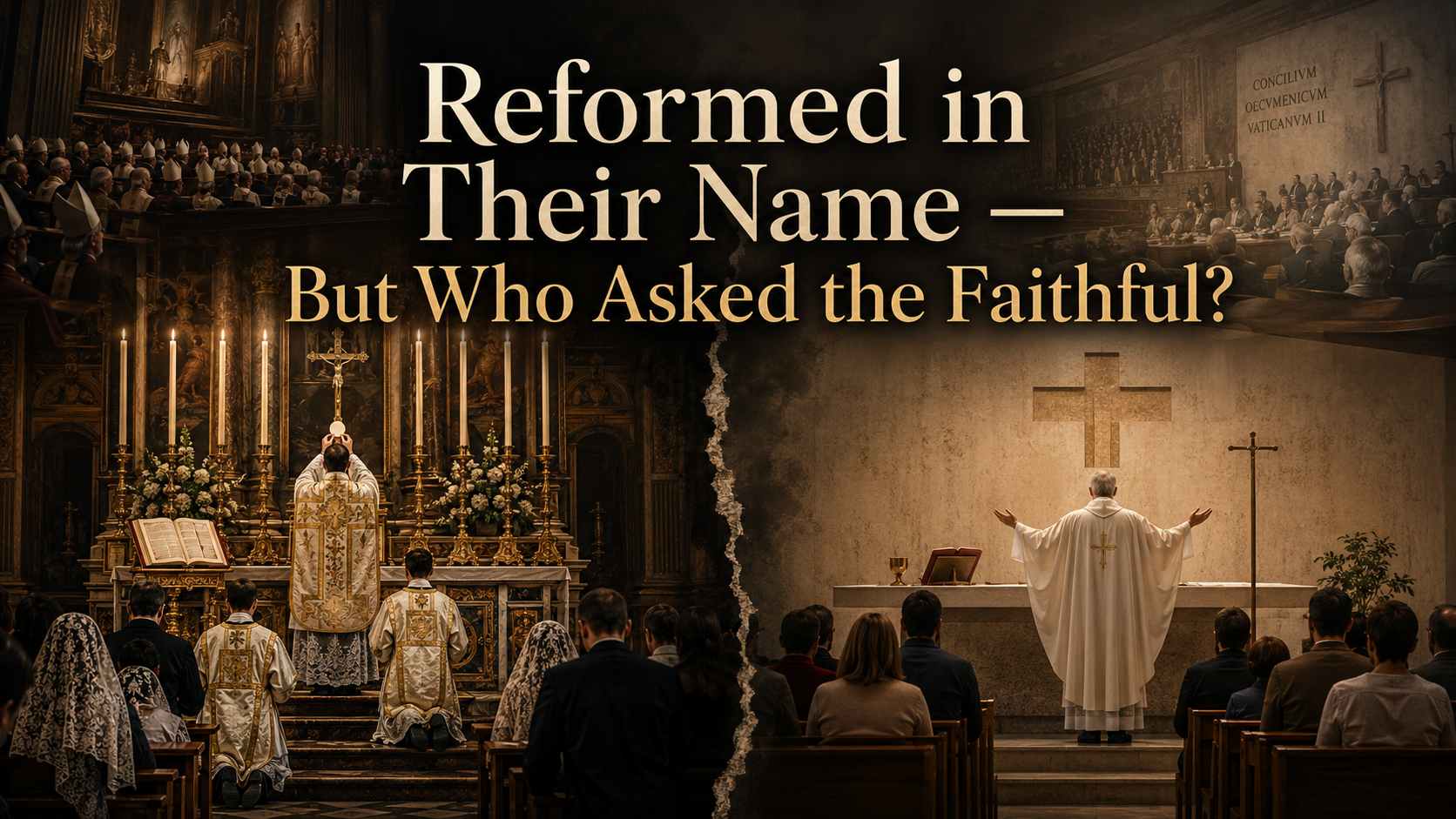
Reformed in Their Name — But Who Asked the Faithful?
Sixty years after the liturgical revolution, Rome is still prescribing formation, correcting abuse and defending a reform whose original necessity was never demonstrated by the people supposedly demanding it

There is a premise at the heart of the post-conciliar liturgical settlement which has been repeated so consistently that it has acquired the appearance of established fact. The Second Vatican Council called for reform of the liturgy; therefore liturgical reform was necessary. The reform subsequently promulgated under Paul VI implemented that mandate; therefore criticism of the reform risks becoming criticism of the Council itself. When abuses followed, they were attributed not to the reform but to misunderstanding, exaggeration, inadequate formation or disobedience. When congregations declined, Latin disappeared, Gregorian chant became exceptional, sanctuaries were reordered, devotional life contracted and liturgical improvisation became notorious, the defence remained substantially unchanged: the reform itself was sound; Catholics simply had not yet learned how properly to implement it.
More than sixty years after Sacrosanctum Concilium, that defence is becoming increasingly difficult to sustain. On 26 August 2026 Pope Leo XIV acknowledged that abuses associated with the post-conciliar period have not disappeared. Where principles underlying the reform have been exaggerated or misunderstood, he said, abuses “unfortunately, still occur from time to time today”.¹ The following day, ✠Claudio Maniago, Metropolitan Archbishop of Catanzaro-Squillace, President of the Centro di Azione Liturgica and President of the Italian Episcopal Conference’s Commission for the Liturgy, concluded Italy’s 76th National Liturgical Week with the remarkable admission “Ancora non sappiamo celebrare”: more than sixty years after the Council and its liturgical reform, Catholics still do not know how to celebrate so that the splendour inherent in the liturgy becomes manifest.²
The juxtaposition is extraordinary. Fifty-six years after the Missal of Paul VI entered ordinary Catholic life, the Pope is still warning against abuses and arbitrariness while one of Italy’s most senior episcopal liturgists says that the Church still does not know how to celebrate adequately. ✠Maniago’s remedy remains further formation, study and a change of liturgical mentality. Leo likewise emphasises formation, fidelity to the books and proper ars celebrandi. The answer, once again, is that Catholics must understand and implement the reform better.
Before asking another generation to do so, however, an earlier and more fundamental question demands an answer: what demonstrated that the inherited Roman liturgy required a general reform in the first place?
Nuntiatoria has approached this problem from several directions. “Reverence Cannot Rewrite History — Leo XIV and the Unanswered Question of Liturgical Reform” distinguished between what Vatican II actually said and what was subsequently done in its name. “The Council, the Reform, and the Missing ‘Thus’” examined Dom Alcuin Reid’s challenge to Leo XIV’s assertion that the twentieth-century history of liturgical reform thus establishes the post-conciliar reform as organically rooted in living Tradition. The difficulty lies precisely in that thus. The fact that legitimate liturgical reform occurred under previous pontificates establishes that reform can be legitimate. It does not establish that every later reform was necessary, organic or prudent.³
Yet there is a question logically prior even to that distinction. Before asking whether the Consilium exceeded the mandate given by the Conciliar Fathers, it is necessary to ask upon what evidence the Council itself concluded that the Roman liturgy required “a general restoration”. Sacrosanctum Concilium declares that there were “particularly cogent reasons” for undertaking reform and promotion of the liturgy, but the necessity of a general reform is largely asserted rather than empirically demonstrated.⁴
The reform was justified principally in pastoral terms. The faithful should understand more easily, participate more consciously, hear Scripture more abundantly and cease to attend as “strangers or silent spectators”. The reform was therefore undertaken substantially for the laity and in the name of the laity. Yet the historical record presents a remarkable anomaly: there was no representative consultation of the worldwide Catholic laity establishing that ordinary Catholics themselves regarded their inherited worship as defective or wanted it generally reformed.
The ante-preparatory consultation beginning in 1959 was extensive, but it was directed overwhelmingly towards bishops, ecclesiastical superiors and Catholic academic institutions. It was not a consultation of Catholics in the pews. A detailed scholarly examination of the Irish vota, for example, identified thirty-one submissions from bishops and ecclesiastical institutions while finding no evidence that wider consultation lay behind them. Ordinary Catholics were not representatively asked whether the Mass required general reform, whether Latin inhibited their spiritual participation, whether they regarded the silent Canon as a problem, whether the ancient Offertory required alteration, or whether inherited orientation and ceremonial prevented them from entering consciously into the Holy Sacrifice.⁵
Some lay opinion was certainly recorded. American surveys from the early 1960s showed considerable support in some places for greater use of English, and later polling recorded more complicated reactions as successive changes accumulated. That evidence matters, but it proves neither a universal demand for reform nor a lay mandate for what eventually followed. A Catholic who wanted the Epistle and Gospel proclaimed in English had not thereby requested new Eucharistic Prayers. A Catholic who wished to make the responses aloud had not demanded the replacement of the traditional Offertory. A desire for easier access to Scripture was not consent to the extensive reconstruction of the lectionary, calendar and Propers, nor to the disappearance of Latin from ordinary parish worship, the near-universal adoption of versus populum, the removal of altar rails or Communion in the hand.⁶
The Council Fathers certainly heard evidence about the laity. Cardinal Giovanni Battista Montini, the future Paul VI, argued that intelligibility possessed pastoral value and that ceremonies might profitably be simplified. Bishop Josef Schoiswohl claimed that liturgical participation had seriously declined in places where Latin remained exclusive and reported benefits from vernacular concessions. Bishop Karl Weber argued that more accessible worship could strengthen Christians facing materialism and atheism. These were real pastoral judgements and deserve to be treated seriously. But they were predominantly episcopal and expert assessments of what the faithful supposedly required.
Evidence about the laity is not evidence from the laity.
Even during the Council there were Fathers who recognised that the causal argument had not been demonstrated. Bishop Vittorio Costantini challenged the assumption that Latin itself caused inadequate participation and argued that insufficient instruction might instead be the underlying difficulty. He proposed statistical comparison between places retaining Latin and places already enjoying vernacular concessions in order to discover whether the latter actually produced stronger Catholic practice. In substance, a Council Father asked the obvious empirical question: if changing the liturgy is said to produce better pastoral results, where are the comparative data proving it?
That intervention exposes a fundamental methodological problem. There is a profound difference between identifying a pastoral difficulty and identifying its cause. If Catholics do not understand the Mass, that establishes insufficient understanding; it does not establish that the Mass itself is defective. If a congregation is silent, that establishes silence; it does not demonstrate spiritual passivity. If Catholics cannot explain the Roman Canon, that may demonstrate inadequate catechesis rather than a defect in the Canon. If Mass attendance is poor, it does not follow without further evidence that Latin, ritual density or inherited ceremonial caused the weakness.
Nuntiatoria examined the theological problem in “Not Silent Spectators, But a Sacrificial People”. The caricature of the pre-conciliar Catholic as essentially passive depends upon equating active participation with audible speech, visible movement or possession of a liturgical function. Yet St Pius X had promoted active participation decades before Vatican II, while Pius XII carefully explained in Mediator Dei the genuine participation of the faithful in the Eucharistic Sacrifice without confusing it with the ministerial priesthood. The Catholic participates by interior union with the Sacrifice, offering himself with Christ, adoring, contemplating, praying and receiving sacramentally. Silence may be intensely active because liturgical participation is first supernatural before it is performative.⁷
What makes the subsequent history particularly striking is that Sacrosanctum Concilium itself identified the obvious alternative remedy. Article 14 says that hopes for full and active participation will be futile unless pastors themselves are first imbued with the spirit and power of the liturgy and capable of instructing the faithful; it explicitly says that participation is to be promoted “by means of the necessary instruction”. Article 19 again orders pastors to promote liturgical instruction “with zeal and patience”.⁴ The Council therefore prescribed formation as indispensable before its reforms had even been implemented.
The central historical question is consequently unavoidable. If inadequate understanding and participation were the problem, why was the Council’s own remedy of comprehensive liturgical formation not first exhausted before the rite itself was extensively reconstructed?
Pius XII had already proposed precisely such an approach in Mediator Dei. He recognised deficiencies in liturgical understanding and encouraged sermons, conferences, lectures and study weeks through which clergy and faithful might enter more deeply into the treasures of Catholic worship. At the same time he warned against excessive novelty, rejected exaggerated antiquarianism, condemned unauthorised experimentation and defended Latin as a sign of the Church’s unity.⁸ The problem of inadequate formation did not lead him to assume that the inherited Roman Mass itself had become the problem.
That catechetical road was never comprehensively exhausted.
Instead, Sacrosanctum Concilium declared that a general restoration should take place. Even then it established a remarkably demanding standard. Article 21 says mutable elements ought to change if they have become unsuitable or inconsistent with the nature of the liturgy. Article 23 insists that there should be no innovations unless the good of the Church “genuinely and certainly requires” them, while new forms must grow organically from those already existing.⁴ The burden of proof rests therefore upon innovation. It is insufficient that a change appears pastorally promising. The good of the Church must genuinely and certainly require it.
Where was that genuine and certain necessity demonstrated? Where was the evidence that the Roman Canon harmed Catholic belief, that the traditional Offertory impeded participation, that Latin obstructed sanctification, that Gregorian chant had ceased to serve worship, that ad orientem prevented lay involvement, or that ritual silence undermined comprehension of the Eucharistic Sacrifice? Where was the empirical evidence showing that Catholics formed by the inherited Roman Mass were incapable of understanding sacrifice, Real Presence, propitiation, priesthood or adoration?
The transitional reforms of 1964–65 make that question sharper. What is commonly called the “1965 Missal” remained substantially the inherited Roman Missal modified through Inter Oecumenici and the revised Ordo Missae. It did not complete every conciliar objective, notably the expanded lectionary, and further revision was anticipated. Nevertheless, it demonstrated that considerable elements of the Council’s stated programme could be pursued without reconstructing the Roman Mass. Greater vernacular use, audible Scripture, restoration of the Prayer of the Faithful and significant simplification could coexist with the Roman Canon, the traditional Offertory, sacred Latin, Gregorian chant and the recognisable inherited structure of the rite.
This does not prove that every 1965 alteration was itself necessary. It proves something narrower and historically important: even if the principal pastoral objectives of Sacrosanctum Concilium are granted, they do not explain the scale of what followed.
Paul VI’s Missale Romanum records that scale. Three additional Eucharistic Prayers joined the ancient Roman Canon; Paul VI himself identified the Eucharistic Prayer as the location of the reform’s “major innovation”; the rites concerning the preparation of the gifts, fraction and Communion were altered; the lectionary was comprehensively reconstructed; and the Propers of Seasons and Saints, Commons, Ritual Masses and Votive Masses were “considerably modified”.⁹ As Nuntiatoria argued in “Authority Is Not Alchemy: The New Mass, the Long Reform and the Limits of Liturgical Obedience”, papal authority establishes juridical competence to legislate, but it does not transform every prudential decision into an organically necessary or pastorally beneficial one merely by promulgating it.¹⁰
Article 23 therefore continues to demand an answer. Why did the good of the Church genuinely and certainly require several Eucharistic Prayers, replacement of the traditional Offertory, extensive alteration of ancient Propers and the practical consequences which followed? Why did Latin virtually disappear when the Council ordered its preservation? Why did Gregorian chant, to which the Council accorded pride of place, become exceptional? Why did versus populum become treated almost universally as the normal conciliar arrangement when Sacrosanctum Concilium never required it?
These are questions about prudence and necessity, not denials of papal jurisdiction.
The absence of a genuine lay mandate becomes especially striking when set beside the contemporary Church’s rhetoric concerning synodality. Nuntiatoria has repeatedly examined the contradiction. “Synodality for the Initiated: How Collegiality Became Permanent Process” showed how a worldwide exercise described as listening to the People of God directly engaged only a fraction of the faithful and then depended upon successive layers of synthesis and interpretation. “Experts in Synodality: Leo XIV and the Rise of the Church of Process” examined how an ecclesiology ostensibly opposed to clericalism can generate a new professional class of facilitators and specialists who frame questions, interpret answers and explain what the process has supposedly discerned. “When Listening Has a Predetermined Answer” asked whether listening remains meaningful when some responses are welcomed while others are treated as obstacles to an already preferred trajectory.¹¹
The liturgical reform now appears as an extraordinary precursor of precisely the same problem. A reform justified specifically by the need to increase lay participation was itself conceived through a process in which the laity had almost no meaningful participation in deciding whether their worship should be generally reformed. Clerics and specialists diagnosed what they believed to be the problem; clerics and specialists formulated the principles; clerics and specialists reconstructed the rites; clerical authority promulgated them; and clergy and laity were then formed to understand and receive what had been decided.
The supposed beneficiaries of the reform were overwhelmingly spoken for.
This is why Nuntiatoria’s “The Most Clerical Revolution in Modern Catholic History” remains so pertinent. The reform commonly presented as a liberation from clerical passivity was administered through an intensely clerical and specialist-driven process. The people were to become participants, but liturgists determined what participation meant. The laity were to be liberated from passivity, but clerics determined what their new activity should look like. The People of God were supposedly being restored to their proper liturgical role without having been representatively asked whether they believed that role required reconstruction at all.¹²
Measured against contemporary synodal rhetoric, the contradiction is extraordinary. A Church which now insists that pastors must listen before acting has never seriously reckoned with the fact that one of the most consequential transformations of ordinary Catholic life was implemented without anything resembling the consultation now regarded as essential for decisions of vastly lesser consequence. If a bishop today announced that he intended radically to restructure a central part of diocesan life because experts had told him what the laity needed, without first meaningfully consulting the laity themselves, the accusation of clericalism would be immediate.
Yet that is substantially what happened to the Roman liturgy.
The inconsistency becomes still more obvious when lay Catholics today ask for the traditional Mass. Traditional apostolates have frequently survived and expanded because lay Catholics request them, finance them, organise around them, travel considerable distances to attend them and pass attachment to them to their children. Here is genuine grassroots demand of precisely the kind contemporary synodality claims to value. Yet when that demand produces an institutionally unwelcome conclusion, the principle of listening becomes remarkably conditional.
Nuntiatoria made this point in “When the Faithful Ask Rome to Listen: Sweden, Apostolic Visitation and the Test of Synodality”. A culture of listening is tested not when the faithful say what ecclesiastical authority already wishes to hear, but when they ask for something inconvenient.¹³ The same test applies to liturgy. If the experience of the People of God matters, Catholics requesting the inherited Roman Rite cannot simply cease to count because their preference runs contrary to prevailing policy.
There is another standard by which the reform must now be examined: its fruits. This does not permit crude historical monocausality. The decline of Western Catholicism since the 1960s cannot be attributed solely to liturgical reform. The sexual revolution, prosperity, individualism, changes in family life, declining institutional loyalty, secularisation, scandals and profound cultural transformation all contributed to disaffiliation. Stephen Bullivant’s major study Mass Exodus recognises those factors while refusing to absolve Vatican II and its aftermath from scrutiny. A Council explicitly intended to equip the Church for the modern world and strengthen pastoral life must nevertheless be assessed against the outcomes which followed.¹⁴
The liturgical reform cannot reasonably be asserted to have caused every decline which followed it. Neither can it reasonably be excluded as a contributory factor without investigation. The liturgy was one of the most profound and universal features of Catholic life to change during precisely the period in which practice and identification collapsed. If liturgy was sufficiently formative that changing it was expected to transform participation and strengthen Christian life, then liturgy remains sufficiently formative to ask whether those changes may also have produced unintended consequences.
One cannot invoke lex orandi, lex credendi prospectively and suspend it retrospectively. If worship forms belief, changed worship must at least be admitted as one possible contributor to changed belief and practice.
The statistics are stark. In England and Wales, typical Sunday Mass attendance stood at approximately 1.95 million around 1960. By 2018 it was about 710,000, despite substantial population growth, while the Bishops’ Conference reported average weekly Mass attendance of only 575,453 in 2024.¹⁵ The precise historical series requires attention to changing methods, but the direction is incontestable: Catholic practice has contracted dramatically.
The American evidence supplies an equally sobering long-term comparison. Gallup recorded approximately 75 per cent of American Catholics reporting church attendance in a given week in 1955. By 2014–17 the figure was approximately 39 per cent, while Pew’s 2023–24 Religious Landscape Study places current weekly Catholic attendance at roughly three in ten. Gallup’s historical comparison also found Protestant attendance considerably steadier through much of the period in which Catholic attendance fell sharply.¹⁶ Western secularisation affected both communities, but the differential trajectory prevents the Catholic collapse from simply being dismissed as the inevitable experience of every Christian body.
Correlation is not proof of exclusive causation. But neither is correlation irrelevant where a reform was justified by predicted pastoral effects. A reform intended to produce fuller participation must be judged at least partly by what subsequently happened to participation.
Nuntiatoria recently applied precisely this evangelical criterion to contemporary synodality in “By Their Fruits: ✠Mutsaerts Puts Synodality to the Test”. ✠Rob Mutsaerts asked whether all the processes, consultations and structures had actually produced conversions, vocations, stronger Eucharistic faith, clearer teaching and increased Mass attendance.¹⁷ The same criterion must be applied retrospectively to liturgical reform. A process cannot be its own fruit, and the completion of a reform does not prove the success of a reform.
The catechetical evidence is still more directly relevant because inadequate understanding lay at the centre of the original diagnosis. Catholics supposedly did not understand the inherited liturgy sufficiently. The Church had two principal possible responses: teach Catholics comprehensively to understand the rite they already possessed, or alter the rite to make it more immediately intelligible. In practice enormous institutional energy was devoted to the latter. The vernacular became nearly universal, presidential prayers became audible, Scripture was vastly expanded, the Eucharistic Prayer could be heard word for word in the language of the congregation, homilies became normative and ceremonies became more immediately visible.
If intelligibility were the central solution, the resulting Catholic population ought by now to possess an exceptionally clear grasp of what occurs at Mass.
Yet Pew’s 2019 survey found only 31 per cent of American Catholics selecting the response that the bread and wine at Mass actually become the Body and Blood of Christ, while 69 per cent selected the symbolic alternative. More troublingly, a large proportion of those giving the symbolic answer believed that this was what the Catholic Church itself taught. Even among weekly Mass attenders, only 63 per cent affirmed the proposition corresponding to Catholic Eucharistic doctrine. The wording of the survey has been legitimately debated and the percentages should not be treated as an infallible theological examination, but the scale of catechetical confusion remains impossible to dismiss.¹⁸
More recent evidence shows that the wider sacramental problem continues. Pew’s 2025 research found about three in ten American Catholics attending Mass weekly, only 46 per cent describing reception of the Eucharist as essential to their Catholic identity and only 23 per cent reporting annual Confession.¹⁹ Sixty years after the liturgy was made overwhelmingly vernacular, audible and ostensibly intelligible, the hierarchy is still lamenting deficient formation, weak Eucharistic understanding and inadequate participation.
Here lies perhaps the most devastating historical irony of the entire project. The Council itself prescribed formation in SC 14 and SC 19. The Church then devoted extraordinary institutional energy to changing the rites before demonstrating that the Council’s own prescribed remedy of formation was insufficient. Sixty years later, the hierarchy is still prescribing formation because the underlying catechetical problem remains.
If catechesis is still the answer in 2026, why was comprehensive catechesis not first exhausted as the answer in 1962?
What might have happened had the immense institutional effort devoted to reconstructing liturgical books, composing new prayers, reorganising sanctuaries, creating commissions, producing repeated translations, training new ministries and continually explaining successive reforms instead been concentrated upon comprehensive liturgical and doctrinal formation in the inherited rite? Catholics could have been taught why the Canon was silent, what the Offertory expressed, why priest and people turned together towards liturgical East, why Latin served the sacrality and universality of Roman worship, why Gregorian chant belonged uniquely to the rite, what interior participation meant, why the Mass was a true propitiatory Sacrifice and what transubstantiation accomplished upon the altar.
The Church instead altered the liturgy partly because the faithful supposedly did not understand it. Sixty years later, the faithful still require comprehensive catechesis. The remedy never comprehensively exhausted before the reform is therefore still being prescribed after six decades of the reform.
Against this background, the vitality visible in traditional liturgical apostolates becomes impossible simply to dismiss. Nuntiatoria examined the issue directly in “The Five-Point Question Facing Leo XIV”. Comparative surveys of Catholics attached to traditional liturgical communities have repeatedly suggested unusually strong levels of Eucharistic belief, sacramental practice and adherence to Catholic moral teaching. Their methodologies differ from nationally representative polling and cannot establish that the traditional rite mechanically produces orthodoxy, but the phenomenon is sufficiently striking to merit serious investigation rather than dismissal.²⁰
Pew’s 2025 national data found that 13 per cent of American Catholics had attended a Traditional Latin Mass at least once during the previous five years, rising to 22 per cent among Catholics who attend Mass weekly. Two per cent of Catholics overall reported attending the traditional liturgy at least weekly, despite restrictions following Traditionis custodes and the uneven availability of the rite.²¹ Those figures do not prove nationwide growth, because there is no directly comparable earlier Pew time-series, but they do make it difficult to portray the traditional liturgy as merely the nostalgia of an ageing remnant.
The vocational evidence is similarly notable. Our Lady of Guadalupe Seminary of the Priestly Fraternity of St Peter reported more than seventy men beginning applications for the 2023–24 year, with more than forty completing the application process and ninety-two seminarians expected in formation. Eleven FSSP priests were ordained together in Omaha in May 2024.²² Such figures do not prove that the traditional rite alone generates vocations, but in a wider ecclesiastical environment habitually described in terms of vocational scarcity they constitute precisely the kind of fruit that serious pastors should investigate.
What makes the contrast striking is that traditional apostolates attract people through many of the characteristics twentieth-century reformers regarded as barriers. The traditional Mass contains more Latin, more silence, stricter ritual, fewer options, greater hieratic distinction and a less immediately conversational ceremonial grammar. Yet Catholics seek it voluntarily, learn it, travel for it, support apostolates and seminaries attached to it and teach it to children who possess no memory whatever of the pre-conciliar Church.
The category of nostalgia is therefore inadequate.
The same evidence exposes another irony in the contemporary Roman emphasis upon ars celebrandi. Leo XIV urges priests to obey approved texts, reject arbitrariness and allow the rite itself to form them. Yet the inherited Roman Rite embedded these principles within its structure. Its texts were overwhelmingly received rather than selected, its ceremonial prescribed rather than constructed, its sacred language resistant to conversational improvisation, its Canon fixed rather than chosen from several alternatives, its silences intrinsic rather than accidental, and its orientation expressive of a common sacrificial action directed towards God. The personality of the priest was restrained because the rite constantly reminded him that he was its servant rather than its author.
This does not mean every traditional Mass was celebrated well. Rubrics cannot make a careless priest devout. But structures influence behaviour, and the older structure imposed powerful limits upon precisely the arbitrariness Rome now seeks to correct through repeated formation.
The historical irony is therefore formidable. The inherited liturgy was changed partly because Catholics supposedly did not know how to participate in it. The reform promised greater intelligibility and fuller participation. Mass attendance subsequently collapsed across much of the West. Eucharistic doctrine remains widely misunderstood. Confession has become uncommon among enormous numbers of Catholics. Rome continues to condemn abuses. Senior episcopal liturgists still say that Catholics do not know how to celebrate. Meanwhile traditional communities continue displaying striking levels of commitment, demand and vocational fruit despite significant restrictions upon their expansion.
At some point the burden of proof must change.
Traditional Catholics have spent decades being required to justify their attachment to the inherited Roman Rite. Those who insist upon the unquestionable pastoral necessity of the post-conciliar settlement should now be prepared to justify that confidence. Where was the representative evidence from the laity that their inherited worship required general reform? Where was the demonstration that catechesis would not suffice? Where was the genuine and certain necessity required by Article 23 for the subsequent innovations? Why did the reform extend so much further than what the Council explicitly specified? Why should its pastoral success be presumed when the measurable indicators of Catholic practice, sacramental life and doctrinal comprehension remain so troubling?
Failure cannot permanently be defined as proof that the reform has not yet been properly implemented. Such reasoning eventually becomes unfalsifiable. If a reverent celebration succeeds, the reform is credited; if an irreverent celebration fails, the celebrant is blamed. If attendance grows somewhere, renewal is credited; if attendance collapses, secularisation is blamed. If Eucharistic faith is strong, the reform can form faith; if Eucharistic faith is weak, catechesis is blamed. If traditional communities decline, their rite is declared pastorally obsolete; if they flourish, their success is dismissed as exceptional or sociologically self-selecting. If nothing is ever permitted to constitute evidence against the prudential assumptions of the reform, the result is not serious historical evaluation but institutional self-vindication.
Pope Leo XIV therefore has an opportunity substantially greater than simply ending bad liturgical practice. If he truly wants the Church to rediscover Sacrosanctum Concilium, Article 23 should be applied retrospectively to what was done in its name. The theological, historical and pastoral investigation demanded by the Council should be undertaken without assuming its conclusion. The claimed necessity of the reforms should be examined, organic development demonstrated rather than merely asserted, the Council’s text distinguished from the work of the Consilium, and the pastoral expectations of the reform compared honestly with the pastoral results.
If the contemporary Church genuinely believes in synodal listening, then the faithful must also be permitted to speak when their testimony proves inconvenient. Catholics asking why Latin vanished when Vatican II said it should remain, why Gregorian chant disappeared when Vatican II accorded it pride of place, why the traditional Offertory was replaced, why the Roman Canon required alternatives, why attendance collapsed after a reform intended to increase participation, and why Eucharistic literacy remains so deficient after sixty years of vernacular intelligibility are not necessarily rejecting Vatican II. They are asking whether what was done afterwards accomplished what Vatican II claimed to seek.
Likewise, younger Catholics, converts, families and seminarians seeking the traditional Roman liturgy should not cease to count as the “People of God” merely because they ask for something the contemporary liturgical establishment would prefer them not to want. A Church cannot invoke listening when the faithful request change in one direction and invoke obedience when they request the recovery of Tradition. That is not the defeat of clericalism; it is clericalism exercised selectively under the vocabulary of participation.
The central historical fact remains remarkably simple. Ordinary Catholics did not rise throughout the world demanding reconstruction of the Roman Mass. Some wanted greater use of the vernacular, some wanted greater immediate intelligibility, some welcomed the early changes and others disliked them. But there was no representative lay mandate establishing that the Catholic faithful judged their inherited liturgy defective and desired its comprehensive reform.
They were largely spoken for.
The reform was conceived overwhelmingly from above, its necessity asserted more confidently than it was demonstrated, and the catechetical alternative prescribed by the Council itself was never comprehensively exhausted before the rites were extensively altered. Its implementation moved considerably beyond what the Council explicitly demanded, while its promised pastoral fruits have, at the very least, been profoundly compromised by the historical record. Sixty years later the hierarchy is still prescribing the remedy that might have been tried first: formation, catechesis, reverence and instruction.
Leo XIV says abuses still occur. ✠Maniago says Catholics still do not know how to celebrate. Pew continues to document profound catechetical weakness. Mass attendance remains a fraction of its mid-century level. Traditional apostolates continue attracting conspicuously committed adherents and vocations. Rome nevertheless continues to defend the reform as the indispensable implementation of the Council while restricting the inherited liturgy against which its results can most readily be compared.
Perhaps, after sixty years, another round of implementation is not sufficient. Perhaps the question which should have been answered before the first general reform was attempted should finally be asked without fear: was the Roman liturgy itself ever demonstrated to be the problem?
Perhaps the Church in 1962 did not principally possess a defective liturgy requiring reconstruction. Perhaps she possessed a magnificent inherited liturgy alongside clergy and faithful who needed deeper catechesis, better preaching, more disciplined celebration and more serious spiritual formation. If so, the tragedy is greater than a reform badly implemented. The Church may have spent sixty years attempting to solve by altering her worship a problem that should first have been addressed by teaching Catholics to understand, love and live the worship they had already received.
And there lies the supreme irony. A Church now proclaiming synodality and denouncing clericalism may eventually have to admit that one of the most profoundly clerical episodes of the modern period was a reform justified specifically in the name of greater lay participation, but devised and imposed without first giving the laity themselves any meaningful participation in deciding whether the worship of the People of God needed to be reformed at all.
¹ Pope Leo XIV, General Audience, 26 August 2026, “The Documents of the Second Vatican Council. III. Constitution Sacrosanctum Concilium. 8. The motivations of the liturgical reform.”
² ✠Claudio Maniago, concluding intervention at the 76th National Liturgical Week, Catania, 27 August 2026.
³ Nuntiatoria, “Reverence Cannot Rewrite History — Leo XIV and the Unanswered Question of Liturgical Reform,” 17 August 2026; “The Council, the Reform, and the Missing ‘Thus’,” 28 August 2026.
⁴ Second Vatican Council, Constitution Sacrosanctum Concilium, 4 December 1963, especially §§1, 14, 19, 21 and 23.
⁵ Ante-preparatory vota for Vatican II; scholarly examination of the Irish episcopal submissions and the absence of evidence for wider consultation behind them.
⁶ Contemporary American Catholic polling concerning vernacular use and reactions to the early liturgical reforms, including surveys reported in 1963 and the succeeding reform period.
⁷ Nuntiatoria, “Not Silent Spectators, But a Sacrificial People,” 28 August 2026.
⁸ Pius XII, Encyclical Mediator Dei, 20 November 1947.
⁹ Paul VI, Apostolic Constitution Missale Romanum, 3 April 1969.
¹⁰ Nuntiatoria, “Authority Is Not Alchemy: The New Mass, the Long Reform and the Limits of Liturgical Obedience,” 14 August 2026.
¹¹ Nuntiatoria, “Synodality for the Initiated: How Collegiality Became Permanent Process,” 14 July 2026; “Experts in Synodality: Leo XIV and the Rise of the Church of Process,” 14 August 2026; “When Listening Has a Predetermined Answer,” 21 August 2026.
¹² Nuntiatoria, “The Most Clerical Revolution in Modern Catholic History,” 21 August 2026.
¹³ Nuntiatoria, “When the Faithful Ask Rome to Listen: Sweden, Apostolic Visitation and the Test of Synodality,” 4 July 2026.
¹⁴ Stephen Bullivant, Mass Exodus: Catholic Disaffiliation in Britain and America since Vatican II, Oxford University Press, 2019.
¹⁵ Catholic historical statistics for England and Wales; Catholic Bishops’ Conference of England and Wales, 2024 Mass-attendance statistics.
¹⁶ Gallup historical Catholic church-attendance series; Pew Research Center, 2023–24 Religious Landscape Study.
¹⁷ Nuntiatoria, “By Their Fruits: ✠Mutsaerts Puts Synodality to the Test,” 18 August 2026.
¹⁸ Pew Research Center, “Just one-third of U.S. Catholics agree with their church that Eucharist is body, blood of Christ,” 5 August 2019.
¹⁹ Pew Research Center, 2025 survey of Catholic practice, sacramental life and identity.
²⁰ Nuntiatoria, “The Five-Point Question Facing Leo XIV,” 28 August 2026.
²¹ Pew Research Center, 2025 data concerning attendance at the Traditional Latin Mass.
²² Priestly Fraternity of St Peter, Our Lady of Guadalupe Seminary statistics for 2023–24 and FSSP priestly ordinations, Omaha, May 2024.
RELATED ARTICLES


LATEST ARTICLES
- “ONLY LUKE IS WITH ME”: THE EVANGELIST OF MERCY AND APOSTOLIC FIDELITYThe feast of St Luke, celebrated on 18 October, honours the beloved physician and Evangelist whose writings convey crucial Christian truths. He emphasises the vital link between divine mercy, repentance, and sacrifice. As St Paul’s companion, Luke’s narrative preserves the essence of the Gospel, reminding the Church to uphold and transmit revelation faithfully.
- Today’s Mass: October 17 St Gall, Confessor;Saint Gall, born in Ireland in the sixth century, became a notable confessor after accompanying Saint Columban to France and later Switzerland, where he preached and converted idolaters. Despite his significant contributions, he humbly declined the position of bishop of Constance. He died in 646, leaving a lasting legacy.
- 18.10.26 Nuntiatoria CXXVIII: NON POTEST VERITAS SUBDI POTESTATIThis editorial asserts that truth should not be subjugated to authority, emphasising that legitimate power derives from truth rather than mandates it. It critiques contemporary tendencies in both ecclesiastical and societal contexts where authority prioritises institutional credibility over accountability. Ultimately, it calls for a return to truth as the foundation of authority, urging faithful adherence to moral principles.
- ORDO w/c 18.10.26The liturgical calendar from 18 to 25 October 2026 includes the feast of St Luke the Evangelist, commemorating essential themes of forgiveness and evangelisation. Subsequent days honour St Peter of Alcantara, St John Cantius, St Ursula and St Raphael, culminating in the celebration of Christ the King, affirming His universal sovereignty over all creation.
- THE DEBTOR AT HIS BROTHER’S THROAT: The Twenty-First Sunday after PentecostThe Twenty-First Sunday after Pentecost highlights the danger of receiving divine mercy and failing to extend the same to others, exemplified by the parable of the unforgiving servant. The Church emphasises the need for genuine charity, justice without vengeance, and the importance of faith in guiding interpersonal conduct amidst spiritual struggle.




Leave a Reply